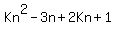
SOLUTION: What value of K will cause {{{Kn^2 - 3n + 2Kn + 1}}} to have two zeroes / roots?

Algebra ->  Equations -> SOLUTION: What value of K will cause {{{Kn^2 - 3n + 2Kn + 1}}} to have two zeroes / roots?      Log On


Question 1206552: What value of K will cause Kn%5E2+-+3n+%2B+2Kn+%2B+1 to have two zeroes / roots?
Found 4 solutions by math_tutor2020, Edwin McCravy, greenestamps, ikleyn:
Answer by math_tutor2020(3835) About Me  (Show Source):
You can put this solution on YOUR website!

Discriminant formula
d+=+b%5E2+-+4ac

Rule: If d+%3E+0, then the quadratic will have two distinct roots.

In this case,
a = k
b = -3+2k
c = 1

It might help to think of kn%5E2+-+3n+%2B+2kn+%2B+1 as kn%5E2+%2B+%28-3%2B2k%29n+%2B+1 so you can match those terms up to the template an%5E2+%2B+bn+%2B+c+=+0

Let's find the expression for the discriminant.
d+=+b%5E2+-+4ac

d+=+%28-3%2B2k%29%5E2+-+4k%281%29

d+=+%289-12k%2B4k%5E2%29+-+4k

d+=+4k%5E2-16k%2B9

Now consider the equation 4k%5E2+-+16k+%2B+9+=+0
Use the quadratic formula, which I'll leave the scratch work for the student to do, to find the following roots k+=+%284-sqrt%287%29%29%2F2+=+0.677124 and k+=+%284%2Bsqrt%287%29%29%2F2+=+3.322876 Both of those decimal values are approximate.

If k+%3C+%284-sqrt%287%29%29%2F2 or k+%3E+%284%2Bsqrt%287%29%29%2F2 then 4k%5E2+-+16k+%2B+9+%3E+0 to lead back to d+%3E+0. This will cause kn%5E2+-+3n+%2B+2kn+%2B+1 to have two distinct roots for variable n.

If k+=+%284-sqrt%287%29%29%2F2 or k+=+%284%2Bsqrt%287%29%29%2F2, then d+=+0 and it will make kn%5E2+-+3n+%2B+2kn+%2B+1 have exactly one real root for variable n.

If %284-sqrt%287%29%29%2F2+%3C+k+%3C+%284%2Bsqrt%287%29%29%2F2 then it leads to d+%3C+0 and causes kn%5E2+-+3n+%2B+2kn+%2B+1 to have no real roots. The two roots would instead be non-real complex numbers.

Answer by Edwin McCravy(20077) About Me  (Show Source):
Answer by greenestamps(13327) About Me  (Show Source):
You can put this solution on YOUR website!


Exactly as posted, there are an infinite number of values of K for which the given polynomial will have two roots....


Answer by ikleyn(53751) About Me  (Show Source):
You can put this solution on YOUR website!
.

This problem is a TRAP.

The trap is in leading coefficient K at n^2.

A regular student does understand (and does know) that a quadratic equation
has two roots, when the discriminant is different from 0 (from zero),
and has one root, if the discriminant is zero.

So, it is a standard expected answer.

But here the trap starts working.

All that I said above is correct if an equation is really quadratic.

But if K= 0, the equation is just NOT a quadratic - it is linear.

In this case, the quadratic formula does not work and is not applicable.

It is what a regular student usually misses - and therefore gets a reduced score at an exam.

So, in this problem bad (or special) values of K are those numbers (real or complex),
that make the discriminant of the quadratic equation zero PLUS the value K= 0,
which makes the quadratic equation degenerated and, actually, linear.

So, this problem is a (well known) tool in hands of some examinators, when they want "to kill" some students.

It is the knowledge that good student must know in order to avoid falling into this trap.


Thus, this my solution has a very practical outcome.