Question 1049300: I have been attempting this problem and I have no clue as to where to go. I only have on problem left and I was not able to solve it for this section and was wondering if anyone could please provide assistance on how I should go about solving this.
1.) Determine the rate of change for each equation.
3/2x - 5/4y = 15
Here is what I have attempted to do with the problem: I have subtracted the 3/2x to the other side and ended up with -5/4y = -3/2x +15 which is what I am currently stuck on. I feel like I went about this the correct way, but I could be wrong.
Found 2 solutions by MathLover1, MathTherapy:
Answer by MathLover1(20855)   (Show Source): (Show Source):
Answer by MathTherapy(10864)  (Show Source): (Show Source):
You can put this solution on YOUR website!
I have been attempting this problem and I have no clue as to where to go. I only have on problem left and I was not able to
solve it for this section and was wondering if anyone could please provide assistance on how I should go about solving this.
1.) Determine the rate of change for each equation.
3/2x - 5/4y = 15
Here is what I have attempted to do with the problem: I have subtracted the 3/2x to the other side and ended up with -5/4y =
-3/2x +15 which is what I am currently stuck on. I feel like I went about this the correct way, but I could be wrong.
***************
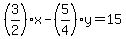 -5/4y = -3/2x +15 "....what I am currently stuck on.
You could continue by DIVIDING each side of the equation by the coefficient of y,
-5/4y = -3/2x +15 "....what I am currently stuck on.
You could continue by DIVIDING each side of the equation by the coefficient of y,  , or MULTIPLYING by its RECIPROCAL, , or MULTIPLYING by its RECIPROCAL,  . .
 ------ Multiplying each side by ------ Multiplying each side by

 , wherein, m, or , wherein, m, or  is your required RATE of CHANGE!
However, it's less complex, less time-consuming and less of a headache, in this author's opinion, when you CLEAR/GET rid of the
fractions, first and foremost, as follows:
6x - 5y = 60 ---- Multiplying by LCD, 4
- 5y = - 6x + 60 is your required RATE of CHANGE!
However, it's less complex, less time-consuming and less of a headache, in this author's opinion, when you CLEAR/GET rid of the
fractions, first and foremost, as follows:
6x - 5y = 60 ---- Multiplying by LCD, 4
- 5y = - 6x + 60
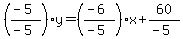 ---- Dividing each side by - 5
, wherein, m, or is your required RATE of CHANGE! ---- Dividing each side by - 5
, wherein, m, or is your required RATE of CHANGE!
| |
|
