Question 1210619: Fill in the blanks so that the resulting system does not have a unique solution.
8x + 12y = 26
8x + 12y = 1
14x + 16y = 14
14x + 16y = -8
20x + 35y = 19
20x + 35y = 4
Found 2 solutions by CPhill, KMST:
Answer by CPhill(2264)   (Show Source): (Show Source):
Answer by KMST(5360)  (Show Source): (Show Source):
You can put this solution on YOUR website! I see no blanks. I only see 6 linear equations on 2 variables.
It is not a properly defined question, but I will answer it for educational purposes, making some assumptions.
I am assuming that the answer expected is a system of 2 equations made using the equations listed.
We can make 15 different systems of 2 equations with the equations listed.
A system of 2 equations on 2 variables could have either a unique solution, or no solution, or infinite solutions.
In this case, I will show below that we cannot form a system of equations with infinite solutions from the equation listed.
The only systems of 2 equations with no unique solution that we can form the equations listed are systems with no solution.
From the equations listed, we could form a system of 3 equations with no solution by taking any 3 of the equations listed,
but I do not think that is the answer expected.
The graph of a linear equation on the x-y coordinate plane is a straight line.
Two lines on a plane could
be parallel, having no points in common, or
intersect at only one point.
If the graphs of two linear equations have 2 points in common,
then both equations represent the same line, such as  and and  . .
A system of two linear equations whose graph shows two intersecting straight line has one solution:
the coordinates of the intersection point, the only ordered pair (x,y) that satisfies both equations.
On a coordinate plane, each of the equations listed would represent a straight line, as shown below.
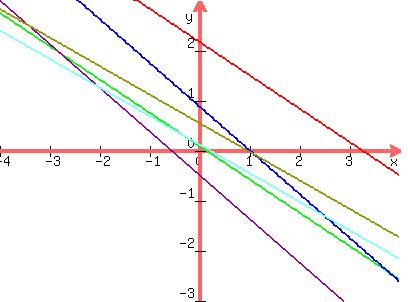
There are 6 lines visible in the graph, and some visible intersection points,
representing unique solutions for some of the possible systems of 2 linear equations.
SYSTEMS WITH UNIQUE SOLUTIONS:
The graph for a system of 2 equations on 2 variables with a unique solution shows 2 lines intersecting at just one point.
The coordinates of the intersection point are the unique solution.
Those systems are not the answer we are looking for.
SYSTEMS WITH INFINITE SOLUTIONS:
A system with infinite solutions does not have a unique solution, and could be a valid answer.
The graph for a system of 2 equations on 2 variables with infinite solutions would show one line because the two equations represent the same line.
That would be the case when you can obtain one of the equations by multiplying the other one by some number other than zero, as in  . .
A system like that cannot be made from the equations listed.
The only way to turn the left hand side of one equations into the left hand side of another is using the first 2,
or the third and fourth equations, or fifth and fourth equations, and multiply by 1,
but we would get the same equation and we see no repeats in the list of equations.
We cannot do it with equations that have different left hand sides, because the ratios of the x and y coefficients are different.
 for the first two, for the first two,
 for the third and fourth equations, and for the third and fourth equations, and
 for third and fourth equations. for third and fourth equations.
We cannot turn one of the left hand sides  , ,  and and  into another by multiplying by any number except zero. into another by multiplying by any number except zero.
So a systems with no unique solution that we can form from the list of
SYTEMS WITH NO SOLUTION:
The graph for a system of 2 equations on 2 variables with no solution shows 2 parallel lines.
There is no point on the x-y coordinate plane that satisfies both equations.
That is obvious for the system 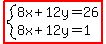 formed by the first 2 equations, formed by the first 2 equations,
because the value of the linear function on 2 variables  cannot be 26 and 1 for the same ordered pair (x,y). cannot be 26 and 1 for the same ordered pair (x,y).
The slope of the lines represented by  <-> <-> and and  <-> <->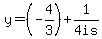 . .
Another system with no solution can be formed by the third and fourth equations; 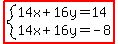 . .
The same can be said of the system formed by the fifth and sixth equations: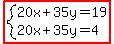 . .
|
|
|
