Question 1160753: Use De Moivre's Theorem to find an expression for cot(3θ)
Answer by KMST(5435)   (Show Source): (Show Source):
You can put this solution on YOUR website! De Moivre's theorem is about complex numbers.
Complex numbers have a real part and an imaginary part,
so we can consider them to be binomials, like  or or  } . } .
 is the power of a binomial, but is the power of a binomial, but  is not any variable in this case. is not any variable in this case.
The in a complex number is a specific imaginary number such that some of its powers are real numbers:
 , , 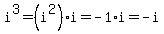 , ,  , ,  , ,  , ,  , ,  , and so on. , and so on.
De Moivre's theorem says that for any integer value of  and any real value of and any real value of  , ,
 , where is the imaginary unit that makes . , where is the imaginary unit that makes .
For  , that gives is , that gives is 
As the cube of a binomial,

However, as we know that and  , we can replace those powers of and simplify, collecting like terms, so , we can replace those powers of and simplify, collecting like terms, so


The two highlighted expressions are equal to 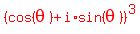 , ,
so they must be equal to each other:
 , ,
and because we cannot mix  with with  , ,
the parts (terms) must be equal to each other:
 , ,
and the parts (terms) must be equal to each other:
 . .
   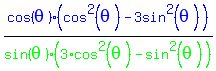 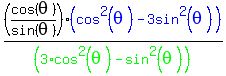 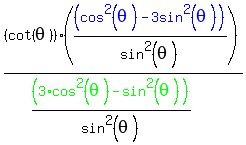 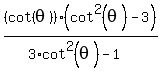 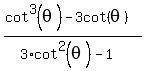
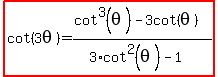
| |
|
