.
Find the value(s) of (k) such that the following piecewise-defined function is continuous at x=0:
f(x) = 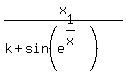 , if x =/= 0 ,
f(x) = 0, if x=0.
~~~~~~~~~~~~~~~~~~~~~~~~~~~
I rewrote/reformatted your formula to make it easier to read.
Look at the denominator in the function definition. It is  k + sin(e^(1/x)).


Let's assume   -1 <= k <= 1.

If x is positive and tends to zero, x --> 0, then  1/x  tends to infinity;

hence, expression  e^(1/x)  tends to infinity, too, and is a monotonically increasing function.

It implies that  sin(e^(1/x))  takes the value of -k infinitely many times.

So, the denominator  k + sin(e^(1/x)) takes the value of zero infinitely many times, as x becomes smaller
and approaches to 0.


It tells us that in the interval  -1 <= k <= 1, the given function has infinitely many poles
as x tends to zero.


In other words, if k is between -1 and 1, the given function is not continuous at x = 0.


Vice versa, if k is less than -1 or k is greater than 1, the denominator of the given function
is a continuous, bounded function, which NEVER takes the value of zero.


This means that for all values of k outside the interval [-1,1], the given function is continuous at zero.


ANSWER.  The given function is a continuous function at x = 0 for all values of k outside the interval [-1,1].
Solved.


