Question 940505: Determine the amplitude period and phase shift of y = -2 cos(pi x -3)
Found 2 solutions by lwsshak3, ikleyn:
Answer by lwsshak3(11628)   (Show Source): (Show Source):
You can put this solution on YOUR website! Determine the amplitude period and phase shift of y = -2 cos(pi x -3)
Form of equation for cos function:
y=Acos(Bx-C), A=amplitude, period=2π/B, phase shift=C/B
For given cos function:y=-2cos(πx-3)
Amplitude=2
B=π
period=2π/B=2
C=3
phase shift=C/B=3/2 (to the right)
Answer by ikleyn(54018)  (Show Source): (Show Source):
You can put this solution on YOUR website! .
Determine the amplitude, period and phase shift of y = -2 cos(pi x -3)
~~~~~~~~~~~~~~~~~~~~~~~~~~~~~
In the Internet, where are many similar problems.
But this one is SPECIAL: it is a TRAP, and its solution in the post by @lwsshar3 is incorrect.
Below is my correct solution with complete explanations.
Regarding the amplitude, the question is trivial: I hope, 9 of 10 tutors will answer correctly " amplitude is 2 units ".
With the period, the question is trivial, too: I hope that many tutors will give a correct answer " the period is 2 ".
But regarding the phase shift, 9 of 10 tutors and 99 of 100 students will answer incorrectly,
saying that the phase shift is  .
To answer correctly, we should remember that the parent function to compare with is cos(x), BY DEFAULT.
When we consider y = .
To answer correctly, we should remember that the parent function to compare with is cos(x), BY DEFAULT.
When we consider y =  , we should first write it equivalently with the positive coefficient
before cosine
y = , we should first write it equivalently with the positive coefficient
before cosine
y =  ,
shifting right by half-period ,
shifting right by half-period  . .    we can rewrite the function, extracting the shift explicitly
y = we can rewrite the function, extracting the shift explicitly
y = 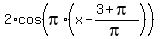 = = 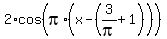 .
Now it becomes obvious that the shift is .
Now it becomes obvious that the shift is  units right, comparing with the parent function cos(x).
ANSWER. The shift is units right. units right, comparing with the parent function cos(x).
ANSWER. The shift is units right.
Solved correctly with complete explanations.
REMEMBER: The sign " - " before the trigonometric functions "sine" and "cosine"
is not a harmless symbol that can be ignored in such analysis.
Actually, this sign means the same and works the same as the half-period shift of the argument.
Therefore, it must be taken into account, and it changes the game completely, turning everything upside down.
//////////// I N T E R E S T I N G ////////////
Driven by my curiosity, I posted this problem today (May 22, 2026, about 12:05 pm) to two Artificial Intelligence
web-sites. One website was Google Overview; the other one was www.math-gpt.org/
Both answered incorrectly, similar to the "solution" by @lwsshar3, giving the shift units right.
Actually, this standard trap is well known to those who learned from good teachers, studied Math following
good educational programs and read relevant popular Math literature.
| |
|
