|
Question 995636: Pls how do I solve this.
Cube root of 2+√5
Found 3 solutions by jim_thompson5910, MathTherapy, ikleyn:
Answer by jim_thompson5910(35256)   (Show Source):
You can put this solution on YOUR website! I'm assuming you want to find the approximate value of 
To do so, type (2+sqrt(5))^(1/3) into your calculator to get the final answer of 1.618033988749895 (round this however you need to)
Answer by MathTherapy(10898)  (Show Source):
You can put this solution on YOUR website!
Pls how do I solve this.
Cube root of 2+√5
***************
Punching numbers into a calculator, as the other person who responded did, is MOST LIKELY NOT what this person was
expecting. Anyone can do such simple tasks. It's quite UNLIKELY that someone would post this problem, just so someone
else can produce a calculator-answer.
Cube root of 2+√5
 If instead of the cube root of 2+√5, suppose the square root of 3+√6 (  ), was requested, the RADICAND would then
need to be in the form:  , where "b" MUST be 4 (  ). To achieve this, the surd MUST be MULTIPLIED by 4. But, in
order to maintain the integrity of the expression, the surd MUST be MULTIPLIED NOT ONLY by 4, but by  , thereby
creating a fraction, with the multiplied surd in the numerator, and 4 in the denominator. So,  becomes: 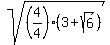 = 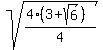 However, with the cube root being requested, the RADICAND would need to be in the form: , and "b" MUST BE > "c."
But, as seen here b (1) < c (5). So, the RADICAND,  needs to be manipulated, and in this case, multiplied by  , or 8.
But, in order to maintain the integrity of the expression, the surd MUST be MULTIPLIED NOT ONLY by 8, but by  , thereby
creating a fraction, with the multiplied surd in the numerator, and 8 in the denominator.  then becomes: 
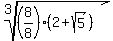
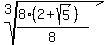
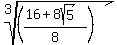 <=== "b" > "c," as 8 > 5 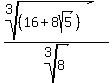 --- Separating numerator and denominator 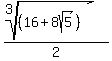
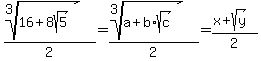 Using SHORTCUT,  In SOME cases, x also = REMAINDER when  , which in this case is 1, the REMAINDER when  .
y = c = 5
So,  = =  And what do we see here? We have "stumbled" upon the GOLDEN RATIO (φ). Are you familiar with this?
Answer by ikleyn(54062)  (Show Source):
You can put this solution on YOUR website! .
Pls how do I solve this.
Cube root of 2+√5
~~~~~~~~~~~~~~~~~~~~~~~~~~~~~~~
Let's assume that
= a + b*sqrt(5) (1)
with some real values 'a' and 'b'. Our goal is to find 'a' and 'b'.
If we find appropriate values 'a' and 'b' (and as soon as we find them), we will solve the problem.
From (1), we have
2 + sqrt(5) =  ,
2 + sqrt(5) =  +  +  +  =
= +  +  +  =
= + +  + =
=  + 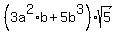 From this last form, it is natural to assume that
= 2, (2)  = 1. (3)
Equations (2) and (3) are equivalent to  = 2, (4)  = 1. (5)
We now have a system of two non-linear equations for 'a' and 'b'.
To solve it, let's divide equation (4) by equation (5). We will get 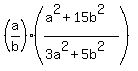 = 2. (6)
In this equation (6), divide the numerator by b^2 and divide the denominator by b^2.
This is an equivalent transformation, so equation (2) takes the form 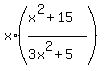 = 2, (7)
where x =  is introduced for brevity.
Equation (7) is easy to solve. For it, multiply both sides by  and simplify further
x*(x^2 + 15) = 2*(3x^2 + 5),
x^3 + 15x = 6x^2 + 10,
x^3 - 6x^2 + 15x - 10 = 0. (8)
For this equation (8), one of the roots is x = 1, which is easy to check.
By dividing the left side of equation (8) by (x-1), we find the quadratic polynomial, which has no real roots,
so x=1 is the unique real root to equation (8).
Thus we found that x = = 1.
This means that a = b, and we can substitute it into equation (2).
We will find then that a^3 = b^3 =  , so a = b =  =  .
Thus we find from (1)
= +  =  .
ANSWER. = .
CHECK. It is always a good idea to check calculations.
The left side value is = 1.618034 (approximately).
The right side value is = 1.618034 (approximately).
It confirms the solution.
Another way to check the solution is to calculate directly  and compare it with  .
By doing this, you get = 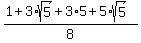 =  = ,  .
Solved and checked.
| |
|
| |
