|
Question 1160908: A spring bounces up and down according to the model d(t)=3sin(30t)+2, where d(t) is the displacement in cm from the rest position and t is time in seconds.
a) What is the amplitude of the function?
b) Is this the same as the maximum displacement from the rest position? Explain.
c) What is the equation of the axis?
d) Explain why the function models periodic behaviour.
I need steps also for each question please
Answer by KMST(5434)   (Show Source): (Show Source):
You can put this solution on YOUR website! a) What is the amplitude of the function?
Amplitude is the maximum displacement from the equilibrium position
The function  "swings" or "bounces" around "swings" or "bounces" around  by by  units to either side, going between units to either side, going between
 and and  , with an amplitude of , with an amplitude of 
b) Is this the same as the maximum displacement from the rest position? Explain.
If the spring was at rest,  would be the rest position. would be the rest position.
With the spring bouncing up and down according to  , ,
I can believe that maybe at some time in the past it was at rest at d=2, and was displaced up or down starting the motion, but I was not there. I did not see the spring at rest. Could it have been bouncing up and down for eternity?
I would call the equilibrium position, where there is no net force causing the motion, and acceleration is zero.
c) What is the equation of the axis?
The line that goes through the middle of the graph may be called the axis.
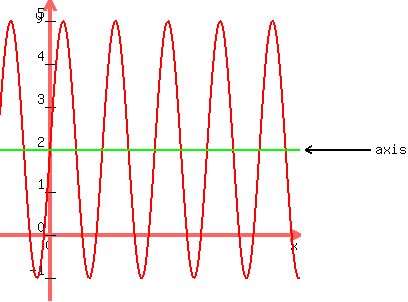
It is not an axis of symmetry in the sense of the function having two parts each being the reflection of the other one across an axis of symmetry, as the axis of a parabola, or the axes of an ellipse, or a hyperbola
d) Explain why the function models periodic behaviour.
Sine and cosine are functions used to model oscillations because they are periodic functions that take all values between -1 and 1.
Their period is  . .
With the independent variable is in radians, is a value that will repeat at intervals, with the function going through an entire cycle in each interval. is a value that will repeat at intervals, with the function going through an entire cycle in each interval.
For any every  of the variable of the variable  for every integer value of for every integer value of  . .
| |
|
| |
