|
Question 1160658: Determine the critical points of the following functions and classify them appropriately:
1) f(x)= x^4/3 (2x+7), -4 ≤ x ≥ ≤ 1
2) f(x) =x+2sinx in the interval (-pi, pi) pi as in 3.142....
Found 2 solutions by KMST, ikleyn:
Answer by KMST(5434)   (Show Source): (Show Source):
Answer by ikleyn(54018)  (Show Source): (Show Source):
You can put this solution on YOUR website! .
Determine the critical points of the following functions and classify them appropriately:
1) f(x)= x^4/3 (2x+7), -4 ≤ x ≥ ≤ 1
2) f(x) =x+2sinx in the interval (-pi, pi) pi as in 3.142....
~~~~~~~~~~~~~~~~~~~~~~~~~~~~~
In the post by tutor @KMST, the analysis for part (1) is incorrect.
Her answer for part (2) is incorrect, too.
I came to provide correct solutions for both parts.
A critical point of a function f(x) is an input 'c' within the function's domain
where its first derivative is either zero (f'(c) = 0) or does not exist (f'(c) is undefined).
1) 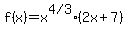   The function is defined for all real values of the variable x.
The derivative
The function is defined for all real values of the variable x.
The derivative  is defined
for all real values of the variable x and is zero at x = 0 and x = -2.
Thus, the critical points of f(x) are x = 0 and x = -2.
2) is defined
for all real values of the variable x and is zero at x = 0 and x = -2.
Thus, the critical points of f(x) are x = 0 and x = -2.
2) in the interval in the interval     The function has the graph
 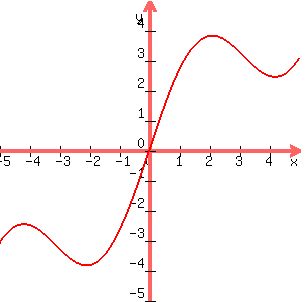 .
The function is defined over whole interval and has its derivative .
The function is defined over whole interval and has its derivative 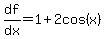 for all real values of the variable x.
When
for all real values of the variable x.
When 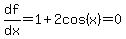 , ,  --> -->  --> -->  .
In the interval , that happens only at .
In the interval , that happens only at  and and  .
The highlighted values are the critical points. .
The highlighted values are the critical points.
Solved correctly.
/////////////////////////////////
Dear tutor @KMST, this info is specially for you.
Your plot for part (1) is incorrect.
To see a correct plot for this function, go to web-site www/desmos.com/calculator
and print this function there. You will see the TRUE correct plot there with all its features and critical points.
The matter is that the plotting tool here, at web-site www.algebra.com ,
works improperly in this case and does not plot this function for negative values of argument x, at all.
I checked it, and it is for the first time I observe this deficiency.
Surely, I will inform the owner of this site about it.
Also, the size of the window for the plot is inappropriate in your post:
it does not allow to see the necessary details. Simply keep it in your mind.
| |
|
| |
