

 Factor the top and bottom:
 Now as long as you do not cancel the (x+4)'s, then
x cannot equal to -4, because if you substitute
x = -4, you get:
Now as long as you do not cancel the (x+4)'s, then
x cannot equal to -4, because if you substitute
x = -4, you get:
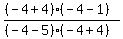

 That is undefined, because we cannot divide anything
by 0, not even 0 divided by 0. It's simply undefined.
That's what causes the hole to be in the graph.
Now if we cancel the (x+4)'s we get a graph which has
no hole.
That is undefined, because we cannot divide anything
by 0, not even 0 divided by 0. It's simply undefined.
That's what causes the hole to be in the graph.
Now if we cancel the (x+4)'s we get a graph which has
no hole.
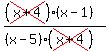
 Its graph does NOT have a hole!
Notice that if we substitute x=-4 in it, we get:
Its graph does NOT have a hole!
Notice that if we substitute x=-4 in it, we get:

 So the graph goes through the point
  So the graph of
whih has no hole, is this:
So the graph of
whih has no hole, is this:
 That's the graph WITHOUT the hole because the point is there, indicated by
the darkened circle.
Now let's go back to the original equation, which has a hole,
because the (x+4)'s were not canceled:
Its graph is the same as the graph of except
that it has a hole and doesn't go through the point . Its graph is:
That's the graph WITHOUT the hole because the point is there, indicated by
the darkened circle.
Now let's go back to the original equation, which has a hole,
because the (x+4)'s were not canceled:
Its graph is the same as the graph of except
that it has a hole and doesn't go through the point . Its graph is:
 So when you leave the equation as it was given originally,
And do not factor and cancel out the (x+4)'s then you have a
hole at the point that makes (x+4) equal to 0.
Then when you factor and cancel the (x+4)'s, you "fill in" the
hole. There is a hole when you don't cancel, and no hole when
you do cancel.
Edwin
So when you leave the equation as it was given originally,
And do not factor and cancel out the (x+4)'s then you have a
hole at the point that makes (x+4) equal to 0.
Then when you factor and cancel the (x+4)'s, you "fill in" the
hole. There is a hole when you don't cancel, and no hole when
you do cancel.
Edwin


