Question 1164537: 1)Find a new representation of the given equation after rotating through the given angle.
11x^2-50√3xy-39y^2+576=0 60degrees
Answer by KMST(5458)   (Show Source): (Show Source):
You can put this solution on YOUR website! A quadratic equation of the form  could represent a circle, ellipse, hyperbola, parabola. There are special cases where I could represent a point, a line, a pair of lines or no point that could exist, depending on the values of the coefficients. could represent a circle, ellipse, hyperbola, parabola. There are special cases where I could represent a point, a line, a pair of lines or no point that could exist, depending on the values of the coefficients.
In the case of  we have we have
 , ,  , ,  , ,  and and  . .
The value  , called the discriminant, suggests parabola, ellipse, or hyperbola if it is zero, negative, or positive respectively. , called the discriminant, suggests parabola, ellipse, or hyperbola if it is zero, negative, or positive respectively.
 suggest it's a hyperbola. suggest it's a hyperbola.
Symmetry and other considerations help visualize the curve represented too.
We can see that if a point (x,y) satisfies that equation, the point (-x, -y) will also satisfy that equation. That tells us that the set of points satisfying that equation is symmetrical with respect to the origin.
When  , the equation turns into , the equation turns into 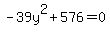 , and there is here is no solution for , and there is here is no solution for  , so we know that the curve does not touch or cross the y-axis. That, for an equation with , so we know that the curve does not touch or cross the y-axis. That, for an equation with  and and  makes me suspect an hyperbola. makes me suspect an hyperbola.
Rotating such a curve (counterclockwise) by an angle  we would get another equation with the coefficients A', B', C', and F' replacing A, B, C, and F. we would get another equation with the coefficients A', B', C', and F' replacing A, B, C, and F.
The formulas to find the new coefficients are:
A'=
B'=
C'=
F'=F
 , so , so  and and 
A'=
B'=
C'=
F'=576
The rotated curve equation is 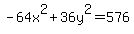 , which can be rewritten as , which can be rewritten as
 or or 
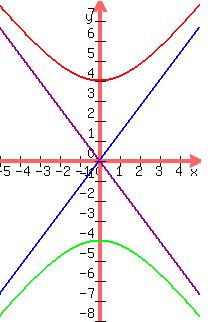
That represents a hyperbola centered at the origin, with vertices at (0,-4) and (0,4) and asymptotes 
Her is what the two branches of the hyperbola and its asymptotes look like:
| |
|
