Question 1158804: 9x^2-24xy+16y^2-20x-15y-50=0
Use axis rotation formulas for x and y to transform the quadratic equation to an equation in (u,v) coordinates with no cross product term. Identify the vertex or vertices in (x,y) coordinates
thank you so so so much
Answer by KMST(5458)   (Show Source): (Show Source):
You can put this solution on YOUR website! A quadratic equation of the form  , like , like  , could represent a circle, ellipse, hyperbola, parabola. , could represent a circle, ellipse, hyperbola, parabola.
In special cases it could represent a point, a line, a pair of lines, or no point that could exist, depending on the values of the coefficients.
ROTATING AXES:
Axis rotation equations:
From coordinates (x, y), to get the new coordinates (u, v) that would result for a point (x,y) after rotating the coordinate axes counterclockwise an angle  we can apply we can apply


From (u, v), rotating an angle  (the reverse change) we get (x,y) using (the reverse change) we get (x,y) using
 --> --> 
 --> --> 
Substituting  for for  and and  for for  in , in ,
with a lot of busy algebra work, we could get a new equation in  and and  with new expressions for the new coefficients. with new expressions for the new coefficients.
That is grueling, mistake-inducing work (and torture to type and edit).
We would have expressions involving  for all the new coefficients of terms with and/or , including the coefficient of the term in for all the new coefficients of terms with and/or , including the coefficient of the term in  . .
That coefficient must be made equal to zero.
From the equation making the coefficient of equal to zero, a value for needs to be found to be used to calculate all other coefficients.
Maybe that is the initial work that was expected for this problem.
IDENTIFYING VERTEX (OR VERTICES):
The new equation on and should be identified as a parabola (one vertex), a hyperbola (two vertices), an ellipse (two vertices and two co-vertices), or something else.
Then, the (u,v) coordinates for any vertices should be found, and converted into (x,y) coordinates.
POSSIBLE SHORTCUTS:
Rotating the coordinate axes counterclockwise an angle , from an equation
we get a new equation in and with new coefficients:
 . .
The new coefficients can be found to be:
 , ,
 , ,
 , and , and  . .
To eliminate the term in we must find a value for that makes
 using the trigonometric identities using the trigonometric identities

Then, it becomes  --> --> 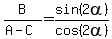 --> --> 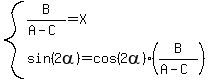 . B/(A-C)=tan(2alpha), sin(2alpha)=cos(2alpha)(B/(A-C) . B/(A-C)=tan(2alpha), sin(2alpha)=cos(2alpha)(B/(A-C)
Avoiding mistakes, with careful algebra work, I might have been able to find the expressions outlined above.
I just copied them from an old Analytical Geometry textbook.
The value  , called the discriminant, suggests parabola, ellipse, or hyperbola if it is zero, negative, or positive respectively. , called the discriminant, suggests parabola, ellipse, or hyperbola if it is zero, negative, or positive respectively.
I got that from the book too.
In the case of ,
 says the equation represents a parabola. says the equation represents a parabola.
A SHORTCUT THAT SHOULD BE ALLOWED:
Using 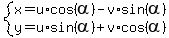 , we can translate into (u, v) coordinates the terms of degree 2 (the first 3 terms): , we can translate into (u, v) coordinates the terms of degree 2 (the first 3 terms):
  
   
 
When “collecting like terms”, the term in will be
 . .
Making the coefficient of equal to zero, we get the equation

We can simplify that equation using the trigonometric identities
 and and  . .
We get  --> --> 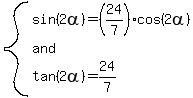 From that we would not get an exact value for From that we would not get an exact value for  or , but we know that alpha is in. or , but we know that alpha is in.
A calculator would give you an approximation with enough digits to figure out that  and and  . .
We can get exact values of the trigonometric functions and their squares, from 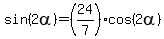
 --> --> 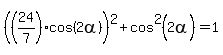 --> -->  --> --> 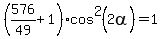 --> --> 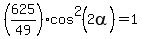 --> --> 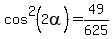 --> -->  and and 
Then, --> 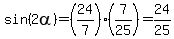 , so , so 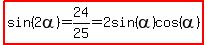
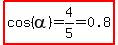
The sine and cosine of can also be calculated from  using the trigonometric identities for half angles as using the trigonometric identities for half angles as
 --> --> 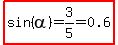 and and
 --> --> 
Now we can go back to expressions for the terms in  and and  , and substitute for the trigonometric functions involved the values we found and highlighted before. , and substitute for the trigonometric functions involved the values we found and highlighted before.
As found before they come from the original terms  , ,  , and , and  expressed as a function of , and : expressed as a function of , and :
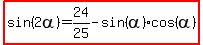 , ,
,
and
,
and
Collecting like terms, we find the term in to be
 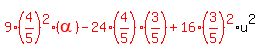 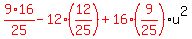 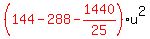  , ,
and the tern in to be
 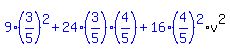 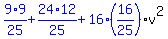   
The linear (degree 1) terms in and come from
  , and , and
 

The equation on and is
 or or 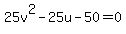 , which simplifies to , which simplifies to  or or  , representing a parabola with axis , representing a parabola with axis  , and vertex , and vertex  all in u,v coordinates. all in u,v coordinates.
The x,y coordinates of the vertex are


| |
|
