|
Question 1142993: Given point A(0,2) on the parabola y^2=x+4. Points B & C also lie on the curve such that BC is perpendicular to AB. Give the range of point C on the y-axis.
Thanks!
Found 3 solutions by KMST, ikleyn, n2:
Answer by KMST(5458)   (Show Source): (Show Source):
You can put this solution on YOUR website! Intuitively, you realize that if B is between A and V,
the perpendicular to AB will slope down inside the parabola and cross the blue part of the curve at some point.
If B=V, the slope of AB will be  and the slope of the perpendicular to AB=AV will be and the slope of the perpendicular to AB=AV will be  . The equation of that perpendicular will be . The equation of that perpendicular will be  < -- > < -- > and will intersect the blue part of the curve at the point where and will intersect the blue part of the curve at the point where 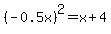 < -- > < -- > < -- > < -- > < -- > < -- >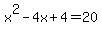 < -- > < -- >
 as two functions as two functions  and and  : :
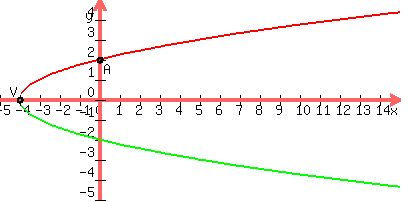
Any line that has one point on the parabola is either
tangent to the parabola at that point, or
intersects the parabola at two points, or
is parallel to the axis of the parabola.
We need the point B on that parabola to be such that the line perpendicular to AB through B intersects the parabola at two points: B and C.
Intuitively we see that the slope  of a tangent to the parabola is of a tangent to the parabola is
positive at all points on the red curve with  , ,
negative for all points on the green curve with ,
and undefined at vertex  , where the tangent is the line , where the tangent is the line  . .
For all points B with  , the slope of AB will be the same as the slope of the tangent at some point between A and B and will be positive: , the slope of AB will be the same as the slope of the tangent at some point between A and B and will be positive:  . .
The slope of a perpendicular to AB will be  , ,
and the line perpendicular to AB at B will intersect the parabola at some point C in green curve, with  : :
  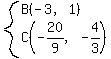   
Intuitively, it seems like we could get any value of for point C by adjusting the position of point B, even though the point (0,-2) as our point B, would make AB be the line  , whose perpendicular through (0,-2) would be the line , whose perpendicular through (0,-2) would be the line  , which intersects is parallel to the axis of symmetry of the parabola and intersects the parabola only at point (0,-2). , which intersects is parallel to the axis of symmetry of the parabola and intersects the parabola only at point (0,-2).
Could we place point C on any point on the red curve by choosing a convenient point B?
If we look at the triangle ABC in each case, and imagine it inscribed in a circle, the side AC, opposite the right angle at B, is the diameter of the circle.
So if we choose a desired point C with y>0, on the red part of the graph,
a corresponding point B, if it exists, must be
where the circle with diameter AC, centered at the midpoint of AC, and intersects the parabola.
Let us see if we have a solution for  and and  <--> <--> . .
We would be looking for  , the diameter of our circle would be the distance AC: , the diameter of our circle would be the distance AC:
 for a radius of for a radius of  . .
The center of the circle, would be M, the midpoint of AC with 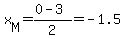 and and 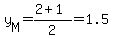 . .
 Point B, if it existed would be a third point on that circle and on the parabola. Point B, if it existed would be a third point on that circle and on the parabola.
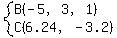
Let's try  --> -->  --> -->  --> --> 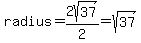 , ,
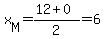 , ,  : :  Point Point  is a third point on that circle and on the parabola. is a third point on that circle and on the parabola.
Let's try  --> -->  --> -->  --> --> 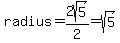 , ,
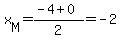 , ,  : :  Point Point  is a third point on that circle and on the parabola. is a third point on that circle and on the parabola.
It seems like there cannot be a point C on the parabola as described in the question with  as for those points the circles with AC for a diameter would be too small to intersect the parabola at a third point. as for those points the circles with AC for a diameter would be too small to intersect the parabola at a third point.
Answer by ikleyn(54053)  (Show Source): (Show Source):
You can put this solution on YOUR website! .
Given point A(0,2) on the parabola y^2=x+4. Points B & C also lie on the curve such that BC is perpendicular
to AB. Give the range of point C on the y-axis.
Thanks!
~~~~~~~~~~~~~~~~~~~~~~~~~~~~~~~
This problem seems to be quite interesting.
In the post by tutor @KMST, you, the reader, will not find an explicit clear answer.
Also, I find that her approach is not precisely correct, her post is not a right solution
and her teaching is not right teaching in this case.
So, I came to bring a correct solution. My idea and the method are totally different
from that of @KMST.
The equation of the parabola can be equivalently rewritten in the form x = y^2-4.
Let  , ,  , ,  be x-coordinates of points A, B and C. and
let be x-coordinates of points A, B and C. and
let  , ,  , ,  be their y-coordinates.
= 0 and = 2 are given.
For leg AB, the slope is be their y-coordinates.
= 0 and = 2 are given.
For leg AB, the slope is
 = =  = =  = =  = =  = = 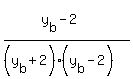 = =  .
For leg BC, the slope is .
For leg BC, the slope is
 = =  = =  = = 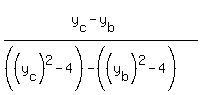 = =  = = 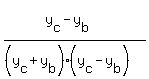 = =  .
The legs AB and BC are perpendicular, so .
The legs AB and BC are perpendicular, so  = -1, or = -1, or
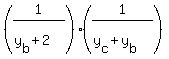 = -1. (1)
It is the same as = -1. (1)
It is the same as
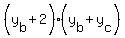 = -1.
FOIL left side of this equation and write it as a quadratic equation for = -1.
FOIL left side of this equation and write it as a quadratic equation for
 + +  + +  + +  + 1 = 0,
+ + 1 = 0,
+  + +  = 0. (2)
The condition for existing real solution is d >= 0, where d is the discriminant of this equation.
For a general form equation
y^2 + py + q = 0,
the discriminant is
d = p^2 - 4q = = 0. (2)
The condition for existing real solution is d >= 0, where d is the discriminant of this equation.
For a general form equation
y^2 + py + q = 0,
the discriminant is
d = p^2 - 4q =  - -  = = 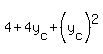 - -  = =  .
So, equation (2) has real solutions for if and only if
>= 0, .
So, equation (2) has real solutions for if and only if
>= 0,
 >= 0.
The set of solutions is the union
<= 0 OR >= 4.
At this point, the problem is solved completely.
ANSWER. The set of possible values of is ( >= 0.
The set of solutions is the union
<= 0 OR >= 4.
At this point, the problem is solved completely.
ANSWER. The set of possible values of is ( , , ] U [ ] U [ , ,  ). ).
Solved.
This is a Math Olympiad level problem.
Answer by n2(98)  (Show Source): (Show Source):
You can put this solution on YOUR website! .
Given point A(0,2) on the parabola y^2=x+4. Points B & C also lie on the curve such that BC is perpendicular to AB.
Give the range of point C on the y-axis.
~~~~~~~~~~~~~~~~~~~~~~~~~~~~~~~~~
Amazingly, this problem has a nice solution.
The equation of the parabola can be equivalently rewritten in the form x = y^2-4.
Let , , be x-coordinates of points A, B and C. and
let , , be their y-coordinates.
= 0 and = 2 are given.
For leg AB, the slope is
= = = = = = .
For leg BC, the slope is
= = = = 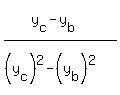 = = .
The legs AB and BC are perpendicular, so = -1, or
= -1. (1)
It is the same as
= -1.
FOIL left side of this equation and write it as a quadratic equation for
+ + + + 1 = 0,
+ + = 0. (2)
The condition for existing real solution is d >= 0, where d is the discriminant of this equation.
For a general form equation
y^2 + py + q = 0,
the discriminant is
d = p^2 - 4q = - = - = .
So, equation (2) has real solutions for if and only if
>= 0,
>= 0.
The set of solutions is the union
<= 0 OR >= 4.
At this point, the problem is solved completely.
ANSWER. The set of possible values of is (,] U [, ). = = .
The legs AB and BC are perpendicular, so = -1, or
= -1. (1)
It is the same as
= -1.
FOIL left side of this equation and write it as a quadratic equation for
+ + + + 1 = 0,
+ + = 0. (2)
The condition for existing real solution is d >= 0, where d is the discriminant of this equation.
For a general form equation
y^2 + py + q = 0,
the discriminant is
d = p^2 - 4q = - = - = .
So, equation (2) has real solutions for if and only if
>= 0,
>= 0.
The set of solutions is the union
<= 0 OR >= 4.
At this point, the problem is solved completely.
ANSWER. The set of possible values of is (,] U [, ).
Solved.
| |
|
| |
