Question 1210648: Precalculus
Michael Sullivan
Section 1.1
Q. 48 (b)
Find all points having a y-coordinate of -6 whose distance from the point (1, 2) is 17 using the Pythagorean Theorem.
Note: I know how to do this using the distance formula for points on the xy-plane.
However, I want to learn how to use the Pythagorean Theorem, which is part (b) of Q. 48.
Found 4 solutions by ikleyn, KMST, n2, MathTherapy:
Answer by ikleyn(54018)   (Show Source): (Show Source):
You can put this solution on YOUR website! .
Precalculus
Michael Sullivan
Section 1.1
Q. 48 (b)
Find all points having a y-coordinate of -6 whose distance from the point (1, 2) is 17 using the Pythagorean Theorem.
Note: I know how to do this using the distance formula for points on the xy-plane.
However, I want to learn how to use the Pythagorean Theorem, which is part (b) of Q. 48.
~~~~~~~~~~~~~~~~~~~~~~~~~~~~
This problem was solved at this forum some time (about two years) ago under this link
https://www.algebra.com/algebra/homework/word/geometry/Geometry_Word_Problems.faq.question.1209063.html
(see solution by @ikleyn).
This solution uses the Pythagorean theorem.
Enjoy.
Answer by KMST(5434)  (Show Source): (Show Source):
You can put this solution on YOUR website! A coordinate plane is like the map of a town, with a grid formed by two sets of line parallel to the lines of the same set, but perpendicular to the lines of the other set.
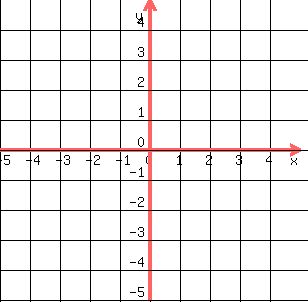 The point P(1,2) is at the corner of street 1 East and street 2 North: The point P(1,2) is at the corner of street 1 East and street 2 North:
From P, going 4 blocks South, and then 3 blocks East you reach point Q(4,-2), but your parakeet flew directly to Q on a street line, and got there faster.
 Your path and the parakeet's form a right triangle. Your path and the parakeet's form a right triangle.
You followed the two legs of the right triangle, going South down x=1 street first, until you found y=-2 street, and then going East on y=-2 street until you got to Q.
The parakeet followed the hypotenuse of the triangle.
And we know that a straight line is the shortest distance between two points.
And some people, since over 2500 years ago knew that the square of the length of the hypotenuse was equal to the sum of the squares of the lengths of the legs.
That is the Pythagorean theorem.
For our triangle the length of you fist leg was the change in y, from 2 to -2.  . .
The length of the second leg was the change in x, from 1 to 4, 
The square of the distance PQ according to the Pythagorean theorem is 
Back then those people understood that concept, but they had not all agreed on how to write that as a nice mathematical formula that would be understood everywhere.
Over the centuries people understood one another progressively better, agreed on a common way to write math, and wrote formulas that people in other places could understand.
Then teachers made students memorize formulas with or without understanding, and here we are.
BACK TO YOUR QUESTION AND PROBLEM:
The square of the distance from P(1,2) to a generic point (x,y) is
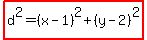 Reason: Pythagorean theorem applied to the points in question. Reason: Pythagorean theorem applied to the points in question.
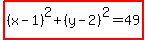
For a point in your circle with radius  centered at P(1,2), centered at P(1,2),
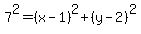 <--> <--> 
From 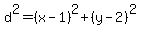 you would get you would get 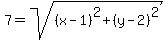 (distance formula applied to those points). (distance formula applied to those points).
The distance formula comes from the Pythagorean theorem.
If you understand that, you memorize only the concept of the Pythagorean theorem, which you would eventually deduce by yourself from similar triangles if you needed to do that to get out of jail.
Answer by n2(97)  (Show Source): (Show Source):
You can put this solution on YOUR website! .
.
Find all points having a y-coordinate of -6 whose distance from the point (1,2) is 17.
(a)By using the Pythagorean Theorem.
(b)By using the distance formula.
~~~~~~~~~~~~~~~~~~~~~~~~~~~~~~~~~~~~~~~~~~
This nickname "n2" is the same as "ikleyn".
This problem is unhappy, in some sense.
First, Edwin in his post solved it incorrectly, using, by mistake, y-coordinate 6 instead of the given value -6.
Then I came (as @ikleyn) and solved it correctly.
After that tutor @KMST came and created wrong solution again,
by using the distance value '7' instead of the given value '17'.
Therefore, I return again to repeat my correct solution one more time here.
Let's call the given point A = (1,2).
All points having y-coordinate of -6, lie on the horizontal line y = -6.
Vertical distance from the point (1,2) to this line (or simply the distance) is 6+2 = 8 units.
This distance is the length of the perpendicular from this point (1,2) to the line y= -6.
We want to find points C on the line y= -6 such that the distance from A to C is 17 units.
Draw the perpendicular AB from A to line y= -6. The length of this perpendicular is 8 units.
The coordinates of B are (1,-6).
The triangle ABC is a right-angled triangle.
Its hypotenuse AC has the length of 17 units; its leg AB is of 8 units.
Hence, the leg BC along the line y = -6 is (Pythagoras)
 = =  = =  = 15 units.
Thus possible points C are (1+15,-6) = (16,-6) or (1-15,-6) = (-14,-6).
ANSWER. There are two such points C = (16,-6) and C' = (-14,-6). = 15 units.
Thus possible points C are (1+15,-6) = (16,-6) or (1-15,-6) = (-14,-6).
ANSWER. There are two such points C = (16,-6) and C' = (-14,-6).
Solved correctly.
Answer by MathTherapy(10864)  (Show Source): (Show Source):
You can put this solution on YOUR website!
Precalculus
Michael Sullivan
Section 1.1
Q. 48 (b)
Find all points having a y-coordinate of -6 whose distance from the point (1, 2) is 17 using the Pythagorean Theorem.
Note: I know how to do this using the distance formula for points on the xy-plane.
However, I want to learn how to use the Pythagorean Theorem, which is part (b) of Q. 48.
***************
When doing certain math problems, It’s always best, in most cases, to provide visual aids, in order to make the math problems
easier to understand, and eventually, figure out.
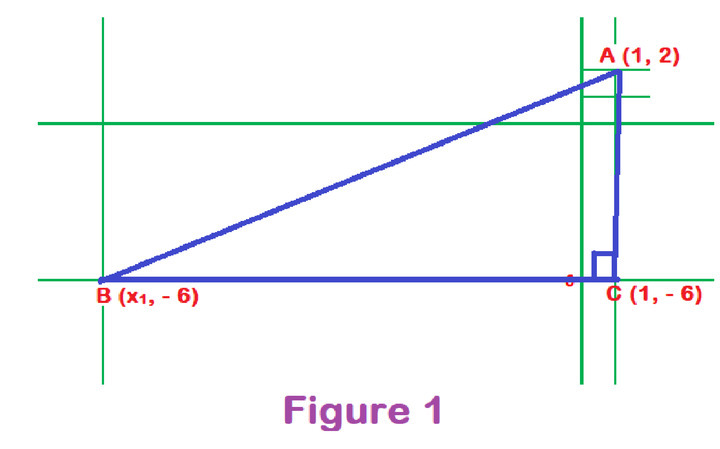 .
Let’s plot the GIVEN and other points.
Point (1, 2) will be in the 1st quadrant. Let’s name this point, A (see Figure 1).
1) Let’s draw a vertical line from point (1, 2) to the horizontal line y = - 6. This point will be (1, - 6), and will be named C.
This vertical line is then AC (see Figure 1).
2) The point that’s 17 units from (1, 2), to the LEFT of (1, 2), and with y-coordinate - 6, will be (x1, - 6), and named B.
Connect points A (1, 2) and B (x1, - 6) to get AB, the 3rd side, or the hypotenuse of right-angled triangle, ABC, with
right angle at C, and legs AC, and BC.
We now have right-triangle ABC, with:
AB = 17, being the hypotenuse
Leg AC, a vertical line with point A (1, 2) and point C (1, - 6), and a measure of y1 - y2 = 2 - - 6) = 2 + 6 = 8 units.
Leg BC, a HORIZONTAL line, with point B (x1, - 6) and point C (1, - 6), and a measure of (1 - x1) units.
Using the PYTHAGOREAN THEOREM, .
Let’s plot the GIVEN and other points.
Point (1, 2) will be in the 1st quadrant. Let’s name this point, A (see Figure 1).
1) Let’s draw a vertical line from point (1, 2) to the horizontal line y = - 6. This point will be (1, - 6), and will be named C.
This vertical line is then AC (see Figure 1).
2) The point that’s 17 units from (1, 2), to the LEFT of (1, 2), and with y-coordinate - 6, will be (x1, - 6), and named B.
Connect points A (1, 2) and B (x1, - 6) to get AB, the 3rd side, or the hypotenuse of right-angled triangle, ABC, with
right angle at C, and legs AC, and BC.
We now have right-triangle ABC, with:
AB = 17, being the hypotenuse
Leg AC, a vertical line with point A (1, 2) and point C (1, - 6), and a measure of y1 - y2 = 2 - - 6) = 2 + 6 = 8 units.
Leg BC, a HORIZONTAL line, with point B (x1, - 6) and point C (1, - 6), and a measure of (1 - x1) units.
Using the PYTHAGOREAN THEOREM,  , we get: , we get:
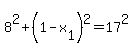 , with a being 8, b being 1 - x1, and c being 17 , with a being 8, b being 1 - x1, and c being 17
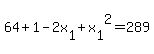
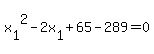
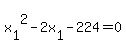
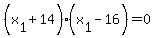
 .
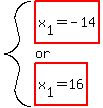
As seen, x1 has 2 values. So, x1 = - 14 will be renamed .
As seen, x1 has 2 values. So, x1 = - 14 will be renamed  , while , while  will be renamed will be renamed  .
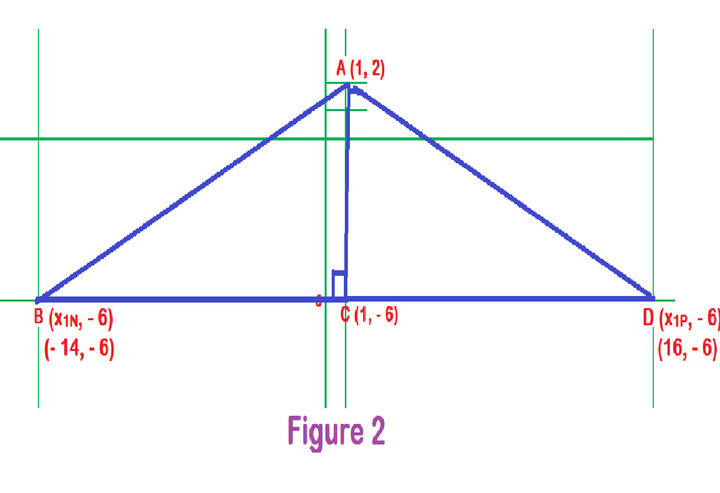
This gives us an ISOSCELES TRIANGLE, ABD - made up of 2 right-angled triangles - with points A (1, 2), D (- 14, - 6), and D (16, - 6),
as seen in Figure 2.
It’s therefore obvious, from Figure 2, that there are 2 points: (- 14, - 6), and (16, - 6), that contain y-coordinate - 6, and are 17 units
from point (1, 2).
The point, (x1, - 6) could've also been placed to the right of A (1, 2), instead of to the LEFT. This would’ve yielded the same above-results. .
This gives us an ISOSCELES TRIANGLE, ABD - made up of 2 right-angled triangles - with points A (1, 2), D (- 14, - 6), and D (16, - 6),
as seen in Figure 2.
It’s therefore obvious, from Figure 2, that there are 2 points: (- 14, - 6), and (16, - 6), that contain y-coordinate - 6, and are 17 units
from point (1, 2).
The point, (x1, - 6) could've also been placed to the right of A (1, 2), instead of to the LEFT. This would’ve yielded the same above-results.
| |
|
