|
This Lesson (Factors and Multiples) was created by by technofranchise(0)
  About technofranchise: Computer System Engineer
Q.Write down the factors of the given numbers:
(a) 16 (b) 28 (c) 96 (d) 100 (e) 120 (f) 210 Solution: Any number which completely divides a given higher number without leaving the remainder is called its factor (a) 16 The factors are: 1,2,4,8,16 (b) 28 The factors are: 1,2,4,7,14,28 (c) 96 The factors are 1,2,3,4,6,8,12,16,24,32,48,96 (d) 100 The factors are: 1,2,4,,5,10,20,25,50,100 (e) 120 The factors are: 1,2,3,4,5,6,8,10,12,15,20,24,30,40,60,120 (f) 210 The factors are: 1,2,3,5,6,7,10,14,15,21,30,35,42,70,105,210 Q Write down the first six multiples of the following number. 21 Solution: Multiples are those numbers that are obtained after multiplying the number by an integer. The first six multiples of 21 are: 21,42,63,84,105,126 Q.Identify the numbers below, that have 18 as factors. 54,126,198,240,320 Solution: We have to check first, which one of these numbers are exactly divisible by 18, leaving no remainder. 54,126,198 are the numbers that have 18 as their factor Q Identify those numbers, which are factors of 120 1,2,3,4,5,6,7,8,10,11,12,13,15,20,23,24,30,40,60,120 Solution:e We have to look for those numbers by which, 120 is completely divisible and leaving no remainder. Therefore, the numbers are: 1,2,3,4,5,6,8,10,12,15,20,24,30,40,60,120 Q Identify those numbers of which 224 is a multiple. The numbers are: 1,2,3,4,5,6,7,8,14,16,28,32,56,112,224 Solution: We have to look for those numbers, which divide the given number completely or letting no remainder.Hence, the numbers are: 1,2,4,7,8,14,16,28,32,56,112,224 Point of interest: If we are required to find all the factors of a given number; then they might also contain negative numbers. For example: Example: All the factors of 10 2 × 5 = 10 , but 5 × 2 = 10 also and definitely=> 1 × 10 = 10. So 1, 2, 5 and 10 are the factors of 10. An interesting thing to note that -1,-2,-5 and -10 are also the factors of 10 because you get a positive number when you multiply two negatives, such as (-2)×(-5) = 10 In this case, our answer is: 1, 2, 5, 10, -1, -2, -5, -10 Word Problem: John has 48 orange-flavored sweets and Susan has 45 lime-flavored sweets. (a) John wishes to divide his sweets equally into bags. List all the possible ways he can do this. (For example, he can have 6 bags of 8 sweets) (b) Susan also wishes to divide her sweets equally into bags.List all the possible ways she can do this. (c) Peter, their good friend, suggests that they combine the sweets and divide them equally into bags in such a way that each bag has equal number of orange-flavored and lime-flavored sweets. Explain how this can be done. Solution: (a) The possible ways that John can divide his sweets in bags can be obtained quite easily if we bring all the factors (positive integers) of the 48 orange-flavored sweets he has, as follows: 1,2,3,4,6,8,12,16,24,48 The logic is simple.Just multiply the two factors to get the total sweets such that 1 x 48 gives 1 bag of 48 sweets and 48 x 1 gives 48 bags of 1 sweet. This is simple! Isn't it? The combinations are: John can divide 48 sweets in 1 bag. John can divide 24 sweets in 2 bags. John can divide 16 sweets in 3 bags. John can divide 12 sweets in 4 bags. John can divide 8 sweets in 6 bags. John can divide 6 sweets in 8 bags. John can divide 4 sweets in 12 bags. John can divide 3 sweets in 16 bags. John can divide 2 sweets in 24 bags. John can divide 1 sweet in 48 bags. (b) Solution: Take the factors of 45 lime-flavored sweets that Susan has: 1,3,5,9,15,45 Thus, the combinations are: 45 sweets for 1 bag 1 sweet for 45 bags 15 sweets for 3 bags 3 sweets for 15 bags 9 sweets for 5 bags 5 sweets for 9 bags (c) Solution: We have to analyze what John wants? He wants combined sweets of both John (48) and Susan (45) in specific numbers of bags such that each bag has equal number of orange-flavored and lime-flavored sweets. Remind that the factors of orange-flavored sweets were:1,2,3,4,6,8,12,16,24,48 and those of lime-flavored were : 1,3,5,9,15,45 What is the common factor between them besides 1 ? It is 3 right ! This brings us the 3 divisions or bags. Now (45/3=15)=> lime-flavored sweets in 3 bags and (48/3=16)=> 16 orange-flavored sweets in 3 bags Q. What are Prime Numbers? A. A prime number is a whole number greater than 1, whose only two whole-number factors are 1 and itself. The first few prime numbers are 2, 3, 5, 7, 11, 13, 17, 19, 23, and 29. Q. What are Composite Numbers? A. A composite number is a positive integer that has at least one positive divisor other than one or the number itself. In other words, a composite number is any integer greater than one that is not a prime number. Examples : 4, 6, 8, 9, 10, 12, 14, 15, 16, 18, 20, 21, 22, 24, 25, 26, 27, 28, 30 Q. What are Whole Numbers? A. Whole numbers are integers without a fraction starting from 0. Example: 0,1,2,3,4,5...... Q. What is Index notation? A. Q. What are Prime factors? A. A prime factor is the product of two or more prime numbers . For Example: Prime factors of 28= 2 x 2 x 7=> 2^2 x 7 48=2 x 2 x 2 x 2 x 3=> 2^4 x 3 Prime factors can easily be obtained by taking the L.C.M or Q.What is LCM? A. The least common multiple (LCM) of number(s) is the smallest number that divide a number evenly into. The simplest method used to find the LCM of 28 is as follows: 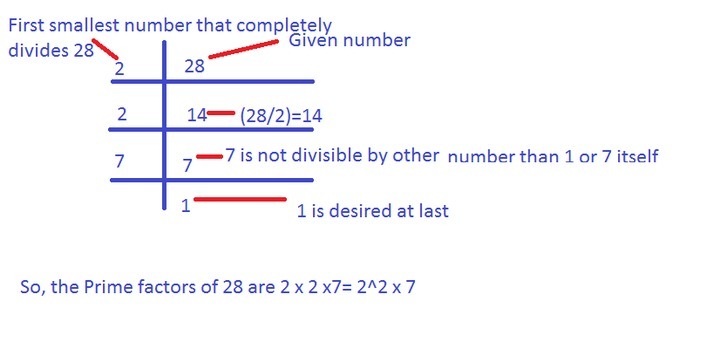 . .
Q. What is factor tree? A.Factor Tree is a Diagram, where you find the factors of specific number in the form of hierarchical or tree like structure Examples: Factor tree of 36: First, we will take the factors of 36 which include : 2 x 2 x 3 x 3=> 2^2 x 3^2 Now, look carefully below:- Note:-We are not restricted to pick the two numbers such as 4 and 9 only which give 36 when multiplied. We can also have 6 x 6, 3 x 12, and 2 x 18 Factor tree of 48: Factors=1, 2, 3, 4, 6, 8, 12, 16, 24, 48 Combinations are: 1 x 48, 2 x 24, 3 x 16, 4 x 12, 8 x 6 We take 8 x 6 as the two numbers that make up 48 after multiplying. Therefore, our factor tree will be: Q. What is Highest Common Factor or HCF ? A. The highest common factor is found by multiplying all the factors which appear in both lists: So the HCF of 20 and 30 is 10. Let's talk logically: Factors of 20= 1,2,4,5,10,20 Factors of 30= 1,2,3,5,6,10,15,20 Now, what is the first highest number common in the factors of 20 and 30? It is 10 !!!. So, the HCF is 10 This lesson has been accessed 10053 times. |
