Question 945054: the sum of three consecutive numbers is 56. the second is five less than the first and the third is 15 more than the smallest. find the three numbers.
Found 5 solutions by lwsshak3, ikleyn, josgarithmetic, greenestamps, MathTherapy:
Answer by lwsshak3(11628)   (Show Source): (Show Source):
You can put this solution on YOUR website! the sum of three consecutive numbers is 56. the second is five less than the first and the third is 15 more than the smallest. find the three numbers.
***
let x=first number
x-5=second number (this must be the smallest of the 3 numbers)
x-5+15=x+10=third number
x+x-5+x+10=56
3x=51
x=17
x-5=12
x+10=27
..
first number=17
second number=12
third number=27
Answer by ikleyn(54053)  (Show Source): (Show Source):
You can put this solution on YOUR website! .
the sum of three consecutive numbers is 56. the second is five less than
the first and the third is 15 more than the smallest. find the three numbers.
~~~~~~~~~~~~~~~~~~~~~~~~~~~~
This problem's formulation is SELF-CONTRADICTORY.
Its first statement contradicts to the next statement.
The person who created this defective problem, is not familiar with the basic Math conceptions and terminology.
Answer by josgarithmetic(39846) (Show Source):
Answer by greenestamps(13386)  (Show Source): (Show Source):
You can put this solution on YOUR website!
The description of the relationships between the three numbers clearly indicates that the three numbers are NOT consecutive numbers. So we need to ignore the statement that says the numbers are consecutive.
In the solution by @josgarithmetic, the given information is not reflected correctly in the setup, so the solution is not right.
The second number is 5 less than the first, and the third number is 15 more than the smallest. So the smallest number is the second number:
x = second (smallest) number
x+5 = first number
x+15 = third number
The sum of the three numbers is 56:
(x)+(x+5)+(x+15) = 56
3x+20 = 56
3x = 36
x = 12
The three (not consecutive) numbers are x=12; x+5=17, and x+15=27.
ANSWERS: 12, 17, and 27
Answer by MathTherapy(10880)  (Show Source): (Show Source):
You can put this solution on YOUR website!
the sum of three consecutive numbers is 56. the second is five less than the first and the third is 15 more than the
smallest. find the three numbers.
*********************************
In all of the years spent studying mathematics, this author has NEVER heard of 3 consecutive numbers, in which the middle number
is 5 greater than the smallest number, and the largest number, is 15 greater than the middle number. How CRAZY is this!!
This author KNOWS, as most do, that CONSECUTIVE NUMBERS are in a SEQUENCE or PATTERN where each number in the sequence
is SEPARATED by the SAME NUMBER. In other words, the difference between each number in a CONSECUTIVE sequence, is EXACTLY
the SAME, 1. Or, ALL numbers are EQUALLY-SPACED, as in: 1,2,3,4,5, etc. or 16,17,18,19, etc. For consecutive ODD/EVEN numbers,
each number increases by 2, or each number in such SEQUENCE differs by 2. Nonetheless, each is EVENLY-SPACED.
How/Why then, can/does a person state that 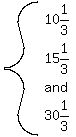 are consecutive? Isn't this a CLEAR indication that something is wrong with
the problem, if these are the numbers, when solved? RIDICULOUS!! are consecutive? Isn't this a CLEAR indication that something is wrong with
the problem, if these are the numbers, when solved? RIDICULOUS!!
| |
|
