SOLUTION: The sum of the squares of two consecutive odd integers is one less than three times the square of the smaller. Choose one of the the integers from those below.

Algebra ->  Problems-with-consecutive-odd-even-integers -> SOLUTION: The sum of the squares of two consecutive odd integers is one less than three times the square of the smaller. Choose one of the the integers from those below.      Log On


Question 446265: The sum of the squares of two consecutive odd integers is one less than three times the square of the smaller. Choose one of the the integers from those below.
Answer by chriswen(106) About Me  (Show Source):
You can put this solution on YOUR website!
Let x be the smaller number.
Let x+2 be the next consecutive odd number.
...
x%5E2%2B%28x%2B2%29%5E2=3%2Ax%5E2-1
x%5E2%2Bx%5E2%2B4x%2B4=3x%5E2-1
0=3x%5E2-2x%5E2-4x-4-1
x%5E2-4x-5=0
Solved by pluggable solver: SOLVE quadratic equation with variable
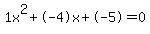
Quadratic equation ax%5E2%2Bbx%2Bc=0 (in our case 1x%5E2%2B-4x%2B-5+=+0) has the following solutons:

x%5B12%5D+=+%28b%2B-sqrt%28+b%5E2-4ac+%29%29%2F2%5Ca

For these solutions to exist, the discriminant b%5E2-4ac should not be a negative number.

First, we need to compute the discriminant b%5E2-4ac: b%5E2-4ac=%28-4%29%5E2-4%2A1%2A-5=36.

Discriminant d=36 is greater than zero. That means that there are two solutions: +x%5B12%5D+=+%28--4%2B-sqrt%28+36+%29%29%2F2%5Ca.

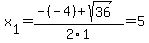
x%5B1%5D+=+%28-%28-4%29%2Bsqrt%28+36+%29%29%2F2%5C1+=+5
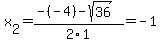
x%5B2%5D+=+%28-%28-4%29-sqrt%28+36+%29%29%2F2%5C1+=+-1

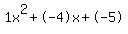
Quadratic expression 1x%5E2%2B-4x%2B-5 can be factored:
1x%5E2%2B-4x%2B-5+=+1%28x-5%29%2A%28x--1%29
Again, the answer is: 5, -1. Here's your graph:
graph%28+500%2C+500%2C+-10%2C+10%2C+-20%2C+20%2C+1%2Ax%5E2%2B-4%2Ax%2B-5+%29

x=-1 or x=5
x+2=1 or x+2=7
Therefore, the two integers are -1 and 1 or they are 5 and 7.