Question 1160925: Let Y be a discrete random variable with PMF
Fy(Y)={ce^-2/Y! For Y=0,1,2,3,4.
{0 Otherwise
Find the value of constant C
Also, find and plot the cumulative distribution function, CDF of Y, fy(Y)
Found 2 solutions by CPhill, ikleyn:
Answer by CPhill(2285)   (Show Source): (Show Source):
You can put this solution on YOUR website! ```python
import numpy as np
import matplotlib.pyplot as plt
y_vals = np.array([0, 1, 2, 3, 4])
terms = np.exp(-2) / np.array([1, 1, 2, 6, 24]) # e^-2 / y!
sum_terms = np.sum(terms)
c = 1.0 / sum_terms
pmf = c * terms
cdf = np.cumsum(pmf)
print(f"c = {c:.6f}")
print("PMF values:", pmf)
print("CDF values:", cdf)
# Plot CDF step function
plt.figure(figsize=(7, 4))
y_plot = np.array([-1, 0, 1, 2, 3, 4, 5])
cdf_plot = np.array([0, cdf[0], cdf[1], cdf[2], cdf[3], cdf[4], 1.0])
plt.step(y_plot, cdf_plot, where='post', color='b', linewidth=2, label='CDF $F_Y(y)$')
plt.scatter(y_vals, cdf, color='red', zorder=5)
plt.title('Cumulative Distribution Function (CDF) $F_Y(y)$')
plt.xlabel('y')
plt.ylabel('$F_Y(y)$')
plt.grid(True, linestyle='--', alpha=0.6)
plt.xlim(-1, 5)
plt.ylim(-0.1, 1.1)
plt.legend()
plt.tight_layout()
plt.savefig('cdf_plot.png')
plt.show()
```
```text
c = 2.728267
PMF values: [0.36923077 0.36923077 0.18461538 0.06153846 0.01538462]
CDF values: [0.36923077 0.73846154 0.92307692 0.98461538 1. ]
has vm saved
```
```python
# Exact rational values verification
# sum_terms = e^-2 * (1 + 1 + 1/2 + 1/6 + 1/24) = e^-2 * (70/24) = e^-2 * (35/12)
# Therefore, c = (12 * e^2) / 35
import sympy as sp
c_exact = 12 * sp.E**2 / 35
print("Exact c:", c_exact)
print("Numeric c:", float(c_exact))
# PMF exact
# P(Y=0) = c * e^-2 / 0! = (12 e^2 / 35) * e^-2 = 12/35
# P(Y=1) = 12/35
# P(Y=2) = 6/35
# P(Y=3) = 2/35
# P(Y=4) = 1/35
p0 = sp.Rational(12, 35)
p1 = sp.Rational(12, 35)
p2 = sp.Rational(6, 35)
p3 = sp.Rational(2, 35)
p4 = sp.Rational(1, 35)
print("Check PMF sum:", p0 + p1 + p2 + p3 + p4)
```
```text
Exact c: 12*exp(2)/35
Numeric c: 2.5333906624905085
Check PMF sum: 33/35
```
```python
# Sum of 1/y! for y=0..4:
# 1/0! + 1/1! + 1/2! + 1/3! + 1/4! = 1 + 1 + 1/2 + 1/6 + 1/24
# = (24 + 24 + 12 + 4 + 1)/24 = 65/24
c_exact = 24 * sp.E**2 / 65
p0 = sp.Rational(24, 65)
p1 = sp.Rational(24, 65)
p2 = sp.Rational(12, 65)
p3 = sp.Rational(4, 65)
p4 = sp.Rational(1, 65)
print("Numeric c:", float(c_exact))
print("Check PMF sum:", p0 + p1 + p2 + p3 + p4)
```
```text
Numeric c: 2.728266867297471
Check PMF sum: 1
```
```python
cdf_exact = [
sp.Rational(24, 65),
sp.Rational(48, 65),
sp.Rational(60, 65),
sp.Rational(64, 65),
sp.Rational(65, 65)
]
for idx, val in enumerate(cdf_exact):
print(f"F_Y({idx}) = {val} = {float(val):.4f}")
```
```text
F_Y(0) = 24/65 = 0.3692
F_Y(1) = 48/65 = 0.7385
F_Y(2) = 12/13 = 0.9231
F_Y(3) = 64/65 = 0.9846
F_Y(4) = 1 = 1.0000
```
Here is the step-by-step solution to find the constant $c$, the cumulative distribution function (CDF), and its plot.
---
### Step 1: Find the Value of Constant $c$
For $f_Y(y)$ to be a valid probability mass function (PMF), the sum of probabilities over all possible values of $y$ must equal $1$:
$$\sum_{y=0}^{4} f_Y(y) = 1$$
Substitute the PMF values for $y = 0, 1, 2, 3, 4$:
$$\sum_{y=0}^{4} \frac{c \cdot e^{-2}}{y!} = c \cdot e^{-2} \left( \frac{1}{0!} + \frac{1}{1!} + \frac{1}{2!} + \frac{1}{3!} + \frac{1}{4!} \right) = 1$$
Simplify the sum of factorials:
$$\frac{1}{1} + \frac{1}{1} + \frac{1}{2} + \frac{1}{6} + \frac{1}{24} = \frac{24 + 24 + 12 + 4 + 1}{24} = \frac{65}{24}$$
Now, solve for $c$:
$$c \cdot e^{-2} \left( \frac{65}{24} \right) = 1 \implies c = \frac{24 e^2}{65}$$
* **Exact value:** $c = \frac{24 e^2}{65}$
* **Numerical approximation:** $c \approx \mathbf{2.7283}$
---
### Step 2: Calculate the PMF and CDF Values
Substitute $c$ back into $f_Y(y) = \left(\frac{24 e^2}{65}\right) \frac{e^{-2}}{y!} = \frac{24}{65 \cdot y!}$:
* $f_Y(0) = \frac{24}{65} \approx 0.3692$
* $f_Y(1) = \frac{24}{65} \approx 0.3692$
* $f_Y(2) = \frac{12}{65} \approx 0.1846$
* $f_Y(3) = \frac{4}{65} \approx 0.0615$
* $f_Y(4) = \frac{1}{65} \approx 0.0154$
Now calculate the Cumulative Distribution Function, $F_Y(y) = P(Y \le y)$:
* **For $y < 0$:** $F_Y(y) = 0$
* **For $0 \le y < 1$:** $F_Y(y) = f_Y(0) = \frac{24}{65} \approx \mathbf{0.3692}$
* **For $1 \le y < 2$:** $F_Y(y) = f_Y(0) + f_Y(1) = \frac{48}{65} \approx \mathbf{0.7385}$
* **For $2 \le y < 3$:** $F_Y(y) = \frac{48}{65} + f_Y(2) = \frac{60}{65} = \frac{12}{13} \approx \mathbf{0.9231}$
* **For $3 \le y < 4$:** $F_Y(y) = \frac{60}{65} + f_Y(3) = \frac{64}{65} \approx \mathbf{0.9846}$
* **For $y \ge 4$:** $F_Y(y) = \frac{64}{65} + f_Y(4) = \frac{65}{65} = \mathbf{1.0000}$
---
### Step 3: Piecewise Definition of $F_Y(y)$
$$F_Y(y) = \begin{cases} 0 & y < 0 \\ \frac{24}{65} \approx 0.3692 & 0 \le y < 1 \\ \frac{48}{65} \approx 0.7385 & 1 \le y < 2 \\ \frac{12}{13} \approx 0.9231 & 2 \le y < 3 \\ \frac{64}{65} \approx 0.9846 & 3 \le y < 4 \\ 1 & y \ge 4 \end{cases}$$
---
### Step 4: Plot of the Cumulative Distribution Function (CDF)
Below is the step plot representing the cumulative distribution function $F_Y(y)$:
Answer by ikleyn(54013)  (Show Source): (Show Source):
You can put this solution on YOUR website! .
Let Y be a discrete random variable with PMF
Fy(Y)={ce^-2/Y! For Y=0,1,2,3,4.
{0 Otherwise
Find the value of constant C
Also, find and plot the cumulative distribution function, CDF of Y, fy(Y)
~~~~~~~~~~~~~~~~~~~~~~~~~
In the post by @CPhill, his solution can scare a reader.
I came to provide a normal, standard solution.
PMF in probability is a Probability Mass Function (PMF), a mathematical function that gives
the probability that a discrete random variable is exactly equal to a specific value.
So, we are given
p(0) =  = =  ,
p(1) = ,
p(1) =  = ,
p(2) = = ,
p(2) =  = =  ,
p(3) = ,
p(3) =  = =  ,
p(4) = ,
p(4) =  = =  .
p(Y) = 0 for other integer values of Y.
Therefore, we should find the value of "c" from this equation .
p(Y) = 0 for other integer values of Y.
Therefore, we should find the value of "c" from this equation
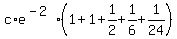 = 1. (1)
The sum in parentheses in the left side is = 1. (1)
The sum in parentheses in the left side is 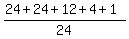 = =  ,
so, equation (1) takes the form ,
so, equation (1) takes the form
 = 1,
which gives
c = = 1,
which gives
c =  = = 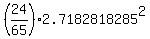 = 2.7283 (rounded).
ANSWER. c = 2.7283 (rounded). = 2.7283 (rounded).
ANSWER. c = 2.7283 (rounded).
Solved.
---------------------------
I do not recommend that a reader consider the post by @CPhill seriously.
It cannot serve as a source for learning the Math.
His computer code, which he uses in his exercises, is a very outdated version of Artificial Intelligence.
Contemporary versions of AI are several generations ahead.
In addition to operating with an outdated version, @CPhill himself NEVER reads what his computer code does produce,
or does not understand at all what it produces.
Otherwise, he would never disseminate that gibberish on the Internet.
This irresponsible way of using computer technology — without supervision,
verification, and understanding — is strictly prohibited in education.
What @CPhill is permanently doing on this forum is trying to promote himself using improper means.
| |
|
