The function that we are to start with,
The "beginning" finction:
y=(x-4)(x+1)(x-8)
has zeros
4, -1, 8
We put them in order smallest to largest
-1, 4, 8
The function that we are to transform it into,
the "final" function,
y=2(x-1)(x+4)(x-5),
has zeros 1, -4, and 5
We put them in order:
-4, 1, 5
We compare them:
beginning function's zeros: -1, 4, 8
final function's zeros: -4, 1, 5
We observe that
moving 3 units left from -1 gives -4
moving 3 units left from 4 gives 1
moving 3 units left from 8 gives 5
So shifting the beginning graph left by 3 units
takes care of moving the zeros of the beginning function
to the zeros of the final function.
Also we notice that the final function has a 2 factor,
which involves a stretch by a factor of 2.
So yes we can create the graph of
y=2(x-1)(x+4)(x-5)
by shifting the graph of
y=(x-4)(x+1)(x-8)
3 units left and stretching it by a
factor of 2.
To see it done, we start with the graph of the beginning
function
y=(x-4)(x+1)(x-8), which is the red graph below:
 We shift it left 3 units by replacing each x by x+3
y=(x-4)(x+1)(x-8)
y=(x+3-4)(x+3+1)(x+3-8)
Simplified,
the intermediate function's equation is:
y=(x-1)(x+4)(x-5)
This intermediate function is graphed below (in green). It is the
beginning graph (in red) shifted 3 units left.
We shift it left 3 units by replacing each x by x+3
y=(x-4)(x+1)(x-8)
y=(x+3-4)(x+3+1)(x+3-8)
Simplified,
the intermediate function's equation is:
y=(x-1)(x+4)(x-5)
This intermediate function is graphed below (in green). It is the
beginning graph (in red) shifted 3 units left.
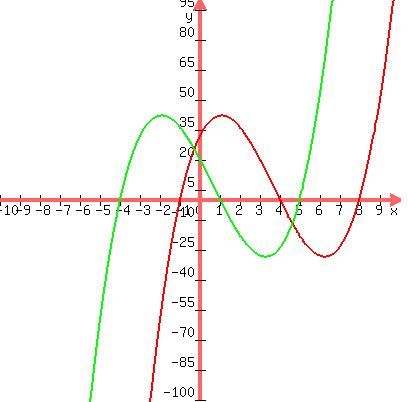 Now we only need to stretch the intermediate green graph vertically
by a factor of 2 to have the graph of the final function:
To stretch the intermediate green graph vertically by a factor of 2,
we multiply the right side by 2, and get this equation, which is
equivalent to the final function:
y = 2(x-1)(x+4)(x-5)
Think of it as if the graph were drawn on a rubber sheet and we
took hold of the top and bottom and stretched it double. The green
graph would become the blue graph below:
Now we only need to stretch the intermediate green graph vertically
by a factor of 2 to have the graph of the final function:
To stretch the intermediate green graph vertically by a factor of 2,
we multiply the right side by 2, and get this equation, which is
equivalent to the final function:
y = 2(x-1)(x+4)(x-5)
Think of it as if the graph were drawn on a rubber sheet and we
took hold of the top and bottom and stretched it double. The green
graph would become the blue graph below:
 .
Edwin
.
Edwin


