Question 1210701: https://ibb.co/Sw0HMdHf
What type of function?
Domain
Range
Odd, even, or neither
End behavior
Relative max and min
Zeros
Increasing/decreasing intervals
Point of inflection
Asymptotes
Found 4 solutions by Edwin McCravy, ikleyn, KMST, AnlytcPhil:
Answer by Edwin McCravy(20089)   (Show Source): (Show Source):
You can put this solution on YOUR website!  What type of function? CUBIC (degree 3, because it has two turning points),
(-3,8) and (2,-5). The degree is 1 more than the maximum number of turning
points.
Domain? (-∞,∞) -∞ on the left of (-∞,∞) because the points on the graph never
stop having negative x-values as you go farther and farther LEFT
on the x-axis.
+∞ on the right of (-∞,∞) because the points on the graph never
stop having positive x-values as you go farther and farther
RIGHT on the x-axis.
Range?-> (-∞,∞) -∞ on the left of (-∞,∞) because the points on the graph never
stop having negative y-values as you go farther and farther DOWN
on the y-axis.
+∞ on the right of (-∞,∞) because the points on the graph never
stop having positive y-values as you go farther and farther
UP on the y-axis.
Odd, even, or neither-> NOT ODD because it is not symmetrical with respect to
the ORIGIN
NOT EVEN because it is not symmetrical with the y-axis.
So it's NEITHER.
End behavior-> UP (INCREASING) on the far right and
DOWN (DECREASING) on the far left. (Obvious by looking)
Relative max and min-> Relative max at (-3,8) because it is a "peak", the
points right around it on both sides are lower.
Relative min at (2,-5) because it is a "valley", the
points right around it on both sides are higher.
Zeros-> The zeros are -6 and 4, because they are the where the y-coordinates
are zero because those points are (-6,0), (0,0) and (4,0). It is where
the graph crosses or touches the x-axis.
Increasing/decreasing intervals-> The graph is increasing (going up) from where
x is on the far left (goes to negative
infinity) going UP from -∞ to where x is -3,
at (-3,8).
This interval is written (-∞,-3).
The graph is also increasing (going up) from
where x is 2, at (2,-5), all the way to the
right where the x-values go to infinity.
This interval is written (2,∞).
So the graph is increasing on TWO intervals, (-∞,-3) and (2,∞).
Increasing/decreasing intervals-> The graph is decreasing (going down) in only
one place, from where x is -3 at (-3,8) down
to where x is 2 at (2,-5).
This interval is written (-3,2). Yes, this is
a glitch in mathematics. The interval (-3,2)
looks exactly like the point (-3,2). But we
have to live with this glitch in math by going
by context.
So the graph is increasing on TWO intervals, (-∞,-3) and (2,∞) and decreasing on
the ONE interval (-3,2).
Point of inflection -> In every part of a curving graph, that part of the graph
is either "bent to the left" or "bent to the right". If it is bent to the left,
it is tending to draw a cup shape opening downward. If it is bent to the right,
it is tending to draw a cup shape opening upward.
An inflection point is a point at which the curve changes from being bent one
way to being bent the other way. That is, at an inflection point, the curve
changes from tending to be drawing a cup shape opening upward to tending to be
drawing a cup shape opening downward, or vice-versa.
We can look at this graph and see that there is only one inflection point at the
origin (0,0). To the left of (0,0), the curve is bent to the left, and tending
to be drawing a cup shape opening downward, but on the right of (0,0), the curve
is bent to the right, and is tending to draw a cup opening upward.
Asymptotes-> There are no asymptotes because this graph never approaches a
straight line, whether horizontal, vertical, or oblique (slanted).
Edwin
What type of function?  CUBIC (degree 3, because it has two turning points),
(-3,8) and (2,-5). The degree is 1 more than the maximum number of turning
points.

Domain?  (-∞,∞) -∞ on the left of (-∞,∞) because the points on the graph never
                stop having negative x-values as you go farther and farther LEFT
                on the x-axis.
                +∞ on the right of (-∞,∞) because the points on the graph never
                stop having positive x-values as you go farther and farther
                RIGHT on the x-axis.

Range?-> (-∞,∞) -∞ on the left of (-∞,∞) because the points on the graph never
                stop having negative y-values as you go farther and farther DOWN
                on the y-axis.
                +∞ on the right of (-∞,∞) because the points on the graph never
                stop having positive y-values as you go farther and farther
                UP on the y-axis.

Odd, even, or neither->  NOT ODD because it is not symmetrical with respect to
                         the ORIGIN
                         NOT EVEN because it is not symmetrical with the y-axis.
                         So it's NEITHER.


End behavior->  UP (INCREASING) on the far right and
                DOWN (DECREASING) on the far left. (Obvious by looking)


Relative max and min->  Relative max at (-3,8) because it is a "peak", the
                        points right around it on both sides are lower.
                        Relative min at (2,-5) because it is a "valley", the
                        points right around it on both sides are higher.

Zeros-> The zeros are -6 and 4, because they are the where the y-coordinates
        are zero because those points are (-6,0), (0,0) and (4,0). It is where
        the graph crosses or touches the x-axis.


Increasing/decreasing intervals-> The graph is increasing (going up) from where
                                  x is on the far left (goes to negative
                                  infinity) going UP from -∞ to where x is -3,
                                  at (-3,8).
                                  This interval is written (-∞,-3).

                                  The graph is also increasing (going up) from
                                  where x is 2, at (2,-5), all the way to the
                                  right where the x-values go to infinity.
                                  This interval is written (2,∞).

So the graph is increasing on TWO intervals, (-∞,-3) and (2,∞).

Increasing/decreasing intervals-> The graph is decreasing (going down) in only
                                  one place, from where x is -3 at (-3,8) down
                                  to where x is 2 at (2,-5).
                                  This interval is written (-3,2). Yes, this is
                                  a glitch in mathematics. The interval (-3,2)
                                  looks exactly like the point (-3,2).  But we
                                  have to live with this glitch in math by going
                                  by context.
So the graph is increasing on TWO intervals, (-∞,-3) and (2,∞) and decreasing on
the ONE interval (-3,2).

Point of inflection -> In every part of a curving graph, that part of the graph
is either "bent to the left" or "bent to the right". If it is bent to the left,
it is tending to draw a cup shape opening downward. If it is bent to the right,
it is tending to draw a cup shape opening upward.

An inflection point is a point at which the curve changes from being bent one
way to being bent the other way. That is, at an inflection point, the curve
changes from tending to be drawing a cup shape opening upward to tending to be
drawing a cup shape opening downward, or vice-versa.
We can look at this graph and see that there is only one inflection point at the
origin (0,0). To the left of (0,0), the curve is bent to the left, and tending
to be drawing a cup shape opening downward, but on the right of (0,0), the curve
is bent to the right, and is tending to draw a cup opening upward.

Asymptotes-> There are no asymptotes because this graph never approaches a
straight line, whether horizontal, vertical, or oblique (slanted).

Edwin
Answer by ikleyn(54018)  (Show Source): (Show Source):
You can put this solution on YOUR website! .
I took the trouble to find the polynomial of degree 3 with real coefficients
(following Edwin's suggestion) that passes through the points (-6,0), (4,0), (-3,8), and (2,-5).
This polynomial is f(x) =  .
I did it in two ways:
- first, I created a system of 4 linear equations for the coefficients of the polynomial
using 4 given points, and then solved this system using the online solver www.reshish.com/
- second, I asked the Artificial intelligence to find such a polynomial, and the AI produced
precisely the same polynomial.
So, I have no doubt that this polynomial is correct.
Below is the plot of this polynomial function .
I did it in two ways:
- first, I created a system of 4 linear equations for the coefficients of the polynomial
using 4 given points, and then solved this system using the online solver www.reshish.com/
- second, I asked the Artificial intelligence to find such a polynomial, and the AI produced
precisely the same polynomial.
So, I have no doubt that this polynomial is correct.
Below is the plot of this polynomial function
 Plot f(x) = .
Points (-3,8) and (2,-5) are also shown in the plot.
But you can see with your eye that point (-3,8) is not the local maximum of the polynomial.
I asked Artificial Intelligence to find the local maximum, and the AI produced the point
(-3.65,8.47) as the local maximum (rounded coordinates).
Point (2,-5) also is not the local minimum.
Again, I asked Artificial Intelligence to find the local minimum, and the AI produced the point
(2.15,-5.03) as the local minimum (rounded coordinates).
Plot f(x) = .
Points (-3,8) and (2,-5) are also shown in the plot.
But you can see with your eye that point (-3,8) is not the local maximum of the polynomial.
I asked Artificial Intelligence to find the local maximum, and the AI produced the point
(-3.65,8.47) as the local maximum (rounded coordinates).
Point (2,-5) also is not the local minimum.
Again, I asked Artificial Intelligence to find the local minimum, and the AI produced the point
(2.15,-5.03) as the local minimum (rounded coordinates).
So, the given post is incorrect, inaccurate, and inconsistent: it incorrectly presents the local maximum and local minimum points.
I did this job to alarm / (to warn) a reader not to trust the original plot in this post.
With the polynomial formula, we can find the point of inflection.
It is the point where the second derivative is zero and changes sign.
The second derivative of the polynomial is
f''(x) = 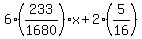 = =  .
An equation for the inflection point is
f''(x) = 0, or .
An equation for the inflection point is
f''(x) = 0, or  = 0.
It gives = 0.
It gives  = =  = =  = =  = =  = -0.751 (rounded). = -0.751 (rounded).
In his post, tutor Edwin gives the inflection point as (0,0).
But this point, (0,0), does not lie on the plot at all, so Edwin's statement is incorrect.
////////////////////////////
Dear tutor @KMST,
I'd like to make my comment regarding this statement in your post
"The points marked as presumable zeros of the function are (-6,0), (0,0), and (4,0)."
In the original post, point (0,0) is not marked as a zero of the function.
Edwin marked it this way in his post, but in the original post, it WAS NOT marked as a zero.
Overall, the post is clearly written unprofessionally.
Indeed, it asks about the inflection point, but this requires precise and consistent information
about the function in order to restore its analytical formula.
A professional writer or a responsible person who wants to get the solution
to a problem from a textbook would write the post differently.
No peer-edited textbook would ever present a problem in this form.
But then - how did this post come to be?
I have no other explanation, as the person who posted it is an unprofessional Math writer
and either copied the problem from a bad source without proper understanding,
or is irresponsible and compiles his post himself without understanding
what a Math problem should be, in general.
That is what I tried to explain in my post (in a very soft form).
In any case, such posts should be stopped for correction, for cleaning
and/or to educate such "writers", and this is what I do on this forum every day.
And as a conclusion: I think that when posts like this meet with such criticism,
their authors should be happy to have such a reviewer.
Answer by KMST(5434)  (Show Source): (Show Source):
You can put this solution on YOUR website! This is one of 3 problems from some author (probably a teacher) who draw implausible curves
to be able to have integer coordinates for the zeros and relative extremes of the function,
and believes you could determine points of inflection from such a curve.
You cannot determine a point of inflection from the drawing,
and it is not possible to find a polynomial function that would have
the zeros and relative maximum and minimum as shown in the drawing.
The points marked as presumable zeros of the function are (-6,0), (0,0), and (4,0).
The graph shows a relative maximum between (-6,0) and (0,0), labeled as (-3,8),
and a relative minimum between (0,0) and (4,0), labeled as (2,-5).
The information above, and the end behavior of the function for x<-6 and x>4
suggests a cubic polynomial of the form  with A>0. with A>0.
However, that polynomial's relative extremes would not happen than at x=-3 and x=2.
They would happen at approximately x=-3.57 and approximately x=2.24.
The inflection point would be at x=-2/3.
The value of A would scale up of down the value of f(x),
but it would do it to the same degree for all values of x,
so the relative maximum and minimum could never be  and and  . .
This is the graph of  . .
It has a maximum at approximately (-3,57,8.21) and (2.24,-4.06)
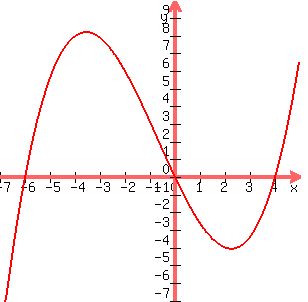
We could write a polynomial function with a maximum at x=-3, and a minimum at x=2,
but it would not go through all the labeled points either.
We could fit a polynomial through the points labeled, but (-3,8) and (2,-5) would not be relative extremes.
Answer by AnlytcPhil(1814)  (Show Source): (Show Source):
You can put this solution on YOUR website!
On this problem you tutors should have gone to the site https://ibb.co/Sw0HMdHf
which the student posted.  The graph I posted was only a similar graph to the
graph on the site the student gave: https://ibb.co/Sw0HMdHf

This was a "LOOK AND SEE" problem, not a calculating problem to find an equation
for, nor a calculus problem to find first derivatives to find relative extrema,
or second derivatives to find inflection points.

It was a problem for the student to look at a graph, not the approximate graph
that I drew. But a problem to answer looking only at the graph on the site:
https://ibb.co/Sw0HMdHf

There is no possible cubic equation with x-intercepts (-4,0), (0,0), and (4,0),
relative maximum (-3,8), and relative minimum (2,-5). However, that was not a
error! The problem was created to PRETEND it was a graph with those properties,
even though you and I know there is no such cubic equation.  But the student at
this point in their studies does not need to know that, nor needs to even be
told that.

The graph I drew OF COURSE did not have those properties.  It was only CLOSE TO
having those properties so I would have something close to it to talk about how
to LOOK AND SEE and answer the LOOK-AND-SEE questions. It DOES NOT and CANNOT
have all those properties.  But, again, the student does not need to know that
or to even be told that. This is only a LOOK-AND-SEE problem.

All the student was supposed to do was to look at the given graph, and PRETEND
it is a legitimate graph of a cubic function, which is isn't, but the way it is
drawn on the site https://ibb.co/Sw0HMdHf it DOES LOOK LIKE it has those
properties, even though you and I know it cannot.

The student was expected ONLY to look at the given graph, and answer the given
questions about it as if the graph were a legitimate cubic graph. The student
does not need to know that there is no such graph. You and I know that and so
does their teacher and the creator of the problem.

This same student posted another LOOK-AND-SEE problem which nobody but me
answered, it was problem number 1210700.  I just referred them to this problem.
If you like, go there and give a complete answer to that LOOK-AND-SEE problem.

This is the link to it:
https://www.algebra.com/algebra/homework/Polynomials-and-rational-expressions/Polynomials-and-rational-expressions.faq.question.1210700.html#google_vignette

It was also a graph of a would-be polynomial with minimum degree of 6 for it has
5 turning points.  That graph is at https://ibb.co/6cj179SG
If you will go there and look, you will find another impossible graph, but one
in which the student is to PRETEND is legitimate anyway.  There is no 6th
degree polynomial with all these properties:

x-intercepts (-9,0), (-5,0), (0,0), (3,0), (6,0)
relative minimums: (-7,-10), (5,-7)
relative maximums: (-3,2), (2,1)

But the graph at https://ibb.co/6cj179SG is drawn to have those properties
anyway.

Apparently the teacher expected the student to guess the inflection points as
a point between a relative maximum and a relative minimum.

If a student posts a link to the graph he or she is referring to, always go to
that site they gives a link to. You cannot know what they are asking without
going to the site they post a link to.

Notice that it is distracting to the student to even mention that a teacher used
a phony graph. It is best that the student never be told that.  When they have
learned enough about graphs, they will know all they will need to know to
determine that there is no such polynomial that has such a graph.  Let's not
confuse them with stuff they don't need to know yet, OK?

Edwin
| |
|
