|
Question 228010: $15000 is deposited every year in an account yeilding 6% interest compounded annually, how much money will have been saved after 10 years?
Found 3 solutions by rfer, JWG, ikleyn:
Answer by rfer(16322)   (Show Source): (Show Source):
Answer by JWG(21) (Show Source): (Show Source):
You can put this solution on YOUR website! This is a complicated problem that I had to do across 10 rows in Excel. Answer came out to be 209,574.64.
Problem with the answer before mine is that the compound interest formula was used while only having one initial deposit of $15,000. However, we start with $15,000, compound that 6% for one year, deposit $15,000 more after the first year and then continue the deposits and compounding for a total of 10 years. Obviously it will be more than $150,000 since the return+investment will be greater than the investment. I wish real world investing worked like that. ;)
Answer by ikleyn(54017)  (Show Source): (Show Source):
You can put this solution on YOUR website! .
$15000 is deposited every year in an account yeilding 6% interest compounded annually,
how much money will have been saved after 10 years?
~~~~~~~~~~~~~~~~~~~~~~~~~~~~~~~~~
This my post is written as a reaction to two previous posts by @rfer and @JWG,
that do not solve the problem or solve it incorrectly.
This problem is a standard typical problem on ordinary annuity, of the beginner level.
Use the standard formula for the Future value of the ordinary annuity
FV =  , (1)
where FV is the future value of the account; P is the annual payment (deposit);
r is the annual compounding percentage rate presented as a decimal;
n is the number of deposits (= the number of years, in this case).
Under the given conditions, P = 15000; r = 0.06; n = 10. So, according to the formula (1),
you get at the end of the 10-th year
FV = , (1)
where FV is the future value of the account; P is the annual payment (deposit);
r is the annual compounding percentage rate presented as a decimal;
n is the number of deposits (= the number of years, in this case).
Under the given conditions, P = 15000; r = 0.06; n = 10. So, according to the formula (1),
you get at the end of the 10-th year
FV = 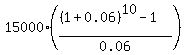 = $197,711.92. ANSWER
Note that you deposit only 10*$15000 = $150,000. The rest is what the account earns/accumulates in 10 years. = $197,711.92. ANSWER
Note that you deposit only 10*$15000 = $150,000. The rest is what the account earns/accumulates in 10 years.
Solved completely.
| |
|
| |
