|
Question 1210703: Single persons pay income tax on their annual earnings using the following tax rates:
On the first €8500, no tax is paid.
On the next €6000, tax is paid at the rate of 15%.
On the next €5000, tax is paid at the rate of 25%.
On the next €40 500, tax is paid at the rate of 29%.
Over €60 000, tax is paid at the rate of 35%.
Jean gets €24 700 gross annual pay and he has no other income.
(i) Work out his annual tax.
(ii) Jean also needs to pay 10% national insurance on his gross salary.
Work out Jean’s weekly national insurance contribution.
(iii) The weekly net salary is the amount that remains after income tax and national insurance
are deducted from the gross weekly salary.
Find Jean’s weekly net salary.
Answer by KMST(5434)   (Show Source): (Show Source):
You can put this solution on YOUR website! Percentages are ratios, or rational numbers, or fractions, that can also be expressed as decimals.
For example
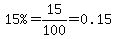 , so it is easy to calculate 15% of any quantity by multiplying the quantity times the decimal 0.15. , so it is easy to calculate 15% of any quantity by multiplying the quantity times the decimal 0.15.
in fact, the  key in my calculator turns key in my calculator turns   into into  . .
(i) Jean's annual tax:
Jean owes no tax for the first €8500 Jean earns.
After earning the first €8500,
Jean starts owing 15% tax on the next €6000 Jean earns up to €8500+€6000=€14 500
After earning the first €14 500,
Jean starts owing 25% tax for the next €5000 earned up to €14 500+€5000=€19 500.
After earning the first €19 500,
Jean starts owing 29% tax for any additional income up to €19 500+€40 500=€60 000, so Jean will owe 29% tax for the last €24 700-€19 500=€5200 Jean earns in a year.
Jean's total tax for the year, in € will be
   
As €60 000 is more than Jean's salary, the 35% tax rate does not apply.
(ii) Jean also needs to pay 10% national insurance on his gross salary.
Work out Jean’s weekly national insurance contribution.
The 10% national insurance on Jean's gross salary would be
€ € € annually. annually.
That translates into € daily and € daily and € € €  weekly. weekly.
(iii) The weekly net salary is the amount that remains after income tax and national insurance are deducted from the gross weekly salary.
Find Jean’s weekly net salary.
Jean’s gross weekly salary:
With weekly checks, Jean would be entitled to  paychecks in a year, with each paycheck having the same gross amount. paychecks in a year, with each paycheck having the same gross amount.
Jean would actually get 52 paychecks most years, and 53 paychecks some years.
Jean's gross weekly salary of €24 700, translates into €24 700/365 daily and
€ € € weekly. weekly.
The total tax for the year, calculated at year star assuming that during the whole year Jean's salary will not change, would get deducted in equal portions from each paycheck.
With weekly checks, the €7350.29 total income tax for the year would translate into
€7350.29/365 daily and € € € weekly weekly
From the figures calculated (and highlighted) above for Jean's gross weekly salary and weekly income tax deduction,
and the figure calculated in part (ii) for Jean's weekly national insurance contribution,
we can calculate Jean's weekly net salary as
€473.70-€47.37-€140.96=€
| |
|
| |
