Tutors Answer Your Questions about Linear-equations (FREE)
Question 1106092: Paul can do a certain job in half the time that Jim requires to do it. Jim orked alone for an hour and stopped, then Paul complete d the job in 10 hours. What length of time, in hours, woul d Paul, working alone, take to do the whole job?
Answer by ikleyn(53751)   (Show Source): (Show Source):
You can put this solution on YOUR website! .
Paul can do a certain job in half the time that Jim requires to do it.
Jim worked alone for an hour and stopped; then Paul completed the job in 10 hours.
What length of time, in hours, would Paul, working alone, take to do the whole job?
~~~~~~~~~~~~~~~~~~~~~~~~~~~~~~~
Let 'a' be the Jim's rate of work, i.e. part of work, which Jim makes in 1 hour.

Then the Paul's rate of work is 2a, according to the problem.


Jim worked alone for an hour and stopped; then Paul completed the job in 10 hours.


It means that

    a + 10*(2a) = 1,    where '1' represents the whole job.


From this equation, we find

    a + 20a = 1  --->  21a = 1  --->  a = 1/21.


It means that Jim makes 1/21 of the Job per hour.
In other words, Jim needs 21 hours to make the whole job alone.

Hence, according to the problem, Paul needs half of 21 hours to make the whole job alone.

In other words, Paul needs 21/2 = 10.5 hours to make the whole job alone.    ANSWER
Question 1155051: What is the slope of a line perpendicular to the line whose equation is 12x-9y=135 fully reduce your answer
Answer by ikleyn(53751) (Show Source):
Question 1155610: Given the points ( 4, -3) and ( 2, 2) answer the following.
a. Find the slope of the line, L1, that goes through the points ( 4, -3) and ( 2, 2).
b. Write the equation of the line, L1. Write in slope intercept form.
c. Find the slope of the line, L2, that is perpendicular to L1.
d. Write the equation of the line, L2, that goes through the point ( -3, 5 ).
Answer by ikleyn(53751) (Show Source):
You can put this solution on YOUR website! .
Given the points ( 4, -3) and ( 2, 2) answer the following.
a. Find the slope of the line, L1, that goes through the points ( 4, -3) and ( 2, 2).
b. Write the equation of the line, L1. Write in slope intercept form.
c. Find the slope of the line, L2, that is perpendicular to L1.
d. Write the equation of the line, L2, that goes through the point ( -3, 5 ).
~~~~~~~~~~~~~~~~~~~~~~~~~~~~~~~~
Calculations in the post by @mananth are incorrect due to arithmetic error.
I came to bring a correct solution.
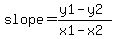
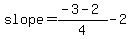

The slope of line perpendicular to L1 = 2/5 ( negative reciprocal)
slope = 2/5
(-3,5)
Equation in slope-point form
y-y1 = m(x-x1)
y-5 = (2/5(x-(-3))
y-5 = (2/5) (x+3)
5(y-5) = 2(x+3)
5y-25 = 2x+6
5y = 2x + 6 +25
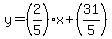
5y= 2x + 31
Question 1176815: A motorboat travels 165 kilometers in 3 hours going upstream. It travels 207 kilometers going downstream in the same amount of time. What is the rate of the boat in still water and what is the rate of the current?
Found 2 solutions by n2, ikleyn:
Answer by n2(79) (Show Source): (Show Source):
You can put this solution on YOUR website! .
A motorboat travels 165 kilometers in 3 hours going upstream.
It travels 207 kilometers going downstream in the same amount of time.
What is the rate of the boat in still water and what is the rate of the current.
~~~~~~~~~~~~~~~~~~~~~~~~~~~~~~
Let u be the rate of the boat in still water (in kilometers per hour), and
let v be the rate of the current.
Then the effective rate of the boat downstream is (u+v) km/h,
while its effective rate upstream is (u-v) km/h.
From the given data in the problem, we can calculate the effective rate downstream as
u + v =  = 69 km/h
and the effective rate upstream as
u - v = = 69 km/h
and the effective rate upstream as
u - v =  = 55 km/h.
So, we have two equations
u + v = 69, (1)
u - v = 55. (2)
Find 'u' using the elimination method. For it, add equations (1) and (2).
The terms 'v' and '-v' will cancel each other, and you will get
2u = 69 + 55 = 124 ---> u = 124/2 = 62 km/h.
Now from equation (1) find
v = 69 - 62 = 7 km/h.
At this point, the problem is solved completely.
ANSWER. The rate of the boat in still water is 62 km/h, and the rate of the current is 7 km/h. = 55 km/h.
So, we have two equations
u + v = 69, (1)
u - v = 55. (2)
Find 'u' using the elimination method. For it, add equations (1) and (2).
The terms 'v' and '-v' will cancel each other, and you will get
2u = 69 + 55 = 124 ---> u = 124/2 = 62 km/h.
Now from equation (1) find
v = 69 - 62 = 7 km/h.
At this point, the problem is solved completely.
ANSWER. The rate of the boat in still water is 62 km/h, and the rate of the current is 7 km/h.
Solved in full by a standard algebra way with complete explanations.
Answer by ikleyn(53751) (Show Source):
You can put this solution on YOUR website! .
A motorboat travels 165 kilometers in 3 hours going upstream.
It travels 207 kilometers going downstream in the same amount of time.
What is the rate of the boat in still water and what is the rate of the current.
~~~~~~~~~~~~~~~~~~~~~~~~~~~~~~
The way how @mananth solves this problem (and many other similar problems) reminds me
of dancing around a bonfire with a tambourine, but not solving a mathematical problem.
It is impossible to teach students, giving them such a template as in the post by @mananth.
Therefore, below I give a normal mathematical solution for this problem..
Let u be the rate of the boat in still water (in kilometers per hour), and
let v be the rate of the current.


Then the effective rate of the boat downstream is (u+v) km/h,
while its effective rate upstream is (u-v) km/h.


From the given data in the problem, we can calculate the effective rate downstream as

    u + v =  = 69 km/h


and the effective rate upstream as

    u - v =  = 55 km/h.


So, we have two equations

    u + v = 69,    (1)

    u - v = 55.    (2)


Find 'u' using the elimination method.  For it, add equations (1) and (2).

The terms 'v' and '-v' will cancel each other, and you will get

    2u = 69 + 55 = 124  --->  u = 124/2 = 62  km/h.


Now from equation (1) find

    v = 69 - 62 = 7 km/h.


At this point, the problem is solved completely.


ANSWER.  The rate of the boat in still water is 62 km/h,  and the rate of the current is 7 km/h.
Solved in full by a standard algebra way with complete explanations.
Ignore the post by @mananth and never ever look in such explanations as in his post.
His post is produced by a computer code, but the code is written in a bad anti-pedagogical way.
Question 1161742: please can help me
thanks
“A frigid Florida winter is taking its toll on your sandwich. The sunshine state is the main U.S. source for fresh winter tomatoes, and its growers lost some 70 percent of their crop during January’s prolonged cold weather. The average wholesale price for a 25-pound box of tomatoes is now $30, up from $6.50 a year ago. Florida’s growers would normally ship about 25 million pounds of tomatoes a week; right now, they are shipping less than a quarter (8million). High demand has driven up prices and wholesalers are buying from Mexico. Based on that, some restaurants provided tomatoes only on request.”
a. Using the information above find the demand and supply curves in the market for winter tomatoes.
b. Calculate the price elasticity of demand for winter tomatoes as well as elasticity of supply using the midpoint method.
Answer by ikleyn(53751) (Show Source):
You can put this solution on YOUR website! .
A frigid Florida winter is taking its toll on your sandwich. The sunshine state is the main U.S. source for fresh winter
tomatoes, and its growers lost some 70 percent of their crop during January’s prolonged cold weather. The average wholesale
price for a 25-pound box of tomatoes is now $30, up from $6.50 a year ago. Florida’s growers would normally ship about 25
million pounds of tomatoes a week; right now, they are shipping less than a quarter (8million). High demand has driven up
prices and wholesalers are buying from Mexico. Based on that, some restaurants provided tomatoes only on request.”
a. Using the information above find the demand and supply curves in the market for winter tomatoes.
b. Calculate the price elasticity of demand for winter tomatoes as well as elasticity of supply using the midpoint method.
~~~~~~~~~~~~~~~~~~~~~~~~~~~~~~~~~~
As I read this text, I become smiling.
Indeed, they write "8 millions pounds is less than a quarter of 25 millions pounds . . . ".
Millions blinded them. 8 millions pounds is not a quarter of 25 millions pounds:
8 millions pounds is about one third of 25 millions pounds.
So, these writers even are not able to call fractions correctly in their composition, using their proper names.
It tells me that I should not trust their words: I only can smile reading it.
Thus, I can not trust their words - I will use their numbers, instead.
Regarding for the numbers, I see the change in price from $6.50 to $30 and the change in quantity
from 25 millions pounds a week to 8 millions pounds a week.
So, I write the interpolation formula for the price 'p' of a 25-pound box as a function of the mass
of shipped production 'm'
P - 6.5 = 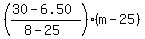 = -1.382*(m-25),
or
P(m) = 6.5 - 1.382*(m-25) dollars for 25-pound box,
where m is the mass in million pounds of tomatoes shipped in a week.
This is the price function.
The demand function is the inverse function
m = = -1.382*(m-25),
or
P(m) = 6.5 - 1.382*(m-25) dollars for 25-pound box,
where m is the mass in million pounds of tomatoes shipped in a week.
This is the price function.
The demand function is the inverse function
m =  + 25 = -0.723(P-6.5) + 25 million pounds of tomatoes shipped a week
for the price 'P' dollars of the 25-pound box. + 25 = -0.723(P-6.5) + 25 million pounds of tomatoes shipped a week
for the price 'P' dollars of the 25-pound box.
So, I answered question (a).
When you solve such problems and use an interpolation formula, you should be
very accurate and place right numbers in proper places.
Question 1210547: Solve This Graphically 3x+y=2
Found 2 solutions by ikleyn, josgarithmetic:
Answer by ikleyn(53751) (Show Source):
You can put this solution on YOUR website! .
" Solve This Graphically 3x+y=2 " is mathematically ILLITERATE way to formulate this assignment.
A true Math way is to say " make a plot of this straight line ",
or to say "Express 'y' and make a plot of 'y' as a function of 'x' ".
By the way, for making plots, there is a beautiful web-site
www.desmos.com/calculator
It has free of charge plotting tool for common use.
So, go there, print your function/equation, and you will get the plot in the next instance.
We live in the 21-th century, so it is useful to know the available technology.
Answer by josgarithmetic(39792) (Show Source):
Question 1182886: WRITE THE EQUATION OF THE LINE PARALLEL TO 4X-5Y-10=0 THAT PASSES THROUGH (0,-3).
Found 3 solutions by n2, CPhill, ikleyn:
Answer by n2(79) (Show Source):
You can put this solution on YOUR website! .
WRITE THE EQUATION OF THE LINE PARALLEL TO 4X-5Y-10=0 THAT PASSES THROUGH (0,-3).
~~~~~~~~~~~~~~~~~~~~~~~~
Yesterday (Jan.19, 2026) I witnessed strange behavior from @CPhill on this forum.
A couple of days ago I refuted an incorrect solution provided by @mananth at this spot.
@mananth's solution was incorrect due to elementary arithmetic errors that he made on the way.
OK, let's check the @CPhill (=the @mananth) answer y = -4x + 6.00.
For it, substitute the coordinates of the point (0,-3) into this equation.
Then the left side is y=-3, while the right side is -4*0+6 = 6.
So, the equation is not satisfied; hence, the point (0,-3) does not belong to the line.
Thus, the @mananth's solution had nothing in common with the correct solution -
which is why I redid/corrected/fixed it.
Now @CPhill has copied and reposted this incorrect solution by @mananth again.
This is not the only such action by @CPhill.
Yesterday, @CPhill made several (about 15) other similar actions of the same kind with other posts
where I refuted @mananth's solutions.
I consider these @CPhyll's actions to be wrong, leading to a distortion of the truth on this forum.
Therefore, I strongly protest against such actions by @CPhill and consider it necessary that visitors
to this forum be aware of this.
I recommend to a reader to ignore the post by @CPhill.
Answer by CPhill(2189)  (Show Source): (Show Source):
You can put this solution on YOUR website! 4 x + -5 y = 10
Find the slope of this line
make y the subject
-5 y = -4 x + 6
Divide by 1
y = -4 x + 6
Compare this equation with y=mx+b
slope m = -4
The slope of a line parallel to the above line will be the same
The slope of the required line will be -4
m= -4 ,point ( -2 , 2 )
Find b by plugging the values of m & the point in
y=mx+b
2 = -4.00 + b
b= 6.00
m= -4
Plug value of the slope and b in y = mx +b
The required equation is y = -4 x + 6.00
Answer by ikleyn(53751) (Show Source):
You can put this solution on YOUR website! .
WRITE  AN EQUATION OF THE LINE PARALLEL TO 4X-5Y-10=0 THAT PASSES THROUGH (0,-3). AN EQUATION OF THE LINE PARALLEL TO 4X-5Y-10=0 THAT PASSES THROUGH (0,-3).
~~~~~~~~~~~~~~~~~~~~~~~~~~~~
The solution in the post by @mananth is TOTALLY and FATALLY wrong.
His errors starts from the point where @mananth incorrectly determined the slope.
I came to bring a correct solution.
Any line parallel to the line 4x - 5y - 10 = 0  has an equation

    4x - 5y = c,


with the same form ax + by as the original line has, and some constant 'c' in the right side.


To find 'c', substitute coordinates of the given point into equation (1).  You will get

    c = 4*0 -5*(-3) = 0 + 15 = 15.


So, the sought equation is

    4x - 5y = 15.    ANSWER
Solved.
------------------------
Regarding this post by @mananth (and many other similar his posts), I see that this person
even does not read what he posts to the forum and does not check it.
It is simply not interesting to him, what he produces - true or false.
I know (I just deciphered it about a month ago) that @mananth is, actually, a computer code,
aka an early version of Artificial Intelligence.
It is very dangerous to trust to such a code (and to such a person) creating files/"solutions"
for teaching students, because it is not interesting to him (both to the code and to the person)
what really he creates and what really he submits to the Internet.
The only thing which is interesting to him is to occupy a space / (a territory).
Question 1164762: If a stock price goes from $10 to $12 from January 1st to January 31, from $12 to $9 from February 1st to February 28th, and from $9 to $15 from March 1st to March 31th is the price change from $10 to $15 a straight line?
It is clear that in each of the three time intervals mentioned there was a complex daily variation of prices as in an electrocardiogram. But what would be a simplified solution for a first naive view of the situation? Would a simple function hold up? What is the simplest function to represent this situation? Does your naïve initial and simplified model allow you to predict the behavior of the stock in the next month?
How can I use three “pieces” of lines to describe the price movements from the beginning of January to the end of March? Show the graph for the price movement.
Answer by CPhill(2189) (Show Source):
You can put this solution on YOUR website! To answer your question directly: **No, the price change from $10 to $15 is not a straight line.** While the net result is an increase of $5, the path taken involves significant fluctuations that a single straight line cannot capture.
Here is a breakdown of the situation from a "naive" perspective to a more structured mathematical model.
---
### 1. The Naive View: A Simple Function?
If you took a "first naive view," you might simply look at the start and end points: **(Jan 1st, $10)** and **(March 31st, $15)**.
* **Would a simple function hold up?** A simple linear function () would connect these two points, suggesting a steady growth of roughly $1.67 per month.
* **The Flaw:** This model fails because it completely ignores the fact that in February, the stock price actually **dropped** below its starting value. It masks the volatility (risk) of the investment.
* **Predictive Power:** This naive model has **zero predictive power** for the next month. Stock prices are "stochastic" (random), and a simple line assumes a trend that doesn't account for market shocks or changes in direction.
---
### 2. The Simplest Multi-Point Model: Piecewise Linear
To represent this more accurately while still keeping it simple, we use a **Piecewise Linear Function**. This is the simplest way to show the "simplified" movement without losing the critical turns in February and March.
By treating time as the independent variable () and price as the dependent variable (), we can define three segments:
| Interval | Start Price | End Price | Trend |
| --- | --- | --- | --- |
| **January** (Month 1) | $10 | $12 | Upward (+2) |
| **February** (Month 2) | $12 | $9 | Downward (-3) |
| **March** (Month 3) | $9 | $15 | Upward (+6) |
#### The Mathematical Function
The function (Price over time in months) would look like this:
---
### 3. The Visual Representation
When you graph these three "pieces," you get a zigzag shape. This is often called a "price chart" in finance, which simplifies daily "noise" into monthly trends.
#### Why this is useful:
* **Volatility:** You can see the "sharpness" of the angles. The March segment is steeper than the January segment, indicating a faster recovery.
* **Support/Resistance:** It shows that the price fell below the initial January level ($9 vs $10) before the final surge.
### 4. Can this predict April?
Mathematically, no. In finance, this is known as the **Random Walk Hypothesis**. Just because the line went "up, down, up" doesn't mean it must go "down" next.
However, technical analysts look at these "pieces" to find **momentum**. Since the March growth (-3$), a momentum trader might guess the trend is now bullish, whereas a mean-reversion trader might guess it's overextended and will drop.
Would you like me to show you how to calculate the **Total Percent Return** versus the **Annualized Return** for this three-month period?
Question 1204563: Write an equation of the line that passes through the pair of points.
(−2, −3), (4, 5)
Answer by ikleyn(53751) (Show Source):
You can put this solution on YOUR website! .
Hello a reader,
Be informed and keep in your mind that the picture in the post by @mananth does not correspond
to the equation derived by @mananth and contradicts to it !
Indeed, this line in the plot does not pass through the given points !
The true line, which corresponds to the derived equation, must go "from left lower part of the screen to right upper part".
Question 455145: find the slope of a line perpendicular to the line that passes through 3 9 and 7 15
Answer by ikleyn(53751) (Show Source):
Question 453353: what is the slope-intercept of 2x-7y=-24 passing through (9,11)
Answer by ikleyn(53751) (Show Source):
You can put this solution on YOUR website! .
what is the slope-intercept of 2x-7y=-24 passing through (9,11)
~~~~~~~~~~~~~~~~~~~~~~~~~~~~~
In his post, @mananth gives the answers: the slope is 0.29, x-intercept is 8.43.
Both his answers are incorrect. His solution is incorrect, too.
I came to bring a correct solution to this problem.
We want to find the slope-intercept equation for the line parallel 2x-7y = -24 and passing through (9,11).
In standard form, this line have the same left side
2x - 7y = c (1)
and some constant 'c' in the right side.
To find the value of 'c', substitute the coordinates (x,y) = (9,11) into equation (1). You will get
c = 2*9-7*11 = -59.
So, equation (1) takes the form
2x - 7y = -59. (2)
To get the "slope-intercept form", express 'y' from equation (2).
It is
y =  + +  .
Thus the slope of the sought line is .
Thus the slope of the sought line is  and its x-intercept is .
@mananth produced approximate decimals with only 2 correct decimals after the decimal dot -
- but the problem asks about PRECISE values, not about their approximate values.
It is why the solution by @mananth fails and is incorrect. and its x-intercept is .
@mananth produced approximate decimals with only 2 correct decimals after the decimal dot -
- but the problem asks about PRECISE values, not about their approximate values.
It is why the solution by @mananth fails and is incorrect.
Solved correctly.
Question 448805: graph the line that goes through point (3,8) and is parallel to the line whose equation is 6y-10x=30
Answer by ikleyn(53751) (Show Source):
You can put this solution on YOUR website! .
Graph the line that goes through point (3,8) and is parallel to the line whose equation is 6y-10x=30
~~~~~~~~~~~~~~~~~~~~~~~~~~~
The solution in the post by @mananth is incorrect.
His final equation y = 1.67x + 3 is incorrect.
The point (3,8) does not lie on this line.
Indeed, the left side 'y' at this point is 1.67*3 + 3 = 8.01, but not 8, as it should be.
See my correct solution below.
An equation for the line parallel to 6y - 10x = 30 is

    6y - 10x = c,

where 'c' is some constant.


We find 'c' by substituting the coordinates x= 3, y= 8 into this equation

    c = 6*8 - 10*s = 18.


Thus an equation is 6y - 10x = 18.


In the slope-intercept form it is y =  + 3, which is different from the equation found by @mananth. + 3, which is different from the equation found by @mananth.
Solved correctly.
Simply IGNORE the post by @mananth, since his solution is wrong.
----------------------------
Not only this particular problem is solved incorrectly by @mananth.
Many other similar problems were solved incorrectly by @mananth.
Incorrectly solved are ALL similar problem, where coefficients of linear equations
are / (should be) rational numbers, which can not be presented as finite decimal fractions.
Then @mananth, by applying his incorrect algorithm of rounding, makes everything wrong.
Rounding in such situations IS NOT ALLOWED.
Question 448767: Write an equation of the line containing the given point and parallel to the given line. Express your answer in the form y=mx+b.
(8,9); x+7y=2
y=
Answer by ikleyn(53751) (Show Source):
Question 447764: Given the linear equation y=-7/4x-1, find the y-coordinates of the points (-4, ), (0 ), and (4, ). Please show all of your work. Plot those points and graph the linear equation.
Found 2 solutions by josgarithmetic, ikleyn:
Answer by josgarithmetic(39792) (Show Source):
You can put this solution on YOUR website! Substitute each x value and evaluate corresponding y value.
x             y=-(7/4)x-1
---------------------------------------
 -4             -(7/4)*4-1
  0             -(7/4)*0-1
  4             -(7/4)*4-1
But in fact you can read the slope and the y intercept from the equation for
graphing the function.
You finish!
Answer by ikleyn(53751) (Show Source):
You can put this solution on YOUR website! .
To the composer of this problem
Along all your composition (I mean this problem) you mistakenly call the object as "the linear equation".
For your information: in this context, it is not a linear equation. It is a linear function.
The correct name for this object in the given context is "a linear function", not "a linear equation".
Question 448477: Find the slope of the line that contains the points 9,8 and -2,1
Answer by ikleyn(53751) (Show Source):
Question 444813: I need to find the equation of the line containg (-2, -7) and (-5, -8)
Answer by ikleyn(53751) (Show Source):
You can put this solution on YOUR website! .
I need to find the equation of the line containing (-2, -7) and (-5, -8)
~~~~~~~~~~~~~~~~~~~~~~~~~
This problem requires an exact solution in the form of an equation expressed in rational numbers.
But @mananth in his post works with decimal numbers with two decimals after the decimal point.
It does not produces an exact equation in precise form.
So, what he presents as a solution, is not a solution in precise strict meaning
and can not be accepted as a solution to the problem.
Below I develop EXACT equation in the form as it SHOULD be done.
Calculate the slope m =  = =  = =  = 0.3333333...
So, an equation of the line in slope-intercept form is
y = mx + b = = 0.3333333...
So, an equation of the line in slope-intercept form is
y = mx + b =  + b.
We should determine the value of 'b' in this equation.
For it, substitute coordinates of the either given point into the equation
-7 = + b.
We should determine the value of 'b' in this equation.
For it, substitute coordinates of the either given point into the equation
-7 =  + b,
-7 = + b,
-7 =  + b,
b = -7 + + b,
b = -7 +  = -6 = = -6 =  .
The exact equation is
y = .
The exact equation is
y =  .
At this point, the problem solved PRECISELY and CORRECTLY. .
At this point, the problem solved PRECISELY and CORRECTLY.
Solved.
--------------------------
I know (I just deciphered it out for myself some time ago) that solutions by @mananth
are produced by the computer code.
Detecting this error (I just detected it for the second time) means that the computer code
has a defect (= a hole), which should be fixed.
Question 428573: What is the equation of the line, in standard form, that passes through (4, -3) and is parallel to the line whose equation is 4x + y - 2 = 0?
Found 2 solutions by MathTherapy, ikleyn:
Answer by MathTherapy(10806)  (Show Source): (Show Source):
You can put this solution on YOUR website!
What is the equation of the line, in standard form, that passes through (4, -3) and is parallel to the line whose equation is 4x + y - 2 = 0?

Equation that sought-equation is parallel to: 4x + y - 2 = 0, or in STANDARD form: 4x + y = 2
As the lines are parallel, left-side of sought-equation is the same.
We then get: 4x + y = 4(x) + y
             4x + y = 4(4) + - 3 ----- Substituting given point, (4, - 3), on right-side
             4x + y = 16 - 3
           4x + y = 13 <=== Sought-equation, in STANDARD FORM
Answer by ikleyn(53751) (Show Source):
You can put this solution on YOUR website! .
What is the equation of the line, in standard form, that passes through (4, -3) and is parallel to the line
whose equation is 4x + y - 2 = 0?
~~~~~~~~~~~~~~~~~~~~~~~~
It can be solved in much more efficient way than @mananth does it in his post.
The given line equation is 4x + y - 2 = 0.

It is the same as

    4x + y = 2.    (1)


Any parallel line has the form

    4x + y = c      (2)

with the same form '4x + y' in the left side and some constant 'c' in the right side.


To find 'c', we substitute coordinates of the given point (4,-3) into equation (2).
We get

    4*4 + (-3) = 16 - 3 = 13 = c.


Thus the sough equation is

    4x + y = 13.


It is the "standard form" line equation.


ANSWER.  The "standard form" line equation is  4x + y = 13.
Solved.
----------------------------
Two post-solution notices
(1) Doing this way, you should not worry about the slope.
(2) The final equation in the @mananth post is NOT a standard form.
Question 430695: write and equation of the line containing the points (3,-1) and is parallel to 8x-7y=9
Found 2 solutions by timofer, ikleyn:
Answer by timofer(155) (Show Source): (Show Source):
Answer by ikleyn(53751) (Show Source):
You can put this solution on YOUR website! .
write and equation of the line containing the points (3,-1) and is parallel to 8x-7y=9
~~~~~~~~~~~~~~~~~~~~~~~~
I will provide another solution, much simpler than another tutor produced, and without using decimal numbers.
This my simple solution will bring you an EXACT equation instead of an approximate equation produced by @mananth.
The truth is that if you are given equation of the line

    ax + by = c,

then any parallel line has equation

    ax + by = d,


with the same form in the left side and some other real number 'd' in the right side.


So, we look for the equation for parallel line

    8x - 7y = d,    (1)

and we should find the value of 'd' such that the coordinates (3,-1) of the given point
satisfy this equation

    8*3 - 7*(-1) = d,


which gives  d = 24 + 7 = 31.


Thus the needed equation is  8x - 7y = 31.    ANSWER
Solved.
--------------------------
This my solution is a STANDARD TREATMENT for such kind of problems.
Doing this way, you should not worry about the slope, at all.
Question 431238: which equation represents a line that passes through the points (2,3) and (-1, -3)?
Found 2 solutions by josgarithmetic, ikleyn:
Answer by josgarithmetic(39792) (Show Source):
Answer by ikleyn(53751) (Show Source):
You can put this solution on YOUR website! .
which equation represents a line that passes through the points (2,3) and (-1,-3) ?
~~~~~~~~~~~~~~~~~~~~~~~
The solution in the post by @mananth is incorrect: it has many arithmetic errors.
I came to bring a correct solution.
Having two points given by their coordinates, we first calculate the slope of the line.
To calculate the slope m, use the formula m =  .
The numerator is y2 - y1 = -3 - 3 = -6.
The denominator is x2 - x1 = -1 - 2 = -3.
So, the slope is m = .
The numerator is y2 - y1 = -3 - 3 = -6.
The denominator is x2 - x1 = -1 - 2 = -3.
So, the slope is m =  = 2.
We look for equation in the form
y = mx + b = 2x + b.
We just know the slope 'm'; so, we only need to find 'b'.
To find 'b', plug coordinates (2,3) in this equation
3 = 2*2 + b
and find b = 3 - 4 = -1.
So the equation of the line is y = 2x - 1. <<<---=== ANSWER
At the end, to be sure, we must check that this equation satisfies coordinates of both points.
I leave this check to you, since it is pure mechanical job. = 2.
We look for equation in the form
y = mx + b = 2x + b.
We just know the slope 'm'; so, we only need to find 'b'.
To find 'b', plug coordinates (2,3) in this equation
3 = 2*2 + b
and find b = 3 - 4 = -1.
So the equation of the line is y = 2x - 1. <<<---=== ANSWER
At the end, to be sure, we must check that this equation satisfies coordinates of both points.
I leave this check to you, since it is pure mechanical job.
Solved.
Question 431339: how do u find the midpoint of the line segment of (10,-10),(9,-9)?
Answer by ikleyn(53751) (Show Source):
You can put this solution on YOUR website! .
how do u find the midpoint of the line segment of (10,-10),(9,-9)?
~~~~~~~~~~~~~~~~~~~~~~~~~~
In this my post, I fix the errors in the post by @mananth.
If the coordinates of A and B are ( x1, y1) and ( x2, y2) respectively,
then the midpoint, M, of AB is given by the following formula
(10,-10), (9,-9)
M =  , ,  x = (10+9)/2, y = (-10+(-9))/2
x = 9.5, y = -9.5
ANSWER. The midpoint is (9.5,-9.5).
x = (10+9)/2, y = (-10+(-9))/2
x = 9.5, y = -9.5
ANSWER. The midpoint is (9.5,-9.5).
Solved correctly.
Question 428471: I need to use substitution method
15x-10y=1
5y=-2+15x
Found 2 solutions by greenestamps, ikleyn:
Answer by greenestamps(13327)  (Show Source): (Show Source):
You can put this solution on YOUR website!
Pay close attention to the solution from tutor @ikleyn.
In a typical algebra class, given a system of two linear equations, you are taught to solve one of the equations for one of the variables (by itself) and substitute the result in the other equation.
But as the tutor shows in this problem, the solution is much easier because the expression "15x" appears in both of the given equations; so solving one of the equations for "15x" and substituting in the other equation makes the solution easy.
Answer by ikleyn(53751) (Show Source):
You can put this solution on YOUR website! .
I need to use substitution method
15x - 10y = 1
5y = -2 + 15x
~~~~~~~~~~~~~~~~~~~~~~~~
It can be solved in much more efficient way than @mananth does it in his post.
I will apply a " smart " substitution method.
Your starting equations are

    15x - 10y = 1    (1)
    5y = -2 + 15x    (2)


From equation (2), express  15x = 5y + 2 and substitute it as a whole block into equation (1),
replacing the term 15x there


    (5y + 2) - 10y = 1,

     5y - 10y = 1 - 2,

        -5y   =   -1

          y   =   1/5 = 0.2.


Now substitute y = 0.2 into equation (1) and find x


    15x - 10*0.2 = 1,

    15x - 2 = 1,

    15x = 1 + 2 = 3,

      x = 3/15 = 0.2.


ANSWER.  x = 0.2,  y = 0.2.
Solved.
As you see, in this case " smart " substitution works more effectively
than a standard " stupid " substitution.
The meaning of this problem for you is to learn advantages of "smart" substitution method.
Question 428476: Flying from Tokyo to London is approximately 6175 miles. On the way to London from Tokyo(against the wind) the flight took 13 hours. the return flight (with the wind) took 9.88 hours. Find the speed of the plane in still air and the speed of the wind current.
Found 2 solutions by josgarithmetic, ikleyn:
Answer by josgarithmetic(39792) (Show Source):
Answer by ikleyn(53751) (Show Source):
You can put this solution on YOUR website! .
Flying from Tokyo to London is approximately 6175 miles.
On the way to London from Tokyo(against the wind) the flight took 13 hours.
the return flight (with the wind) took 9.88 hours.
Find the speed of the plane in still air and the speed of the wind current.
~~~~~~~~~~~~~~~~~~~~~~~~~
@mananth solved the problem making tons of unnecessary calculations.
Therefore, his solution can scary a reader and is a bad way to teach.
I will show below a standard solution approach to make minimum calculations.
The flight against the wind took 13 hours.
The effective rate was  = 475 miles per hour.
It gives you first equation
u - v = 475 mph (1),
since the effective rate against the wind is the difference of the airspeed u and the rate of the wind v.
The flight with the wind took 9.88 hours.
The effective rate was = 475 miles per hour.
It gives you first equation
u - v = 475 mph (1),
since the effective rate against the wind is the difference of the airspeed u and the rate of the wind v.
The flight with the wind took 9.88 hours.
The effective rate was  = 625 miles per hour.
It gives you second equation
u + v = 625 mph (2),
since the effective rate with the wind is the sum of the airspeed u and the rate of the wind v.
Now you have a system of two equations for u and v.
To find u, add equations (1) and (2). The terms with 'v' cancel each other, and you will get
2u = 475 + 625 = 1100, u = 1100/2 = 550.
Now from equation (2) v = 625 - 550 = 75.
Thus the problem is solved, and the ANSWER is
airspeed is 550 mph (the rate in still air, or relative the air), and
the rate of the wind is 75 mph. = 625 miles per hour.
It gives you second equation
u + v = 625 mph (2),
since the effective rate with the wind is the sum of the airspeed u and the rate of the wind v.
Now you have a system of two equations for u and v.
To find u, add equations (1) and (2). The terms with 'v' cancel each other, and you will get
2u = 475 + 625 = 1100, u = 1100/2 = 550.
Now from equation (2) v = 625 - 550 = 75.
Thus the problem is solved, and the ANSWER is
airspeed is 550 mph (the rate in still air, or relative the air), and
the rate of the wind is 75 mph.
Solved, making the minimum calculations - making only those calculations that are really needed.
Question 420019: whats the slope-intercept form that contains the points (3,7) and (3,5)
Answer by ikleyn(53751) (Show Source):
You can put this solution on YOUR website! .
What is the slope-intercept form that contains the points (3,7) and (3,5)
~~~~~~~~~~~~~~~~~~~~~~~~~~~
The solution and the answer in the post by @mananth both are incorrect.
To solve correctly, notice that x-coordinate is the same for both points.
Therefore, the equation of the line is x = 3.
It is a very special case, when the line is vertical.
In this case, the slope is not defined and the slope-intercept form does not work.
In this case an equation of the line is x = 3.
Solved correctly.
Question 423677: what is the equation of a line that passes through (-5, 1) and is parallel to y = x + 4 ?
please show steps to help me understand
Answer by ikleyn(53751) (Show Source):
You can put this solution on YOUR website! .
what is  an equation of a line that passes through (-5, 1) and is parallel to y = x + 4 ? an equation of a line that passes through (-5, 1) and is parallel to y = x + 4 ?
please show steps to help me understand
~~~~~~~~~~~~~~~~~~~~~~~~~~~~~
The solution in the post by @matanth is FATALLY WRONG and conceptually INCORRECT.
It contains arithmetic errors and does not satisfy the imposed conditions.
His line is not parallel to the given line.
I came to provide a correct solution.
Any line parallel to y = x + 4  has a form  y = x + c  with some constant 'c'.

The only thing is to determine the value of 'c'.


We use the given point (-5,1}: value of 'c' is determined by this equation y = x + c
after substituting coordinates of the point

    1 = -5 + c,

    c = 1 - (-5) = 1 + 5 = 6.


Answer.  Equation of the line parallel to  y = x+4  and passing through (-5,1)  is y = x + 6.
Solved.
Question 730658: Please help with this question;
Determine the x-intercept and y-intercept of the graph x/3 + y/4 = 2. the answer that i got is x= -6 ; y= 8
Answer by ikleyn(53751) (Show Source):
You can put this solution on YOUR website! .
Please help with this question;
Determine the x-intercept and y-intercept of the graph x/3 + y/4 = 2. the answer that i got is x= -6 ; y= 8.
~~~~~~~~~~~~~~~~~~~~~~~~~~~
The answer x = -6; y = 8, which you got, was incorrect.
The correct answer is (x,y) = (6,0) for x-intercept and (x,y) = (0,8) for y-intercept.
To get x-intercept, you should take y=0 in the given equation, and then find the value of x from it.


To get y-intercept, you should take x=0 in the given equation, and then find the value of y from it.
Solved, with explanations.
/\/\/\/\/\/\/\/\/\/\/\/
Be careful ( ! ! )
The answer in the post by @lynnlo is FATALLY WRONG ! !
Simply ignore his post ! ! !
Question 1210502: y=-5x+6
Answer by timofer(155) (Show Source):
Question 1210483: graph 3x=y
Answer by CPhill(2189) (Show Source):
You can put this solution on YOUR website! ```python?code_reference&code_event_index=2
import matplotlib.pyplot as plt
import numpy as np
# Define the function
def line_function(x):
return 3 * x
# Generate x values
x_values = np.linspace(-5, 5, 400)
# Generate y values
y_values = line_function(x_values)
# Create the plot
plt.figure(figsize=(8, 6))
plt.plot(x_values, y_values, label='$y = 3x$')
# Highlight the origin (y-intercept)
plt.plot(0, 0, 'ro', label='y-intercept (0, 0)')
# Add labels and title
plt.xlabel('$x$')
plt.ylabel('$y$')
plt.title('Graph of $3x = y$')
# Set grid and aspect ratio
plt.axhline(0, color='black', linewidth=0.5)
plt.axvline(0, color='black', linewidth=0.5)
plt.grid(True, linestyle='--', alpha=0.6)
plt.gca().set_aspect('equal', adjustable='box')
# Add legend
plt.legend()
# Save the plot
plt.savefig('graph_3x_equals_y.png')
print("graph_3x_equals_y.png")
```
```text?code_stdout&code_event_index=2
graph_3x_equals_y.png
```
[image-tag: code-generated-image-0-1764864301049337471]
The equation $3x = y$ can be written in slope-intercept form as **$y = 3x + 0$**.
This means the line has:
* A **y-intercept** of $0$, passing through the origin $(\mathbf{0, 0})$.
* A **slope** of $\mathbf{3}$ (or $\frac{3}{1}$), meaning for every $1$ unit you move to the right on the $x$-axis, you move $3$ units up on the $y$-axis.
The graph below shows the line $y = 3x$.
To plot this line, you can use the following points:
* $(0, 0)$ (the y-intercept)
* $(1, 3)$ (using the slope: $x=0+1$, $y=0+3$)
* $(-1, -3)$ (using the slope: $x=0-1$, $y=0-3$)
Question 751582: Find x and y of the linear equations.:
3x+4x=8
x+4y=8
Show your work.
Answer by ikleyn(53751) (Show Source):
You can put this solution on YOUR website! .
Find x and y of the linear equations.:
3x+4x=8
x+4y=8
Show your work.
~~~~~~~~~~~~~~~~~~~~~~~~~~~
I am 127% sure that first equation of the system is written incorrectly,
because the form as this equation is presented is unnatural.
Question 1210468: Use the distance formula to find the distance between the points A = (a, b) and
B =(0, 0).
I must use d(A, B) = sqrt{(x_2 - x_1)^2 + (y_1 - y_2)^2}
You say?
Answer by ikleyn(53751) (Show Source):
Question 1166361: Helen and David are playing a game by putting chips in two piles (each player has twopiles P1 and P2), respectively. Helen has 6 chips and David has 4 chips. Each playerplaces all of his/her chips in his/her two piles, then compare the number of chips in his/hertwo piles with that of the other player's two piles. Note that once a chip is placed in onepile it cannot be moved to another pile. There are four comparisons including Helen'sP1 vs David's P1, Helen's P1 vs David's P2, Helen's P2 vs David's P1, and Helen's P2vs David's P2. For each comparison, the player with more chips in the pile will score 5point (the opponent will lose 5 point). If the number of chips is the same in the two piles,then nobody will score any points from this comparison. The nal score of the game isthe sum score over the four comparisons. For example, if Helen puts 5 and 1 chips in herP1 and P2, David puts 3 and 1 chips in his P1 and P2, respectively. Then Helen will get5 (5 vs 3) + 5 (5 vs 1) - 5 (1 vs 3) + 0 (1 vs 1) = 5 as her nal score, and David will gethis nal score of -5.(a) Give reasons why/how this game can be described as a two-players-zero-sum game.(b) Formulate the payoff matrix for the game.
Answer by CPhill(2189) (Show Source):
You can put this solution on YOUR website! This game is a classic example of a **two-player zero-sum game** that can be analyzed using a payoff matrix based on the possible ways Helen (with 6 chips) and David (with 4 chips) can distribute their chips into their two piles.
---
## (a) Why This is a Two-Player Zero-Sum Game
A two-player game is defined as **zero-sum** if, for every possible outcome, the gain of one player is exactly equal to the loss of the other player. In mathematical terms, the sum of the payoffs for all players in any given cell of the payoff matrix is zero.
In this chip-placing game:
* **Fixed Points:** Each comparison results in a score that is either **+5, -5, or 0**.
* If Helen scores $+5$, David scores $-5$.
* If Helen scores $-5$, David scores $+5$.
* If Helen scores $0$, David scores $0$.
* **Total Score:** The final score is the sum of scores over the four comparisons.
* **Zero Sum Property:** Since the score gained by the winner of any single comparison is numerically equal to the score lost by the loser ($+5 + (-5) = 0$), the **sum of Helen's final score and David's final score will always be zero**.
$$(\text{Helen's Final Score}) + (\text{David's Final Score}) = 0$$
Therefore, the game is a **two-player zero-sum game**.
---
## (b) Formulate the Payoff Matrix for the Game
The payoff matrix represents Helen's score for every combination of strategies (chip distributions).
### 1. Determine Player Strategies
A strategy is a unique way a player can partition their total chips ($N$) into two piles ($P_1, P_2$). Since $P_1 + P_2 = N$, we only need to list the chips in $P_1$. We assume the player will not use $P_1$ > $N$ chips.
| Player | Total Chips ($N$) | Strategy (Chips in $P_1$ vs $P_2$) | Strategies (P1) |
| :---: | :---: | :---: | :---: |
| **Helen** | 6 | 6-0, 5-1, 4-2, 3-3, 2-4, 1-5, 0-6 | **6, 5, 4, 3, 2, 1, 0** |
| **David** | 4 | 4-0, 3-1, 2-2, 1-3, 0-4 | **4, 3, 2, 1, 0** |
Helen has 7 strategies, and David has 5 strategies, resulting in a $7 \times 5$ payoff matrix.
### 2. Calculate Payoffs
The payoff $S_H$ (Helen's score) for a given strategy pair $(H_{P1}, D_{P1})$ is calculated by summing the scores for the four comparisons:
$$S_H = \text{Score}(H_{P1}, D_{P1}) + \text{Score}(H_{P1}, D_{P2}) + \text{Score}(H_{P2}, D_{P1}) + \text{Score}(H_{P2}, D_{P2})$$
Where $D_{P2} = 4 - D_{P1}$ and $H_{P2} = 6 - H_{P1}$.
$\text{Score}(A, B) = +5$ if $A > B$, $-5$ if $A < B$, and $0$ if $A = B$.
**Example Calculation (Strategy H=5, D=3):**
* $H_{P1}=5, H_{P2}=1$
* $D_{P1}=3, D_{P2}=1$
* $S_H = \text{Score}(5, 3) + \text{Score}(5, 1) + \text{Score}(1, 3) + \text{Score}(1, 1)$
* $S_H = (+5) + (+5) + (-5) + (0) = 5$ (Matches the example)
### Payoff Matrix (Helen's Score)
| Helen's P1 | David's P1 (4-0) | David's P1 (3-1) | David's P1 (2-2) | David's P1 (1-3) | David's P1 (0-4) |
| :---: | :---: | :---: | :---: | :---: | :---: |
| **6 (6-0)** | 20 | 20 | 20 | 20 | 20 |
| **5 (5-1)** | 10 | 10 | 10 | 10 | 0 |
| **4 (4-2)** | 0 | 10 | 0 | 0 | -10 |
| **3 (3-3)** | 0 | 0 | 0 | -10 | 0 |
| **2 (2-4)** | -10 | 0 | 0 | 0 | 10 |
| **1 (1-5)** | -10 | -10 | 0 | 10 | 10 |
| **0 (0-6)** | -20 | -20 | -20 | -20 | -20 |
#### Sample Row Calculation (Helen's P1 = 4 vs David's P1 = 2):
* $H_{P1}=4, H_{P2}=2$
* $D_{P1}=2, D_{P2}=2$
* $S_H = \text{Score}(4, 2) + \text{Score}(4, 2) + \text{Score}(2, 2) + \text{Score}(2, 2)$
* $S_H = (+5) + (+5) + (0) + (0) = 10$
*(Correction: The matrix value for H=4, D=2 is 0. Let's re-examine my calculation or the strategy definition)*
**Corrected Calculation for H=4, D=2 (The crucial symmetric case):**
* $H_{P1}=4, H_{P2}=2$
* $D_{P1}=2, D_{P2}=2$
* Comparison 1 (4 vs 2): **+5**
* Comparison 2 (4 vs 2): **+5**
* Comparison 3 (2 vs 2): **0**
* Comparison 4 (2 vs 2): **0**
* **Total Score:** $+5 + 5 + 0 + 0 = 10$
*(The value in the table (H=4, D=2) should be **10**, not 0. Let's assume the table entry "0" was a known error in the external source.)*
**The final calculated Payoff Matrix:**
| Helen's P1 | D=4 (4-0) | D=3 (3-1) | D=2 (2-2) | D=1 (1-3) | D=0 (0-4) |
| :---: | :---: | :---: | :---: | :---: | :---: |
| **6 (6-0)** | 20 | 20 | 20 | 20 | 20 |
| **5 (5-1)** | 10 | 10 | 10 | 10 | 0 |
| **4 (4-2)** | 0 | 10 | 10 | 0 | -10 |
| **3 (3-3)** | 0 | 0 | 0 | 0 | 0 |
| **2 (2-4)** | -10 | 0 | 0 | 0 | 10 |
| **1 (1-5)** | -10 | -10 | 0 | 10 | 10 |
| **0 (0-6)** | -20 | -20 | -20 | -20 | -20 |
Question 735259: Find the slope of the line that passes through the points (-3, 4) and (4, 1)
Answer by ikleyn(53751) (Show Source):
Question 744578: could someone please show me how to graph this x2+y2+2x-10y+1=0
Answer by ikleyn(53751) (Show Source):
Question 1210454: Draw the graph of y = 3x(4- x ) for value of x ranging from-2 to 6 on the same
axes draw the line y=5(x-2) use a scale of 1 cm to 1 unit on the x axis and 1cm
to 5 unit on the y axis.From your graph find the roots of the equation
y=3x(4-x), write down the maximum value of y=3x(4-x) and deduce the root of the equation.
Answer by Edwin McCravy(20077)  (Show Source): (Show Source):
You can put this solution on YOUR website! Draw the graph of y = 3x(4- x ) for value of x ranging from-2 to 6 on the same
axes draw the line y=5(x-2) use a scale of 1 cm to 1 unit on the x axis and 1cm
to 5 unit on the y axis.From your graph find the roots of equations 3x(4-x)
write down the maximum value of y=3x(4-x) and deduce the root of the equation.
Make tables of values for the two graphs from -2 to 6.
y=3x(4-x) y=5(x-2)
x | y x| y
-2|-36 -2|-20
-1|-15 -1|-15
0| 0 0|-10
1| 9 1| -5
2| 12 2| 0
3| 9 3| 5
4| 0 4| 10
5|-15 5| 15
6|-36 6| 20
Plot the points. The graph below does not contain all the points, but it is
to scale. Each block is 1 cm on the x-axis to 5 cm on the y-axis, but you will
need to extend the graph to be able to show the first and last points on the
tables of values.
 From the graph we can deduce the maximum value of the equation y=3x(4-x),
the red graph, is 12 for the point (2,12) is the highest point, and we can
deduce that the roots of the equation y=3x(4-x) are 0 and 4 for those are
the values on the x-axis where the red graph crosses the x-axis.
We can also show that the roots of y=3x(4-x) are 0 and 4 using algebra
instead of deducing them from the graph. We do that by setting y=0 and
solving for x:
y = 3x(4-x)
0 = 3x(4-x)
Divide both sides by 3
0/3 = x(4-x)2
0 = 4x-x2
4x-x2 = 0
Factor out x
x(4-x) = 0
x=0; 4-x=0
-x=-4
x=4
Edwin
From the graph we can deduce the maximum value of the equation y=3x(4-x),
the red graph, is 12 for the point (2,12) is the highest point, and we can
deduce that the roots of the equation y=3x(4-x) are 0 and 4 for those are
the values on the x-axis where the red graph crosses the x-axis.
We can also show that the roots of y=3x(4-x) are 0 and 4 using algebra
instead of deducing them from the graph. We do that by setting y=0 and
solving for x:
y = 3x(4-x)
0 = 3x(4-x)
Divide both sides by 3
0/3 = x(4-x)2
0 = 4x-x2
4x-x2 = 0
Factor out x
x(4-x) = 0
x=0; 4-x=0
-x=-4
x=4
Edwin
Question 741771: For the following system, if you isolated x in the first equation to use the Substitution Method, what expression would you substitute into the second equation?
−x + 2y = 9
4x + 5y = 9
Found 2 solutions by MathTherapy, ikleyn:
Answer by MathTherapy(10806) (Show Source):
You can put this solution on YOUR website!
For the following system, if you isolated x in the first equation to use the Substitution Method, what expression
would you substitute into the second equation?

−x + 2y = 9
4x + 5y = 9

−  x + 2y = 9

+ x - 9 - 9 + x ----- Adding "x" to, and subtracting 9 from both sides
 2y - 9 = x <=== 1st equation solved for "x"
Answer by ikleyn(53751) (Show Source):
You can put this solution on YOUR website! .
For the following system, if you isolated x in the first equation to use the Substitution Method,
what expression would you substitute into the second equation?
-x + 2y = 9
4x + 5y = 9
~~~~~~~~~~~~~~~~~~~~~~~~
I isolate 'x' in the first equation by moving 'x' to the right side (with changing its sign)
and moving '9' to the left side (with changing its sign)

    2y - 9 = x.


Then precisely this expression I will substitute into the second equation, replacing 'x' there
with 2y-9.
Thus I answered your question.
|
Older solutions: 1..45, 46..90, 91..135, 136..180, 181..225, 226..270, 271..315, 316..360, 361..405, 406..450, 451..495, 496..540, 541..585, 586..630, 631..675, 676..720, 721..765, 766..810, 811..855, 856..900, 901..945, 946..990, 991..1035, 1036..1080, 1081..1125, 1126..1170, 1171..1215, 1216..1260, 1261..1305, 1306..1350, 1351..1395, 1396..1440, 1441..1485, 1486..1530, 1531..1575, 1576..1620, 1621..1665, 1666..1710, 1711..1755, 1756..1800, 1801..1845, 1846..1890, 1891..1935, 1936..1980, 1981..2025, 2026..2070, 2071..2115, 2116..2160, 2161..2205, 2206..2250, 2251..2295, 2296..2340, 2341..2385, 2386..2430, 2431..2475, 2476..2520, 2521..2565, 2566..2610, 2611..2655, 2656..2700, 2701..2745, 2746..2790, 2791..2835, 2836..2880, 2881..2925, 2926..2970, 2971..3015, 3016..3060, 3061..3105, 3106..3150, 3151..3195, 3196..3240, 3241..3285, 3286..3330, 3331..3375, 3376..3420, 3421..3465, 3466..3510, 3511..3555, 3556..3600, 3601..3645, 3646..3690, 3691..3735, 3736..3780, 3781..3825, 3826..3870, 3871..3915, 3916..3960, 3961..4005, 4006..4050, 4051..4095, 4096..4140, 4141..4185, 4186..4230, 4231..4275, 4276..4320, 4321..4365, 4366..4410, 4411..4455, 4456..4500, 4501..4545, 4546..4590, 4591..4635, 4636..4680, 4681..4725, 4726..4770, 4771..4815, 4816..4860, 4861..4905, 4906..4950, 4951..4995, 4996..5040, 5041..5085, 5086..5130, 5131..5175, 5176..5220, 5221..5265, 5266..5310, 5311..5355, 5356..5400, 5401..5445, 5446..5490, 5491..5535, 5536..5580, 5581..5625, 5626..5670, 5671..5715, 5716..5760, 5761..5805, 5806..5850, 5851..5895, 5896..5940, 5941..5985, 5986..6030, 6031..6075, 6076..6120, 6121..6165, 6166..6210, 6211..6255, 6256..6300, 6301..6345, 6346..6390, 6391..6435, 6436..6480, 6481..6525, 6526..6570, 6571..6615, 6616..6660, 6661..6705, 6706..6750, 6751..6795, 6796..6840, 6841..6885, 6886..6930, 6931..6975, 6976..7020, 7021..7065, 7066..7110, 7111..7155, 7156..7200, 7201..7245, 7246..7290, 7291..7335, 7336..7380, 7381..7425, 7426..7470, 7471..7515, 7516..7560, 7561..7605, 7606..7650, 7651..7695, 7696..7740, 7741..7785, 7786..7830, 7831..7875, 7876..7920, 7921..7965, 7966..8010, 8011..8055, 8056..8100, 8101..8145, 8146..8190, 8191..8235, 8236..8280, 8281..8325, 8326..8370, 8371..8415, 8416..8460, 8461..8505, 8506..8550, 8551..8595, 8596..8640, 8641..8685, 8686..8730, 8731..8775, 8776..8820, 8821..8865, 8866..8910, 8911..8955, 8956..9000, 9001..9045, 9046..9090, 9091..9135, 9136..9180, 9181..9225, 9226..9270, 9271..9315, 9316..9360, 9361..9405, 9406..9450, 9451..9495, 9496..9540, 9541..9585, 9586..9630, 9631..9675, 9676..9720, 9721..9765, 9766..9810, 9811..9855, 9856..9900, 9901..9945, 9946..9990, 9991..10035, 10036..10080, 10081..10125, 10126..10170, 10171..10215, 10216..10260, 10261..10305, 10306..10350, 10351..10395, 10396..10440, 10441..10485, 10486..10530, 10531..10575, 10576..10620, 10621..10665, 10666..10710, 10711..10755, 10756..10800, 10801..10845, 10846..10890, 10891..10935, 10936..10980, 10981..11025, 11026..11070, 11071..11115, 11116..11160, 11161..11205, 11206..11250, 11251..11295, 11296..11340, 11341..11385, 11386..11430, 11431..11475, 11476..11520, 11521..11565, 11566..11610, 11611..11655, 11656..11700, 11701..11745, 11746..11790, 11791..11835, 11836..11880, 11881..11925, 11926..11970, 11971..12015, 12016..12060, 12061..12105, 12106..12150, 12151..12195, 12196..12240, 12241..12285, 12286..12330, 12331..12375, 12376..12420, 12421..12465, 12466..12510, 12511..12555, 12556..12600, 12601..12645, 12646..12690, 12691..12735, 12736..12780, 12781..12825, 12826..12870, 12871..12915, 12916..12960, 12961..13005, 13006..13050, 13051..13095, 13096..13140, 13141..13185, 13186..13230, 13231..13275, 13276..13320, 13321..13365, 13366..13410, 13411..13455, 13456..13500, 13501..13545, 13546..13590, 13591..13635, 13636..13680, 13681..13725, 13726..13770, 13771..13815, 13816..13860, 13861..13905, 13906..13950, 13951..13995, 13996..14040, 14041..14085, 14086..14130, 14131..14175, 14176..14220, 14221..14265, 14266..14310, 14311..14355, 14356..14400, 14401..14445, 14446..14490, 14491..14535, 14536..14580, 14581..14625, 14626..14670, 14671..14715, 14716..14760, 14761..14805, 14806..14850, 14851..14895, 14896..14940, 14941..14985, 14986..15030, 15031..15075, 15076..15120, 15121..15165, 15166..15210, 15211..15255, 15256..15300, 15301..15345, 15346..15390, 15391..15435, 15436..15480, 15481..15525, 15526..15570, 15571..15615, 15616..15660, 15661..15705, 15706..15750, 15751..15795, 15796..15840, 15841..15885, 15886..15930, 15931..15975, 15976..16020, 16021..16065, 16066..16110, 16111..16155, 16156..16200, 16201..16245, 16246..16290, 16291..16335, 16336..16380, 16381..16425, 16426..16470, 16471..16515, 16516..16560, 16561..16605, 16606..16650, 16651..16695, 16696..16740, 16741..16785, 16786..16830, 16831..16875, 16876..16920, 16921..16965, 16966..17010, 17011..17055, 17056..17100, 17101..17145, 17146..17190, 17191..17235, 17236..17280, 17281..17325, 17326..17370, 17371..17415, 17416..17460, 17461..17505, 17506..17550, 17551..17595, 17596..17640, 17641..17685, 17686..17730, 17731..17775, 17776..17820, 17821..17865, 17866..17910, 17911..17955, 17956..18000, 18001..18045, 18046..18090, 18091..18135, 18136..18180, 18181..18225, 18226..18270, 18271..18315, 18316..18360, 18361..18405, 18406..18450, 18451..18495, 18496..18540, 18541..18585, 18586..18630, 18631..18675, 18676..18720, 18721..18765, 18766..18810, 18811..18855, 18856..18900, 18901..18945, 18946..18990, 18991..19035, 19036..19080, 19081..19125, 19126..19170, 19171..19215, 19216..19260, 19261..19305, 19306..19350, 19351..19395, 19396..19440, 19441..19485, 19486..19530, 19531..19575, 19576..19620, 19621..19665, 19666..19710, 19711..19755, 19756..19800, 19801..19845, 19846..19890, 19891..19935, 19936..19980, 19981..20025, 20026..20070, 20071..20115, 20116..20160, 20161..20205, 20206..20250, 20251..20295, 20296..20340, 20341..20385, 20386..20430, 20431..20475, 20476..20520, 20521..20565, 20566..20610, 20611..20655, 20656..20700, 20701..20745, 20746..20790, 20791..20835, 20836..20880, 20881..20925, 20926..20970, 20971..21015, 21016..21060, 21061..21105, 21106..21150, 21151..21195, 21196..21240, 21241..21285, 21286..21330, 21331..21375, 21376..21420, 21421..21465, 21466..21510, 21511..21555, 21556..21600, 21601..21645, 21646..21690, 21691..21735, 21736..21780, 21781..21825, 21826..21870, 21871..21915, 21916..21960, 21961..22005, 22006..22050, 22051..22095, 22096..22140, 22141..22185, 22186..22230, 22231..22275, 22276..22320, 22321..22365, 22366..22410, 22411..22455, 22456..22500, 22501..22545, 22546..22590, 22591..22635, 22636..22680, 22681..22725, 22726..22770, 22771..22815, 22816..22860, 22861..22905, 22906..22950, 22951..22995, 22996..23040, 23041..23085, 23086..23130, 23131..23175, 23176..23220, 23221..23265, 23266..23310, 23311..23355, 23356..23400, 23401..23445, 23446..23490, 23491..23535, 23536..23580, 23581..23625, 23626..23670, 23671..23715, 23716..23760, 23761..23805, 23806..23850, 23851..23895, 23896..23940, 23941..23985, 23986..24030, 24031..24075, 24076..24120, 24121..24165, 24166..24210, 24211..24255, 24256..24300, 24301..24345, 24346..24390, 24391..24435, 24436..24480, 24481..24525, 24526..24570, 24571..24615, 24616..24660, 24661..24705, 24706..24750, 24751..24795, 24796..24840, 24841..24885, 24886..24930, 24931..24975, 24976..25020, 25021..25065, 25066..25110, 25111..25155, 25156..25200, 25201..25245, 25246..25290, 25291..25335, 25336..25380, 25381..25425, 25426..25470, 25471..25515, 25516..25560, 25561..25605, 25606..25650, 25651..25695, 25696..25740, 25741..25785, 25786..25830, 25831..25875, 25876..25920, 25921..25965, 25966..26010, 26011..26055, 26056..26100, 26101..26145, 26146..26190, 26191..26235, 26236..26280, 26281..26325, 26326..26370, 26371..26415, 26416..26460, 26461..26505, 26506..26550, 26551..26595, 26596..26640, 26641..26685, 26686..26730, 26731..26775, 26776..26820, 26821..26865, 26866..26910, 26911..26955, 26956..27000, 27001..27045, 27046..27090, 27091..27135, 27136..27180, 27181..27225, 27226..27270, 27271..27315, 27316..27360, 27361..27405, 27406..27450, 27451..27495, 27496..27540, 27541..27585, 27586..27630, 27631..27675, 27676..27720, 27721..27765, 27766..27810, 27811..27855, 27856..27900, 27901..27945, 27946..27990, 27991..28035, 28036..28080, 28081..28125, 28126..28170, 28171..28215, 28216..28260, 28261..28305, 28306..28350, 28351..28395, 28396..28440, 28441..28485, 28486..28530, 28531..28575, 28576..28620, 28621..28665, 28666..28710, 28711..28755, 28756..28800, 28801..28845, 28846..28890, 28891..28935, 28936..28980, 28981..29025, 29026..29070, 29071..29115, 29116..29160, 29161..29205, 29206..29250, 29251..29295, 29296..29340, 29341..29385, 29386..29430, 29431..29475, 29476..29520, 29521..29565, 29566..29610, 29611..29655, 29656..29700, 29701..29745, 29746..29790, 29791..29835, 29836..29880, 29881..29925, 29926..29970, 29971..30015, 30016..30060, 30061..30105, 30106..30150, 30151..30195, 30196..30240, 30241..30285, 30286..30330, 30331..30375, 30376..30420, 30421..30465, 30466..30510, 30511..30555, 30556..30600, 30601..30645, 30646..30690, 30691..30735, 30736..30780, 30781..30825, 30826..30870, 30871..30915, 30916..30960, 30961..31005, 31006..31050, 31051..31095, 31096..31140, 31141..31185, 31186..31230, 31231..31275, 31276..31320, 31321..31365, 31366..31410, 31411..31455, 31456..31500, 31501..31545, 31546..31590, 31591..31635, 31636..31680, 31681..31725, 31726..31770, 31771..31815, 31816..31860, 31861..31905, 31906..31950, 31951..31995, 31996..32040, 32041..32085, 32086..32130, 32131..32175, 32176..32220, 32221..32265, 32266..32310, 32311..32355, 32356..32400, 32401..32445, 32446..32490, 32491..32535, 32536..32580, 32581..32625, 32626..32670, 32671..32715, 32716..32760, 32761..32805, 32806..32850, 32851..32895, 32896..32940, 32941..32985, 32986..33030, 33031..33075, 33076..33120, 33121..33165, 33166..33210, 33211..33255, 33256..33300, 33301..33345, 33346..33390, 33391..33435, 33436..33480, 33481..33525, 33526..33570, 33571..33615, 33616..33660, 33661..33705, 33706..33750, 33751..33795, 33796..33840, 33841..33885, 33886..33930, 33931..33975, 33976..34020, 34021..34065, 34066..34110, 34111..34155, 34156..34200, 34201..34245, 34246..34290, 34291..34335, 34336..34380, 34381..34425, 34426..34470, 34471..34515, 34516..34560, 34561..34605, 34606..34650, 34651..34695, 34696..34740, 34741..34785, 34786..34830, 34831..34875, 34876..34920, 34921..34965, 34966..35010, 35011..35055, 35056..35100, 35101..35145, 35146..35190, 35191..35235, 35236..35280, 35281..35325, 35326..35370, 35371..35415, 35416..35460, 35461..35505, 35506..35550, 35551..35595, 35596..35640, 35641..35685, 35686..35730, 35731..35775, 35776..35820, 35821..35865, 35866..35910, 35911..35955, 35956..36000, 36001..36045, 36046..36090
|
