Question 1160739: Solve:
Sqrt(sin(x) - sqrt(sin(x) + cos(x))) = cos(x)
Found 2 solutions by KMST, ikleyn:
Answer by KMST(5434)   (Show Source): (Show Source):
You can put this solution on YOUR website! GRAPHING CALCULATOR PROBLEM?
This may be one of those questions designed for using one of those graphing calculators,
that give you solutions to equations without requiring reasoning and understanding.
In this website, I can easily graph too, and at least find the approximate solution or solutions that way.
If the approximate solutions found are suspiciously close to something like  or or  , ,
we can verify if they are exactly that, and may find exact solutions that way.
However, that does not require much understanding or reasoning,
and is a sad outsourcing to a device of the reasoning that makes humans unique.
ANOTHER WAY?
Maybe a graphing calculator is not needed.
Maybe there is even an elegant simple and obvious solution that we cannot quite see right now.
Let us see how we can use some reasoning and understanding.
Do we need to know a lot about the functions  and and  ? ?
Maybe all we need to know is not much more than that  . .
Maybe we can replace the expressions in the original equation with something simpler.
How about  and and  with the condition that with the condition that  ? ?
means that we cannot have  . .
We could have  or or  , but not both. , but not both.
When one is zero, the square of the other must be 1.
also means that  and and 
With that change of variable the problem simplifies to
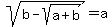 and that looks easier to handle. and that looks easier to handle.
I will color the inside of the first square root, to make it easier to track those nested square roots:
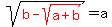
We know that 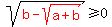 if it exists, so that means if it exists, so that means 
and that for  to exist, we must have to exist, we must have
 and and 
If they exist,  and and
-->  --> -->  . .
Now we know that it must be  , ,  and with it cannot be and with it cannot be
Could it be that  and and  ? ?
In that case,
 --> -->  --> -->  --> -->  --> -->  --> --> 
Then, it must be either with  or with or with  . .
Can we have and in either case?
If {{b=0}}} with , we get  , so that cannot give us a solution. , so that cannot give us a solution.
Then it must be and , and if  , ,
then  or or  where n is an integer. where n is an integer.
Answer by ikleyn(54018)  (Show Source): (Show Source):
You can put this solution on YOUR website! .
Solve:
Sqrt(sin(x) - sqrt(sin(x) + cos(x))) = cos(x)
~~~~~~~~~~~~~~~~~~~~~~~~~~~
Our starting equation is
 = cos(x). (1)
Let's consider function = cos(x). (1)
Let's consider function  first, which is under the outer square root of the left side.
Inside the first quadrant, QI, when 0 < x < first, which is under the outer square root of the left side.
Inside the first quadrant, QI, when 0 < x <  , both sin(x) and cos(x) are positive.
Therefore, the sum sin(x) + cos(x) is greater than sin(x):
sin(x) + cos(x) > sin(x). (2)
Square root is a monotonic function of its argument; therefore, from inequality (1) we have , both sin(x) and cos(x) are positive.
Therefore, the sum sin(x) + cos(x) is greater than sin(x):
sin(x) + cos(x) > sin(x). (2)
Square root is a monotonic function of its argument; therefore, from inequality (1) we have
 > >  . (3)
Since inside the first quadrant, QI, sin(x) is less than 1, we have
> sin(x). (4)
So, combining (3) and (4), we have
sin(x) < .
It means that inside QI the expression under the outer square root is negative;
so, left side of the given equation is not defined.
Let's inspect endpoints of QI, angles x = 0 and x = .
At x = 0, left side of the given equation is not defined.
At x = , the given equation is valid, so x = is a solution.
Thus we found that in the first quadrant, 0 <= x <= , the only solution is x = ,
where both sides of the given equation are defined and the equation is valid.
In the second quadrant, < x <= . (3)
Since inside the first quadrant, QI, sin(x) is less than 1, we have
> sin(x). (4)
So, combining (3) and (4), we have
sin(x) < .
It means that inside QI the expression under the outer square root is negative;
so, left side of the given equation is not defined.
Let's inspect endpoints of QI, angles x = 0 and x = .
At x = 0, left side of the given equation is not defined.
At x = , the given equation is valid, so x = is a solution.
Thus we found that in the first quadrant, 0 <= x <= , the only solution is x = ,
where both sides of the given equation are defined and the equation is valid.
In the second quadrant, < x <=  , the left side of the given equation
is EITHER positive OR not defined, while the right side is always negative, so in the domain
< x <= our given equation has no solutions.
In QIII and QIV, where < x < , the left side of the given equation
is EITHER positive OR not defined, while the right side is always negative, so in the domain
< x <= our given equation has no solutions.
In QIII and QIV, where < x <  ,
(a) sin(x) is negative
and the term
(b) ,
(a) sin(x) is negative
and the term
(b)  is either negative or not defined.
Therefore, the left side of the given equation is not defined at < x < .
So, in the union { QIII U QIV ) there is no solution to equation (1), at all.
Thus we found that the only solution to equation (1) in the interval [ is either negative or not defined.
Therefore, the left side of the given equation is not defined at < x < .
So, in the union { QIII U QIV ) there is no solution to equation (1), at all.
Thus we found that the only solution to equation (1) in the interval [ ,) is x = .
If you want to get the GENERAL solution for any real x, then use the fact that both
left side and right side of equation (1) are periodic functions of x with the period .
Hence, the general solution to equation (1) is the set of values ,) is x = .
If you want to get the GENERAL solution for any real x, then use the fact that both
left side and right side of equation (1) are periodic functions of x with the period .
Hence, the general solution to equation (1) is the set of values  ,
where 'k' is any integer k = 0, +/-1, +/-2, . . . and so on.
At this point, the problem is solved completely. ,
where 'k' is any integer k = 0, +/-1, +/-2, . . . and so on.
At this point, the problem is solved completely.
The method of solution is an accurate analysis of left side and right side of the equation.
| |
|
