Tutors Answer Your Questions about Geometry proofs (FREE)
Question 1210573: H is the orthocenter of acute triangle ABC and the extensions of AH, BH, and CH intersect the circumcircle of traingle ABC at A prime, B prime and C prime. We know angle AHB : angle BHC : angle CHA = 2 : 5 : 8. Find angle AprimeBprimeCprime in degrees.
Answer by ikleyn(53749)   (Show Source): (Show Source):
You can put this solution on YOUR website! .
H is the orthocenter of acute triangle ABC and the extensions of AH, BH, and CH intersect the circumcircle
of triangle ABC at A', B' and C'. We know angle AHB : angle BHC : angle CHA = 2 : 5 : 8. Find angle A'B'C' in degrees.
~~~~~~~~~~~~~~~~
This "problem" is SELF-CONTRADICTORY and describes a situation which NEVER may happen in Euclidian geometry.
Indeed, in an acute triangle, the orthocenter (the intersection point of three altitudes) is always inside
the triangle. So, the angles of visibility to any side of an acute triangle from the orthocenter
must be less than 180 degrees each.
Let's look at the given angles. We have 2 + 5 + 8 = 15 equal parts, so each part is 360/15 = 24 degrees.
Then angle AHB = 2*24 = 48 degrees, angle BHC = 5*24 = 120 degrees and angle CHA = 8*24 = 192 degrees.
We see that angle CHA of 192 degrees is greater than 180 degrees, which, as we discussed above, may not happen.
So, the posed problem is a FAKE.
Question 1210565: Points $L$ and $M$ lie on a circle $\omega_1$ centered at $O$. The circle $\omega_2$ passing through points $O,$ $L,$ and $M$ is drawn. If the measure of arc $PQ$ in circle $\omega_1$ is $40^\circ,$ then find the measure of arc $LM$ in circle $\omega_1$, in degrees.
Answer by ikleyn(53749) (Show Source):
You can put this solution on YOUR website! .
Points L and M lie on a circle omega_1 centered at O. The circle omega_2 passing through points
O, L, and M is drawn. If the measure of arc PQ in circle omega_1 is 40°,
then find the measure of arc LM in circle omega_1, in degrees.
~~~~~~~~~~~~~~~~~~~~~~
Makes no sense.
Different parts of this "quasi"-problem have NEITHER logical,
nor geometrical, nor physical connection to each other.
Another attempt by the laboratory of fake geometric problems
to cram nonsense into the reader's head.
Question 1210566: Trapezoid $HGFE$ is inscribed in a circle, with $\overline{EF} \parallel \overline{GH}$. If arc $EG$ is $40$ degrees, arc $EH$ is $120$ degrees, and arc $FG$ is $20$ degrees, find arc $EF$.
Answer by KMST(5345)  (Show Source): (Show Source):
Question 1210567: In cyclic quadrilateral $PQRS,$
\angle P = 30, \angle Q = 60, PQ = 4, QR = 8.
Find the largest side in quadrilateral $PQRS,$ in degrees.
Answer by ikleyn(53749) (Show Source):
You can put this solution on YOUR website! .
In cyclic quadrilateral PQRS, angle P = 30, angle Q = 60, PQ = 4, QR = 8.
Find the largest side in quadrilateral PQRS, in degrees.
~~~~~~~~~~~~~~~~~~~~~~~~~~~~
Obviously, the question in the post is posed in mathematically illiterate way.
But I will not pay attention to it.
My goal here is to prove that such a quadrilateral, as described in the post,
DOES NOT EXIST and CAN NOT EXIST.
Let's consider triangle PRQ, formed by sides PQ and QR and the diagonal PR of quadrilateral PQRS.
Since the quadrilateral PQRS is cyclic, it is convex, so the diagonal PR lies inside this quadrilateral.
In this triangle, we are given the side lengths PQ = 4 and QR = 8.
We also are given the contained angle Q of 60°.
So, we can compute the opposite side PR of this triangle using the cosine law
PR =  = = 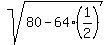 = =  = =  = =  .
Now we see that .
Now we see that  + +  = =  + +  = 16 + 48 = 64 = = 16 + 48 = 64 =  = =  .
Hence, triangle PQR is a right-angled triangle with the legs PQ and PR with the right angle at vertex P.
But angle P is 30°, as it is given in the problem - - - so, it CAN NOT contain angle QPR of 90°.
This CONTRADICTION proves that quadrilateral PQRS as described in the post, DOES NOT EXIST and CAN NOT EXIST.
The problem describes something geometric shape that does not exist and can not exist,
and the problem tries to implant this wrong/false idea into the reader's mind. .
Hence, triangle PQR is a right-angled triangle with the legs PQ and PR with the right angle at vertex P.
But angle P is 30°, as it is given in the problem - - - so, it CAN NOT contain angle QPR of 90°.
This CONTRADICTION proves that quadrilateral PQRS as described in the post, DOES NOT EXIST and CAN NOT EXIST.
The problem describes something geometric shape that does not exist and can not exist,
and the problem tries to implant this wrong/false idea into the reader's mind.
Thus the problem is refuted, i.e. killed to the death and ruined into dust.
The posed problem tries to conceive a reader, as it do many other problems from the same source,
which I call " the Laboratory for false defective problems in Geometry ".
Question 1210564: In the figure, if the measure of arc $FG$ is $118^\circ$, the measure of arc $FQ$ is $12^\circ$, and $FR = GR,$ then what is $\angle GRP$, in degrees?
Answer by ikleyn(53749) (Show Source):
You can put this solution on YOUR website! .
In the figure, if the measure of arc $FG$ is $118^\circ$, the measure of arc $FQ$ is $12^\circ$, and $FR = GR,$ then what is $\angle GRP$, in degrees?
~~~~~~~~~~~~~~~~~~~~~~~~~
Where is the figure ?
Question 1210569: In rectangle $EFGH$, let $M$ be the midpoint of $\overline{EF}$, and let $X$ be a point such that $MH = MX$, as shown below. If $\angle EMH = 19^\circ$ and $\angle MEG = 44^\circ,$ then find $\angle GEH,$ in degrees.
Answer by ikleyn(53749) (Show Source):
You can put this solution on YOUR website! .
In rectangle $EFGH$, let $M$ be the midpoint of $\overline{EF}$, and let $X$ be a point such that $MH = MX$, as shown below.
If $\angle EMH = 19^\circ$ and $\angle MEG = 44^\circ,$ then find $\angle GEH,$ in degrees.
~~~~~~~~~~~~~~~~~~~~~~~
How far below is shown what is promised to be shown below ?
Question 1210568: In the diagram, chords $\overline{XY}$ and $\overline{VW}$ are extended to meet at $U.$ If $\angle UXY = 25^\circ$, minor arc $VW$ is $155^\circ$, and minor arc $XY$ is $82^\circ$, find arc $UW$, in degrees.
Answer by ikleyn(53749) (Show Source):
You can put this solution on YOUR website! .
In the diagram, chords XY and VW are extended to meet at U.
If angle UXY = 25 degs, minor arc VW is 155 degs, and minor arc XY is 82 degs, find arc UW, in degrees.
~~~~~~~~~~~~~~~~~~~~~~~~~~~~~
This problem is FATALLY DEFECTIVE, and I will explain WHY it is so, right now in two positions.
Position 1. XY is extended to point U - - - THEREFORE, angle UXY can not be 25 degs.
Position 2. UW is not an arc, since U is a point out of the circle, according to the problem.
So, your " problem " is rotten from the surface to the core.
Question 1210570: Let P_1 P_2 P_3 \dotsb P_{10} be a regular polygon inscribed in a circle with radius $1.$ Compute
P_1 P_2 + P_2 P_3 + P_3 P_4 + \dots + P_9 P_{10} + P_{10} P_1
Answer by ikleyn(53749) (Show Source):
You can put this solution on YOUR website! .
Let P_1 P_2 P_3 ... P_{10} be a regular polygon inscribed in a circle with radius 1. Compute
P_1 P_2 + P_2 P_3 + P_3 P_4 + . . . + P_9 P_{10} + P_{10} P_1
~~~~~~~~~~~~~~~~~~~~~~~~~~~~~
If this sum
P_1 P_2 + P_2 P_3 + P_3 P_4 + . . . + P_9 P_{10} + P_{10} P_1
is the sum of vectors, then this sum is equal to zero - as any sum of vectors along a closed contour.
Question 1210572: Compute \angle AGD, in degrees.
Answer by ikleyn(53749) (Show Source):
You can put this solution on YOUR website! .
Compute \angle AGD, in degrees.
~~~~~~~~~~~~~~~~~~~~~~~~~~~~~~~~~~~
Makes no sense.
-------------------------------
It's just time for you to add a signature to your work: "Laboratory of Defective Geometry Problems".
Then everyone will understand how to interpret your compositions.
Question 1210571: Find the radius of the quarter-circle.
Answer by ikleyn(53749) (Show Source):
You can put this solution on YOUR website! .
Find the radius of the quarter-circle.
~~~~~~~~~~~~~~~~~~~~~~~~~
Makes no sense.
-------------------------------
It's just time for you to add a signature to your work: "Laboratory of Defective Geometry Problems".
Then everyone will understand how to interpret your compositions.
Question 1210555: In the diagram below, chords $\overline{AB}$ and $\overline{CD}$ are perpendicular, and meet at $X.$ Find the diameter of the circle.
Answer by greenestamps(13327)  (Show Source): (Show Source):
Question 1210556: Semicircles are drawn on diameters \overline{AB} and \overline{CD}, as shown below. Find AB.
Answer by greenestamps(13327) (Show Source):
Question 1210557: The circle below centered at $O$ has a radius of $5.$ Find $CD.$
Answer by greenestamps(13327) (Show Source):
Question 1210558: The circle below centered at $O$ has a radius of $5.$ Find $CD.$
Answer by greenestamps(13327) (Show Source):
Question 1210559: Two quarter-circles are drawn inside a unit square. A smaller square is inscribed in the two quarter-circles. Find the area of the smaller square.
Answer by greenestamps(13327) (Show Source):
You can put this solution on YOUR website!
The description is not precise enough to know what the figure looks like, so the problem can't be solved.
Re-post with a precise description; or provide a figure.
Question 1210554:
Answer by josgarithmetic(39792) (Show Source):
Question 1210551: In equiangular octagaon EFGHIJKL, we know that EF = GH = IJ = KL = 1 and FG = HI = JK = LE = sqrt(2). Find the area of the octagon.
Found 2 solutions by ikleyn, math_tutor2020:
Answer by ikleyn(53749) (Show Source):
You can put this solution on YOUR website! .
In equiangular octagon EFGHIJKL, we know that EF = GH = IJ = KL = 1 and FG = HI = JK = LE = sqrt(2).
Find the area of the octagon.
~~~~~~~~~~~~~~~~~~~~~~~~~
Let's write the sequence of side lengths in the row
EF FG GH HI IJ JK KL LE
1 sqrt(2) 1 sqrt(2) 1 sqrt(2) 1 sqrt(2) <<<---=== (1)
You see the repeating pattern as a cycle.
All interior angles are  = =  = =  = =  = 45*3 = 135 degrees.
You can calculate the length of the diagonal EG using the cosine law formula = 45*3 = 135 degrees.
You can calculate the length of the diagonal EG using the cosine law formula
 = =  = = 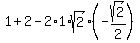 = =  = 5.
so EG = = 5.
so EG =  .
Obviously, all such sides EG, GI, IK and KE have the same length due to the same reason (the same logic).
Next, this octagon has a remarkable symmetry: if you rotate it in a way that vertex E goes to vertex G
E ---> G,
then the new octagon (the image under this rotation) will coincide with the original octagon.
(simply because the sequence of side lengths (1) will be the same and all interior angles are congruent).
It means that the quadrilateral FHJK will map into and onto itself.
It means that this quadrilateral is a square.
If such reasoning confuses you, you can notice that sides FH and HJ of the quadrilateral FHJK are orthogonal
since two times angle 135 degs is 270 degs. And, similarly, quadrilateral FHJK has all his consecutive sides
orthogonal with equal lengths, so this quadrilateral is a square.
Now, the area of the square FHJK is the square of its side, i.e. .
Obviously, all such sides EG, GI, IK and KE have the same length due to the same reason (the same logic).
Next, this octagon has a remarkable symmetry: if you rotate it in a way that vertex E goes to vertex G
E ---> G,
then the new octagon (the image under this rotation) will coincide with the original octagon.
(simply because the sequence of side lengths (1) will be the same and all interior angles are congruent).
It means that the quadrilateral FHJK will map into and onto itself.
It means that this quadrilateral is a square.
If such reasoning confuses you, you can notice that sides FH and HJ of the quadrilateral FHJK are orthogonal
since two times angle 135 degs is 270 degs. And, similarly, quadrilateral FHJK has all his consecutive sides
orthogonal with equal lengths, so this quadrilateral is a square.
Now, the area of the square FHJK is the square of its side, i.e.  = 5.
Now you can calculate the area of triangle EFG = 5.
Now you can calculate the area of triangle EFG
 = = 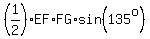 = = 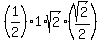 = =  = =  .
We have 4 such triangles as EFG, so their total area is .
We have 4 such triangles as EFG, so their total area is  = 2.
Now the total area of the octagon EFGHIJKL is the sum of the area of square FHGK PLUS four triangles
5 + 2 = 7.
At this point, the solution is complete.
The area of the octagon EFGHIJKL is 7 square units. ANSWER = 2.
Now the total area of the octagon EFGHIJKL is the sum of the area of square FHGK PLUS four triangles
5 + 2 = 7.
At this point, the solution is complete.
The area of the octagon EFGHIJKL is 7 square units. ANSWER
Solved.
Nice problem. It is a fun to solve it.
Answer by math_tutor2020(3835) (Show Source):
You can put this solution on YOUR website!
Answer: 7 square units
Explanation
On a piece of graph paper, plot the points
P = (0,0)
Q = (3,0)
R = (3,3)
S = (0,3)
This forms square PQRS which has area 3^2 = 9 square units.
We'll use this value later.
Contained in this square will be octagon EFGHIJKL.
We'll place the vertices at the following locations
E = (1, 0)
F = (2, 0)
G = (3, 1)
H = (3, 2)
I = (2, 3)
J = (1, 3)
K = (0, 2)
L = (0, 1)
For horizontal or vertical segments, such as EF, you can simply count the number of spaces between the points to find the segment lengths.
The distance formula could be used, but it would be overkill.
You should find all horizontal and vertical segments are 1 unit each.
For diagonal pieces, use either the Distance Formula or the Pythagorean Theorem.
Each diagonal piece is sqrt(2) units long.
You should find that each interior angle of the octagon is 135 degrees, which proves it to be equiangular. It's not regular since the sides aren't the same length.
Let's return to square PQRS.
We need to clip a right triangle from each corner to form octagon EFGHIJKL.
One such triangular piece to clip off would be triangle ELP, which has area = base*height/2 = 1*1/2 = 0.5
Four such congruent pieces to clip off would mean a total of 4*0.5 = 2 square units are removed.
Therefore octagon EFGHIJKL has area 9-2 = 7 square units
Question 1210549: In the diagram below, chords $\overline{AB}$ and $\overline{CD}$ are perpendicular, and meet at $X.$ Find the diameter of the circle.
Found 2 solutions by ikleyn, greenestamps:
Answer by ikleyn(53749) (Show Source):
You can put this solution on YOUR website! .
If you refer to a diagram, you must either include the diagram, or provide a link to the diagram,
or describe the diagram accurately, completely and adequately.
If you do not make anything of the above, you violate the laws and rules of mathematical writing,
and also violate the rules of mutual courtesy in written communication.
I am writing it because I know precisely the source of these problems -
it is the forum/website www.web2.0calc.com, from which such defective posts arrive almost every day.
And I know exactly who stays behind the forwarding of these defective posts - I don't need to explain this.
Answer by greenestamps(13327) (Show Source):
Question 1210548: In triangle $XYZ,$ circles are drawn centered at $X$, $Y$, and $Z$, so that all pairs of circles are externally tangent. If $XY = 2,$ $XZ = 2,$ and $YZ = 2$, then find the sum of the areas of all three circles.
Answer by greenestamps(13327) (Show Source):
You can put this solution on YOUR website!
From the description, triangle XYZ is equilateral with side length 2.
If circles drawn from each vertex are pairwise externally tangent, then each circle has radius 1.
So the area of each circle is pi, and the sum of the areas of the three circles is 3pi.
ANSWER: 3pi
Question 1210550: Trapezoid $ABCD$ is inscribed in the semicircle with diameter $\overline{AB}$, as shown below. Find the radius of the semicircle.
Answer by greenestamps(13327) (Show Source):
Question 1210541: In quadrilateral ABCD, the longest side is AB, and the shortest side is CD. Which of the following inequalities must hold? Select all that apply.
AB + AC > BD + BC
AB > (BD + AC)/2
BC > (AB + AC)/2
BD > AC
Answer by CPhill(2189)  (Show Source): (Show Source):
You can put this solution on YOUR website! To determine which inequalities must hold, let’s analyze the properties of a quadrilateral based on the given constraints: **AB is the longest side** and **CD is the shortest side**.
---
### 1. (Not necessarily true)
This inequality involves a mix of side lengths and diagonals. While is the longest side, there is no geometric theorem that guarantees the sum of a side and a diagonal () will always exceed the sum of the other diagonal and side (). This depends entirely on the specific angles and "stretch" of the quadrilateral.
### 2. (Must hold)
This can be proven using the **Triangle Inequality**.
In any quadrilateral, the sum of the diagonals is less than the sum of all four sides, but more importantly, we can look at the triangles formed by the diagonals:
* In ,
* In ,
Summing these gives: .
Since is the longest side, and . If we replace and with , we see that is a very "heavy" component of the perimeter. While a formal proof involves more steps, in any convex quadrilateral where is the maximum side, will always be greater than the average of the two diagonals.
### 3. (Cannot be true)
We are told that **AB is the longest side**. This means .
If , then the average of and another length () cannot be smaller than unless is significantly smaller. More simply, because is the maximum, cannot be greater than the average of the longest side and a diagonal.
### 4. (Not necessarily true)
The lengths of the diagonals and depend on the internal angles of the quadrilateral, not just the side lengths. You can tilt or "squish" a quadrilateral to make very long and very short (or vice versa) without changing the fact that is the longest side and is the shortest.
---
### Summary of Results
The only inequality that **must** hold under these constraints is:
> ****
Would you like me to walk through a coordinate geometry example to show how the diagonals can change while remains the longest side?
Question 1210540: In triangle ABC, let D be a point on side BC. Select all the true statements.
If AD is an altitude of triangle ABC, then AC > AD.
If AD is a median of triangle ABC, then BD > CD.
If AD is an angle bisector of triangle ABC, then AB > BD.
Answer by greenestamps(13327) (Show Source):
You can put this solution on YOUR website!
In triangle ABC, let D be a point on side BC. Select all the true statements.
If AD is an altitude of triangle ABC, then AC > AD.
TRUE. If AD is an altitude, then it is the shortest distance from A to any point on BC; in particular, it is shorter than AC.
If AD is a median of triangle ABC, then BD > CD.
FALSE. By definition, if AD is a median then BD = CD.
If AD is an angle bisector of triangle ABC, then AB > BD.
FALSE. If angle B is a right angle or an obtuse angle, then AB is always shorter than AD.
Question 1210542: All the sides of a triangle have integer length. The perimeter of the triangle is 10, and the triangle is scalene. How many such non-congruent triangles are there?
Answer by greenestamps(13327) (Show Source):
You can put this solution on YOUR website!
There are no such triangles.
Here is a list of all the combinations of three positive integers with a sum of 10:
1, 1, 8   does not make a triangle
1, 2, 7   does not make a triangle
1, 3, 6   does not make a triangle
1, 4, 5   does not make a triangle

2, 2, 6   does not make a triangle
2, 3, 5   does not make a triangle
2, 4, 4   the triangle is not scalene

3, 3, 4   the triangle is not scalene
ANSWER: 0
Question 1210522: Two regular pentagons and a regular decagon, all with the same side length, can completely surround a point, as shown.
An equilateral triangle, a regular octagon, a square, a regular pentagon, and a regular n-gon, all with the same side length, also completely surround a point. Find n.
Found 3 solutions by greenestamps, ikleyn, CPhill:
Answer by greenestamps(13327) (Show Source):
You can put this solution on YOUR website!
To me, the wording of the problem clearly states that a point is complete surrounded by...
 equilateral triangle, equilateral triangle,  regular octagon, square, regular pentagon, regular octagon, square, regular pentagon,  regular n-gon. regular n-gon.
In that case, as hidden in the messy response from the first tutor, there is no solution, since the sum of the interior angles of the triangle, octagon, square, and pentagon is already greater than the required sum of 360 degrees.
Answer by ikleyn(53749) (Show Source):
You can put this solution on YOUR website! .
Two regular pentagons and a regular decagon, all with the same side length, can completely surround a point, as shown.
An equilateral triangle, a regular octagon, a square, a regular pentagon, and a regular n-gon, all with the same side length,
also completely surround a point. Find n.
~~~~~~~~~~~~~~~~~~~~~~~~~~
(1) As the question is posed in the post, it is formulated in unsatisfactory form, in my view.
According to the context of the problem, the question should ask about possible pairs/combinations of n-gons.
Below is my solution for this modified formulation.
(2) The post by @CPhill has no clearly written answer.
His text is badly organized, badly structured, badly worded, and factually is unreadable.
It is impossible to read it, impossible to understand, as well as impossible to discuss it.
So, from the point of view of a reader, the quality of the @CPhill solution and the quality of his presentation
is below the floor level, i.e. is below zero.
Therefore, I present my solution below.
My solution consists of two tables.  First table is for interior angles of n-gons for n = 3, 4, 5, 6, 8, 9, 10, 12.

Second table contains the answers in the form of possible combinations.


   T A B L E  1 :  Interior angles of several regular n-gons


n-gon, n:          3     4     5     6     8     9     10     12     15     18     20


interior angle,   60    90   108    120   135   140    144   150
  degrees


  T A B L E  2 :   T h e   a n s w e r


Combinations:   n * angle1 + m * angle2 = 360 degrees   ( angle1 and angle2 are interior angles )

                6 * 60                  = 360             6 equilateral triangles

                3 * 60     + 2 * 90     = 360             3 eq. triangles + 2 squares

                4 * 90                  = 360             4 squares

                2 * 108    + 1 * 144    = 360             2 reg.  pentagons and 1 reg. 10-gon

                2 * 135    + 1 * 90     = 360             2 reg. octagons + 1 square

                2 * 150    + 1 * 60     = 360             2 reg. 12-gons  + 1 eq. triangle


The solution method is, actually, trial and error by brute force, and I did it mentally.


@CPhill, actually, tries to do the same using a computer code,
but my presentation of the solution and of the answer is incomparable better than that by @CPhill (in my opinion).


I do not try to impress a reader by my knowledge of names for regular n-gons, as @CPhill does,
but simply present the logic, the solution and the answer in clear straightforward way.
Solved.
-------------------------
As I observe the @CPhill compositions every day,
this person simply does not know true commonly accepted standards of formulation to Math problems,
as well does not know true commonly accepted standards for presentations of their solutions.
Therefore, every day he constantly tries to break the existing standards and to re-establish them at the lowest level,
which corresponds to his own level in Math.
It is inacceptable attempt which must be resolutely rejected by the community.
Answer by CPhill(2189) (Show Source):
You can put this solution on YOUR website! ```python
from itertools import combinations_with_replacement
def interior_angle(n):
return 180 * (n - 2) / n
def solve_for_n(current_angles):
target = 360 - sum(current_angles)
if target <= 0:
return None
# target = 180 - 360/n => 360/n = 180 - target => n = 360 / (180 - target)
if 180 - target <= 0:
return None
n = 360 / (180 - target)
if abs(n - round(n)) < 1e-6:
return int(round(n))
return None
polygons = {
'triangle': 3,
'square': 4,
'pentagon': 5,
'hexagon': 6,
'octagon': 8,
'decagon': 10,
'dodecagon': 12,
'pentadecagon': 15,
'icosagon': 20,
'icositetragon': 24,
'triacontagon': 30,
'tetracontagon': 40
}
# Check subsets of the user's list
user_list = [3, 8, 4, 5]
for i in range(1, len(user_list) + 1):
from itertools import combinations
for combo in combinations(user_list, i):
angles = [interior_angle(x) for x in combo]
n = solve_for_n(angles)
if n and n >= 3:
print(f"Combo {combo} + {n}-gon = 360")
# Check if the whole list + n works
angles = [interior_angle(x) for x in user_list]
n = solve_for_n(angles)
print(f"Full list {user_list} sum: {sum(angles)}, target n: {n}")
```
```text
Combo (3, 8) + 24-gon = 360
Combo (8, 4) + 8-gon = 360
Combo (4, 5) + 20-gon = 360
Full list [3, 8, 4, 5] sum: 393.0, target n: None
```
To find the value of , we use the geometric principle that for a set of regular polygons to "completely surround a point" (i.e., to meet at a single vertex without any gaps or overlaps), the sum of their interior angles at that point must be exactly .
### 1. The Geometry of the First Example
The problem mentions that **two regular pentagons** and **one regular decagon** surround a point. We can verify this using the formula for the interior angle of a regular -gon:
* **Regular Pentagon ():**
* **Regular Decagon ():**
**Sum at the vertex:** . This confirms they surround the point perfectly.
---
### 2. Solving for in the Second Group
The second group of polygons includes an **equilateral triangle**, a **regular octagon**, a **square**, a **regular pentagon**, and a **regular -gon**.
However, if we calculate the sum of the interior angles of the first four shapes, we get:
* **Equilateral Triangle ():**
* **Regular Octagon ():**
* **Square ():**
* **Regular Pentagon ():**
**Current Sum:**
Because the sum of these four polygons () is **already greater than **, they cannot surround a point in a flat plane. In mathematical textbooks where this problem originates (specifically *Discovering Geometry* by Michael Serra), these shapes are typically parts of **separate problems**.
Depending on which specific set of shapes from your list were meant to be grouped with the -gon, there are three standard solutions for :
| If the set is... | Sum of known angles | Remaining Angle for -gon | Value of |
| --- | --- | --- | --- |
| **Triangle + Octagon + -gon** | | | **** |
| **Square + Pentagon + -gon** | | | **** |
| **Triangle + Decagon + -gon** | | | **** |
### Conclusion
Based on the specific polygons listed in your prompt:
* If you are pairing the **triangle** and **octagon**, then ****.
* If you are pairing the **square** and **pentagon**, then ****.
In the context of the textbook from which this puzzle likely comes, these are usually presented as two distinct exercises: **** for the triangle-octagon configuration and **** for the square-pentagon configuration.
Question 1210534: Point P lies in regular hexagon ABCDEF such that [ABP] = 3, [CDE] = 5, and [EFA] = 8. Compute [ABC].
Answer by ikleyn(53749) (Show Source):
You can put this solution on YOUR website! .
Point P lies in regular hexagon ABCDEF such that [ABP] = 3, [CDE] = 5, and [EFA] = 8. Compute [ABC].
~~~~~~~~~~~~~~~~~~~~~~~
Makes no sense.
Question 1210535: The diagram shows a square within a regular nonagon. Find $x,$ in degrees.
Answer by ikleyn(53749) (Show Source):
You can put this solution on YOUR website! .
The diagram shows a square within a regular nonagon. Find $x,$ in degrees.
~~~~~~~~~~~~~~~~~~~~~~~~~~
The post refers to a diagram, but the diagram is not shown and the link to the diagram absents.
The variable 'x' is not defined.
What I see in the post is an illiterate attempt to create a Math problem,
but incorrect, defective and unsuccessful attempt.
FAKE.
Question 1210533: Let PQRST be an equilateral pentagon. If the pentagon is concave, and \angle P = \angle Q = 135^{\circ}, then what is the degree measure of \angle T?
Answer by ikleyn(53749) (Show Source):
You can put this solution on YOUR website! .
Let PQRST be an equilateral pentagon. If the pentagon is concave, and \angle P = \angle Q = 135^{\circ},
then what is the degree measure of \angle T?
~~~~~~~~~~~~~~~~~~~~~~~~~~~~~~~
Similar problem was considered and solved at this forum yesterday under link
https://www.algebra.com/algebra/homework/Geometry-proofs/Geometry_proofs.faq.question.1210529.html
It was shown/proved there that such equilateral pentagon as described in the post - does not exist and can not exist.
So, the problem is an attempt to deceive a reader.
Go in peace and don't interfere with our work.
Question 1210528: ABCDEF is a concave hexagon with exactly one interior angle greater than 180 degrees. (The diagram below is not drawn to scale.) Noah measured the marked angles, getting 90, 120, 45, 75, 150, 180, 15, 60, 30. What interior angle measure of the hexagon, in degrees, is missing from Noah's list?
Answer by ikleyn(53749) (Show Source):
You can put this solution on YOUR website! .
The missing is the mentioned interior angle, which is greater than 180 degrees.
May be, other interior angles are missed, too - the given information does not
allow to judge about it, but the question does not ask about it.
What we can say for sure is that the mentioned angle, greater than 180 degrees,
is not among the presented angles.
Judging the problem in whole, I would say that it is from that kind of problems,
which badly prepared low level substitute teacher may assign in the class,
when he (or she) does not know how to use the class time more productively.
God save us from such teachers . . .
Question 1210520: A regular hexagon has a perimeter of p (in length units) and an area of A (in square units). If A=3/2 then find the side length of the hexagon.
Found 2 solutions by ikleyn, CPhill:
Answer by ikleyn(53749) (Show Source):
Answer by CPhill(2189) (Show Source):
You can put this solution on YOUR website! ```python
import math
# A = (3 * sqrt(3) / 2) * s^2
# 3/2 = (3 * sqrt(3) / 2) * s^2
# 1 = sqrt(3) * s^2
# s^2 = 1 / sqrt(3)
# s = 1 / (3**(1/4))
s = 1 / (3**0.25)
print(f"s = {s}")
print(f"s^4 = {s**4}")
print(f"1/3 = {1/3}")
```
```text
s = 0.7598356856515925
s^4 = 0.3333333333333333
1/3 = 0.3333333333333333
```
To find the side length of a regular hexagon given its area, we use the standard area formula for a regular hexagon with side length .
### 1. The Area Formula
A regular hexagon can be divided into six equilateral triangles. The area of one equilateral triangle with side is . Therefore, the total area of the hexagon is:
### 2. Solving for the Side Length ()
We are given that the area . Substituting this into the formula:
To solve for , we divide both sides by :
Now, we take the square root of both sides to find :
Using exponent notation, and . Thus:
### Summary
If the area is exactly , the side length of the hexagon is:
*(Note: In many geometry problems, the area is given as . In that specific case, the side length would simplify to exactly ****. However, based on the value provided, the side length is .)*
Question 1210530: Grogg draws an equiangular polygon with g sides, and Winnie draws an equiangular polygon with w sides, where g < w. If the exterior angle of Grogg's polygon is congruent to six times the interior angle of Winnie's polygon, find w.
Answer by greenestamps(13327) (Show Source):
You can put this solution on YOUR website!
The problem has no solution.
The exterior angle of Grogg's equilateral polygon has measure  degrees. degrees.
That exterior angle has a measure equal to 6 times the measure of each interior angle of Winnie's polygon, so the measure of each interior angle of Winnie's polygon is  . .
But the smallest possible measure of the interior angle of a regular polygon is 60 degrees.
ANSWER: The problem as stated is faulty
Question 1210529: Let ABCDE be an equilateral pentagon. If the pentagon is concave, and angle A = angle B = 135, then what is the degree measure of angle E?
Answer by greenestamps(13327) (Show Source):
You can put this solution on YOUR website!
The described figure does not exist.
If each side of the pentagon has length x and the measures of angles A and B are each 135 degrees, then the distance from C to E is greater than 2x, making it impossible for the pentagon to be equilateral.
With the given conditions, again letting x be the length of each side of the equilateral pentagon, extend sides CB and EA to meet at F. Then the distance from C to E is the hypotenuse of isosceles right triangle EFC with side length  ; the length of that hypotenuse is ; the length of that hypotenuse is 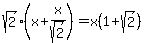 , which is greater than 2x. , which is greater than 2x.
The problem is faulty; or else the "answer" to the problem is that there is no such figure.
Question 1210531: In the regular octagon below, find x.
https://web2.0calc.com/api/ssl-img-proxy?src=%2Fimg%2Fupload%2Fb8a0eeb81cd61ebb5182a8a7%2Fregular-octagon2.jpg
Answer by greenestamps(13327) (Show Source):
Question 1210519: In a certain regular polygon, the measure of each interior angle is 2 times the measure of each exterior angle. Find the number of sides in this regular polygon.
Found 2 solutions by MathTherapy, ikleyn:
Answer by MathTherapy(10806)  (Show Source): (Show Source):
You can put this solution on YOUR website!
In a certain regular polygon, the measure of each interior angle is 2 times the measure of each exterior angle.
Find the number of sides in this regular polygon.
The exterior angles of any polygon, sum to  . Therefore, each exterior angle of any regular polygon will be . Therefore, each exterior angle of any regular polygon will be  ,
with n being the number of sides
Since it's stated that each interior angle is TWICE each exterior angle, then each interior angle of this regular polygon = ,
with n being the number of sides
Since it's stated that each interior angle is TWICE each exterior angle, then each interior angle of this regular polygon =  = =  .
Since the 2 angles (interior and exterior) are on a straight line, they are supplementary. This gives us: .
Since the 2 angles (interior and exterior) are on a straight line, they are supplementary. This gives us: 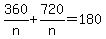 360 + 720 = 180n ---- Multiplying by LCD, n
1,080 = 180n
Number of sides that this regular polygon contains, or
360 + 720 = 180n ---- Multiplying by LCD, n
1,080 = 180n
Number of sides that this regular polygon contains, or  The regular polygon contains 6 sides, and is therefore, a regular HEXAGON!
OR
Let each exterior angle, be E
Then each interior angle = 2E
As these 2 angles are supplementary, we get: E + 2E = 180
3E = 180
Measure of each exterior angle of this regular polygon, or E =
The regular polygon contains 6 sides, and is therefore, a regular HEXAGON!
OR
Let each exterior angle, be E
Then each interior angle = 2E
As these 2 angles are supplementary, we get: E + 2E = 180
3E = 180
Measure of each exterior angle of this regular polygon, or E =  .
As each exterior angle is .
As each exterior angle is  , and the sum of the exterior angles of any polygon is , number of sides of this polygon = , and the sum of the exterior angles of any polygon is , number of sides of this polygon =  With 6 sides, this makes this a regular HEXAGON!
Answer by ikleyn(53749) (Show Source):
Question 1210517: Trapezoid $ABCD$ has bases $\overline{AB}$ and $\overline{CD}$. The extensions of the two legs of the trapezoid intersect at $P$. If $[ABC]=3$ and $[PAQ]=8$, then what is $[BDE]$?
Answer by CPhill(2189) (Show Source):
You can put this solution on YOUR website! To solve this problem, we need to clarify the positions of points and , as they are standard points in this specific geometry problem. In this configuration:
* **** is the intersection of the diagonals and .
* **** is the intersection of the line with the base .
### 1. Understanding the Geometry
In a trapezoid where the legs and meet at , and the diagonals intersect at , a fundamental property is that the line bisects both bases and .
### 2. Setting up the Ratios
Let the ratio of the bases be .
* Because , the ratio of their heights is also .
* Because (by AA similarity), the ratio of their heights is also .
We are given ****. Note that and share the same base and the same height (the height of the trapezoid). Therefore:
### 3. Finding the Relationship between and
Let be the height of and be the height of the trapezoid.
From similarity, the height of is . Thus:
Now consider the heights of the triangles meeting at . The height of is .
The area can be expressed as a ratio of the area of . Through the properties of triangles sharing sides on the legs of the trapezoid, there is a constant relationship:
### 4. Solving for
In this specific problem, there is a powerful identity for trapezoids:
Wait—let's look at the specific values. If and :
*
*
Alternatively, in some configurations of this problem where is the point , the answer is derived from the geometric mean. However, given as the intersection of diagonals and as the intersection of with the base, the areas satisfy an additive property.
**The value for is .**
---
**Would you like me to provide the step-by-step derivation of the height ratios to prove the result?**
Question 1210516: The perimeter of a rectangle is 40, and the length of one of its diagonals is 10 \sqrt{2}. Find the area of the rectangle.
Answer by ikleyn(53749) (Show Source):
You can put this solution on YOUR website! .
The perimeter of a rectangle is 40, and the length of one of its diagonals is 10 \sqrt{2}.
Find the area of the rectangle.
~~~~~~~~~~~~~~~~~~~~~~~
Let 'a' and 'b' be the lengths of two adjacent sides of the rectangle.
Then
a + b = 40/2 = 20,
a^2 + b^2 =  = 200.
Thus we have b = 20-a, and we substitute it into the second equation
a^2 + (20-a)^2 = 200,
a^2 + 400 - 40a + a^2 = 200,
2a^2 - 40a + 200 = 0,
a^2 - 20a + 100 = 0,
(a-10)^2 = 0,
a = 10.
Hence, the rectangle is a square with the side length of 10 units.
Thus the area of this rectangle (square) is 10^2 = 100 square untis. = 200.
Thus we have b = 20-a, and we substitute it into the second equation
a^2 + (20-a)^2 = 200,
a^2 + 400 - 40a + a^2 = 200,
2a^2 - 40a + 200 = 0,
a^2 - 20a + 100 = 0,
(a-10)^2 = 0,
a = 10.
Hence, the rectangle is a square with the side length of 10 units.
Thus the area of this rectangle (square) is 10^2 = 100 square untis.
At this point, the problem is solved completely.
Question 1210518: The diagram below consists of a small square, four equilateral triangles, and a large square. Find the area of the large square.
https://web2.0calc.com/api/ssl-img-proxy?src=%2Fimg%2Fupload%2Faf6a1af0cd0ede49901885c6%2Fsquare-triangles.png
Answer by ikleyn(53749) (Show Source):
You can put this solution on YOUR website! .
The diagram below consists of a small square, four equilateral triangles,
and a large square. Find the area of the large square.
https://web2.0calc.com/api/ssl-img-proxy?src=%2Fimg%2Fupload%2Faf6a1af0cd0ede49901885c6%2Fsquare-triangles.png
~~~~~~~~~~~~~~~~~~~~~~~~~~~~~~~~~~~
The side length of the large square is 2.5 units, which is obvious from the consideration in horizontal direction.
Hence, the area of the large square is  = 6.25 square units. = 6.25 square units.
As simple as an orange :)
Question 1210526: Let B, A, and D be three consecutive vertices of a regular hexagon. A regular pentagon is constructed on \overline{AB}, with a vertex C next to A. Find \angle BAD, in degrees.
Answer by ikleyn(53749) (Show Source):
You can put this solution on YOUR website! .
Let B, A, and D be three consecutive vertices of a regular hexagon. A regular pentagon
is constructed on \overline{AB}, with a vertex C next to A. Find \angle BAD, in degrees.
~~~~~~~~~~~~~~~~~~~~~~~~~~~~
Since B, A and D are three consecutive vertices of a regular hexagon,
the angle BAD is 120 degrees, giving a complete answer to the problem's question.
All additional information in the post is irrelevant to the question.
I only may suggest/hypothesize that this irrelevant info is included to confuse a reader.
Question 1210523: The interior angles of a polygon form an arithmetic sequence. The difference between the largest angle and smallest angle is $148^\circ$. If the polygon has 3 sides, then find the smallest angle, in degrees.
Answer by ikleyn(53749) (Show Source):
You can put this solution on YOUR website! .
The interior angles of a polygon form an arithmetic sequence. The difference between the largest angle
and smallest angle is $148^\circ$. If the polygon has 3 sides, then find the smallest angle, in degrees.
~~~~~~~~~~~~~~~~~~~~~~~~~~~~
As I read the problem, I see that it is about a triangle, whose interior angles form
an arithmetic sequence.
Then I immediately conclude that the central angle of this AP is 60 degrees
(since the sum of the three angles is 180 degrees).
I also conclude that the doubled common difference of the AP is 148 degrees, so
the common difference itself is 148/2 = 74 degrees.
Having it, I immediately conclude that the problem is erroneous: it is self contradictory
and describes a situation which NEVER may happen: it produces the interior angle of this triangle
which has the negative measure of 60-74 = -14 degrees.
Taking everything into account, I conclude that the problem in whole is heavily defective and terminally ill.
Question 1210524: Let IJKLMN be a hexagon with side lengths IJ = LM = 2, JK = MN = 2, and KL = NI = 2. Also, all the interior angles of the hexagon are equal. Find the area of hexagon IJKLMN.
Answer by ikleyn(53749) (Show Source):
|
Older solutions: 1..45, 46..90, 91..135, 136..180, 181..225, 226..270, 271..315, 316..360, 361..405, 406..450, 451..495, 496..540, 541..585, 586..630, 631..675, 676..720, 721..765, 766..810, 811..855, 856..900, 901..945, 946..990, 991..1035, 1036..1080, 1081..1125, 1126..1170, 1171..1215, 1216..1260, 1261..1305, 1306..1350, 1351..1395, 1396..1440, 1441..1485, 1486..1530, 1531..1575, 1576..1620, 1621..1665, 1666..1710, 1711..1755, 1756..1800, 1801..1845, 1846..1890, 1891..1935, 1936..1980, 1981..2025, 2026..2070, 2071..2115, 2116..2160, 2161..2205, 2206..2250, 2251..2295, 2296..2340, 2341..2385, 2386..2430, 2431..2475, 2476..2520, 2521..2565, 2566..2610, 2611..2655, 2656..2700, 2701..2745, 2746..2790, 2791..2835, 2836..2880, 2881..2925, 2926..2970, 2971..3015, 3016..3060, 3061..3105, 3106..3150, 3151..3195, 3196..3240, 3241..3285, 3286..3330, 3331..3375, 3376..3420, 3421..3465, 3466..3510, 3511..3555, 3556..3600, 3601..3645, 3646..3690, 3691..3735, 3736..3780, 3781..3825
|
