Question 1013669: Show that the quadrilaterals with vertices (-2,3), (-2,-1) (1,1) and (1,5) is a parallelogram.
Answer by MathLover1(20855)   (Show Source): (Show Source):
You can put this solution on YOUR website! recall: A parallelogram is a quadrilateral with both pairs of opposite sides parallel.
A parallelogram have:
- 2 sets of parallel sides
- 2 sets of congruent sides
- opposite angles congruent
- consecutive angles supplementary
- diagonals bisect each other
- diagonals form 2 congruent triangles
you can use:
If ONE PAIR of opposite sides of a quadrilateral are BOTH parallel and congruent, the quadrilateral is a parallelogram.
first we sketch given points and figure they make:
( , , ), (, ), (, ) ( ) ( ,) and (, ,) and (, ) )

opposite sides of a quadrilateral are sides made by points
(,), (,)
and
(,) and (,)
to prove that BOTH parallel and congruent, we need to find out if the lines passing through these points have equal slopes:
a. the line passing through the points
( , ,  ) = (, ) and ( ) = (, ) and ( , ,  ) = (, ) has a slope ) = (, ) has a slope  : :

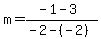

 .........which means a slope is undefined, and an undefined slope is the slope of a vertical line .........which means a slope is undefined, and an undefined slope is the slope of a vertical line
b. the line passing through the points
(, ) =(,) and
(, ) = (, ) has a slope

 .........which means a slope is undefined, and an undefined slope is the slope of a vertical line .........which means a slope is undefined, and an undefined slope is the slope of a vertical line
so, since both lines have an undefined slope, both are vertical, we can conclude that both are 
now we need to prove that the distance between points is same:
(,), (,)
| Solved by pluggable solver: Distance Formula |
The first point is (x1,y1). The second point is (x2,y2)
Since the first point is (-2, 3), we can say (x1, y1) = (-2, 3)
So  , , 
Since the second point is (-2, -1), we can also say (x2, y2) = (-2, -1)
So  , , 
Put this all together to get: , , , and
--------------------------------------------------------------------------------------------
Now use the distance formula to find the distance between the two points (-2, 3) and (-2, -1)

 Plug in , , , and Plug in , , , and
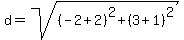
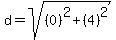


==========================================================
Answer:
The distance between the two points (-2, 3) and (-2, -1) is exactly 4 units
|
and
(,) and (,)
| Solved by pluggable solver: Distance Formula |
The first point is (x1,y1). The second point is (x2,y2)
Since the first point is (1, 1), we can say (x1, y1) = (1, 1)
So  , , 
Since the second point is (1, 5), we can also say (x2, y2) = (1, 5)
So  , , 
Put this all together to get: , , , and
--------------------------------------------------------------------------------------------
Now use the distance formula to find the distance between the two points (1, 1) and (1, 5)
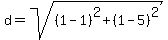 Plug in , , , and Plug in , , , and
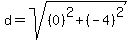
==========================================================
Answer:
The distance between the two points (1, 1) and (1, 5) is exactly 4 units
|
distances are same
since both are that contain given points are and distances are same, we can conclude that the quadrilaterals with vertices (,), (,) (,) and (,)  a parallelogram a parallelogram
|
|
|
