|
Question 1158026: What function has the following characteristics?
A zero at x = 3
A hole when x = 5
A vertical asymptote at x = -1
A horizontal asymptote at y = 3
A y-intercept at y = -2
Answer by KMST(5438)   (Show Source): (Show Source):
You can put this solution on YOUR website! There could be other ways to get a function that does that, but we could easily find a ratio of polynomials (a rational function) that could do that.
Characteristic #1: A zero at x = 3
Having  as a factor would do that. as a factor would do that.
Characteristic #2: A hole when x = 5
Having  as a factor (having as a factor (having  as a factor in numerator and denominator) would do that. as a factor in numerator and denominator) would do that.
Characteristic #3: A vertical asymptote at x = -1
Having  as a factor only in the denominator would do that. as a factor only in the denominator would do that.
So far we have the building blocks for a function that has the 3 characteristics above,
     , ,
with a graph that looks like this:
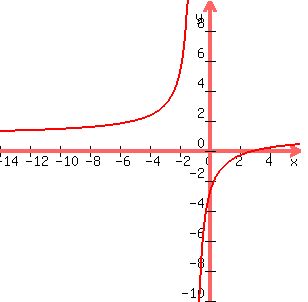 . .
It even has a horizontal asymptote, but at  , ,
and its y-intercept is 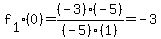 . .
The asymptote and intercept are not yet what we want.
If we add  , the horizontal asymptote becomes , the horizontal asymptote becomes  , but then , but then  is not a zero. is not a zero.
If we include  as another factor, the he horizontal asymptote becomes , but then the y- intercept becomes as another factor, the he horizontal asymptote becomes , but then the y- intercept becomes  . .
We need to meet the required characteristics #4 and #5 without loosing what we already have achieved.
Characteristic #4: A horizontal asymptote at y = 3
Characteristic #5: A y-intercept at y = -2
has a horizontal asymptote because it is the ratio of polynomials of the same degree, and when divide numerator  by denominator by denominator  the quotient is the quotient is  , and the remainder polynomial degree is less, , and the remainder polynomial degree is less,
so that we could re-write as  as as
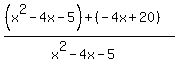 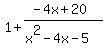 , ,
and we know that 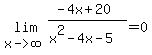
Of course the reason the quotient is is that the leading coefficients of are both , and their ratio is .
The leading coefficient of is the product of the leading coefficients of the factors and that we had to include to get characteristics #1 and 2.
The leading coefficient of is the product of the leading coefficients of the factors and  that we had to include to get characteristics #2 and #3. that we had to include to get characteristics #2 and #3.
The value of the y-intercept 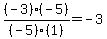 depended only on the independent terms of factors , , and . depended only on the independent terms of factors , , and .
We could include an extra factor in the denominator,
and an extra factor  in the numerator in the numerator
to try to achieve characteristics #4 and #5.
Horizontal asymptote is achieved by 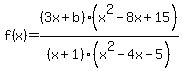
because the ratio of leading coefficients would be  . .
To get "A y-intercept at y = -2"we need  --> --> 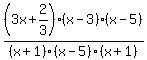
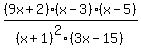 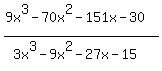
The graph would then be
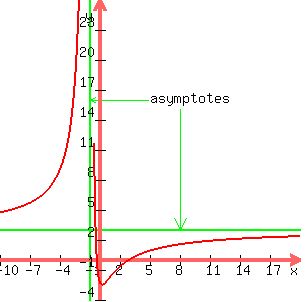
Closeup: 
| |
|
| |
