Question 430019: Could anyone help me with the following?
What would be the semiannual interest payment on a $24,000 Proctor and Gamble 10-year bond at 6.875%? (round to the nearest dollar)
and...
What would be total amount of interest earned on a $24,000 Proctor and Gamble 10-year bond at 6.875% over the entire life of the bond?
Thank you in advance!!
Found 2 solutions by mananth, ikleyn:
Answer by mananth(16949)   (Show Source): (Show Source):
You can put this solution on YOUR website! Principal P = 24000
Amount= A
years=n 10
compounded 2 times a year
Rate = 6.88
0.03/term
Amount =P*((n+r)/n)^n
Amount =24000*(1+0.03)^ 10*2
Amount =24000*( 1+0.03)^20
24000 *(1.03)^20
Amount = $47181.48
Subtract the two to get total interest
Answer by ikleyn(54018)  (Show Source): (Show Source):
You can put this solution on YOUR website! .
(a) What would be the semiannual interest payment on a $24,000 Proctor and Gamble 10-year bond at 6.875%? (round to the nearest dollar)
(b) What would be total amount of interest earned on a $24,000 Proctor and Gamble 10-year bond at 6.875% over the entire life of the bond?
~~~~~~~~~~~~~~~~~~~~~~~~~~~~~~
The solution in the post by @mananth is absolutely incorrect.
See my correct solution below.
But first, I place an explanation on HOW BONDS WORK (from the Google Artificial Intelligence OVERVIEW).
After that explanation, see my solution to your problem.
How bonds work (from the Google Artificial Intelligence OVERVIEW).

Bonds work like an IOU: you lend money to a government or company (the issuer) for a set period, and in return, they
promise to pay you regular interest (coupons) and return your original investment (principal) on a specific maturity
date, making them a fixed-income loan where you earn predictable payments and get your initial sum back, with market
prices fluctuating inversely to interest rates. [1, 2, 3, 4, 5]

How a Bond Works

1. Lending Money: When you buy a bond, you're essentially giving a loan to the entity that issues it (e.g., a company,
   city, or country). [3, 6]
2. Coupon Payments (Interest): The issuer agrees to pay you fixed interest payments, called coupons, at regular intervals
   (like semi-annually). [1, 7]
3. Face Value/Principal: This is the original amount of the loan, which is repaid to you on the bond's maturity date.
   [2,4]
4. Maturity Date: The date when the issuer must repay the principal to you, ending the bond. [3, 4]

Example:

You buy a $1,000 bond with a 5% coupon rate maturing in 2 years. [1]

• You receive $25 every six months ($1,000 x 5% / 2).
• After two years, you get your original $1,000 back, plus the total interest earned.

Key Concepts

• Issuer: The borrower (government, corporation). [3, 4]
• Coupon Rate: The fixed interest rate paid to you. [2, 4]
• Yield: The actual return you get, which changes with market prices. [8]
• Interest Rate Risk: Bond prices move inversely to market interest rates; if rates rise, your existing bond's price
  falls (and vice versa) because its fixed payments become less attractive. [2, 3, 9]

Why People Buy Bonds [1, 10, 11]

• Regular Income: For steady interest payments.
• Capital Preservation: For the return of principal at maturity.
• Diversification: To balance riskier stock investments in a portfolio.

Types of Bonds

• Government Bonds: Issued by national governments, generally considered safer (e.g., U.S. Treasuries). [4, 12]
• Corporate Bonds: Issued by companies, carrying higher risk (credit risk) but potentially higher yields. [4, 12]
• Municipal Bonds (Munis): Issued by state and local governments, often offering tax advantages. [6]

AI responses may include mistakes.

[1] https://investor.vanguard.com/investor-resources-education/understanding-investment-types/what-is-a-bond
[2] https://dfi.wa.gov/financial-education/information/basics-investing-bonds
[3] https://www.investopedia.com/terms/b/bond.asp
[4] https://www.youtube.com/watch?v=qQAxLF_bJDc
[5] https://www.merrilledge.com/article/understanding-bonds-and-their-risks
[6] https://www.schwab.com/learn/story/what-are-bonds-understanding-bond-types-and-how-they-work
[7] https://www.nerdwallet.com/investing/learn/what-is-a-bond
[8] https://www.bbc.co.uk/news/10093437
[9] https://www.getsmarteraboutmoney.ca/learning-path/videos/bonds-101-what-is-a-bond-2/
[10] https://www.youtube.com/watch?v=vAdn7aLHpO0
[11] https://www.fidelity.com/learning-center/investment-products/fixed-income-bonds/what-is-a-bond
[12] https://www.youtube.com/watch?v=Zn3Ixr-OiF4
/\/\/\/\/\/\/\/\/\/\/\/\/\/\/
Now to the solution of your problem
Face value (Principal) is $24000.
They want you find the semiannual interest payment at the annual rate 6.875% during 10 years.
It means that after bying their bond, you get from Proctor & Gamble
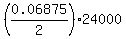 = $825 every 6 months during 10 years.
At the end of 10 years, you get $24000 back from Proctor and Gamble.
So, the answer to question (a) is THIS: you get $825 dollars from Proctor & Gamble semiannually during 10 years.
The answer to question (b) is THIS: total amount of interest earned on this bond in 10 years is
2*10*825 = 16500 dollars. = $825 every 6 months during 10 years.
At the end of 10 years, you get $24000 back from Proctor and Gamble.
So, the answer to question (a) is THIS: you get $825 dollars from Proctor & Gamble semiannually during 10 years.
The answer to question (b) is THIS: total amount of interest earned on this bond in 10 years is
2*10*825 = 16500 dollars.
Solved, answered and explained.
Keep in your mind that @mananth tries to teach others WITHOUT KNOWING THE SUBJECT.
| |
|
