Question 1065425: A retired woman has $80,000 to invest but needs to make $3,000 a year from the interest to meet certain living expenses. One bond investment pays 15% annual interest. The rest of it she wants to put in a CD that pays 7%.
If we let x be the amount the woman invests in the 15% bond, how much in dollars will she be able to invest in the CD?
Found 2 solutions by MathTherapy, greenestamps:
Answer by MathTherapy(10864)   (Show Source): (Show Source):
You can put this solution on YOUR website!
A retired woman has $80,000 to invest but needs to make $3,000 a year from the interest to meet certain living expenses.
One bond investment pays 15% annual interest. The rest of it she wants to put in a CD that pays 7%.
If we let x be the amount the woman invests in the 15% bond, how much in dollars will she be able to invest in the CD?
*************************************
She can NEVER invest any part of $80,000 in both instruments, simultaneously, to acquire $3,000 annually!
To secure annual interest income of $3,000, she'd just have to invest 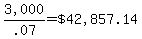 in the
smaller-interest investment: the CD, which "pays" 7%. No FURTHER investment would be required. As a
result, $37,142.86 would remain uninvested.
If investing in the bond instead, only $20,000 ( in the
smaller-interest investment: the CD, which "pays" 7%. No FURTHER investment would be required. As a
result, $37,142.86 would remain uninvested.
If investing in the bond instead, only $20,000 ( ) would be needed to secure $3,000, annually, thereby
leaving $60,000 uninvested.
Bottom LINE: At these interest rates, she wouldn't need to invest the entire $80,000 in both the CD and the
bond. Either would suffice, with funds left over. ) would be needed to secure $3,000, annually, thereby
leaving $60,000 uninvested.
Bottom LINE: At these interest rates, she wouldn't need to invest the entire $80,000 in both the CD and the
bond. Either would suffice, with funds left over.
Answer by greenestamps(13382)  (Show Source): (Show Source):
You can put this solution on YOUR website!
Getting $3000 interest on an investment of $80,000 requires a percentage return of  = 3.75 percent. = 3.75 percent.
With interest rates of 7% and 15% from the two investment opportunities, she will earn MORE than $3000 regardless of how much she invests in each place.
The problem as posted makes little or no sense.
| |
|
