Tutors Answer Your Questions about Exponential-and-logarithmic-functions (FREE)
Question 416707: Please help me solve this equation! log2 x+ log2 (x+1)=1
Found 2 solutions by ikleyn, MathTherapy:
Answer by ikleyn(53751)   (Show Source): (Show Source):
You can put this solution on YOUR website! .
Please help me solve this equation! log2 x+ log2 (x+1)=1
~~~~~~~~~~~~~~~~~~~~~~~~~~~~~
Below is my complete correct solution
log2(x) + log2(x+1) = 1
The domain for this equation is the set of all real positive numbers x > 0.
In this domain, the given equation is equivalent to this one
log2(x*(x+1)) = 1
Simplify and find x
x(x+1) = 2^1,
x^2+x-2 = 0
(x+2)(x-1) = 0
x = -2, 1
x = -2 is an extraneous solution out the domain, so we disregard x = -2
(since logarithm of the negative argument is not defined).
Thus, x = 1 is the unique real solution to the original equation. <<<---=== ANSWER
Solved.
Answer by MathTherapy(10806)  (Show Source): (Show Source):
You can put this solution on YOUR website!
Please help me solve this equation! log2 x+ log2 (x+1)=1
***********************************************************
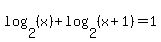 , with x > 0
The other person's claim, that - 2 is a solution to this equation, is FALSE.
1 is, though, since it's > 0!! , with x > 0
The other person's claim, that - 2 is a solution to this equation, is FALSE.
1 is, though, since it's > 0!!
Question 62416: A population is increasing at a rate of 0.6% each year. The population is currently 3000. Find a function p(t)that gives the size of the population t years from now.
Answer by ikleyn(53751) (Show Source):
You can put this solution on YOUR website! .
A population is increasing at a rate of 0.6% each year. The population is currently 3000.
find the function p(t)that gives the size of the population t years from now.
~~~~~~~~~~~~~~~~~~~~~~~~~
The solution in the post by @jai_kos is incorrect.
The function p(t) that gives the size of the population t years from now is
p(t) = 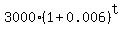 = =  . ANSWER . ANSWER
Solved correctly.
Question 62314: A population is increasing at a rate of 0.6% each year. The population is currently 3000. find the function p(t)that gives the size of the population t years from now.
Answer by ikleyn(53751) (Show Source):
You can put this solution on YOUR website! .
A population is increasing at a rate of 0.6% each year. The population is currently 3000.
find the function p(t)that gives the size of the population t years from now.
~~~~~~~~~~~~~~~~~~~~~~~~~
The solution in the post by @jai_kos is incorrect.
The function p(t) that gives the size of the population t years from now is


    p(t) =  = .    ANSWER
Solved correctly.
Question 1078473: 
Solve. Justify your work
The number above the square root of 8 is a one
Answer by MathTherapy(10806) (Show Source):
Question 1149061: Abby opened a retirement account with 9% APR and initial deposit of $8,000 compounded monthly.
(a) Find the exponential function that models the value of Abby's retirement account after t years.
(b) How long will it take to double the initial value? Estimate your answer to the nearest year.
(c) How long will it take to triple the initial value? Estimate your answer to the nearest year.
(d) How long will it take for the value of the account to reach 7 times the value of the account after 2 years?
Answer by MathTherapy(10806) (Show Source):
You can put this solution on YOUR website!
Abby opened a retirement account with 9% APR and initial deposit of $8,000 compounded monthly.
(a) Find the exponential function that models the value of Abby's retirement account after t years.
(b) How long will it take to double the initial value? Estimate your answer to the nearest year.
(c) How long will it take to triple the initial value? Estimate your answer to the nearest year.
(d) How long will it take for the value of the account to reach 7 times the value of the account after 2 years?
****************************************
(a) Find the exponential function that models the value of Abby's retirement account after t years.
Future-value-of-$1 formula: 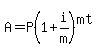 , with , with  = Future Value (Unknown, in this case) = Future Value (Unknown, in this case)
 = Principal/Initial Deposit ($8,000, in this case) = Principal/Initial Deposit ($8,000, in this case)
 = Interest rate, as a decimal (9%, or .09, in this case) = Interest rate, as a decimal (9%, or .09, in this case)
 = Number of ANNUAL compounding periods (monthly, or 12, in this case) = Number of ANNUAL compounding periods (monthly, or 12, in this case)
 = Time Principal/Initial Deposit has been invested, in YEARS (t, in this case) = Time Principal/Initial Deposit has been invested, in YEARS (t, in this case)
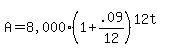 ----- Substituting $8,000 for P, .09 for i, and 12 for m ----- Substituting $8,000 for P, .09 for i, and 12 for m
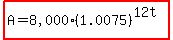 <=== Exponential function that models Abby's account-value, after t years
=========================================================
(b) How long will it take to double the initial value? Estimate your answer to the nearest year. <=== Exponential function that models Abby's account-value, after t years
=========================================================
(b) How long will it take to double the initial value? Estimate your answer to the nearest year.
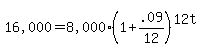 ----- Substituting $16,000 for A, $8,000 for P, .09 for i, and 12 for m ----- Substituting $16,000 for A, $8,000 for P, .09 for i, and 12 for m
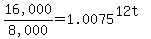
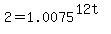
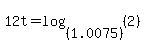 ----- Converting to LOGARITHMIC form
Time it'll take to double the initial value, or ----- Converting to LOGARITHMIC form
Time it'll take to double the initial value, or 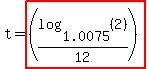 = 7.730480505, or approximately 8 years.
========================================================
(c) How long will it take to triple the initial value? Estimate your answer to the nearest year. = 7.730480505, or approximately 8 years.
========================================================
(c) How long will it take to triple the initial value? Estimate your answer to the nearest year.
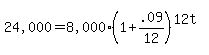 ----- Substituting $24,000 for A, $8,000 for P, .09 for i, and 12 for m ----- Substituting $24,000 for A, $8,000 for P, .09 for i, and 12 for m
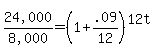
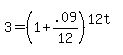
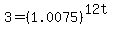
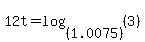 ----- Converting to LOGARITHMIC form
Time it'll take to triple the initial value, or ----- Converting to LOGARITHMIC form
Time it'll take to triple the initial value, or 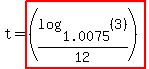 = 12.25252171, or approximately 13 years.
** Notice that although 12.25252171 rounds off to 12 (nearest integer), the $8,000 investment, at the 12-year
juncture, will be less than TRIPLE, or less than $24,000 (3 * $8,000). This is why it's necessary to ROUND UP
to year 13, at which time, the $8,000 initial deposit will surpass the triple-value, $24,000.
===============================================================
How long will it take for the value of the account to reach 7 times the value of the account after 2 years? = 12.25252171, or approximately 13 years.
** Notice that although 12.25252171 rounds off to 12 (nearest integer), the $8,000 investment, at the 12-year
juncture, will be less than TRIPLE, or less than $24,000 (3 * $8,000). This is why it's necessary to ROUND UP
to year 13, at which time, the $8,000 initial deposit will surpass the triple-value, $24,000.
===============================================================
How long will it take for the value of the account to reach 7 times the value of the account after 2 years?
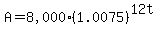 <=== Exponential function that models Abby's account-value, after t years <=== Exponential function that models Abby's account-value, after t years
 ---- Substituting 2 for t ---- Substituting 2 for t
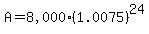 Value of account after 2 years, or A = 9571.308235, or approximately $9,572.
Seven (7) times the 2-year account value = 7(9,572) = $67,004. Now, when will the initial deposit ($8,000) increase to $67,004?
Value of account after 2 years, or A = 9571.308235, or approximately $9,572.
Seven (7) times the 2-year account value = 7(9,572) = $67,004. Now, when will the initial deposit ($8,000) increase to $67,004?
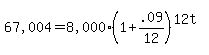 ----- Substituting $67,004 for A, $8,000 for P, .09 for i, and 12 for m ----- Substituting $67,004 for A, $8,000 for P, .09 for i, and 12 for m
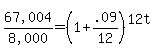
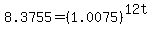
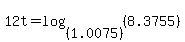 ----- Converting to LOGARITHMIC form
It'll take ----- Converting to LOGARITHMIC form
It'll take 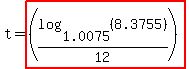 = 23.70300853, or approximately 24 years for the $8,000
initial-deposit to increase to $67,004 (7 times its 2-year value, or 7 times appr. $9,572). = 23.70300853, or approximately 24 years for the $8,000
initial-deposit to increase to $67,004 (7 times its 2-year value, or 7 times appr. $9,572).
Question 1095894: Solve for A if f(x)=-Ax^2+Bx-8, f(-5)=-123 and g(x)=4x+B, g(2)=11
Answer by MathTherapy(10806) (Show Source):
Question 1113133: Show that log base a (a^2 - x^2) = 2 + log base a (1 - x^2/a^2)
Answer by MathTherapy(10806) (Show Source):
Question 1104549: Please help me solve this word problem: in 1997, there were a total of 1,316,999 bankruptcies filed under the Bankruptcy Reform Act. The model for the number of bankruptcies filed is B(t)=0.798*1.164^t, where t is the number of years since 1994 and B is the number of bankruptcies filed in terms of millions (administrative office in US courts, statistical tables for the federal judiciary). In what year is it predicted that 12 million bankruptcies will be filed?
Found 3 solutions by ikleyn, josgarithmetic, MathTherapy:
Answer by ikleyn(53751) (Show Source):
You can put this solution on YOUR website! .
Please help me solve this word problem:
in 1997, there were a total of 1,316,999 bankruptcies filed under the Bankruptcy Reform Act.
The model for the number of bankruptcies filed is B(t)=0.798*1.164^t, where t is the number of years since 1994
and B is the number of bankruptcies filed in terms of millions (administrative office in US courts,
statistical tables for the federal judiciary). In what year is it predicted that 12 million bankruptcies will be filed?
~~~~~~~~~~~~~~~~~~~~~~~~~
Been a curious person, I asked Google: "What is the maximum number of bankrupts per year in the US history ?"
Below is the Google answer
The maximum number of bankruptcy filings in US history occurred in 2005, with over two million cases filed.
This record spike was driven by a rush to file before the implementation of the Bankruptcy Abuse Prevention
and Consumer Protection Act (BAPCPA) in October of that year.
Key Data Points:
Historical Peak: 2005 saw > 2 million total (individual and business) cases.
Pre-2005 Surge: 1 in 55 households filed for bankruptcy in 2005.
Recent Corporate Highs: In terms of large corporate bankruptcies, 2024 saw a 14-year high with 694 companies filing, according to data from LPL Financial.
Record Failure: The largest bankruptcy by assets in US history was Lehman Brothers in 2008 ($691 billion), notes
Statista.
///////////////////////////
So, based on this data, I think that the proposed model in the post
is NOT adequate, has NO any relation to reality, is pure imagination and is fundamentally wrong.
Answer by josgarithmetic(39792) (Show Source):
Answer by MathTherapy(10806) (Show Source):
You can put this solution on YOUR website!
Please help me solve this word problem: in 1997, there were a total of 1,316,999 bankruptcies filed under the Bankruptcy Reform Act. The model for the number of bankruptcies filed is B(t)=0.798*1.164^t, where t is the number of years since 1994 and B is the number of bankruptcies filed in terms of millions (administrative office in US courts, statistical tables for the federal judiciary). In what year is it predicted that 12 million bankruptcies will be filed?
*******************************************************************************
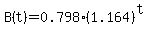
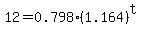 ---- Substituting 12 for B(t), the number of bankruptcies, in MILLIONS ---- Substituting 12 for B(t), the number of bankruptcies, in MILLIONS
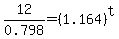
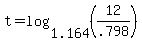 -- Converting to LOGARITHMIC form -- Converting to LOGARITHMIC form
t = 17.8488, approximately
With t representing TIME, in years, since 1994, we get the year that 12M bankruptcies
will be predicted to be filed as: 1994 + 17.8488, or 2011.8488, which is in the year 2011.
Question 822027: log3 15 − log3 40 + log3 648
Answer by MathTherapy(10806) (Show Source):
Question 734837: solve log3(x-3) + log3(x+2) = log3 6
Answer by MathTherapy(10806) (Show Source):
You can put this solution on YOUR website!
solve log3(x-3) + log3(x+2) = log3 6
************************************
The other person's statement that if "all log bases are the same (namely 3)", then: x-3 + x+2 = 6
2x - 1 = 6 and
2x = 7 and x = 3.5, is a FALLACY!
He couldn't be more WRONG!! If he'd checked, he would've seen that 3.5 doesn't: make sense
make the equation TRUE!
This log equation starts with 2 log arguments: a1 (x - 3), and a2 (x + 2), the smaller being log argument
a1, x - 3. Argument "a1" "tells" one that x - 3 MUST be > 0. So, x - 3 > 0_____x > 3
We then get:  , with x > 3 , with x > 3
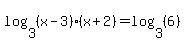 ----- Applying ----- Applying 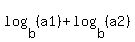 = =  (x - 3)(x + 2) = 6 ------ Applying c = d, if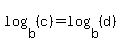

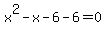
 (x - 4)(x + 3) = 0
x - 4 = 0 OR x + 3 = 0
x = 4 OR x = - 3
As stated above, x MUST be > 3, so ONLY x = 4 is ACCEPTABLE. This makes x = - 3, an EXTRANEOUS solution to this
equation, and is therefore IGNORED/REJECTED.
(x - 4)(x + 3) = 0
x - 4 = 0 OR x + 3 = 0
x = 4 OR x = - 3
As stated above, x MUST be > 3, so ONLY x = 4 is ACCEPTABLE. This makes x = - 3, an EXTRANEOUS solution to this
equation, and is therefore IGNORED/REJECTED.
Question 977752: If log{{x+y}/3}=1/2{logx+log Y}, then find the value of x/y+y/x?
Answer by MathTherapy(10806) (Show Source):
Question 974318: If  then then  = ? = ?
Answer by MathTherapy(10806) (Show Source):
Question 280462: This one looked easy but it's got me confused please help and thank you.
Use the laws of logarithms to express log base2 6 - log base 2 3 + 2 log base 2 sqrt8 as a single logarithm then evaluate. I got this far log base 2^6 - log base2^3 +2 log base 2 sqrt 8 =log base 2 6/3 sqrt8^2??? help
Found 2 solutions by greenestamps, MathTherapy:
Answer by greenestamps(13330)  (Show Source): (Show Source):
Answer by MathTherapy(10806) (Show Source):
Question 718152: Please help me solve for A and B in this exponential decay model y= ae^-bx. I have the following points: when x=0.6, y=1000 and when x=1.8, y=1.
I have done the following but I am not convienced it is the right path...
y=ae-bx therefor e-bx=y/a ... take log e of both sides ... loge e-bx = loge y/a
but logee=1 therefor -bx=loge y/a ... move the x over to get -b=x loge y/a
then enter values for x and y from example 1... -b= (0.6) loge(1000/a)
Is this the correct path to take for solving this?? Any advice would be greafull appreciated. Thank you.
Found 2 solutions by greenestamps, MathTherapy:
Answer by greenestamps(13330) (Show Source):
Answer by MathTherapy(10806) (Show Source):
You can put this solution on YOUR website!
Please help me solve for A and B in this exponential decay model y= ae^-bx. I have the following points: when x=0.6, y=1000 and when x=1.8, y=1.
I have done the following but I am not convienced it is the right path...
y=ae-bx therefor e-bx=y/a ... take log e of both sides ... loge e-bx = loge y/a
but logee=1 therefor -bx=loge y/a ... move the x over to get -b=x loge y/a
then enter values for x and y from example 1... -b= (0.6) loge(1000/a)
Is this the correct path to take for solving this?? Any advice would be greafull appreciated. Thank you.
========================================================================================================
I've chosen to show you the CORRECT path, instead of looking through your work to identify your error(s), if any!
 , if: , if:   , if: , if: 
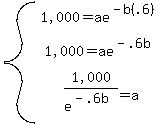 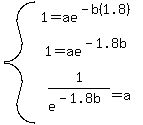 Equating the 2 "a" values, we get: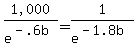
 ---- Cross-multiplying ---- Cross-multiplying
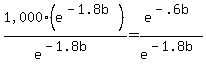 --- Dividing both sides by --- Dividing both sides by 
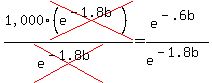


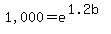 1.2b = ln (1,000) --- Converting to LOGARITHMIC (natural) form
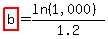 = 5.76, approximately.
You can now substitute this value for b in either = 5.76, approximately.
You can now substitute this value for b in either  , or , or  to determine the value of "a."
If/When you do, you should get the value of a as approximately 31,622.8, to the nearest tenth.
@GREENESTAMPS is CORRECT! An INCORRECT value of 51,622.8 for "a" was entered previously, although the
correct value, 31,622.8 was calculated. This has now been corrected. Thx for pointing out the error. to determine the value of "a."
If/When you do, you should get the value of a as approximately 31,622.8, to the nearest tenth.
@GREENESTAMPS is CORRECT! An INCORRECT value of 51,622.8 for "a" was entered previously, although the
correct value, 31,622.8 was calculated. This has now been corrected. Thx for pointing out the error.
Question 942780: Solve for x.
a.) log sub2(log sub4{log sub3[log sub2 x]}) = -1
b.) log sub2(x+4) + log sub2(x-2) - log sub2(x-6) = 0
Answer by MathTherapy(10806) (Show Source):
You can put this solution on YOUR website!
a.) log sub2(log sub4{log sub3[log sub2 x]}) = -1
b.) log sub2(x+4) + log sub2(x-2) - log sub2(x-6) = 0
a) PAINSTAKINGLY LONG solution by the other person.
 b) Other person's solutions are EXTRANEOUS, and therefore, UNACCEPTABLE!!!
b.) log sub2(x+4) + log sub2(x-2) - log sub2(x-6) = 0
b) Other person's solutions are EXTRANEOUS, and therefore, UNACCEPTABLE!!!
b.) log sub2(x+4) + log sub2(x-2) - log sub2(x-6) = 0
 Smallest log: (x - 6), so x - 6 > 0. Therefore, x > 6.
We then have: , with x > 6.
The 2 solutions the other person got, x = - 2, and x = 1 are < 6, NOT > 6, obviously.
This makes them EXTRANEOUS, thereby leading to this equation having NO SOLUTIONS!
Smallest log: (x - 6), so x - 6 > 0. Therefore, x > 6.
We then have: , with x > 6.
The 2 solutions the other person got, x = - 2, and x = 1 are < 6, NOT > 6, obviously.
This makes them EXTRANEOUS, thereby leading to this equation having NO SOLUTIONS!
Question 959061: how do you solve log base 4 (log base 3 (log base 2 of X)) = 0??
Answer by MathTherapy(10806) (Show Source):
Question 31666: Oh this logarithm problems are killing me :)
Can you help! Write hte logarithm of a single expression:
log[b]6x+4(log[b]x-log[b]y)
(A) log[b] 6x^5/y^4
(B) log [b] 24x^2/y
(C) log [b] 10x/4y
(D) none of these.
Do we even consider the "B" in this expression?
Answer by MathTherapy(10806) (Show Source):
Question 738696: Log base 9 of 3 to the 3x-4=x. How do I solve for x
Answer by MathTherapy(10806) (Show Source):
Question 452859: what does x equal?
log 10,000=x
Answer by MathTherapy(10806) (Show Source):
Question 47675: Logarithms:
a) Using a calculator, find log 1000 where log means log to the base of 10.
Answer:
b) Most calculators have 2 different logs on them: log, which is base 10, and ln, which is base e. In computer science, digital computers are based on the binary numbering system which means that there are only 2 numbers available to the computer, 0 and 1. When a computer scientist needs a logarithm, he needs a log to base 2 which is not on any calculator. To find the log of a number to any base, we can use a conversion formula as shown here:
Using this formula,a=log a/log b, find log2 1000 . Round your answer to the hundredth's place.
Answer:
Show work in this space.
Answer by MathTherapy(10806) (Show Source):
You can put this solution on YOUR website!
Logarithms:
a) Using a calculator, find log 1000 where log means log to the base of 10.
Answer:
b) Most calculators have 2 different logs on them: log, which is base 10, and ln, which is base e. In computer
science, digital computers are based on the binary numbering system which means that there are only 2 numbers available
to the computer, 0 and 1. When a computer scientist needs a logarithm, he needs a log to base 2 which is not on any
calculator. To find the log of a number to any base, we can use a conversion formula as shown here:
Using this formula,a=log a/log b, find log2 1000 . Round your answer to the hundredth's place.
Answer:
Show work in this space.
b)  = =  = = 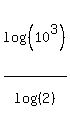 = =  = =  = =  = 9.97, approximately = 9.97, approximately
Question 454898: Can you show me step by step how to solve this equation?
You deposit $1000 into a savings account in which the intrest is compounded anuualy at a rate of 5%.
What is the pricipal after 5 years?
Answer by ikleyn(53751) (Show Source):
You can put this solution on YOUR website! .
Can you show me step by step how to solve this equation?
You deposit $1000 into a savings account in which the intrest is compounded anuualy at a rate of 5%.
What is the pricipal after 5 years?
~~~~~~~~~~~~~~~~~~~~~~~~~~~~~~~
The question in the post is posed incorrectly and shows
that a person who created/composed the problem did not know the terminology of the subject.
A correct question should ask about the Future value of the account in 5 years.
The principal is and remains unchangeable.
Question 253889: beryllium-11 decomposes into boron-11 with a half life of 13.8 seconds. How long will it take 240 g of beryllium-11 to decompose into 7.5g of beryllium-11?
based on the forumula provided in the text book C(t)=C(0)2e^-t/h
where C(0) = 240, C(t)=7.5 ,h=13.8
7.5/240=2e^-t/13.8
this was a s far as i got
Answer by ikleyn(53751) (Show Source):
You can put this solution on YOUR website! .
Beryllium-11 decomposes into boron-11 with a half life of 13.8 seconds.
How long will it take 240 g of beryllium-11 to decompose into 7.5 g of berlyium-11?
~~~~~~~~~~~~~~~~~~~~~~~~~~~~~
This problem is very special and very specific.
For the complete solution, there is NO NEED to write many-store complicated exponential functions.
There is a special method and a special approach/reasoning, and this problem
is SPECIALLY CREATED for you to learn this special solution method from me.
Notice that the ratio  is 32. is 32.
It means that 5 (five) half-lives happened in this decay process
from 240 gram of Beryllium-11 to 7.5 grams of Beryllium-11, because  = 32. = 32.
5 half-lives is 5 times 13.8 seconds, or 5 * 13.8 = 69 seconds.
ANSWER. It will take 69 seconds for 240 grams of Beryllium-11 to decompose into 7.5 grams of Beryllium-11.
*************************************************************
Solved and explained in a way how it SHOULD be done
and how it is EXPECTED to be done.
*************************************************************
Question 253874: beryllium-11 decomposes into boron-11 with a half life of 13.8 seconds. How long will it take 240 g of beryllium-11 to decompose into 7.5g of beryllium-11?
based on the forumula provided in the text book C(t)=C(0)2e^-t/h
where C(0) = 240, C(t)=7.5 ,h=13.8
7.5/240=2e^-t/13.8
this was a s far as i got
Answer by ikleyn(53751) (Show Source):
You can put this solution on YOUR website! .
Beryllium-11 decomposes into boron-11 with a half life of 13.8 seconds.
How long will it take 240 g of beryllium-11 to decompose into 7.5 g of berlyium-11?
~~~~~~~~~~~~~~~~~~~~~~~~~~~~~
This problem is very special and very specific.
For the complete solution, there is NO NEED to write many-store complicated exponential functions.
There is a special method and a special approach/reasoning, and this problem
is SPECIALLY CREATED for you to learn this special solution method from me.
Notice that the ratio is 32.
It means that 5 (five) half-lives happened in this decay process
from 240 gram of Beryllium-11 to 7.5 grams of Beryllium-11, because = 32.
5 half-lives is 5 times 13.8 seconds, or 5 * 13.8 = 69 seconds.
ANSWER. It will take 69 seconds for 240 grams of Beryllium-11 to decompose into 7.5 grams of Beryllium-11.
*************************************************************
Solved and explained in a way how it SHOULD be done
and how it is EXPECTED to be done.
*************************************************************
Question 730115: Berlyium-11 decomposes into boron-11 with a half life of 13.8 seconds. How long will it take 2400g of berlyium-11 to decompose into 75g of berlyium-11?
Thats the question, and I tried solving it but im stuck. This is what I have so far:
75=2400 x 2^-t/13.8
0.01325=27.6 (-t)
Answer by ikleyn(53751) (Show Source):
You can put this solution on YOUR website! .
Beryllium-11 decomposes into boron-11 with a half life of 13.8 seconds.
How long will it take 2400g of beryllium-11 to decompose into 75g of berlyium-11?
~~~~~~~~~~~~~~~~~~~~~~~~~~~~~
First, from chemical and physical points of views, your post was written terrifically.
I mean the name of Beryllium. So I re-wrote it in correct form.
Next, this problem is very special and very specific.
For the complete solution, there is NO NEED to write many-store complicated exponential functions.
There is a special method and a special approach/reasoning, and this problem
is SPECIALLY CREATED for you to learn this special solution method from me.
Notice that the ratio  is 32. is 32.
It means that 5 (five) half-lives happened in this decay process
from 2400 gram of Beryllium-11 to 75 grams of Beryllium-11, because = 32.
5 half-lives is 5 times 13.8 seconds, or 5 * 13.8 = 69 seconds.
ANSWER. It will take 69 seconds for 2400 grams of Beryllium-11 to decompose to 75 grams of Beryllium-11.
*************************************************************
Solved and explained in a way how it SHOULD be done
and how it is EXPECTED to be done.
*************************************************************
Question 742195: One pipe can fill a tank in 20 minutes, while
another takes 30 minutes to fill the same tank. How long would it take the two pipes together to fill the tank?
Found 4 solutions by MathTherapy, josgarithmetic, greenestamps, ikleyn:
Answer by MathTherapy(10806) (Show Source):
You can put this solution on YOUR website!
One pipe can fill a tank in 20 minutes, while
another takes 30 minutes to fill the same tank. How long would it take the two pipes together to fill the tank?

Answer is RIGHT HERE, below.....Question 45662:
Hi again,
I need some assistance with this mixture problem:
It takes a pipe 10 minutes less than another one to fill a tank of water. Both pipes together can fill the tank
in 12 minutes. How long will it take each one to fill the tank separately?
I am having trouble on how to start setting the equation up.
Thanks again,
Lou
Answer by josgarithmetic(39792) (Show Source):
Answer by greenestamps(13330) (Show Source):
You can put this solution on YOUR website!
Here is a different way of solving a problem like this.
Consider the least common multiple of the two given times, which is 60 minutes.
In 60 minutes, the first pipe could fill the tank 60/20 = 3 times.
In 60 minutes, the second pipe could fill the tank 60/30 = 2 times.
So in 60 minutes together the two pipes could fill the tank 3+2 = 5 times.
So the time it takes the two pipes to fill the tank one time is 60/5 = 12 minutes.
ANSWER: 12 minutes
NOTE: Both this method and the method shown by the other tutor can be used to solve similar problems in which one pipe is trying to fill the tank while another pipe is trying to drain the tank.
Answer by ikleyn(53751) (Show Source):
Question 617971: Solve the problem.
The logistic growth function f(t) = 400/1+9.0e-0.22t describes the population of a species of butterflies after they are introduced to a non-threatening habitat. How many butterflies are expected in the habitat after 12 months?
Answer by ikleyn(53751) (Show Source):
You can put this solution on YOUR website! .
The logistic growth function f(t) = 400/1+9.0e-0.22t describes the population of a species of butterflies
after they are introduced to a non-threatening habitat. How many butterflies are expected in the habitat
after 12 months?
~~~~~~~~~~~~~~~~~~~~~~~~~~~~~~
The problem in the post is printed/written incorrectly/inaccurately.
To be correct/accurate, the problem must say that 't' in the formula is the time in months.
Question 475306: The annual Gross Domestic Product (GDP) of a country is the value of all of the goods and services produced in the country during a year. During the period 1985-1999, the Gross Domestic Product of the United States grew about 3.2% per year, measured in 1996 dollars. In 1985, the GDP was $577 billion.
In what year will the GDP reach $2 trillion? You just need to give the year, not part of a year.
Answer by ikleyn(53751) (Show Source):
You can put this solution on YOUR website! .
The annual Gross Domestic Product (GDP) of a country is the value of all of the goods and services produced
in the country during a year. During the period 1985-1999, the Gross Domestic Product of the United States
grew about 3.2% per year, measured in 1996 dollars. In 1985, the GDP was $577 billion.
In what year will the GDP reach $2 trillion? You just need to give the year, not part of a year.
~~~~~~~~~~~~~~~~~~~~~~~~~~~~
In the post by @Theo, there is an error in his calculations, and the answer is incorrect.
I came to bring a correct solution.
The formula for the future value in n years for this problem is
FV = 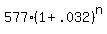 ,
in billions dollars, where n is the number of years after 1985.
Substitute here FV = 2000 billion dollars and solve equation step by step
2000 = ,
in billions dollars, where n is the number of years after 1985.
Substitute here FV = 2000 billion dollars and solve equation step by step
2000 =  , ,
 = =  ,
3.466204506 = ,
log(3.466204506) = n*log(1.032)
n = ,
3.466204506 = ,
log(3.466204506) = n*log(1.032)
n = 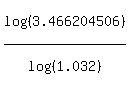 = 39.46389829.
Next, 1985 + 39.46389829 = 2024.464.
It tells us that the Future Value of 2 trillions will be reached
somewhen in the year of 2024, under the given conditions. <<<---=== ANSWER = 39.46389829.
Next, 1985 + 39.46389829 = 2024.464.
It tells us that the Future Value of 2 trillions will be reached
somewhen in the year of 2024, under the given conditions. <<<---=== ANSWER
Solved correctly.
Question 481218: Compound Interest formula:
A= P(1+(r/n))^nt
I have to use this formula to answer this question:
Determine how much time is required for an investment to double in value if interest is earned at a rate of 6.25% and compounded annually?
Please give me a detailed answer, I have tried using the formula myself but I keep getting stuck and am not having much success.
Thank you in advance for all your help! I really do appreciate it.
Answer by ikleyn(53751) (Show Source):
You can put this solution on YOUR website! .
Compound Interest formula:
A= P(1+(r/n))^nt
I have to use this formula to answer this question:
Determine how much time is required for an investment to double in value if interest is earned at a rate of 6.25% and compounded annually?
Please give me a detailed answer, I have tried using the formula myself but I keep getting stuck and am not having much success.
Thank you in advance for all your help! I really do appreciate it.
~~~~~~~~~~~~~~~~~~~~~~~~~~~~~~~~~~~
I came to make a notice to the @Theo' solution.
You may follow @Theo in his calculations to get t = 14.43 years.
But then you must round 14.43 years to the closest integer greater value, which is 15 years.
Only at the end of the 15-th year the bank will make its last compounding,
and it will be first time, when the amount at your account will exceed its doubled original value.
So, 14.43 years is NOT a correct answer in this problem.
Your account will exceed its doubled original value first time after 15 years.
The bank will not make the last compounding earlier than in 15 years.
Question 1181507: Determine the absolute deviation and the coefficient of variation.
𝑦=[200.432 (±0.002)]^1/2 / log(20.42 × 10^15(±0.06))
Answer by CPhill(2189)  (Show Source): (Show Source):
You can put this solution on YOUR website! Here's how to calculate the absolute deviation and coefficient of variation for the given expression:
**1. Calculate the value of y:**
y = sqrt(200.432) / log(20.42 × 10^15)
y ≈ 14.157 / 15.310
y ≈ 0.9246
**2. Calculate the uncertainty in y:**
To do this properly, we need to consider the uncertainties in both the numerator and the denominator. We'll use the formula for propagation of uncertainty through division:
(δy/y) = sqrt((δA/A)^2 + (δB/B)^2)
Where:
* A = 200.432, δA = 0.002
* B = 20.42 × 10^15, δB = 0.06 × 10^15
First, find the relative uncertainties:
* (δA/A) = 0.002 / 200.432 ≈ 0.00001
* (δB/B) = 0.06 × 10^15 / (20.42 × 10^15) ≈ 0.00294
Now, calculate the relative uncertainty in y:
(δy/y) = sqrt((0.00001)^2 + (0.00294)^2)
(δy/y) ≈ 0.00294
Finally, calculate the absolute uncertainty in y:
δy = (δy/y) * y
δy ≈ 0.00294 * 0.9246
δy ≈ 0.00272
**3. Express the result:**
y = 0.9246 ± 0.00272
**4. Calculate the coefficient of variation:**
Coefficient of variation = (δy / y) * 100%
Coefficient of variation = (0.00272 / 0.9246) * 100%
Coefficient of variation ≈ 0.294%
**Therefore:**
* **Absolute deviation:** ± 0.00272
* **Coefficient of variation:** ≈ 0.294%
Question 1209412: Find all real numbers x such that (3x - 27)^3 + (27x - 3)^3 = (3x + 27x - 30)^3.
Answer by Edwin McCravy(20077)  (Show Source): (Show Source):
Question 1198664: An optical instrument with limiting magnitude L of any optical telescope and lens
diameter D, in inches, is given by
𝐿 = 8.8 + 5.1 𝑙𝑜𝑔 𝐷
a) Determine the limiting magnitude for a homemade I -inch reflecting telescope.
b) Determine the diameter of a lens that would have a limiting magnitude of R.
Answer by CPhill(2189) (Show Source):
You can put this solution on YOUR website! **a) Determine the limiting magnitude for a homemade 1-inch reflecting telescope.**
* Use the given formula: L = 8.8 + 5.1 * log(D)
* Substitute D = 1 inch:
L = 8.8 + 5.1 * log(1)
* Since log(1) = 0:
L = 8.8 + 5.1 * 0
L = 8.8
**Therefore, the limiting magnitude for a homemade 1-inch reflecting telescope is 8.8.**
**b) Determine the diameter of a lens that would have a limiting magnitude of R.**
* **Rearrange the formula to solve for D:**
* L = 8.8 + 5.1 * log(D)
* L - 8.8 = 5.1 * log(D)
* (L - 8.8) / 5.1 = log(D)
* 10^[(L - 8.8) / 5.1] = 10^(log(D))
* 10^[(L - 8.8) / 5.1] = D
**Therefore, the diameter of a lens that would have a limiting magnitude of R is:**
* D = 10^[(R - 8.8) / 5.1]
This equation allows you to calculate the required lens diameter for any desired limiting magnitude (R).
Question 1209241: Can you explain the quotient rule and the power rule and how to tell the difference between them in example. I’m confused how you know the difference and what they mean by the power rule.
Found 2 solutions by ikleyn, Edwin McCravy:
Answer by ikleyn(53751) (Show Source):
You can put this solution on YOUR website! .
Can you explain the quotient rule and the power rule and how to tell the difference between
them in example. I’m confused how you know the difference and what they mean by the power rule.
~~~~~~~~~~~~~~~~~~~~~~
It seems to me that you want to ask something different,
but your question drowned in words.
A reasonable question to ask is THIS:
Let's consider a rational function y(x) =  , where n is a positive integer number.
We can consider it as a power function y = , where n is a positive integer number.
We can consider it as a power function y =  , too.
If we want to find the derivative y'(x), we can do it using the power rule
or using the quotient rule.
Is there the difference and how to know, which rule to use ? , too.
If we want to find the derivative y'(x), we can do it using the power rule
or using the quotient rule.
Is there the difference and how to know, which rule to use ?
The answer is that both these rules lead to the same result in this case,
so one can use any of these two rules.
Indeed, if we use the power rule, then
y'(x) = ' = 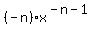 = =  . (1)
If we use the quotient rule, then the calculations are as follows
(derivative of the numerator)*denominator - numerator*(derivative of denominator)
y' = ----------------------------------------------------------------------------------- =
denominator^2
0*denominator - 1*n*x^(n-1) (-n)
= ------------------------------ = --------- (2)
x^(2n) x^(n+1)
(1) and (2) are the same, so the answer is the same:
you may use any of these two rules/techniques, the result is the same. . (1)
If we use the quotient rule, then the calculations are as follows
(derivative of the numerator)*denominator - numerator*(derivative of denominator)
y' = ----------------------------------------------------------------------------------- =
denominator^2
0*denominator - 1*n*x^(n-1) (-n)
= ------------------------------ = --------- (2)
x^(2n) x^(n+1)
(1) and (2) are the same, so the answer is the same:
you may use any of these two rules/techniques, the result is the same.
Answer by Edwin McCravy(20077) (Show Source):
Question 1209240: A biologist is researching a newly discovered species of bacteria. At time T equals zero hours, he put 100 bacteria into what he has determined to be a favorable growth medium. Six hours later, he measures 450 bacteria. Assuming exponential growth, what is the growth constant K for the bacteria? (Round K2 decimal places) By what hour to the nearest 10 will there be 1000 bacteria?
Answer by timofer(155) (Show Source): (Show Source):
Question 1208791: Solve for x.
12^(sqrt{x^2}) - 24^(x - 2) = 144
Answer by ikleyn(53751) (Show Source):
You can put this solution on YOUR website! .
Solve for x.
12^(sqrt{x^2}) - 24^(x - 2) = 144
~~~~~~~~~~~~~~~~~~~~~~~~~~~~~~~~~~
It is not for algebraic solution - in Algebra, there are no methods solving such equations.


Use either your graphics calculator or online tools to get approximate numerical solutions.


For example, you may use an online solver https://www.desmos.com/calculator


Print there  y = 12^(sqrt{x^2}) - 24^(x - 2)  in one window and  y = 144  in another window.


Calculator will provide the plot, and you can identify two root

    x = -2 (an approximate value)  and x = 2.00281  (another approximate value)


by clicking at the intersection points.   ANSWER
Solved.
Question 1208832: Investing $8,000 for 6 years.
Option #1
7% compounded monthly
Option #2
6.85% compounded continuously
Which is the better investment?
Found 2 solutions by ikleyn, math_tutor2020:
Answer by ikleyn(53751) (Show Source):
Answer by math_tutor2020(3835) (Show Source):
You can put this solution on YOUR website!
Option 1
A = P*(1+r/n)^(n*t)
A = 8000*(1+0.07/12)^(12*6)
A = 12160.84 approximately when rounding to the nearest penny
Option 2
A = P*e^(r*t) where e = 2.718 roughly
A = 8000*e^(0.0685*6)
A = 12066.60 approximately when rounding to the nearest penny
You earn slightly more with option 1.
The difference is 12160.84 - 12066.60 = 94.24 extra dollars.
|
Older solutions: 1..45, 46..90, 91..135, 136..180, 181..225, 226..270, 271..315, 316..360, 361..405, 406..450, 451..495, 496..540, 541..585, 586..630, 631..675, 676..720, 721..765, 766..810, 811..855, 856..900, 901..945, 946..990, 991..1035, 1036..1080, 1081..1125, 1126..1170, 1171..1215, 1216..1260, 1261..1305, 1306..1350, 1351..1395, 1396..1440, 1441..1485, 1486..1530, 1531..1575, 1576..1620, 1621..1665, 1666..1710, 1711..1755, 1756..1800, 1801..1845, 1846..1890, 1891..1935, 1936..1980, 1981..2025, 2026..2070, 2071..2115, 2116..2160, 2161..2205, 2206..2250, 2251..2295, 2296..2340, 2341..2385, 2386..2430, 2431..2475, 2476..2520, 2521..2565, 2566..2610, 2611..2655, 2656..2700, 2701..2745, 2746..2790, 2791..2835, 2836..2880, 2881..2925, 2926..2970, 2971..3015, 3016..3060, 3061..3105, 3106..3150, 3151..3195, 3196..3240, 3241..3285, 3286..3330, 3331..3375, 3376..3420, 3421..3465, 3466..3510, 3511..3555, 3556..3600, 3601..3645, 3646..3690, 3691..3735, 3736..3780, 3781..3825, 3826..3870, 3871..3915, 3916..3960, 3961..4005, 4006..4050, 4051..4095, 4096..4140, 4141..4185, 4186..4230, 4231..4275, 4276..4320, 4321..4365, 4366..4410, 4411..4455, 4456..4500, 4501..4545, 4546..4590, 4591..4635, 4636..4680, 4681..4725, 4726..4770, 4771..4815, 4816..4860, 4861..4905, 4906..4950, 4951..4995, 4996..5040, 5041..5085, 5086..5130, 5131..5175, 5176..5220, 5221..5265, 5266..5310, 5311..5355, 5356..5400, 5401..5445, 5446..5490, 5491..5535, 5536..5580, 5581..5625, 5626..5670, 5671..5715, 5716..5760, 5761..5805, 5806..5850, 5851..5895, 5896..5940, 5941..5985, 5986..6030, 6031..6075, 6076..6120, 6121..6165, 6166..6210, 6211..6255, 6256..6300, 6301..6345, 6346..6390, 6391..6435, 6436..6480, 6481..6525, 6526..6570, 6571..6615, 6616..6660, 6661..6705, 6706..6750, 6751..6795, 6796..6840, 6841..6885, 6886..6930, 6931..6975, 6976..7020, 7021..7065, 7066..7110, 7111..7155, 7156..7200, 7201..7245, 7246..7290, 7291..7335, 7336..7380, 7381..7425, 7426..7470, 7471..7515, 7516..7560, 7561..7605, 7606..7650, 7651..7695, 7696..7740, 7741..7785, 7786..7830, 7831..7875, 7876..7920, 7921..7965, 7966..8010, 8011..8055, 8056..8100, 8101..8145, 8146..8190, 8191..8235, 8236..8280, 8281..8325, 8326..8370, 8371..8415, 8416..8460, 8461..8505, 8506..8550, 8551..8595, 8596..8640, 8641..8685, 8686..8730, 8731..8775, 8776..8820, 8821..8865, 8866..8910, 8911..8955
|
