Question 1157957: The population of Plano, Texas, which follows the exponential growth model, increased from
222,030 in 2000 to 259,841 in 2010. (Source: U.S. Census Bureau, www.census.gov)
Work is required!
a. Find the exponential growth rate, k. Give the exact rate.
b. Write the exponential growth function that models the population after t years.
c. What is the projected population in 2020?
d. How long should it take the population to double?
Answer by KMST(5434)   (Show Source): (Show Source):
You can put this solution on YOUR website! Exponential functions are functions where the variable is in the exponent, such as  . .
Exponential functions of the form  where where  and and  are constants are constants
are used to model exponential growth and exponential decay.
Let's call our function  for population. for population.
Let  be the number of years after 2000. be the number of years after 2000.
The function is  . .
For the year 2000,  and and  , and , and
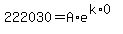 --> --> 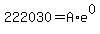 --> --> 
For the year 2010,  , ,  , and , and
 --> --> 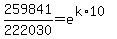 --> --> 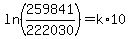 --> --> 
That is the exact value.
  or or  . .
We could write the growth function as
 , or , or
 , or , or
 , or , or 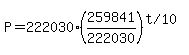 , ,
or maybe use the approximate value for k, and write it as

We can calculate the projected population in 2010 and 2020, using the equations found above.
For 2010, . Substituting that value into , we get
 (rounded to whole number). (rounded to whole number).
However using  , we get , we get
   (rounded to whole number). (rounded to whole number).
To match all 6 digits in the population for 2010, we need the exact value of , or at least a better approximation and we need to carry more digits through the calculations.
For 2020  , substituting it into we get , substituting it into we get
 . .
Rounding to whole numbers, we get that the projected population in 2020 is  . .
If we use the more accurate 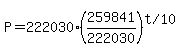 , we get , we get
 . .
Rounding to whole numbers, we get that the projected population in 2020 is .
Using the equation with the exact value of , , we could set  and solve for . and solve for .
We get
 --> --> --> --> (rounded to 3 decimal places). (rounded to 3 decimal places).
Rounding to whole numbers, it takes  years for the population to double at the rate observed between 2000 and 2010. years for the population to double at the rate observed between 2000 and 2010.
| |
|
