Question 158: If an aircraft pilot wishes to fly to a city that is N20'E of the airport. A wind is blowing at 60KM /hour from the northwest. If the airplane has a cruising speed of 520 km/hour find:
a) the direction in which the airplane should face
b) the actual ground speed of the airplane
Answer by KMST(5484)   (Show Source):
You can put this solution on YOUR website! The destination city is  East of North, as the arrow shows.
The wind is from the northwest. No angle is given,
so I will assume it comes between North and West, at a  .
The speed of the wind is 60 km per hour (60kph) with respect to the ground,
and the airplane can move at 520kph with respect to the air.
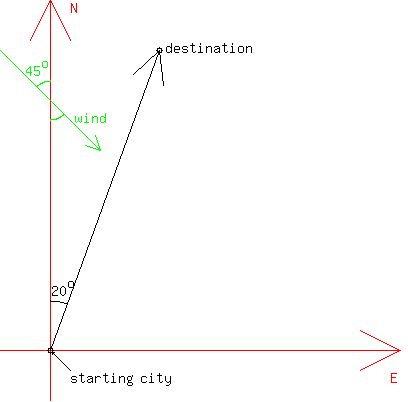
If the pilot points the nose of the plane in the direction of the destination city,
that wind will push him East and the plane will pass to the East of that city.
It will never be above the destination city.
The pilot must point the nose at some angle to the West,
so that the velocity vectors of plane and wind result in a trajectory
vector that points to the destination city.
We have the directions of 2 vectors (for wind and trajectory to destination).
The trajectory to the destination forms a angle with the North direction.
The wind direction forms a angle with the north direction.
Those 3 directions form a triangle with red, green, and black sides.
The other angle of that triangle is the angle between wind and trajectory,
and its measure is 
How could we find the direction of the vector for airplane heading (direction the nose of the plain is pointing),
the direction of the vector for plane velocity relative to air.
We can say it forms an angle measuring  with the North direction, and try to find  .
 Now we have a triangle with sides in blue, green, and black.
Those sides represent the vectors involved.
The blue side represents the velocity of the plane with respect to the air.
The green side represents the velocity of the wind with respect to the ground.
The velocities above add to represent the velocity of the plane with respect to the ground, represented by the black side.
The lengths of those sides represent the magnitude of those velocities.
The length of the blue side represent  .
The length of the green side represents the wind speed.
Can we solve that triangle?
For that triangle, Law of Sines says that
  
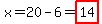
Using  , we get
 -->  --> 
Our blue, green and black triangle has angles measuring  and  .
The remaining angle must measure  .
The length  of the black side,
representing the speed of the plane with respect to the ground
can also be found using Law of Sines, and 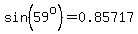 (rounded):
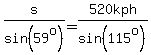 --> 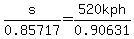 -->  (rounded).
| |
|
