Question 1197640: Solve for θ. 0° ≤ θ ≤ 360°.
1. (sin^2)θ + (1/(sin^2)θ) + sinθ + (1/sinθ) = 4
I tried substituting m for sinθ but after simplifying I get 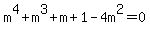 . I'm not sure what to do next? . I'm not sure what to do next?
Found 2 solutions by math_tutor2020, ikleyn:
Answer by math_tutor2020(3835)   (Show Source): (Show Source):
You can put this solution on YOUR website!

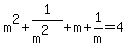 Let m = sin(theta) Let m = sin(theta)
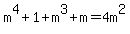 Multiply each term by the LCD m^2 to clear out the fractions. Multiply each term by the LCD m^2 to clear out the fractions.
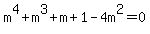
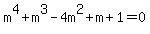
It appears you followed these steps, or similar to them, since you arrived at what I got shown above.
The steps are there to help any future student down the road with a similar problem.
----------------------------------------
The task is now solving for m.
Use the rational root theorem to find the only possible rational roots are: -1 and 1.
Test each possible root. If you plugged in m = -1, then you should find 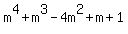 turns into turns into  . This shows m = -1 is NOT a root of the fourth degree polynomial. A root is some input that leads to an output of zero. . This shows m = -1 is NOT a root of the fourth degree polynomial. A root is some input that leads to an output of zero.
Try m = 1 and you should get 0 as a result.
This shows m = 1 is a root of the fourth degree polynomial.
This then means (m-1) is a factor of m^4+m^3-4m^2+m+1
Use either polynomial long division or synthetic division to find that

I skipped showing the steps, but let me know if you need to see them.
Then use the rational root theorem on 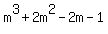 to find that m = 1 is a root of that as well. to find that m = 1 is a root of that as well.
It turns out m = 1 is a double root of
Use polynomial long division or synthetic division to find that

----------------------------------------
Overall, we can say

Each m-1 factor leads to m = 1 as a root
Which in turn means 
Use a chart, calculator, or the unit circle to find the only solution to is  where where 
You'll need the quadratic formula to compute the roots of 
I'll skip the steps, but you should have these two roots:
 and and 
They approximate to
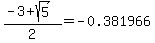 and and 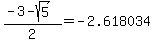
Therefore, we have these additional equations to solve for theta
 and and 
But wait, the second equation isn't possible since the range of sine is  . .
The lowest sine can get is -1, which means we can't reach -2.618034 unless we involve complex numbers.
I'll assume your teacher is working with the real number set only.
In short, we can rule out
I'll leave the task of solving to the student.
Hint: there are 2 solutions in the interval ; one in quadrant III and the other in quadrant IV
I recommend using the unit circle.
I also recommend graphing software like Desmos or GeoGebra to confirm that you found the correct roots of (there are 3 distinct roots). Furthermore, that graphing software should also verify each solution for the trig functions in terms of theta.
Answer by ikleyn(53756)  (Show Source): (Show Source):
You can put this solution on YOUR website! .
Solve for θ. 0° ≤ θ ≤ 360°.
(sin^2)θ+(1/(sin^2)θ)+sinθ+(1/sinθ)=4
~~~~~~~~~~~~~~~~~~
Introduce new variable x =  + +  .
Notice that .
Notice that  = =  + +  + 2;
so + = + 2;
so + =  .
THEREFORE, the original equation takes the form
+ x = 4,
or .
THEREFORE, the original equation takes the form
+ x = 4,
or
 = 0.
Factor left side
{x+3)*(x-2) = 0.
The roots are x= -3 and x= 2.
Next we consider two cases.
(a) if x= -3, it means + = -3, which implies = 0.
Factor left side
{x+3)*(x-2) = 0.
The roots are x= -3 and x= 2.
Next we consider two cases.
(a) if x= -3, it means + = -3, which implies
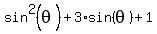 = 0, and then, due to the quadratic formula
= = 0, and then, due to the quadratic formula
= 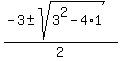 = =  .
It gives only one root = .
It gives only one root =  = -0.382 (rounded),
so = -0.382 (rounded),
so  = -arcsin(0.382) = 360° - 22.457° = 337.543°
or = 180° + arcsin(0.382) = 180° + 22.457° = 202.457°.
(b) if x= 2, it means + = 2, which implies = -arcsin(0.382) = 360° - 22.457° = 337.543°
or = 180° + arcsin(0.382) = 180° + 22.457° = 202.457°.
(b) if x= 2, it means + = 2, which implies
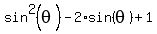 = 0, and then = 0, and then
 = 0.
It gives one root = 1 of multiplicity 2, so = 90° of multiplicity 2.
ANSWER. The solutions are = 90° of multiplicity 2, = 202.457° and = 337.543°. = 0.
It gives one root = 1 of multiplicity 2, so = 90° of multiplicity 2.
ANSWER. The solutions are = 90° of multiplicity 2, = 202.457° and = 337.543°.
Solved.
The key to the solution is the substitution made at the very beginning of my post.
It is a standard way to solve such equations, but far not everyone knows it.
It is what you need to learn from my solution: how it works.
|
|
|
