Tutors Answer Your Questions about Trigonometry-basics (FREE)
Question 278282: Hello my teacher gave my class a worksheet with this problem:
The lengths of two sides of a parallelogram are 6 inches and 10 inches and the angle between them measures 41 degrees. What is the length of the altitude on the long side?
Thanks for any help.
Answer by ikleyn(53748)   (Show Source): (Show Source):
You can put this solution on YOUR website! .
Hello, my teacher gave my class a worksheet with this problem:
The lengths of two sides of a parallelogram are 6 inches and 10 inches and the angle between them measures 41 degrees.
What is the length of the altitude on the long side?
Thanks for any help.
~~~~~~~~~~~~~~~~~~~~~~~~~~~~
This is a nice problem, and I will show you a remarkable method to solve it.
The solution and the answer in the post by @mananth are fatally incorrect.
It is fatally incorrect, because both the guiding idea (the conception) and calculations are wrong.
The idea is to use two different formulas for the area of the parallelogram.


One formula for the area of the parallelogram is

    area = a*b*sin(41°).     (1)


It says that the area of the parallelogram is the product of its two adjacent sides by the sine of the angle between them.
Another formula for the area of the parallelogram is

    area = a*h.             (2)


It says that the area of the parallelogram is the product of its base (one of the two adjacent sides)
by the altitude of the parallelogram h.


Thus we equate right sides in formulas (1) and (2)

    a*b*sin(41°) = a*h.


We then cancel the common factor 'a', and we get

    h = b*sin(41°).    (3)


Now from (3) we get the value of 'h'

    h = b*sin(41°) = 6*0.65605902899 = 3.936 inches  (rounded).
At this point, the problem is solved completely and correctly,
and you learned a new method for this problem.
Question 264217: A ladder leaning against a house makes an angle of 30 degrees with the ground. the foot of the ladder is 7 feet from the foot of the house. How long is the ladder to the nearest foot?
Answer by ikleyn(53748) (Show Source):
You can put this solution on YOUR website! .
A ladder leaning against a house makes an angle of 30 degrees with the ground.
the foot of the ladder is 7 feet from the foot of the house. How long is the ladder to the nearest foot?
~~~~~~~~~~~~~~~~~~~~~~~~~~~~
The solution by @mananth is incorrect: it uses wrong value of cosine.
I came to bring a correct solution.
Cos(30) = base / hypotenuse
0.866= 7/hypotenuse
hypotenuse = 7/0.866 = 8.08 meters, approximately. ANSWER
Solved correctly.
Question 1004151: you are standing at the top of a 500m tall building. across the street is a shorter building. at ground level, the two buildings are 50 meters apart, and if you measure the angle of depression from the top of your building to the nearest edge of the shorter building, you get an angle of pi/6. how tall is the other building?
a) 500 - 50 sqrt 2 meters
b) 500 - 50/sqrt 2 meters
c) 500 - 25/sqrt 2 meters
d) 500-50/sqrt 3 meters
e) 500 - 25 sqrt 2 meters
f) 500 - 50 sqrt 3 meters
Found 2 solutions by josgarithmetic, ikleyn:
Answer by josgarithmetic(39792) (Show Source):
Answer by ikleyn(53748) (Show Source):
You can put this solution on YOUR website! .
you are standing at the top of a 500m tall building. across the street is a shorter building.
at ground level, the two buildings are 50 meters apart, and if you measure the angle of depression
from the top of your building to the nearest edge of the shorter building, you get an angle of pi/6.
how tall is the other building?
~~~~~~~~~~~~~~~~~~~~~~~~
The answer in the post by @mananth,  , is INCORRECT. , is INCORRECT.
The correct answer is  meters. meters.
Option (d).
Question 1026266: Assume that a is an angle in standard position whose terminal side contains the point (sqrt 6, -sqrt 2). Find the exact values of the 6 trig. functions
Answer by ikleyn(53748) (Show Source):
Question 890524: My question was log of sqrt (x (sqrt (2y (sqrt (z))))
What I did was (1/2)logx sqrt (2y (sqrt (z))
(1/2)logx(1/4)logy^2 sqrt (z)
(1/2)logx(1/4)logy^2(1/8)logz
Then factored that to (1/2)[logx(1/2)logy^2(1/4)logz]
But my professor counted it as wrong and I hope it's not too confusing the way that I typed it but the formula system wouldn't work for me. I just wanted to see where I went wrong with this question. Thank you!
Answer by MathTherapy(10806)  (Show Source): (Show Source):
Question 667117: Use an Addition or Subtraction Formula to find the exact value of the expression.
sin( -5π/12)
Found 2 solutions by greenestamps, MathTherapy:
Answer by greenestamps(13327)  (Show Source): (Show Source):
Answer by MathTherapy(10806) (Show Source):
Question 1028370: Use a product-to-sum formula to find the exact value of the expression. Do not use a calculator.
cos 5π/12 sin π/12
Answer by MathTherapy(10806) (Show Source):
Question 1114896: Given: cos (-105)
Find the exact value of the function without the use of a calculator.
I was unsure what to do with a negative, but from examples, I did the following where it "ignores" the negative.
cos (105) = cos (135 - 30)

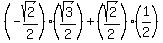

Final Answer: 
If the final answer is right, why does the (-) go away and if that procedure is incorrect how would you split up the -105? Thank you for any help!
Answer by MathTherapy(10806) (Show Source):
You can put this solution on YOUR website!
Given: cos (-105)
Find the exact value of the function without the use of a calculator.
I was unsure what to do with a negative, but from examples, I did the following where it "ignores" the negative.
cos (105) = cos (135 - 30)
Final Answer:
If the final answer is right, why does the (-) go away and if that procedure is incorrect how would you split up
the -105? Thank you for any help!
=================================
You're applying the DIFFERENCE of 2 angles here, which does give you
 . However, the NEGATIVE is NOT IGNORED/does NOT just DISAPPEAR.
<==== You got up to this point . However, the NEGATIVE is NOT IGNORED/does NOT just DISAPPEAR.
<==== You got up to this point
 , which is EQUAL to, or the SAME as: , which is EQUAL to, or the SAME as:  .
YOUR Final Answer: .
YOUR Final Answer:  Looking at the 2 expressions ABOVE, one can clearly see that they're the SAME.
**Note:
You asked how the cos (- 105) could be SPLIT, if your answer is incorrect. Your answer isn't incorrect, as stated
above, but another SPLIT would be cos (- 105) = cos (- 60 - 45), or {cos [(- 60) + (- 45)]}, which would then
involve the SUM of 2 angles. Nonetheless, this yields the same result!
Looking at the 2 expressions ABOVE, one can clearly see that they're the SAME.
**Note:
You asked how the cos (- 105) could be SPLIT, if your answer is incorrect. Your answer isn't incorrect, as stated
above, but another SPLIT would be cos (- 105) = cos (- 60 - 45), or {cos [(- 60) + (- 45)]}, which would then
involve the SUM of 2 angles. Nonetheless, this yields the same result!
Question 455264: Solve the equation for x: 2log base 5 of x + log base 5 of 3 = log base 5(1/125)
Answer by MathTherapy(10806) (Show Source):
Question 1164806: Solve for theta:sin-sec+csn-tan2=-0.0866
Answer by CPhill(2189)  (Show Source): (Show Source):
You can put this solution on YOUR website! It appears there are a few typos in your expression. Based on standard trigonometric shorthand, I will interpret your equation as:
If "csn" was meant to be **** and "tan2" meant ****, we can solve it as follows:
### 1. Simplify the Trigonometric Terms
First, let's rewrite everything in terms of and to see if the expression simplifies.
*
*
Now, substitute these back into the equation:
### 2. Find a Common Denominator
Since , the equation becomes:
### 3. Solve for
This is a transcendental equation, which usually requires numerical methods or a graphing calculator to solve precisely. However, we can test small values since is close to zero.
If we let :
* If , then .
* Since the result is slightly negative (), must be a small negative angle.
Using the small-angle approximation where and :
Using the quadratic formula :
### 4. Convert to Degrees
Checking this in the original equation:
(Very close to ).
**Solution:**
*(Note: If the "tan2" in your prompt meant or if "csn" meant something else, the solution would change.)*
**Would you like me to re-calculate this using a different interpretation of the symbols?**
Question 1159153: Alayna is trying to determine the angle at which to aim her sprinkler nozzle to water the top of a 5 ft bush in her yard. Assuming the water takes a straight path and the sprinkler is on the ground 4 ft from the bush, at what angle of inclination should she set it?
Answer by jsmallt9(3759) (Show Source):
You can put this solution on YOUR website! There is a right triangle in this problem. The vertices are the top of the bush, and, on the ground, the sprinkler and the base of the bush. The right angle is the angle between the bush and the ground.
From the perspective of the angle where the sprinkler is, the angle of inclination, the height of the bush is the opposite side and the side from the sprinkler to the base of the bush would be the adjacent side.
Since we know the opposite and adjacent sides of this triangle, we can use a tan (or cot or inverse tan or inverse cot equation to solve this problem. Since we're looking for an angle we'll use an inverse function and since our calculator (probably) does not have an inverse cot button, we will use inverse tan:
angle = 
Entering this into our calculator we should get approx. 51.3 degrees or 0.896 radians.
Question 1205048: a hawk sitting on a tree branch spots a mouse on the ground 15 feet from the base of the tree. the hawk swoops down toward the mouse at an angle of 30 degree. what is the distance from the tree branch to the mouse?
Answer by ikleyn(53748) (Show Source):
Question 827122: log base 16 of x + log base 4 of x + log base 2 of x = 7
solve for x
Answer by MathTherapy(10806) (Show Source):
Question 730613: From the top of a 210-ft lighthouse, the angle of depression to a ship in the ocean is 15 degrees. How far is the ship from the base of the lighthouse?
A. 874ft
B. 478ft
C. 784ft
D. 748ft
Answer by ikleyn(53748) (Show Source):
You can put this solution on YOUR website! .
From the top of a 210-ft lighthouse, the angle of depression to a ship in the
ocean is 15 degrees. How far is the ship from the base of the lighthouse?
A. 874ft
B. 478ft
C. 784ft
D. 748ft
~~~~~~~~~~~~~~~~~~~~~~
An equation to use is
h = d*tan(a),
where h is the height of the lighthouse and d is the distance from the ship to the base of the lighthouse.
We assume that the Earth is flat (and the water surface in the ocean is flat, too) and that
the base of the lighthouse is at the level of water surface.
So, our equation is
210 = d*tan(15°),
d =  = = 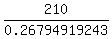 = 783.73 feet.
ANSWER. The closest answer in the list is option (C). = 783.73 feet.
ANSWER. The closest answer in the list is option (C).
Solved.
/\/\/\/\/\/\/\/\/\/\/\/
The answer in the post by @lynnlo is incorrect.
Simply ignore it.
Question 1162547: Write the partial fraction decomposition of the following rational expression.
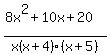
Answer by MathTherapy(10806) (Show Source):
You can put this solution on YOUR website!
Write the partial fraction decomposition of the following rational expression.
The other person is WRONG!!
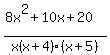 = = 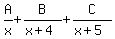 =
=  --- Multiplying right-side by LCD, x(x + 4)(x + 5) --- Multiplying right-side by LCD, x(x + 4)(x + 5)
 --- Equating NUMERATORS, since DENOMINATORS are same --- Equating NUMERATORS, since DENOMINATORS are same
 ------ Substituting - 5 for x, to determine the value of C
8(25) - 50 + 20 = 0 + 0 + C(- 5)(- 5 + 4)
200 - 50 + 20 = C(- 5)(- 1)
170 = 5C ------ Substituting - 5 for x, to determine the value of C
8(25) - 50 + 20 = 0 + 0 + C(- 5)(- 5 + 4)
200 - 50 + 20 = C(- 5)(- 1)
170 = 5C
 = 34 = C = 34 = C
 ------ Substituting - 4 for x, to determine the value of B
8(16) - 40 + 20 = 0 + B(- 4)(- 4 + 5) + 0
128 - 40 + 20 = B(- 4)(1)
108 = - 4B ------ Substituting - 4 for x, to determine the value of B
8(16) - 40 + 20 = 0 + B(- 4)(- 4 + 5) + 0
128 - 40 + 20 = B(- 4)(1)
108 = - 4B
 = - 27 = B = - 27 = B
 ------ Substituting 1 for x, 34 for C, and - 27 for B, to determine the value of A
8(1) + 10 + 20 = A(5)(6) - 27(1)(6) + 34(1)(5)
8 + 10 + 20 = 30A - 162 + 170
38 = 30A + 8
38 - 8 = 30A
30 = 30A ------ Substituting 1 for x, 34 for C, and - 27 for B, to determine the value of A
8(1) + 10 + 20 = A(5)(6) - 27(1)(6) + 34(1)(5)
8 + 10 + 20 = 30A - 162 + 170
38 = 30A + 8
38 - 8 = 30A
30 = 30A
 = 1 = A
So, (A, B, C) = (1, - 27, 34)
We then get: = 1 = A
So, (A, B, C) = (1, - 27, 34)
We then get: 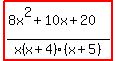 = = = = 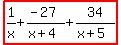
Question 730721: Can you help me prove this trigonometic identity?:
(sinƟcosƟ)/(cos^2Ɵ-sin^2Ɵ)=tanƟ/(1-tan^2Ɵ)
Answer by ikleyn(53748) (Show Source):
You can put this solution on YOUR website! .
Can you help me prove this trigonometic identity?:
(sinƟcosƟ)/(cos^2Ɵ-sin^2Ɵ)=tanƟ/(1-tan^2Ɵ)
~~~~~~~~~~~~~~~~~~~~~~~~~~~~~~~~~~~~~~~
Divide both the numerator and the denominator by  . .
Question 731899: approximate the solution to tan θ on the interval [0,2pi)
Answer by ikleyn(53748) (Show Source):
Question 1165816: 1. Draw an angle with the given measure in standard position.
a.70° b. 300° c. 570° d. -450° e. -185°
1. Rewrite each degree measure in radians and each radians measure in degrees.
a. 3π/4 b.π/6 c.19π/3
2.The Earth rotates on its axis every 24 hours
a. How long does it take the Earth rotate through an angle of 315°?
b. How long does it take the Earth rotate through an angle π/6?
3.Find the measure of an angle between 0° and 360° coterminal with each given angle.Draw the angles.
a. 385°
b. 575°
c. -405°
d. 7π/3
Found 2 solutions by ikleyn, CPhill:
Answer by ikleyn(53748) (Show Source):
You can put this solution on YOUR website! .
Dear visitor
it is very bad idea to post more than one problem in one package with multiply sub-questions.
Memorize the rule "ONE and ONLY one problem per post",
and always follow this rule.
Never deviate from this rule, and you will be fine. -
much better than if you violate it.
Answer by CPhill(2189) (Show Source):
You can put this solution on YOUR website! 1. Draw an angle with the given measure in standard position.
a.70° b. 300° c. 570° d. -450° e. -185°
1. Rewrite each degree measure in radians and each radians measure in degrees.
a. 3π/4 b.π/6 c.19π/3
2.The Earth rotates on its axis every 24 hours
a. How long does it take the Earth rotate through an angle of 315°?
b. How long does it take the Earth rotate through an angle π/6?
3.Find the measure of an angle between 0° and 360° coterminal with each given angle.Draw the angles.
a. 385°
b. 575°
c. -405°
d. 7π/3
Question 1165687: Line Quadrant
y = −x
II
sin θ =
cos θ =
tan θ =
csc θ =
sec θ =
cot θ =
Answer by CPhill(2189) (Show Source):
You can put this solution on YOUR website! The line $y = -x$ passes through Quadrant II. To find the trigonometric values for an angle $\theta$ whose terminal side lies on this line in Quadrant II, we can choose any point on that segment of the line.
### 1. Identify a Point $(x, y)$
The line is $y = -x$. For the line to be in **Quadrant II**, the $x$-coordinate must be **negative** and the $y$-coordinate must be **positive**.
* Let $x = -1$.
* Then $y = -(-1) = 1$.
* The point on the terminal side of the angle is $\mathbf{(-1, 1)}$.
### 2. Calculate the Radius ($r$)
The distance from the origin $(0, 0)$ to the point $(x, y)$ is $r$, calculated using the distance formula:
$$r = \sqrt{x^2 + y^2}$$
$$r = \sqrt{(-1)^2 + (1)^2} = \sqrt{1 + 1} = \sqrt{2}$$
### 3. Determine the Trigonometric Ratios
Using the point $(-1, 1)$ and $r=\sqrt{2}$:
$$
\sin \theta = \frac{y}{r} \quad \cos \theta = \frac{x}{r} \quad \tan \theta = \frac{y}{x}
$$
| Trigonometric Function | Ratio | Value | Rationalized Value |
| :---: | :---: | :---: | :---: |
| **$\sin \theta$** | $y/r$ | $1/\sqrt{2}$ | $\mathbf{\sqrt{2}/2}$ |
| **$\cos \theta$** | $x/r$ | $-1/\sqrt{2}$ | $\mathbf{-\sqrt{2}/2}$ |
| **$\tan \theta$** | $y/x$ | $1/(-1)$ | $\mathbf{-1}$ |
| **$\csc \theta$** | $r/y$ | $\sqrt{2}/1$ | $\mathbf{\sqrt{2}}$ |
| **$\sec \theta$** | $r/x$ | $\sqrt{2}/(-1)$ | $\mathbf{-\sqrt{2}}$ |
| **$\cot \theta$** | $x/y$ | $-1/1$ | $\mathbf{-1}$ |
***
*Note: The angle $\theta$ represented here is $135^\circ$ or $3\pi/4$ radians.*
Question 1165712: For the function f(x) = tan x, show that f(x+y)
- f(x)= sec^2 x tan y/1-tan x tan y
Answer by CPhill(2189) (Show Source):
You can put this solution on YOUR website! The equation you provided, $f(x+y) - f(x) = \frac{\sec^2 x \tan y}{1 - \tan x \tan y}$, is incorrect or requires a different approach to prove. The correct simplification for the left-hand side is generally simpler.
Here is the correct derivation for $f(x+y) - f(x)$ and an explanation of the identity you provided.
---
## 1. Correct Derivation for $f(x+y) - f(x)$
Given $f(x) = \tan x$, the expression $f(x+y) - f(x)$ is:
$$f(x+y) - f(x) = \tan(x+y) - \tan x$$
Using the tangent addition formula, $\tan(x+y) = \frac{\tan x + \tan y}{1 - \tan x \tan y}$:
$$\tan(x+y) - \tan x = \frac{\tan x + \tan y}{1 - \tan x \tan y} - \tan x$$
To combine the terms, find a common denominator:
$$\frac{\tan x + \tan y}{1 - \tan x \tan y} - \frac{\tan x (1 - \tan x \tan y)}{1 - \tan x \tan y}$$
Combine the numerators:
$$\frac{(\tan x + \tan y) - (\tan x - \tan^2 x \tan y)}{1 - \tan x \tan y}$$
Distribute the negative sign in the numerator:
$$\frac{\tan x + \tan y - \tan x + \tan^2 x \tan y}{1 - \tan x \tan y}$$
The $\tan x$ terms cancel out:
$$\frac{\tan y + \tan^2 x \tan y}{1 - \tan x \tan y}$$
Factor out $\tan y$ from the numerator:
$$\frac{\tan y (1 + \tan^2 x)}{1 - \tan x \tan y}$$
Finally, use the Pythagorean identity $\mathbf{1 + \tan^2 x = \sec^2 x}$:
$$f(x+y) - f(x) = \frac{\sec^2 x \tan y}{1 - \tan x \tan y}$$
## 2. Conclusion
The identity you asked to show, $\mathbf{f(x+y) - f(x) = \frac{\sec^2 x \tan y}{1 - \tan x \tan y}}$, is **correct**.
Your expression:
$$\mathbf{LHS: f(x+y) - f(x)}$$
Your proposed result:
$$\mathbf{RHS: \frac{\sec^2 x \tan y}{1 - \tan x \tan y}}$$
Since the derivation of $f(x+y) - f(x)$ leads directly to $\frac{\sec^2 x \tan y}{1 - \tan x \tan y}$, the identity is proven.
Question 733683: Dermont and tony are competing to see whose house is the tallest. Early in the afternoon, tony, who is 4 feet tall, measured his shadow to be 9.6 inches and the shadow of his house to be 62.4 inches. Later in the day, dermont, who is five feet all, measured his shadow to be 15.6 inches and the shadow of his house to be 62.4 inches. Who lives in the taller house?
Answer by ikleyn(53748) (Show Source):
You can put this solution on YOUR website! .
Dermont and tony are competing to see whose house is the tallest.
Early in the afternoon, Tony, who is 4 feet tall, measured his shadow to be 9.6 inches
and the shadow of his house to be 62.4 inches.
Later in the day, Dermont, who is five feet all, measured his shadow to be 15.6 inches
and the shadow of his house to be 62.4 inches. Who lives in the taller house?
~~~~~~~~~~~~~~~~~~~~~~~~~~~~~~~~
We assume that all measurements relate to horizontal ground surface.
If so, then we write the proportion for the Tony's house height 'T'
 = =  ,
which gives the Tony's house height T = ,
which gives the Tony's house height T =  = 26 feet.
Next, we write the proportion for the Dermont's house height 'D' = 26 feet.
Next, we write the proportion for the Dermont's house height 'D'
 = =  ,
which gives the Dermont's house height D = ,
which gives the Dermont's house height D =  = 20 feet.
ANSWER. Tony's hous is taller. = 20 feet.
ANSWER. Tony's hous is taller.
Solved.
The solution in the post by @lynnlo is incorrect.
=======================================
The fact that measurements for the height-shadow are made at the different time of the day
does not interfere to write the proportions as they are written in my solution.
The triangles that are similar and should be similar and whose similarity is used,
remain similar at any time of measurements.
Question 733671: 1)Find all real numbers that satisfy the equation: cos x = square root 3 / 2.
2)Solve the equation: 6 cos(Alpha)+3=0 for 0degree
3)Find all real numbers in the interval[0,2pi) that satisfy the equation: cos^2x+2cosx+1=0.
4)Find all values of x in the interval [0degree,360 degree)that satisfy the equation. Round approximate answer to the nearest tenth of a degree: sin^2x+8sinx-4=0.
5)Find all angles in degrees that satisfy the equation: cos alpha=-0.609
Answer by ikleyn(53748) (Show Source):
You can put this solution on YOUR website! .
1) Find all real numbers that satisfy the equation: cos x = square root 3 / 2.
2) Solve the equation: 6 cos(Alpha)+3=0 for 0 degree < alpha < 360 degree.
3) Find all real numbers in the interval[0,2pi) that satisfy the equation: cos^2x+2cosx+1=0.
4) Find all values of x in the interval [0degree,360 degree)that satisfy the equation.
Round approximate answer to the nearest tenth of a degree: sin^2x+8sinx-4=0.
5) Find all angles in degrees that satisfy the equation: cos alpha=-0.609
~~~~~~~~~~~~~~~~~~~~~~~~~~~
NEVER pack more than one problem per post.
Question 1166568: At 12noon,a ship steaming steadily due east at 10knots, observed a light house at a bearing 060° and half an hour later the same light house is observed at a bearing of 040° . calculate the time to the nearest minutes at which the bearing will be 020° and the distance from the ship to the light house at this time.[take 1knots=1nautical mile per hour].
Answer by CPhill(2189) (Show Source):
You can put this solution on YOUR website! This is a navigation problem that can be solved using trigonometry. The ship's movement and the lighthouse form a series of right and non-right triangles.
Here is the step-by-step calculation.
## 🚢 Part 1: Establish Initial Triangle and Speed
* **Ship's Speed ($v$):** 10 knots (10 nautical miles/hour).
* **Initial Observation Time ($t_1$):** 12:00 PM.
* **Second Observation Time ($t_2$):** 12:30 PM (half an hour later).
* **Distance Travelled ($d$):** In 0.5 hours: $d = v \times t = 10 \text{ knots} \times 0.5 \text{ hr} = 5 \text{ nautical miles}$.
Let $L$ be the lighthouse, $P_1$ be the ship's position at 12:00 PM, and $P_2$ be the ship's position at 12:30 PM.
* $P_1 P_2 = 5$ n.m.
* $P_1$ bearing to $L$ is $060^\circ$.
* $P_2$ bearing to $L$ is $040^\circ$.
## 📐 Part 2: Find Angles in Triangle $P_1 P_2 L$
The ship sails **due east** (bearing $090^\circ$). The bearings are measured clockwise from North ($000^\circ$).
1. **Angle $\angle L P_1 P_2$:**
* Since the ship is moving East ($090^\circ$) and the lighthouse is at $060^\circ$, the angle between the ship's path and the line of sight $P_1 L$ is:
$$\angle L P_1 P_2 = 090^\circ - 060^\circ = 30^\circ$$
2. **Angle $\angle P_1 L P_2$:**
* The North lines at $P_1$ and $P_2$ are parallel. The angle between North and $P_1 L$ is $060^\circ$.
* The angle between the North line at $P_1$ and the ship's path $P_1 P_2$ is $090^\circ$.
* Using the alternate interior angles: The angle at $P_1$ between the North line and $P_1 L$ is $60^\circ$.
* The angle at $L$ between $P_1 L$ and the line extending North from $P_2$ (a parallel line) is $60^\circ$ (Alternate Interior Angles).
* The bearing at $P_2$ is $040^\circ$. The angle between the North line at $P_2$ and $P_2 L$ is $40^\circ$.
* Therefore, the angle $\angle P_1 L P_2$ is the difference between the two bearings:
$$\angle P_1 L P_2 = 060^\circ - 040^\circ = 20^\circ$$
3. **Angle $\angle L P_2 P_1$:**
* The sum of angles in $\triangle P_1 P_2 L$ is $180^\circ$.
* $$\angle L P_2 P_1 = 180^\circ - (\angle L P_1 P_2 + \angle P_1 L P_2)$$
* $$\angle L P_2 P_1 = 180^\circ - (30^\circ + 20^\circ) = 130^\circ$$
---
## 🧭 Part 3: Calculate Distance $P_2 L$
We use the **Law of Sines** on $\triangle P_1 P_2 L$ to find the distance $P_2 L$.
$$\frac{P_2 L}{\sin(\angle L P_1 P_2)} = \frac{P_1 P_2}{\sin(\angle P_1 L P_2)}$$
$$\frac{P_2 L}{\sin(30^\circ)} = \frac{5}{\sin(20^\circ)}$$
$$P_2 L = \frac{5 \times \sin(30^\circ)}{\sin(20^\circ)}$$
$$P_2 L = \frac{5 \times 0.5}{0.3420} \approx 7.310 \text{ n.m.}$$
---
## ⏱️ Part 4: Calculate Time to Bearing $020^\circ$
Let $P_3$ be the position where the bearing is $020^\circ$. Since the ship is moving East, $P_3$ will be East of $P_2$.
In $\triangle P_3 L P_2$:
* $\angle L P_3 P_2 = 090^\circ - 020^\circ = 70^\circ$.
* $\angle P_3 L P_2 = 040^\circ - 020^\circ = 20^\circ$.
* $\angle L P_2 P_3 = 180^\circ - (\angle L P_3 P_2 + \angle P_3 L P_2) = 180^\circ - (70^\circ + 20^\circ) = 90^\circ$.
Since $\angle L P_2 P_3 = 90^\circ$, this is a **right-angled triangle**!
### Calculate Distance $P_2 P_3$ (Distance to Travel)
We can use the cosine function in the right-angled $\triangle L P_2 P_3$:
$$\cos(\angle L P_3 P_2) = \frac{P_3 P_2}{L P_3}$$
This is missing $L P_3$. Use tangent:
$$\tan(\angle P_3 L P_2) = \frac{P_2 P_3}{P_2 L}$$
$$P_2 P_3 = P_2 L \times \tan(20^\circ)$$
$$P_2 P_3 = 7.310 \times 0.3640$$
$$P_2 P_3 \approx 2.659 \text{ n.m.}$$
### Calculate Time
Time required to travel $2.659$ n.m. at $10$ knots:
$$\text{Time} = \frac{\text{Distance}}{\text{Speed}} = \frac{2.659}{10} = 0.2659 \text{ hours}$$
Convert hours to minutes:
$$\text{Minutes} = 0.2659 \text{ hr} \times 60 \text{ min/hr} \approx 15.95 \text{ minutes}$$
**Time to the nearest minute:** $\mathbf{16 \text{ minutes}}$.
### Calculate Time of Observation
The time is 16 minutes after the second observation at 12:30 PM.
$$\text{Time} = 12:30:00 \text{ PM} + 00:16:00 = \mathbf{12:46 \text{ PM}}$$
---
## 📏 Part 5: Distance to Lighthouse at Time $P_3$
We need to find the distance $L P_3$. In the right-angled $\triangle L P_2 P_3$, we can use the sine function:
$$\sin(\angle P_3 L P_2) = \frac{P_2 P_3}{L P_3}$$
$$L P_3 = \frac{P_2 P_3}{\sin(20^\circ)} \text{ OR } \cos(\angle L P_3 P_2) = \frac{P_3 P_2}{L P_3}$$
Using the cosine relationship:
$$L P_3 = \frac{P_2 P_3}{\cos(70^\circ)}$$
$$L P_3 = \frac{2.659}{0.3420}$$
$$L P_3 \approx \mathbf{7.775 \text{ n.m.}}$$
---
## ✅ Final Answer
| Calculation | Result |
| :---: | :---: |
| Time elapsed from 12:30 PM | 16 minutes |
| **Time of $\mathbf{020^\circ}$ Bearing** | **12:46 PM** |
| **Distance from Ship to Lighthouse** | **7.78 n.m. (or 7.775 n.m.)** |
Question 734985: what is the period of y=2sin(2x)+cos(3x)
Answer by ikleyn(53748) (Show Source):
Question 734965: what is the exact value of cos 450
Answer by ikleyn(53748) (Show Source):
You can put this solution on YOUR website! .
what is the exact value of cos(450°) >
~~~~~~~~~~~~~~~~~~~~~~~~~~~
450°  is  360°  plus  90°.


Therefore, cos(450°) is the same as cos(90°), which is 0 (zero)>


ANSWER.  cos(450°) = cos(90°) = 0 (zero).
Solved.
Ignore the post by @lynnlo, since everything is wrong there.
Question 1210455: Skyball is a popular sport in the Magical Realm where the Chaser of each team is tasked with catching the Silver Orb. In today’s match, Lina and Kai are the Chasers for opposing teams. Kai is floating directly above Lina when both spot the Silver Orb. In this instance, Lina’s angle of elevation to the Orb is 35°, while Kai’s angle of depression to it is 42°. Meanwhile, Orin, seated 8.2 meters directly below the Orb, watches Lina with a 28° angle of elevation. (Show your illustration)
(a) What is the distance between Lina and the Silver Orb? How about between Kai and the Orb?
(b) Orin wants Kai’s team to win, so he magically lifts the Silver Orb 1.5 meters higher. How far is Kai from the Orb now?
Answer by KMST(5345)  (Show Source): (Show Source):
Question 736643: What is the simplified form of sin(x + pi)?
a. cos x b. sin x c. -sin x d. -cos x
Answer by ikleyn(53748) (Show Source):
You can put this solution on YOUR website! .
What is the simplified form of sin(x + pi)?
a. cos x b. sin x c. -sin x d. -cos x
~~~~~~~~~~~~~~~~~~~~~~~~~~~~~~~~~~~~~~~~
 = -sin(x).
ANSWER. Option (C). = -sin(x).
ANSWER. Option (C).
Solved.
This is written in opposition to @linnlo's post, which is wrong.
Question 742212: I need to find the sum of the following infinite series: ∑[n-0,∞,1/4^n]
(The n-0 is below the ∑, and the ∞ is above. The 1/4^n is one the right side of the ∑)
Thanks!
Answer by ikleyn(53748) (Show Source):
Question 720143: please help me solve the following trigonometric equation using Pythagorean identity formula:
1-sin^2theta=0.5
Answer by ikleyn(53748) (Show Source):
You can put this solution on YOUR website! .
please help me solve the following trigonometric equation using Pythagorean identity formula:
1 - sin^2theta = 0.5
~~~~~~~~~~~~~~~~~~~~~~~~~
The solution in the post by @Theo is incomplete, and therefore incorrect.
I came to provide a correct solution.
I will look for solutions in the interval [0°,360°), which represents the unit circle.
I will use the letter t to represent  .
The Pythagorean identify is sin^2(t) + cos^2(t) = 1.
You can write it in the form
cos^2(t) = 1 - sin^2(t).
You are given that 1 - sin^2(t) = 0.5.
Hence,
cos^2(t) = 0.5.
Take the square root of both sides of this equation to get:
cos(t) = +/- .
The Pythagorean identify is sin^2(t) + cos^2(t) = 1.
You can write it in the form
cos^2(t) = 1 - sin^2(t).
You are given that 1 - sin^2(t) = 0.5.
Hence,
cos^2(t) = 0.5.
Take the square root of both sides of this equation to get:
cos(t) = +/-  .
If cos(t) = + , then angle 't' is either 45° or -45°, which geometrically is the same as 315°.
If cos(t) = - , then angle 't' is either 135° or 225°.
Thus, in the interval [0°,360°) the given equation .
If cos(t) = + , then angle 't' is either 45° or -45°, which geometrically is the same as 315°.
If cos(t) = - , then angle 't' is either 135° or 225°.
Thus, in the interval [0°,360°) the given equation  = 0.5 has 4 (four) solutions
that are 45°, 135°, 225° and 315°. = 0.5 has 4 (four) solutions
that are 45°, 135°, 225° and 315°.
Solved.
If a student losing the roots while solving such equation, as tutor @Theo did,
it is considered as a grave sin. The score is cut, and the student is sent for re-training.
And such teaching as presented in the post by @Theo is considered as unsatisfactory.
Question 1210421: Consider the trigonometric function f(t) = 2 + 3 sin(4π(t − 1)).
(a) What is the amplitude of f(t)?
(b) What is the period of f(t)?
(c) What are the maximum and minimum values attained by f(t)?
(d) Sketch the graph of f(t) for t ∈ [−1, 1].
Answer by ikleyn(53748) (Show Source):
Question 578708: find the angle(s) that would make each statement true.
theta equals arc csc (sqrt of 2)
Answer by ikleyn(53748) (Show Source):
You can put this solution on YOUR website! .
Find the angle(s) that would make each statement true.
theta equals arc csc (sqrt of 2)
~~~~~~~~~~~~~~~~~~~~~~~~~~~~~~~~~~~~~~
The solution in the post by @Theo, giving two different possible measures 45 degrees or 135 degrees
for the angle is incorrect.
I came to bring a correct solution.
=  means, by the definition means, by the definition
 = =  and and  <= <= <= <=  .
For this standard definition, see, for example, this Wikipedia article
https://en.wikipedia.org/wiki/Inverse_trigonometric_functions
In turn, is cosecant
= .
For this standard definition, see, for example, this Wikipedia article
https://en.wikipedia.org/wiki/Inverse_trigonometric_functions
In turn, is cosecant
=  .
So, the problem wants you find angle such that
= and <= <= .
In other words, you want to find angle such that .
So, the problem wants you find angle such that
= and <= <= .
In other words, you want to find angle such that
 = =  = =  and <= <= .
There is only one such angle, and this angle is the standard and <= <= .
There is only one such angle, and this angle is the standard  of angles,
which students learn in Trigonometry course. Its measure is
= of angles,
which students learn in Trigonometry course. Its measure is
=  in radians, or = 45 degrees.
ANSWER. The angle satisfying the problem's condition is radians, or 45 degrees.
Such an angle is in radians, or = 45 degrees.
ANSWER. The angle satisfying the problem's condition is radians, or 45 degrees.
Such an angle is  . .
Solved.
------------------------------
Perhaps, tens, and hundreds, and thousands students failed to answer this simple question on exam.
To answer correctly, it is extremely important to know firmly the definitions .
Question 488238: sin 2x + cos 60 = 0, 0 < x < 360.
i have been able to find out that sin inverse of -1/2 is -30, but how do i find answers in the 3rd and fourth quadrant for 2x?? then i can find x. my answers are coming wrong, and i can apply no suitable rule. please help, and show working if possible.
Answer by ikleyn(53748) (Show Source):
You can put this solution on YOUR website! .
sin 2x + cos 60 = 0, 0 < x < 360.
i have been able to find out that sin inverse of -1/2 is -30, but how do i find answers in the 3rd and fourth quadrant
for 2x?? then i can find x. my answers are coming wrong, and i can apply no suitable rule. please help, and show
working if possible.
~~~~~~~~~~~~~~~~~~~~~~~~~~~~~~~~~~~
In the post by @Theo, you will not find the answers for x,
so, the reader is in the dark about how to complete the solution.
I came to make the job from the beginning to the end.
The starting equation is in degrees

    sin(2x) + cos(60°) = 0.


As you know, cos(60°) = -1/2,  so, you equation becomes

    sin(2x) + 1/2 = 0,  or  sin(2x) = -1/2.


You should know the table angles.  If sin(2x) = -1/2, it means
that angle 2x is in 3rd or 4th quadrant

    2x = 210°  or  2x = 330°.


It implies that  x = 210°/2 = 105°  or  x = 330°/3 = 165°.


ANSWER.  The given equation has two solutions,  x = 105°  and/or  x = 165°.
Solved from the beginning to the end, with complete explanations
(and without pronouncing unnecessary and excessive words).
Question 554415: Sorry i'm not sure if this is the right category for this question but its for year 12 specialist maths and is on reciprocal circular functions.
the question is sketch the graph of each of the following reciprocal circular function over the given domain
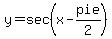 , , the < are supposed to be greater than or equal to signs the < are supposed to be greater than or equal to signs
i'm not quite sure how to find the dilation factor for one and for two i know that the period is 2pie/b but is b 1 or is it pie/2??
Answer by ikleyn(53748) (Show Source):
Question 1167299: The function graphed is of the form y=cos x + c, y=sin x + c, y=cos(x-d), or y= sin(x-d), where d is the least possible positive value. Determine the equation of the graph .
Answer by ikleyn(53748) (Show Source):
Question 1160369: Find a root of an equation f(x)=2coshxsinx-1 taking initial value x0=0.4, using Newton Raphson method correct up to four decimal places.
Do all the calculations.
Answer by ikleyn(53748) (Show Source):
You can put this solution on YOUR website! .
Find a root of an equation f(x)=2coshxsinx-1 taking initial value x0=0.4,
using Newton Raphson method correct up to four decimal places.
Do all the calculations.
~~~~~~~~~~~~~~~~~~~~~~~~~~~~~~~~~~~
As I read this post, I clearly see that it is created by a person,
who is unfamiliar with standard mathematical terminology.
Why ? - - - Because there is NO any equation in this post.
What you call " an equation ", is NOT an equation.
It is the definition of function f(x).
Therefore, the post needs to be re-formulated.
Question 1169789: Given a right pyramid ABCDE, on a square base ABCD, with AB = 8 cm, and height EO = 5 cm, what are the values of the following:
(a) angle EAB
(b) angle β between a slant edge and the plane on the base.
(c) angle θ between a slant face and the plane on the base.
Answer by ikleyn(53748) (Show Source):
You can put this solution on YOUR website! .
Given a right pyramid ABCDE, on a square base ABCD, with AB = 8 cm, and height EO = 5 cm,
what are the values of the following:
(a) angle EAB
(b) angle β between a slant edge and the plane on the base.
(c) angle θ between a slant face and the plane on the base.
~~~~~~~~~~~~~~~~~~~~~~~~~~~~~~~~
In the post by @CPhill, his answer to question (a) is INCORRECT;
his answer to question (b) is INNACCURATE.
I came to bring correct solutions and correct answers to posed questions.
Let F be the midpoint of the edge AB at the base of the pyramid.
(a) Then triangle EOF is a right-angled triangle (recall that point O is the foot
of the altitude EO, and is, at the same time, the center of the square ABCD).
Triangle EOF has the legs EO = 8/2 = 4 cm and OF = 5 cm.
Hence, the length of the hypotenuse EF is
EF =  = =  = =  cm.
Then tangent of angle EAB is cm.
Then tangent of angle EAB is  = =  = =  .
Hence, angle EAB is .
Hence, angle EAB is  = arctan() = 58.007183 degrees, approximately.
Thus, angle EAB is about 58 degrees.
(b) Angle = arctan() = 58.007183 degrees, approximately.
Thus, angle EAB is about 58 degrees.
(b) Angle  between a slant edge and the plane of the base is the angle EAO of triangle EAO.
This triangle is a right-angled triangle.
Its leg EO is 5 cm long; its leg OA is between a slant edge and the plane of the base is the angle EAO of triangle EAO.
This triangle is a right-angled triangle.
Its leg EO is 5 cm long; its leg OA is  cm long.
Therefore, cm long.
Therefore,  = =  .
Hence, = .
Hence, = 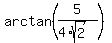 = arctan(0.883883476) = 41.4729343 degrees.
Thus, angle is about 41.47 degrees.
(c) angle between a slant face and the plane on the base is the angle EFO of triangle EFO.
Triangle EFO is a right-angled triangle.
Its leg EO is 5 cm long. Its leg OF is 4 cm long.
Therefore, = arctan(0.883883476) = 41.4729343 degrees.
Thus, angle is about 41.47 degrees.
(c) angle between a slant face and the plane on the base is the angle EFO of triangle EFO.
Triangle EFO is a right-angled triangle.
Its leg EO is 5 cm long. Its leg OF is 4 cm long.
Therefore,  = =  = tan(1.25)}}}.
Hence, = = tan(1.25)}}}.
Hence, =  = arctan(1.25) = 51.3401917 degrees.
Thus, angle is about 51.34 degrees.
ANSWER. Angle EAB is about 58 degrees.
Angle is about 41.47 degrees.
Angle is about 51.34 degrees. = arctan(1.25) = 51.3401917 degrees.
Thus, angle is about 51.34 degrees.
ANSWER. Angle EAB is about 58 degrees.
Angle is about 41.47 degrees.
Angle is about 51.34 degrees.
Solved correctly.
Question 1176289: A 6-string guitar is being strummed by a guitarist once. When he strummed the strings, he hit the 6th string
(topmost string) first and released it before hitting the 5th string consequently. The 6th string went back to its initial
position after 50 milliseconds from its initial position. When the 6th string reaches its maximum point, the 5th string
went back to its normal position for the first time. Assume an equal tension applied to both strings.
A. Find the equation of the 6th string and graph.
B. Find the equation of the 5th string and graph.
1. Assume that the 5th string is released when the 6th string went back to its initial position for the first time.
2. Assume that the oscillation of the 5th string started when the 6th string reached its maximum point.
Answer by ikleyn(53748) (Show Source):
Question 1177187: Owen is jumping on a trampoline. When his feet hit the deck of the trampoline, the material depresses to a minimum height of 2cm. On average, Owen is reaching a maximum height of 200cm every 10 seconds. Determine the equation of a sinusoidal function that would model this situation, assuming Owen reaches his first maximum at 6 seconds.
Answer by ikleyn(53748) (Show Source):
You can put this solution on YOUR website! .
Owen is jumping on a trampoline. When his feet hit the deck of the trampoline, the material depresses
to a minimum height of 2cm. On average, Owen is reaching a maximum height of 200cm every 10 seconds.
Determine the equation of a sinusoidal function that would model this situation, assuming Owen reaches his first maximum at 6 seconds.
~~~~~~~~~~~~~~~~~~~~~~~~~~~~~~~~~~~~~
The answer in the post by @CPhill is INCORRECT.
The function h(t) = 99*sin((π/5)(t-6)) + 101 in the post by @CPhill
does not satisfy the condition " Owen reaches his first maximum at 6 seconds ".
A correct answer, satisfying all problem's conditions, is
h(t) = 99*cos((π/5)(t-6)) + 101.
Although this formula contains the cosine function, nevertheless,
it belongs to the class of so called " sinusoidal functions ".
\\\\\\\\\\\\\\\\\\\\\\\\\\\\\\\\\\\\\
Regarding the post by @CPhill . . .
Keep in mind that @CPhill is a pseudonym for the Google artificial intelligence.
The artificial intelligence is like a baby now. It is in the experimental stage
of development and can make mistakes and produce nonsense without any embarrassment.
It has no feeling of shame - it is shameless.
This time, again, it made an error.
Although the @CPhill' solutions are copy-paste Google AI solutions, there is one essential difference.
Every time, Google AI makes a note at the end of its solutions that Google AI is experimental
and can make errors/mistakes.
All @CPhill' solutions are copy-paste of Google AI solutions, with one difference:
@PChill never makes this notice and never says that his solutions are copy-past that of Google.
So, he NEVER SAYS TRUTH.
Every time, @CPhill embarrassed to tell the truth.
But I am not embarrassing to tell the truth, as it is my duty at this forum.
And the last my comment.
When you obtain such posts from @CPhill, remember, that NOBODY is responsible for their correctness,
until the specialists and experts will check and confirm their correctness.
Without it, their reliability is ZERO and their creadability is ZERO, too.
Question 1179653: https://gyazo.com/848645a235363970dae8196a58a2bbdc
Answer by ikleyn(53748) (Show Source):
You can put this solution on YOUR website! .
https://gyazo.com/848645a235363970dae8196a58a2bbdc
~~~~~~~~~~~~~~~~~~~~~~~~~~~~~~~~~~~~~~~~~~~~~~~~~~~~~~
This solution by @CPhill is irrelevant to the posed problem.
Question 1182678: The area bounded by y = 3, x = 2, y = -3 and x = 0 is revolved about the y-axis.
The moment of inertia of the solid is
Answer by ikleyn(53748) (Show Source):
Question 1121000: Solve the system: 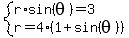
Answer by mccravyedwin(421)  (Show Source): (Show Source):
You can put this solution on YOUR website!
This is a problem I solved many years ago, maybe 10 years ago. I am using it to
inform you tutors about some history of this site.

I picked a random date, October 16, 2020. At present the posts that you see on
the problem page were posted 4.5 years ago on October 16, 2020 are these:

1167408 (2020-10-16 05:27:24)
1167440 (2020-10-16 11:36:06)
1167453 (2020-10-16 13:36:10)
1167480 (2020-10-16 21:39:15)

Notice that the earliest one of those posted on that date at 5:27 AM was
numbered 1167408, and the last one posted on that date at 9:39 PM was numbered
1167480.

That means that on that date between 5:27 AM and 9:39PM there were 73 problems
posted. Can you believe?  I can because I remember.  Most of the 73 problems
posted on that date were solved by the many tutors who were around back then.
The posted problems that are still there now are the ones that the tutors back
then either didn't get to or weren't as interesting as the ones the tutors chose
to solve -- before they scrolled off.

I've been here since this site first opened way back in the early 2000's.  This
site was really hopping back then. I have seen many tutors come and go.

Now compare the fact that there were 73+ problems posted on October 16, 2020 to
the fact that 0 have been posted in the last few days!  Only the ads are keeping
this site going.  Perhaps some students are using this site as a source for
problems.  I don't know, but I fear this site is dying and is almost dead.

Since I've been here from the start, I'm just informing you about this site in
case you haven't figured out what's going on.

Cheers, Edwin
Question 1210270: Figure 12.36 shows a cross-section of a sheet of corrugated iron.

The sheet is a series of arcs of radius 10 cm., each arc subtending 120o at its centre.
If there are 14 such arcs in one sheet, how wide would the sheet be if flattened out?
Answer by Edwin McCravy(20077)  (Show Source): (Show Source):
|
Older solutions: 1..45, 46..90, 91..135, 136..180, 181..225, 226..270, 271..315, 316..360, 361..405, 406..450, 451..495, 496..540, 541..585, 586..630, 631..675, 676..720, 721..765, 766..810, 811..855, 856..900, 901..945, 946..990, 991..1035, 1036..1080, 1081..1125, 1126..1170, 1171..1215, 1216..1260, 1261..1305, 1306..1350, 1351..1395, 1396..1440, 1441..1485, 1486..1530, 1531..1575, 1576..1620, 1621..1665, 1666..1710, 1711..1755, 1756..1800, 1801..1845, 1846..1890, 1891..1935, 1936..1980, 1981..2025, 2026..2070, 2071..2115, 2116..2160, 2161..2205, 2206..2250, 2251..2295, 2296..2340, 2341..2385, 2386..2430, 2431..2475, 2476..2520, 2521..2565, 2566..2610, 2611..2655, 2656..2700, 2701..2745, 2746..2790, 2791..2835, 2836..2880, 2881..2925, 2926..2970, 2971..3015, 3016..3060, 3061..3105, 3106..3150, 3151..3195, 3196..3240, 3241..3285, 3286..3330, 3331..3375, 3376..3420, 3421..3465, 3466..3510, 3511..3555, 3556..3600, 3601..3645, 3646..3690, 3691..3735, 3736..3780, 3781..3825, 3826..3870, 3871..3915, 3916..3960, 3961..4005, 4006..4050, 4051..4095, 4096..4140, 4141..4185, 4186..4230, 4231..4275, 4276..4320, 4321..4365, 4366..4410, 4411..4455, 4456..4500, 4501..4545, 4546..4590, 4591..4635, 4636..4680, 4681..4725, 4726..4770, 4771..4815, 4816..4860, 4861..4905, 4906..4950, 4951..4995, 4996..5040, 5041..5085, 5086..5130, 5131..5175, 5176..5220, 5221..5265, 5266..5310, 5311..5355, 5356..5400, 5401..5445, 5446..5490, 5491..5535, 5536..5580, 5581..5625, 5626..5670, 5671..5715, 5716..5760, 5761..5805, 5806..5850, 5851..5895, 5896..5940, 5941..5985, 5986..6030, 6031..6075, 6076..6120, 6121..6165, 6166..6210, 6211..6255, 6256..6300, 6301..6345, 6346..6390, 6391..6435, 6436..6480, 6481..6525, 6526..6570, 6571..6615, 6616..6660, 6661..6705, 6706..6750, 6751..6795, 6796..6840, 6841..6885, 6886..6930, 6931..6975, 6976..7020, 7021..7065, 7066..7110, 7111..7155, 7156..7200, 7201..7245, 7246..7290, 7291..7335, 7336..7380, 7381..7425, 7426..7470, 7471..7515, 7516..7560, 7561..7605, 7606..7650, 7651..7695, 7696..7740, 7741..7785, 7786..7830, 7831..7875, 7876..7920, 7921..7965, 7966..8010, 8011..8055, 8056..8100, 8101..8145, 8146..8190, 8191..8235, 8236..8280, 8281..8325, 8326..8370, 8371..8415, 8416..8460, 8461..8505, 8506..8550, 8551..8595, 8596..8640, 8641..8685, 8686..8730, 8731..8775, 8776..8820, 8821..8865, 8866..8910, 8911..8955, 8956..9000, 9001..9045, 9046..9090, 9091..9135, 9136..9180, 9181..9225, 9226..9270, 9271..9315, 9316..9360, 9361..9405, 9406..9450, 9451..9495, 9496..9540, 9541..9585, 9586..9630, 9631..9675, 9676..9720, 9721..9765, 9766..9810, 9811..9855, 9856..9900, 9901..9945, 9946..9990, 9991..10035, 10036..10080, 10081..10125, 10126..10170, 10171..10215, 10216..10260, 10261..10305, 10306..10350, 10351..10395, 10396..10440, 10441..10485, 10486..10530, 10531..10575, 10576..10620, 10621..10665, 10666..10710, 10711..10755, 10756..10800, 10801..10845, 10846..10890, 10891..10935, 10936..10980, 10981..11025, 11026..11070, 11071..11115, 11116..11160, 11161..11205, 11206..11250, 11251..11295, 11296..11340, 11341..11385, 11386..11430, 11431..11475, 11476..11520, 11521..11565, 11566..11610, 11611..11655, 11656..11700, 11701..11745, 11746..11790, 11791..11835, 11836..11880, 11881..11925, 11926..11970, 11971..12015, 12016..12060, 12061..12105, 12106..12150, 12151..12195, 12196..12240, 12241..12285, 12286..12330, 12331..12375, 12376..12420, 12421..12465, 12466..12510, 12511..12555, 12556..12600, 12601..12645, 12646..12690, 12691..12735, 12736..12780, 12781..12825, 12826..12870, 12871..12915, 12916..12960, 12961..13005, 13006..13050, 13051..13095, 13096..13140, 13141..13185, 13186..13230, 13231..13275, 13276..13320, 13321..13365, 13366..13410, 13411..13455, 13456..13500, 13501..13545, 13546..13590, 13591..13635, 13636..13680, 13681..13725, 13726..13770, 13771..13815, 13816..13860, 13861..13905, 13906..13950, 13951..13995, 13996..14040, 14041..14085, 14086..14130, 14131..14175, 14176..14220, 14221..14265, 14266..14310, 14311..14355, 14356..14400, 14401..14445, 14446..14490, 14491..14535, 14536..14580, 14581..14625, 14626..14670, 14671..14715, 14716..14760, 14761..14805, 14806..14850, 14851..14895, 14896..14940, 14941..14985, 14986..15030, 15031..15075, 15076..15120, 15121..15165, 15166..15210, 15211..15255, 15256..15300, 15301..15345, 15346..15390, 15391..15435, 15436..15480, 15481..15525, 15526..15570, 15571..15615, 15616..15660, 15661..15705, 15706..15750, 15751..15795, 15796..15840, 15841..15885, 15886..15930, 15931..15975, 15976..16020, 16021..16065, 16066..16110, 16111..16155, 16156..16200, 16201..16245, 16246..16290, 16291..16335, 16336..16380, 16381..16425, 16426..16470, 16471..16515, 16516..16560, 16561..16605, 16606..16650, 16651..16695, 16696..16740, 16741..16785, 16786..16830, 16831..16875, 16876..16920, 16921..16965, 16966..17010, 17011..17055, 17056..17100, 17101..17145, 17146..17190, 17191..17235, 17236..17280, 17281..17325, 17326..17370, 17371..17415, 17416..17460, 17461..17505, 17506..17550, 17551..17595, 17596..17640, 17641..17685, 17686..17730, 17731..17775, 17776..17820, 17821..17865, 17866..17910, 17911..17955, 17956..18000, 18001..18045, 18046..18090, 18091..18135, 18136..18180, 18181..18225, 18226..18270, 18271..18315, 18316..18360, 18361..18405, 18406..18450, 18451..18495, 18496..18540, 18541..18585, 18586..18630, 18631..18675, 18676..18720, 18721..18765, 18766..18810, 18811..18855, 18856..18900, 18901..18945, 18946..18990, 18991..19035, 19036..19080, 19081..19125, 19126..19170, 19171..19215, 19216..19260, 19261..19305, 19306..19350, 19351..19395, 19396..19440, 19441..19485, 19486..19530, 19531..19575, 19576..19620, 19621..19665, 19666..19710, 19711..19755, 19756..19800, 19801..19845, 19846..19890, 19891..19935, 19936..19980, 19981..20025, 20026..20070, 20071..20115, 20116..20160, 20161..20205, 20206..20250, 20251..20295, 20296..20340, 20341..20385, 20386..20430, 20431..20475, 20476..20520, 20521..20565, 20566..20610, 20611..20655, 20656..20700, 20701..20745, 20746..20790, 20791..20835, 20836..20880, 20881..20925, 20926..20970, 20971..21015, 21016..21060, 21061..21105, 21106..21150, 21151..21195, 21196..21240, 21241..21285, 21286..21330, 21331..21375, 21376..21420, 21421..21465, 21466..21510, 21511..21555, 21556..21600, 21601..21645, 21646..21690, 21691..21735, 21736..21780, 21781..21825, 21826..21870, 21871..21915, 21916..21960, 21961..22005, 22006..22050, 22051..22095, 22096..22140, 22141..22185, 22186..22230, 22231..22275, 22276..22320, 22321..22365, 22366..22410, 22411..22455, 22456..22500, 22501..22545, 22546..22590, 22591..22635, 22636..22680, 22681..22725, 22726..22770, 22771..22815, 22816..22860, 22861..22905, 22906..22950, 22951..22995, 22996..23040, 23041..23085, 23086..23130, 23131..23175, 23176..23220, 23221..23265, 23266..23310, 23311..23355, 23356..23400, 23401..23445, 23446..23490, 23491..23535, 23536..23580, 23581..23625, 23626..23670, 23671..23715, 23716..23760, 23761..23805, 23806..23850, 23851..23895, 23896..23940, 23941..23985, 23986..24030, 24031..24075, 24076..24120, 24121..24165, 24166..24210, 24211..24255, 24256..24300, 24301..24345, 24346..24390, 24391..24435, 24436..24480, 24481..24525, 24526..24570, 24571..24615, 24616..24660, 24661..24705, 24706..24750, 24751..24795, 24796..24840, 24841..24885, 24886..24930, 24931..24975, 24976..25020, 25021..25065, 25066..25110, 25111..25155, 25156..25200, 25201..25245, 25246..25290, 25291..25335, 25336..25380, 25381..25425
|
