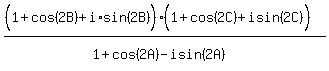
 We REALize the denominator by multiplying by the conjugate of the
denominator over itself:
We REALize the denominator by multiplying by the conjugate of the
denominator over itself:

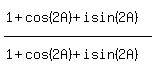
 The denominator could be simplified but we don't need to because it
is the sum of two squares which is real and positive. So we only
need to show that the numerator is real and positive as well.
Numerator =
The denominator could be simplified but we don't need to because it
is the sum of two squares which is real and positive. So we only
need to show that the numerator is real and positive as well.
Numerator =
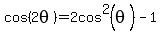
 We use the double-angle identities:
 Numerator =



 These are complex numbers in polar or trig form, so we multiply the magnitudes and add the angles:
 Since B, C, and A are angles of a triangle, B+C+A = 180° or
 Since
Since  and
and 

 , which is real.
So we only need to show that this is positive.
Since we are told that a² > b²+c², This makes the longest side
greater than the hypotenuse of a right triangle with sides b
and c, which means that angle A is greater than 90°, an obtuse
angle. An obtuse angle is a QII angle which has a negative
cosine.
Therefore cos(A) is negative, and since a triangle with one
obtuse angle has the other two angles acute.
So cos(A) < 0, cos(B) > 0, cos(C) > 0
Therefore
is the product of 4 factors, two of which are negative and two
positive, which makes the product positive.
Edwin
, which is real.
So we only need to show that this is positive.
Since we are told that a² > b²+c², This makes the longest side
greater than the hypotenuse of a right triangle with sides b
and c, which means that angle A is greater than 90°, an obtuse
angle. An obtuse angle is a QII angle which has a negative
cosine.
Therefore cos(A) is negative, and since a triangle with one
obtuse angle has the other two angles acute.
So cos(A) < 0, cos(B) > 0, cos(C) > 0
Therefore
is the product of 4 factors, two of which are negative and two
positive, which makes the product positive.
Edwin


