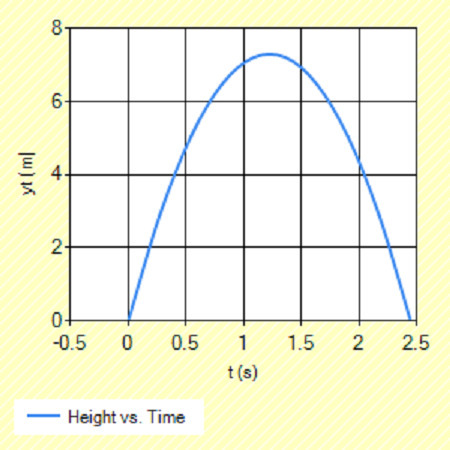
SOLUTION: The soccer player kicks the ball in the Figure above with an initial velocity of 35 m/s at an angle of 20°. (a) Calculate for the time when it reaches 0.40 m. (b) Find its positio
Algebra ->
Customizable Word Problem Solvers
-> Travel
-> SOLUTION: The soccer player kicks the ball in the Figure above with an initial velocity of 35 m/s at an angle of 20°. (a) Calculate for the time when it reaches 0.40 m. (b) Find its positio
Log On
Question 1202581: The soccer player kicks the ball in the Figure above with an initial velocity of 35 m/s at an angle of 20°. (a) Calculate for the time when it reaches 0.40 m. (b) Find its position parallel to the field at height equal to 0.40 m. (c) Find the time when it reaches its highest point. (d) At what point is the ball at its highest and farthest? Answer by mananth(16949) (Show Source):
You can put this solution on YOUR website! Initial velocity = U , angle =
Here , Angle = 20 degrees, Initial velocity = 35m/s
35*sin 20 degrees vertical velocity =11.97 m/s
35*cos 20 degrees horizontal velocity 30.31 m/s
Newtons equation of motion, S= ut+1/2 * gt^2
a) Time at which it is 0.4 m height
S=0.4 m, u=35 sin 20^0
-4.9t^2 +11.97t-0.4 =0
Solve
t=2.40s or 0.034s Two values since path is parabolic
(b) Find its position parallel to the field at height equal to 0.40 m.
Two horizontal distance values
35*cos 20 degrees horizontal velocity 30.31 m/s
(1) 30.31 *0.034 m (2) 30.31* *2.40 m
(c) Find the time when it reaches its highest point.
Max height = u^2/2g = (11.97/2)^2*9.8 = 7.31 m
d) At what point is the ball at its highest and farthest?
v=u+gt
Final velocity is 0 at maximum height
0 =11.97 +(-9.8) *t
t = 11.97 /9.8=1.22 s
Time of ascent = time of descent
Farthest = 1.22*2= 2.44 s
.


 .
.
