Tutors Answer Your Questions about Subset (FREE)
Question 488902: 1. If n(A) = 8, then how many proper subsets does A have?
2. At a local college, a survey was taken to determine where students studied on campus. Of 180 students surveyed, it was determined that:
89 studied in the library
76 studied in the student center
55 studied in both places
Of those interviewed,
a. how many studied in only the library?
b. how many studied in only the student center?
c. how many did not study in either location?
Answer by ikleyn(53751)   (Show Source): (Show Source):
You can put this solution on YOUR website! .
1. If n(A) = 8, then how many proper subsets does A have?
2. At a local college, a survey was taken to determine where students studied on campus. Of 180 students surveyed, it was determined that:
89 studied in the library
76 studied in the student center
55 studied in both places
Of those interviewed,
a. how many studied in only the library?
b. how many studied in only the student center?
c. how many did not study in either location?
~~~~~~~~~~~~~~~~~~~~~~~~~~~~~~~~~~~~~
For part (1), tutor @Theo wrote a long essay, but his solution is TOTALLY WRONG.
I came to bring a correct solution to part (1).
It is well known fact that every finite set of 'n' elements has precisely  subsets,
including the empty set and the set itself as a subset.
In our problem, n = 8, so there are subsets,
including the empty set and the set itself as a subset.
In our problem, n = 8, so there are  = 256 subsets, as described.
From these 256 subsets, we should exclude one subset, which is the set itself, to get proper subsets.
So, in this problem, there are - 1 = 256 - 1 = 255 proper subsets.
ANSWER. Set A has 255 proper subsets. = 256 subsets, as described.
From these 256 subsets, we should exclude one subset, which is the set itself, to get proper subsets.
So, in this problem, there are - 1 = 256 - 1 = 255 proper subsets.
ANSWER. Set A has 255 proper subsets.
Solved correctly.
Question 1184602: Let H={2^k:k∈Z}. Show that H is a subgroup of Q^*.
Answer by ikleyn(53751) (Show Source):
You can put this solution on YOUR website! .
You should check or prove that
- (1) the product of any two elements of H does belong to H;
- (2) the unit element does belong to H;
- (3) the inverse element to any element of H does belong to H.
All three statements/steps are OBVIOUS.
I want to say that their proofs are obvious for every statement.
Question 1208148: If every element of a set A is also an element of a set B, then we say that A is a subset of B and write A ⊆ B.
Sample 1
Set A = { x, y, z }
Set B = { w, x, y, z }
We can say that A ⊆ B.
Sample 2
Set A = { 1, 2, 3 }
Set B = { 0, 1, 2, 3, 4, 5 }
We can say that A ⊆ B.
You say?
Answer by ikleyn(53751) (Show Source):
You can put this solution on YOUR website! .
D U P L I C A T E
It was just answered at this forum TWICE (by two tutors) under this link
https://www.algebra.com/algebra/homework/Subset/Subset.faq.question.1208142.html
Please do not bombard us with duplicates.
Question 1208142: If every element of a set A is also an element of a set B, then we say that A is a subset of B and write A ⊆ B.
Sample 1
Set A = { x, y, z }
Set B = { w, x, y, z }
I can say that A ⊆ B.
Sample 2
Set A = { 1, 2, 3 }
Set B = { 0, 1, 2, 3, 4, 5 }
I can say that A ⊆ B.
You say?
Found 2 solutions by math_tutor2020, ikleyn:
Answer by math_tutor2020(3835) (Show Source):
You can put this solution on YOUR website!
Both of your answers are correct.
It might help to highlight the items of interest.
A = { x, y, z }
B = { w, x, y, z }
which helps confirm that A is indeed a subset of B.
Anything inside set A is also in set B (but not vice versa).
Also,
A = { 1, 2, 3 }
B = { 0, 1, 2, 3, 4, 5 }
which is another scenario when A is a subset of B.
--------------------------------------------------------------------------
Let's look at another example
A = {1,2,3}
B = {1,2,4,5,6}
Highlight everything in set A. Mark those items in set B (if they exist).
A = {1,2,3}
B = {1,2,4,5,6}
Unfortunately the element "3" is not found in set B, so set A isn't a subset of B.
Answer by ikleyn(53751) (Show Source):
You can put this solution on YOUR website! .
If every element of a set A is also an element of a set B, then we say that A is a subset of B and write A ⊆ B.
Sample 1
Set A = { x, y, z }
Set B = { w, x, y, z }
I can say that A ⊆ B.
Sample 2
Set A = { 1, 2, 3 }
Set B = { 0, 1, 2, 3, 4, 5 }
I can say that A ⊆ B.
You say?
~~~~~~~~~~~~~~~~~~~~
(1)  Your answer in part (1) is correct.


(2)  Your answer in part (2) is correct.
Question 1207922: Let U = {q, r, s, t, u, v, w, x, y, z} A = {q, s, u, w, y} B = {q, s, y, z} C = {v, w, x, y, z}.
List the elements in the set - A∩(B∪C)^c
Found 2 solutions by math_tutor2020, Edwin McCravy:
Answer by math_tutor2020(3835) (Show Source):
You can put this solution on YOUR website!
An unfortunate tragedy of mathematics is that symbols get reused, and similar symbols clash with one another.
The universal set (uppercase letter U) looks an awful lot like the union symbol (technically not an uppercase U, but it looks similar enough).
To avoid confusion, I'll replace "U = universal set" with "E = set of everything"
This is known as the sample space.
E = set of everything
E = {q, r, s, t, u, v, w, x, y, z}
A = {q, s, u, w, y}
B = {q, s, y, z}
C = {v, w, x, y, z}
Let's union sets B and C.
The set union operation has us combine the two sets into one big bin.
Duplicates are tossed.
I'll use color-coding to indicate which items come from which set.
B U C = B union C
B U C = {q, s, y, z} union {v, w, x, y, z}
B U C = {q, s, y, z} union {v, w, x, y, z}
B U C = {q, s, y, z, v, w, x, y, z}
B U C = {q, s, v, w, x, y, z}
Optionally you can sort the items.
The union symbol basically represents "or". An item is in set B, or set C, or both.
Return to the set of everything
E = {q, r, s, t, u, v, w, x, y, z}
We'll erase anything that is in set B U C so we can find (B U C)^c
The items to be erased will be marked in red
E = {q, r, s, t, u, v, w, x, y, z}
(B U C )^c = {q, r, s, t, u, v, w, x, y, z}
( B U C )^c = {r, t, u}
The lowercase c exponent represents "set complement".
It represents the complete opposite of set B U C.
If an element is in B U C, then it's not in (B U C)^c, and vice versa.
So we have
A = {q, s, u, w, y}
( B U C )^c = {r, t, u}
What do these sets have in common?
Which element(s) is/are in both sets at the same time?
That would be only one item and it is element "u".
Therefore,
A ∩ (B∪C)^c = {u}
is the final answer
Notes:- The upside down U symbol is the set intersection symbol. It represents "and". If something is in set A ∩ B, then it is in A and B at the same time.
- A set with one element is called a singleton.
- Don't forget about the surrounding curly braces when writing the answer.
Answer by Edwin McCravy(20077)  (Show Source): (Show Source):
You can put this solution on YOUR website!
A ∩ (B ∪ C)c

Substitute the sets for the capital letters:

{q, s, u, w, y} ∩ ({q, s, y, z} ∪ {v, w, x, y, z})c

Do in the parentheses first which is a "∪", which means "union", so we
combine the two sets on each side of the "∪" into one (we don't repeat
the y or z, which are elements of both):

{q, s, u, w, y} ∩ ({q, s, y, z, v, w, x})c

Now we do the "c", which means "complement", by replacing it with
all the elements of U, the universal set, that are not in
{q, s, y, z, v, w, x}

So when we remove all those from U, the universal set, we have this left
{r, t, u} so that's the complement set.  So now we have

{q, s, u, w, y} ∩ {r, t, u}

Now we do the "∩", which means "intersection", so we take only the
elements that are common to both sets, and ignore all the others. So the final
answer is {u}, which has only one element, and is called a "singleton".

Answer: {u}

Edwin
Question 1206779: Let S be the universal set, where: S = {1,2,3,...,28,29,30}
Let sets A and B be subsets of S, where set A = {2,11,14,15,16,18,26}, Set B = {3,915,22,24,28}, Set C = {16,20,23,30}. List the elements for (AnBnC)
Found 2 solutions by ikleyn, MathLover1:
Answer by ikleyn(53751) (Show Source):
You can put this solution on YOUR website! .
Let S be the universal set, where: S = {1,2,3,...,28,29,30}
Let sets A and B be subsets of S, where
set A = {2,11,14,15,16,18,26},
Set B = {3,915,22,24,28},
Set C = {16,20,23,30}.
List the elements for (AnBnC)
~~~~~~~~~~~~~~~~~~
There is a FATAL ERROR in this post.
The number 915 can not be in the set B, since the number 915 is not an element of the universal set S.
Answer by MathLover1(20855)  (Show Source): (Show Source):
You can put this solution on YOUR website!
Let S be the universal set, where:
S = {1,2,3,...,28,29,30}
A = {2,11,14,15,16,18,26},
B = {3,9,15,22,24,28},
C = {16,20,23,30}.
List the elements for (A ∩ B ∩ C)
A ∩ B ∩ C= {x : x ∈ A , x ∈ B, and x ∈ C}
as you can see, there is NO elements in A, B and C which are common
(A ∩ B ∩ C)= { }
Question 1204958: In a class of 50 students, 24 like football, 21 basketball and 18 cricket. Six like football and basketball only, 3 like basketball only, 5 like all three games and 14 did not like any of the three games
(i) Illustrate this information on a Venn diagram.
(ii) Find the number of students who like:
(α) football and cricket only;
(β) exactly one of the games.
Answer by math_tutor2020(3835) (Show Source):
You can put this solution on YOUR website!
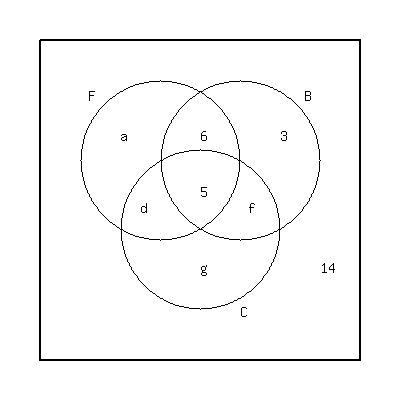
Draw three circles labeled F, B, and C
F = football
B = basketball
C = cricket

We have 3 sports and two options for each (either the person likes it or they don't). That gives 2^3 = 8 distinct regions.
Those 8 regions are labeled 'a' through h
a = those who like football only
b = those who like football and basketball, but not cricket
c = those who like basketball only
etc.
Given Facts
Fact [1]: 50 students
Fact [2]: 24 like football
Fact [3]: 21 like basketball
Fact [4]: 18 like cricket.
Fact [5]: 6 like football and basketball only
Fact [6]: 3 like basketball only
Fact [7]: 5 like all three games
Fact [8]: 14 did not like any of the three games
Facts 5, 6, 7, and 8 lead to b = 6, c = 3, e = 5, and h = 14 in that exact order.
Then we'll use fact [3] to determine that:
b+c+e+f = 21
6+3+5+f = 21
14+f = 21
f = 21-14
f = 7
Next, turn to fact [2] which allows us to say the following
a+b+d+e = 24
a+6+d+5 = 24
a+d+11 = 24
a+d = 24-11
a+d = 13
We'll use this in a substitution step in the next part.
Next we rely on fact [1]
a+b+c+d+e+f+g+h = 50
a+6+3+d+5+7+g+14 = 50
a+d+g+35 = 50
a+d+g = 15
13+g = 15 ...... substitution step
g = 15-13
g = 2
Then we'll turn to fact [4] to say:
d+e+f+g = 18
d+5+7+2 = 18
d+14 = 18
d = 18-14
d = 4
Return to a previous equation to fill in the last missing piece of the puzzle
a+d = 13
a+4 = 13
a = 13-4
a = 9
Summary
a = 9
b = 6
c = 3
d = 4
e = 5
f = 7
g = 2
h = 14
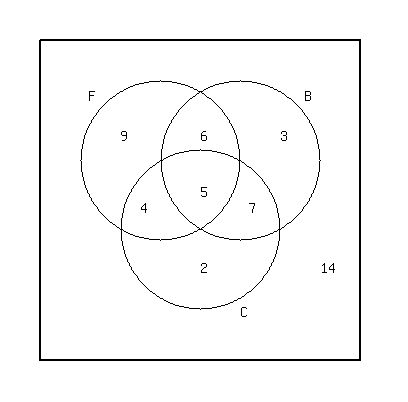
I'll let the student verify this Venn diagram is correct by referring to the 8 facts shown above.
Example:
fact [1] is verified since a+b+c+d+e+f+g+h = 9+6+3+4+5+7+2+14 = 50
The rest of the questions should be fairly straight forward.
I'll let the student take over from here.
Please let me know if you have any questions.
More practice
https://www.algebra.com/algebra/homework/sets-and-operations/sets-and-operations.faq.question.1204589.html
Question 1204028: The cardinal number of {xlx=x+5 and x∈N} is
Found 2 solutions by ikleyn, greenestamps:
Answer by ikleyn(53751) (Show Source):
Answer by greenestamps(13327)  (Show Source): (Show Source):
You can put this solution on YOUR website!
If I read your notation correctly, the set is the set of integers x for which the equation x=x+5 is true. Since there are no such integers x, the set is the empty set, and the cardinal number of an empty set is 0.
ANSWER: 0
Question 1201378: The subsets of a set are sets that contain some of the elements of the original set. for example, the set {A,B} has four subsets: {}, {A},{B} and {A,B}. notice that the original and the empty set are both considered to be subsets of the original set. The number of subsets that the set {A,B,C,D,E,F} has is
a) 8 b) 16 c) 32 d) 64 e) 128
Answer by ikleyn(53751) (Show Source):
Question 1197000: 1.Each of the four children Dino, Sonny, Nikko, and Xian, holds a different object (fan, car, dart, and slime).
From the following clues, determine who owns which object.
a. Sonny is older than his friend who owns the car and younger than his friend who owns the dart.
b. Nikko and his friend who owns the slime both have the same age. They are the youngest members of
them.
c. Dino is older than his friend who owns the fan.
2.Nine teams register in a basketball league. Each team will compete with the other teams only once. How
many games will be played in the basketball league?
3.On three quizzes, Alan received scores 82, 91, and 77. What score does Alan need on the fourth quiz to
raise his average to 86?
Answer by ikleyn(53751) (Show Source):
You can put this solution on YOUR website! .
In this post, I will solve #2 and #3.
#2.
Each of 9 teams plays with all 8 other teams.


It gives the product of 9*8 = 72, which we should divide by 2,
since taking the product we count each game twice.
Solved.
#3.
The governing equation is
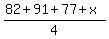 = 86 (average).
The solution is in one line
fourth quiz score x = 4*86 - (82 + 91 + 77) = 94. ANSWER = 86 (average).
The solution is in one line
fourth quiz score x = 4*86 - (82 + 91 + 77) = 94. ANSWER
Solved.
////////////////////////
One and ONLY ONE problem/question per post.
It is the RULE, the POLICY and the REQUIREMENT of this forum.
It is written in this page
https://www.algebra.com/tutors/students/ask.mpl?action=ask_question&topic=Equations&return_url=http://www.algebra.com/algebra/homework/equations/
from which you post your problems.
It is assumed that you read these rules before posting.
It is also assumed that you do understand what is written in that page and follow the rules.
Those who violate them, work against their own interests.
Question 1196992: All the members of a group of 30 students belong to at least one of these clubs: Academic, Music and Arts.
6 of the students belong to only the Arts Club.
5 of the students belong to all 3 clubs.
2 of the students belong to the Academic and Arts clubs but not to the Music club.
15 of the students belong to the Arts Club.
2of the students belong only to the Academic Club.
3 of the students belong only to the Music Club.
Find the number of students who belong to at least two clubs?
Answer by math_tutor2020(3835) (Show Source):
You can put this solution on YOUR website!
A = arts club
B = academic club
C = music club
This is what the Venn Diagram looks like

We have these 8 distinct regions marked in red
a = number in arts club only
b = number in arts & academics, but not music
c = number in academics club only
d = number in arts & music, but not academic
e = number of students in all 3 clubs
f = number in academics & music, but not arts
g = number in music club only
h = number of students in neither of the 3 clubs mentioned
I'll break the given info into these facts
Fact [1]: 6 of the students belong to only the Arts Club.
Fact [2]: 5 of the students belong to all 3 clubs.
Fact [3]: 2 of the students belong to the Academic and Arts clubs but not to the Music club.
Fact [4]: 15 of the students belong to the Arts Club.
Fact [5]: 2of the students belong only to the Academic Club.
Fact [6]: 3 of the students belong only to the Music Club.
Based on those facts we can then determine the following:
a = 6 .... from Fact [1]
b = 2 .... from Fact [3]
c = 2 .... from Fact [5]
d = unknown for now
e = 5 .... from Fact [2]
f = unknown for now
g = 3 .... from Fact [6]
h = 0 ... because every student mentioned belongs to at least one of the three clubs
We've used nearly every fact, except fact 4, to determine values a,b,c,e,g,and h.
Use Fact [4] to form and solve this equation
a+b+d+e = 15 students in the arts club (circle A)
6+2+d+5 = 15
13+d = 15
d = 15-13
d = 2
Now we'll use the fact that there are 30 students total, each of which belongs to one or more clubs.
a+b+c+d+e+f+g+h = 30
6+2+2+2+5+f+3+0 = 30
20+f = 30
f = 30-20
f = 10
Here's a summary of all the values
a = 6
b = 2
c = 2
d = 2
e = 5
f = 10
g = 3
h = 0
and here's what the Venn diagram looks like now after replacing the letters with their corresponding numbers.

We're now told to "Find the number of students who belong to at least two clubs".
There are two ways to do this:
Method 1)
Add up the values b, d, e, f as they represent students who are in 2 clubs or more.
b+d+e+f = 2+2+5+10 = 19
There are 19 students who are in 2 clubs or more.
---------------------------------
Method 2)
As a slight detour, let's find out how many students are in exactly one club only.
artsOnly + academicsOnly + musicOnly = a + c + g = 6+2+3 = 11
There are 11 students who have signed up for exactly one club.
There are 30 students total, so that must mean 30-11 = 19 students are in at least two clubs.
The events "in exactly one club" and "in at least two clubs" are complementary events. One or the other must happen, but not both at the same time.
----------------------------------------------------------------------------
----------------------------------------------------------------------------
Final Answer: 19 students who belong to at least two clubs.
Question 1196537: Let U = {q, r, s, t, u, v, w, x, y, z}, A = {q, s, u, w, y}, B = {q, s, y, z}, and C = {v, w, x, y, z}. List the elements in the following set.
A ∩ B with line on top
Found 2 solutions by math_tutor2020, MathLover1:
Answer by math_tutor2020(3835) (Show Source):
You can put this solution on YOUR website!
There's ambiguity when you mention "with a line on top"
Is the line solely over the B? Or is it over everything?
Do you mean 
Or do you mean 
---------------------------------------------------------------------
I'll go over each interpretation.
Let's focus on
The universal set is
U = {q, r, s, t, u, v, w, x, y, z}
Cross off the stuff you find in set B
So we'll cross off: q, s, y, and z
This forms the set B' which is the same as writing 
B' = {r, t, u, v, w, x}
This is the complement of set B.
Stuff in B' is not found in B, and vice versa.
They are complete opposite of one another.
The two sets union together to form the universal set.
Think of it like this:
stuff inside B is inside a house
stuff outside B is outside the house
Now we'll intersect the set A with set B'
A = {q, s, u, w, y}
B' = {r, t, u, v, w, x}
We see that the letters u and w are inside both A and B' at the same time.
Hence A ∩ B' = {u, w}
which is the same as saying 
-----------------------------------------------------
Now onto
This is the same as writing (A ∩ B)'
We're taking the complement of set (A ∩ B)
Here are sets A and B
A = {q, s, u, w, y}
B = {q, s, y, z}
which means,
A ∩ B = {q, s, y}
since those three letters are found in both sets
We'll delete q,s,y from the universal set
U = {q, r, s, t, u, v, w, x, y, z}
(A ∩ B)' = {q, r, s, t, u, v, w, x, y, z}
(A ∩ B)' = {r, t, u, v, w, x, z}
Therefore, 
Answer by MathLover1(20855) (Show Source):
You can put this solution on YOUR website!
A ∩ B with line on top
First, A ∩ B is equal to the set that contains elements common to both A and B. The line on top means “complement” (all the objects that do not belong to set A∩ B), and you can write it as (A ∩ B)’ or (A ∩ B)^c
to find (A ∩ B)’ , first find A ∩ B (elements common to both A and B)
if A = {q, s, u, w, y} and B = {q, s, y, z}
A ∩ B={q, s, y}
now find complement (A ∩ B)’ (all the objects in set U that do not belong to set A∩ B)
(A ∩ B)’={ r, t, u, v, w, x, z} => your answer
Question 1196189: Let U = {1,2,3,...,8,9,10} be the universal set.
Let sets A and B be subsets of U, where:
Set
A
=
{
2
,
3
,
4
,
8
,
9
}
Set
B
=
{
3
,
4
,
6
,
7
,
8
,
9
}
LIST the elements in the set
A
'
:
A
'
= {
1,2,3,4,6,10
Partially correct }
LIST the elements in the set
B
'
:
B
'
= {
}
LIST the elements in the set
A
∪
B
:
A
∪
B
= {
3,10
Partially correct }
LIST the elements in the set
A
∩
B
:
A
∩
B
=
Answer by ikleyn(53751) (Show Source):
Question 1195639: Let S={1,2,3,4,5,6,7,8,9,10} be the universal set.
Let sets A, B, and C be subsets of S , where:
Set A={1,6,7,10}
Set B={2,9,10}
Set C={3,4,5,7,8}
LIST the elements in the set A∩B∩C:A∩B∩C= {___}
LIST the elements in the set A∪B∪C:A∪B∪C= {__}
Answer by math_tutor2020(3835) (Show Source):
You can put this solution on YOUR website!
∩ is the intersection symbol
U is the union symbol
Set A∩B is where we look at elements in both sets A and B at the same time. This is the overlapped region in the Venn Diagram.
Similarly, A∩B∩C looks at numbers in all three sets at the same time.
Set A={1,6,7,10}
Set B={2,9,10}
Set C={3,4,5,7,8}
The value 1 is in set A, but not in any other set
6 is in set A, but not in any other set
7 is in A and C, but not set B, so this value is crossed off as well
10 is in A and B, but not in set C
The values 1,6,7 and 10 are not found in all three sets.
As you can see, we only need to check one set to determine A∩B∩C since this intersected set must consist of values from that particular single set mentioned.
In other words, there isn't any value that is in all three sets at the same time.
Therefore, A∩B∩C = { } is the empty set.
We write two curly braces with nothing between them.
Not even 0 is in this set.
The set { } is different from { 0 }
--------------------------------------------
For the next part, we'll be doing set union.
A∪B means we combine sets A and B into one bigger set.
Toss out any duplicates.
Example:
A = {1,2}
B = {3,4}
A∪B = {1,2     3,4}
A∪B = {1,2,3,4}
The spacing is intentional to show how sets A and B combine together. When writing the actual union, you'd just write a list of numbers like normal without the massive gap.
Another example:
A = {1,2,3}
B = {3,4,5}
A∪B = {1,2,3     3,4,5}
A∪B = {1,2,3     3,4,5}
A∪B = {1,2,3,4,5}
We combine the 1,2,3 with 3,4,5
Cross off the second copy of 3 to avoid duplicates.
Going back to the original problem
Set A={1,6,7,10}
Set B={2,9,10}
Set C={3,4,5,7,8}
We have
A∪B∪C = {1,6,7,10,        2,9,10,       3,4,5,7,8}
A∪B∪C = {1,2,3,4,5,6,7,8,9,10}
Common practice is to sort the values in the set from smallest to largest.
Don't forget to erase any duplicates.
It turns out that we have the universal set S = {1,2,3,4,5,6,7,8,9,10} as the result of the union of all three sets mentioned.
All of the values in the universe are found in set A, set B, or set C.
We have this interesting contrast going on.
A∩B∩C is the empty set, aka "nothing"
A∪B∪C consists of everything in the universal set.
This won't always happen. It is possible your teacher purposefully crafted these sets in this fashion to attain this dichotomy.
--------------------------------------------
Answers:
A∩B∩C = { } which is the empty set
A∪B∪C = {1,2,3,4,5,6,7,8,9,10} which in this case is the universal set
Question 1195210: P and q are two sets such that np=17, nq=14 and n(p n q)=5. find n(p u q).
Answer by ikleyn(53751) (Show Source):
Question 1194127: Given a set A = {
7
,
5
,
6
,
H
,
G
,
n
}, answer the following questions:
a. Find the number of subsets of A
Found 4 solutions by ikleyn, math_tutor2020, greenestamps, MathLover1:
Answer by ikleyn(53751) (Show Source):
Answer by math_tutor2020(3835) (Show Source):
You can put this solution on YOUR website!
Rule: If a set has n elements, then it has 2^n possible subsets.
The proof of this can be done many ways, but the simplest (in my opinion) is to imagine a row of light switches. They can be either on or off.
If we have n of these switches to represent the n elements of the set, then we have 2*2*2*2*...*2 = 2^n different on/off combos to represent the 2^n subsets.
Note: We can define "on" to mean "include this in the subset", while "off" means "exclude it from the subset".
For instance, let's say we had the set of people code named A,B,C,D
{A,B,C,D} is the original set
Now consider the string 0,1,1,0
0 = off
1 = on
We'll exclude members A and D, while including members B and C
The string 0,1,1,0 leads us to the subset {B, C} which is one of the 2^2 = 4 possible.
Having all zeros gets us the empty set with nothing inside.
Having all ones gets us the original set. Any set is a subset of itself.
With that rule in mind, we can see that there are 6 elements in the set A = {7, 5, 6, H, G, n}
This must mean there are 2^6 = 64 different subsets.
Answer by greenestamps(13327) (Show Source):
You can put this solution on YOUR website!
The response from the other tutor shows a partial list of the subsets and then, without explanation, the answer, 64.
That doesn't help the student much in determing HOW to find that the answer is 64. If there were 10, or 100, elements in the set, you wouldn't want to find the number of subsets by listing all of them.
To see how to get the answer of 64, imagine the process of forming a subset from the 6 elements in the given set. You look at each of the elements and choose whether or not to include that element in your subset. That's 2 choices -- Yes or No -- for each element. With 6 elements, the total number of different subsets you can form is the product of those numbers of choices for all 6 elements, which is 2^6 = 64.
So, in short, the number of subsets of set with n elements is 2^n.
This result can also be seen in Pascal's Triangle.
In forming a subset from a set of 6 elements, you can choose either 0, 1, 2, 3, 4, 5, or 6 of the elements. So the total number of subsets you can form is
C(6,0)+C(6,1)+C(6,2)+C(6,3)+C(6,4)+C(6,5)+C(6,6)
But those numbers are the entries in the 6th row of Pascal's Triangle; and the sum of the entries in the 6th row of Pascal's triangle is 2^6.
So again we see that the number of subsets of a set with n elements is 2^n.
Answer by MathLover1(20855) (Show Source):
You can put this solution on YOUR website! Given a set A = {7,5,6,H,G,n}, answer the following questions:
recall that: The subsets of any set consists of all possible sets including its elements and the null set. Let us understand with the help of an example.
Example: Find all the subsets of set A = {1,2,3,4}
Solution: Given, A = {1,2,3,4}
Subsets =
{}
{1}, {2}, {3}, {4},
{1,2}, {1,3}, {1,4}, {2,3},{2,4}, {3,4},
{1,2,3}, {2,3,4}, {1,3,4}, {1,2,4}
{1,2,3,4}
so, in your case
a. Find the number of subsets of A
∅ | {5} | {6} | {7} | {G} | {H} | {n} | {5, 6} | {5, 7} | {5, G} | {5, H} | {5, n} | {6, 7} | {6, G} | {6, H} | {6, n} | {7, G} | {7, H} | {7, n} | {G, H} | {G, n} | {H, n} | {5, 6, 7} | {5, 6, G} | {5, 6, H} | {5, 6, n} | {5, 7, G} | {5, 7, H} | {5, 7, n} | {5, G, H} | {5, G, n} | {5, H, n} | {6, 7, G} | {6, 7, H} | {6, 7, n} | {6, G, H} | {6, G, n} | {6, H, n} | {7, G, H} | {7, G, n} | ... (total: 64)
Question 1194155: Let S be the universal set, where: -
S={1,2,3,...,18,19,20}
Let sets A and B be subsets of S, where: Set A={3,4,6,12,13,14,18}
Set B={1,3,7,8,11,12,15,17,19,20}
Find the following:
-LIST the elements in the set (AUB):
(AUB)=(1,3,4,6,7,8,11,12,13,14,15,17,18
LIST the elements in the set (AnB):
(AnB) =(3,12)
Answer by ikleyn(53751) (Show Source):
Question 1192015: In a group of 200 students, each student studies at least one of the three science subjects:
Biology, Chemistry and Physics. 130 study Biology, 135 study Chemistry, 115 study Physics, 86
study Biology and Chemistry, 70 study Chemistry and Physics, and 64 study Physics and Biology.
a. All 3 subjects
b. Exactly 2 subjects
c.Only Biology.
Answer by math_tutor2020(3835) (Show Source):
You can put this solution on YOUR website!
Part (a)
B = biology
C = chemistry
P = physics
n(B) = number of people in biology
n(C) = number of people in chemistry
n(P) = number of people in physics
Given facts:- Fact 1: 130 study Biology
- Fact 2: 135 study Chemistry
- Fact 3: 115 study Physics
- Fact 4: 86 study Biology and Chemistry
- Fact 5: 70 study Chemistry and Physics
- Fact 6: 64 study Physics and Biology
n(B) = 130 from Fact 1
n(C) = 135 from Fact 2
n(P) = 115 from Fact 3
n(B and C) = 86 from Fact 4
n(C and P) = 70 from Fact 5
n(B and P) = 64 from Fact 6
There are 200 students total, and they take at least one of the courses mentioned.
This means there aren't any students who don't take one of the courses.
n(B or C or P) = 200
Use the inclusion-exclusion principle
n(B or C or P) = n(B)+n(C)+n(P) - n(B and C) - n(C and P) - n(B and P) + n(B and C and P)
200 = 130+135+115 - 86 - 70 - 64 + n(B and C and P)
200 = 160 + n(B and C and P)
n(B and C and P) = 200 - 160
n(B and C and P) = 40
Answer: There are 40 students who take all 3 subjects.
===========================================================
Part (b)
We'll use the result of part (a) to write the following:
n(B and C, not P) = n(B and C) - n(B and C and P)
n(B and C, not P) = 86 - 40
n(B and C, not P) = 46
There are 46 students in biology and chemistry, but not in physics.
and,
n(C and P, not B) = n(C and P) - n(B and C and P)
n(C and P, not B) = 70 - 40
n(C and P, not B) = 30
There are 30 students in chemistry and physics, but not in biology.
and,
n(B and P, not C) = n(B and P) - n(B and C and P)
n(B and P, not C) = 64 - 40
n(B and P, not C) = 24
There are 24 students in biology and physics, but not in chemistry.
Adding the three results gets us
46+30+24 = 100
Answer: There are 100 students in exactly two subjects.
===========================================================
Part (c)
Use the inclusion-exclusion principle.
n(B only) = n(B) - n(B and C) - n(B and P) + n(B and C and P)
n(B only) = 130 - 86 - 64 + 40
n(B only) = 20
Answer: 20 students study only biology
===========================================================
The venn diagram is shown below

Take note how the numbers are placed in the 8 regions.
For example, we have "46" in the region inside B and C, but outside P to represent the 46 students taking bio and chem, but not physics.
Also notice that- The numbers in the B circle add to 130
- The numbers in the C circle add to 135
- The numbers in the P circle add to 115
- All of the numbers add to the grand total of 200
The venn diagram is a quick visual way to organize all of the data, and to quickly pick out the number of students who take exactly one course, exactly two courses, or all three.
We have 0 outside all the circles to represent the idea that everyone is taking at least one of the three mentioned courses.
The venn diagram may also help show how/why the inclusion-exclusion principle works.
The "exclusion" part is us subtracting off something like n(B and C) and then the "inclusion" part is to counterbalance things by adding in something like n(B and C and P).
Question 1191833: Let U = {q, r, s, t, u, v, w, x, y, z}
A = {q, s, u, w, y}
B = {q, s, y, z}
C = {v, w, x, y, z}.
Determine the following.
A ∩ B'
Found 2 solutions by greenestamps, Edwin McCravy:
Answer by greenestamps(13327) (Show Source):
You can put this solution on YOUR website!
The answer from the other tutor is fine; however, with relatively small sets like this, there is an easier way to get to the answer.
The set A ∩ B' consists of all the elements of A that are NOT in B. So start with the set A and eliminate any elements that are also in B.
q? no - also in B
s? no - also in B
u? yes -- not in B
w? yes -- not in B
y? no - also in B
ANSWER: A ∩ B' = {u,w}
Answer by Edwin McCravy(20077) (Show Source):
You can put this solution on YOUR website!
A ∩ B'

Substitute {q, s, u, w, y} for A and {q, s, y, z} for B:

{q, s, u, w, y} ∩ {q, s, y, z}'

Take care of the " ' " first.  That means "complement", which means
to take all the elements of U that are not members of {q, s, y, z}.
So in place of {q, s, y, z}' we write {r, t, u, v, w, x}.

{q, s, u, w, y} ∩ {r, t, u, v, w, x}

Now " ∩ " (intersection) says to take ONLY the elements which are
IN COMMON to both sets.  That is, only those elements which are
contained in both sets on the left and right of ∩.  There are only
two:

{u, w}     <--answer

Edwin
Question 1191038: U = {1, 2, 3, 4, 5, 6, 7, 8, 9}, A = {3, 5, 7, 8}, B = {2, 6}
Create a venn diagram from the given sets.
Answer by Solver92311(821)  (Show Source): (Show Source):
Question 1188861: Cameron is 5 years older than Samuel. Tommy is 42. Reba is 6 years younger than Tommy and 1 year older than Samuel. How old is Cameron?
Answer by josgarithmetic(39792) (Show Source):
Question 1187782: An article in the San Jose Mercury News stated that students in the California state university system take 4.8 years, on average with a standard deviation of 1.9, to finish their undergraduate degrees. Suppose you believe that the mean time is longer.
You conduct a survey of 72 students and find they have a mean of 5.5 and a standard deviation of 1.8.
What would be your standard error of the mean (SEM)? Please compute to 4 decimal places.
Answer by Boreal(15235)  (Show Source): (Show Source):
You can put this solution on YOUR website! SEM is sd/sqrt(n)=1.9/sqrt(72), or 0.2239 years. We know the population sd, so we use that to calculate the SEM of the sample. If we didn't know that, we would have to use the one estimate we have, 1.8 years, from the sample.
Question 1187619: A hen lays eight eggs. Each egg was weighed and recorded as follows:
60 g, 56 g, 61 g, 68 g, 51 g, 53 g, 69 g, 54 g. Find the Variance?
Im a little lost please help
Answer by MathLover1(20855) (Show Source):
Question 1187132: Let U = {0,1, 2, 3, 4, 5, 6, 7}
A = {2, 6, 7}
B = {2, 3, 5, 7}, and C = {0, 2, 6}.
Find A ∪ B'
im lost can someone help?
Answer by MathLover1(20855) (Show Source):
You can put this solution on YOUR website!
Let U = {0,1, 2, 3, 4, 5, 6, 7}
A = {2, 6, 7}
B = {2, 3, 5, 7}, and C = {0, 2, 6}.
Find A ∪ B'
first find B'
B' is the absolute complement of B, and it is the set of elements in U that are not in B
B' ={0,1,4,6 }
then A ∪ B'= {2,6,7} ∪ {0,1,4,6 }= {0,1,2,4,6,7 }
Question 1186668: If p={1,2,3.4},Write down all the subsets of p which have exactly two element
Found 2 solutions by greenestamps, MathLover1:
Answer by greenestamps(13327) (Show Source):
You can put this solution on YOUR website!
You need to choose 2 of the 4 elements; the number of ways you can do that is "4 choose 2" = C(4,2) = 6.
You can make the list; it should have 6 different subsets.
To make sure you don't count any subset twice, make sure each subset you write has the smaller of the two elements first -- that is, for example, you don't want to have two different subsets {2,4} and {4,2}, because those are the same.
Or of course you could make sure that in each subset you list the larger of the two numbers is first....
Answer by MathLover1(20855) (Show Source):
You can put this solution on YOUR website!
{},{1},{2},{3},{4},{1,2},{1,3},{2,3},{1,4},{2,4},{3,4},{1,2,3},{1,2,4},{1,3,4},{2,3,4},{1,2,3,4}
Subsets: total 
Proper Subsets total: 
 subset with no elements subset with no elements
 subset with elements subset with elements
 subset with subset with elements elements
subset with  elements elements
subset with elements
you need subset with elements: {1,2},{1,3},{2,3},{1,4},{2,4},{3,4}
Question 1181416: N ( a) = 13 and n ( b) = 8 then what is n (b/a) and n(u)
Answer by ikleyn(53751) (Show Source):
Question 1176594: Let A = { 1, 2, 3 }, B = { 2, 4, 5, 6 }, C = { 1, 2, 3, 5, 6 }, D = { 4, 5, 6 }
1.) Is A subset of B ?
Answer by Solver92311(821) (Show Source):
Question 1176595: TRUE or FALSE. ( 2 pts. Each)
1.) Given { x Є R / -1 < x < 2 } then the solution set is { -1, 0, 1, 2 ].
2.) Given { x Є Z / -2 < x ≤ 1 }, the solution set is { -1, 0, 1 ].
3.) Let { x Є Z+/ -3 ≤ x < 3 }, the solution set is { 0,1, 2 }.
4.) Let { x Є Z-/ -5 ≤ x ≤ 1 }, the solution set is { -5, -4, -3, -2, -1}.
5.) Let { x Є Prime nos. / 1 ≤ x ≤ 5 }, the solution set is { 1, 3, 5 }.
Found 2 solutions by ikleyn, MathLover1:
Answer by ikleyn(53751) (Show Source):
You can put this solution on YOUR website! .
TRUE or FALSE. ( 2 pts. Each)
~~~~~~~~~~~~~~
1) Given { x Є R / -1 < x < 2 } then the solution set is { -1, 0, 1, 2 }.

         FALSE.


   The correct answer is  { all REAL numbers between -1 and 2, EXCLUDING endpoints }.


   The answer by @MathLover1 is INCORRECT at this part, since she missed to include all real numbers.


2) Given { x Є Z / -2 < x ≤ 1 }, the solution set is { -1, 0, 1 }.


         TRUE.


3) Let { x Є Z+/ -3 ≤ x < 3 }, the solution set is { 0,1,2 }.


         FALSE


        Z+ means positive integer numbers (greater than 0).
        The correct answer is  { 1,2 }.


4) Let { x Є Z-/ -5 ≤ x ≤ 1 }, the solution set is { -5, -4, -3, -2, -1}.


         TRUE


        Z- means negative integer numbers (less than 0).
        The answer is  { -5,-4,-3,-2,-1 }.


5) Let { x Є Prime nos. / 1 ≤ x ≤ 5 }, the solution set is { 1, 3, 5 }.


        FALSE.


        The correct answer is { 3,5 }.
Solved.
All questions are answered.
Answer by MathLover1(20855) (Show Source):
You can put this solution on YOUR website!
TRUE or FALSE. ( 2 pts. Each)
1.) Given { x Є R / -1 < x < 2 } then the solution set is { -1, 0, 1, 2 ].->FALSE
reason:  and and  should be excluded and the solution set is ( -1, 0, 1, 2 ) should be excluded and the solution set is ( -1, 0, 1, 2 )
2.) Given { x Є Z / -2 < x ≤ 1 }, the solution set is { -1, 0, 1 ].->TRUE
3.) Let { x Є Z+/ -3 ≤ x < 3 }, the solution set is { 0,1, 2 }.->FALSE
reason:  includes all numbers equal and greater to includes all numbers equal and greater to  and less than and the solution set is { -3, -2, -1, 0, 1,2} and less than and the solution set is { -3, -2, -1, 0, 1,2}
4.) Let { x Є Z-/ -5 ≤ x ≤ 1 }, the solution set is { -5, -4, -3, -2, -1}.->FALSE
reason:  so it includes all numbers from so it includes all numbers from  to and the solution set is { -5, -4, -3, -2, -1,0,1} to and the solution set is { -5, -4, -3, -2, -1,0,1}
5.) Let { x Є ->FALSE. / 1 ≤ x ≤ 5 }, the solution set is { 1, 3, 5 }.->FALSE
reason:
List of prime some numbers: , ,  , ,  ,..... ,.....
Question 1175865: express the set using roaster listing method
{ x | x ∈ N and 9 < x ≤ 14}
Answer by CubeyThePenguin(3113)  (Show Source): (Show Source):
You can put this solution on YOUR website! The roster listing method is basically listing every element of the set one by one.
x ∈ N and 9 < x ≤ 14
x is in {10, 11, 12, 13, 14}
Question 1173285: Write the equation for the following relation. Include all of your work in your final answer.
\[P=\left\{(x,y):(1,0),\ (2,4),\ (3,8),\ (4,12),\ ...\right\}\]
Found 2 solutions by ewatrrr, Edwin McCravy:
Answer by ewatrrr(24785)  (Show Source): (Show Source):
You can put this solution on YOUR website!
Hi
Write the equation for the following relation
x y
1 0
2 4
3 8
4 12
Plotting Points: One can see it is a Line:
m =
P(4,12)
P(3, 8) m = 4/1, m = 4
y = mx = b
y = 4x + b |Using P(2, 4)
4 = 8 + b
-4 = b
y = 4x - 4 is the Equation of the Line satisfying the points given
Wish You the Best in your Studies.

Answer by Edwin McCravy(20077) (Show Source):
You can put this solution on YOUR website!
You cannot use the backslash notation you are using on this site.
What is that code anyway? UNIX?

I assume you mean:

P = {(x,y):(1,0), (2,4), (3,8), (4,12), ...}

P = {(x,y):(n,4(n-1))} for n=1,2,3,4,...

Is that what you want?  If not, answer at the bottom of this and I'll get back
to you by email.  No charge ever.

Edwin
Question 1171805: If A = {a, e, I, o, u} can you tell how many subsets with one element each can you make?
Answer by Edwin McCravy(20077) (Show Source):
You can put this solution on YOUR website!
What an easy question! There are just 5 subsets of A = {a, e, I, o, u} that have
just 1 element.  They are these 5:

1.  {a}
2.  {e}
3.  {I}
4.  {o}
5.  {u}

Edwin
Question 1171720: List all numbers from the given set B that are members of the given Real Number subset.
B = {11, , Square root 8 -18, 0, 3/4, Sqaure Root 4, 0, 0.61} Rational numbers
Found 2 solutions by ikleyn, Solver92311:
Answer by ikleyn(53751) (Show Source):
Answer by Solver92311(821) (Show Source):
|
Older solutions: 1..45, 46..90, 91..135, 136..180, 181..225, 226..270, 271..315, 316..360, 361..405, 406..450, 451..495, 496..540, 541..585, 586..630, 631..675, 676..720, 721..765, 766..810, 811..855, 856..900
|

