Tutors Answer Your Questions about Signed-numbers (FREE)
Question 11621: I seem to be having issues with the equations with fractions in them. I'm getting frustrated because just when I think I have it down, I end up with the wrong answer. If you can please help me, here's a problem I am having issues with.
2/3{-3/8 + [(3/4)^3 / (-3/5)^2]}
If it helps I'll say what I am doing and maybe you can tell me what I am doing wrong. First I take 3/4^3 which is 27/64 divided by -3/5^2 which is 9/25...so at this point I have an eqation of 2/3{-3/8 + [27/64 / 9/25]} this is where I get confused...so if you have any idea what I'm doing...please help me...thanks a million ~V
Answer by MathTherapy(10806)   (Show Source): (Show Source):
Question 1210402: There are 30 legs in my backyard but I'm counting dogs and kids.How many kids and dogs are in my backyard?
Found 4 solutions by greenestamps, MathTherapy, ikleyn, josgarithmetic:
Answer by greenestamps(13327)  (Show Source): (Show Source):
You can put this solution on YOUR website!
It should be clear from the given statement of the problem that there are many possible answers for the number of dogs.
Each dog has 4 legs; each kid has 2. Those are both even numbers, so the total number of legs for any numbers of dogs and kids will be even.
2 is the smallest even number, so you could have a total of 30 legs with only kids.
30 is not a multiple of 4, so you can't get a total of 30 legs with only dogs.
Obviously the number of dogs and the number of kids must be non-negative integers.
So the number of dogs can be any non-negative integer for which the total number of dog legs is less than 30.
ANSWER: The number of dogs can be any integer from 0 to 7 inclusive.
Answer by MathTherapy(10806) (Show Source):
You can put this solution on YOUR website!
There are 30 legs in my backyard but I'm counting dogs and kids.How many kids and dogs are in my backyard?
Let number of dogs, and kids, be D and K, respectively
As dogs have 4 legs, kids 2, and with a total 30 legs in the backyard, the following equation is derived:
4D + 2K = 30
2(2D + K) = 2(15)
2D + K = 15
2D = 15 - K
Number of dogs, or D =  As such, 15 - K is a non-NEGATIVE-INTEGER-MULTIPLE of 2, and so, K can ONLY be ODD, natural numbers from
1 to 13 (1,3,5,7,9,11, and 13). Therefore, unless some other info or clue is provided, there could be 7
DIFFERENT combinations of dogs and kids in the backyard.
A clue, such as, a COMPOSITE number of kids were present, would result in the number of kids being 9 (9 being the
ONLY composite number in the list of possibilities). It follows then, that there’d be 3 dogs, which makes sense,
since it’s more logical and “normal” to have 9 kids around 3 dogs (9:3, or 3:1 kids-to-dog ratio), as opposed to
1 kid around 7 dags (1:7 kid-to-dogs ratio), or 3 kids around 6 dogs (3:6, or 1:2 kid-to-dogs ratio).
Just SAYING!!
As such, 15 - K is a non-NEGATIVE-INTEGER-MULTIPLE of 2, and so, K can ONLY be ODD, natural numbers from
1 to 13 (1,3,5,7,9,11, and 13). Therefore, unless some other info or clue is provided, there could be 7
DIFFERENT combinations of dogs and kids in the backyard.
A clue, such as, a COMPOSITE number of kids were present, would result in the number of kids being 9 (9 being the
ONLY composite number in the list of possibilities). It follows then, that there’d be 3 dogs, which makes sense,
since it’s more logical and “normal” to have 9 kids around 3 dogs (9:3, or 3:1 kids-to-dog ratio), as opposed to
1 kid around 7 dags (1:7 kid-to-dogs ratio), or 3 kids around 6 dogs (3:6, or 1:2 kid-to-dogs ratio).
Just SAYING!!
Answer by ikleyn(53749)  (Show Source): (Show Source):
You can put this solution on YOUR website! .
There are 30 legs in my backyard but I'm counting dogs and kids.
How many kids and dogs are in my backyard?
~~~~~~~~~~~~~~~~~~~~~~~~~~~
x dogs and y kids.


Counting the legs, we can write an equation

    4x + 2y = 30.


Thus we have one equation in non-negative integer numbers in two unknowns.


        +------------------------------------+
        |   It has more than one solution.   |
        +------------------------------------+


The possible solutions are listed in the Table below (every dog contributes 4 legs,
every kid contributes 2 legs)


    x dogs   y kids     total legs

       7        1     7*4 + 1*2  = 30

       6        3     6*4 + 3*2  = 30

       5        5     5*4 + 5*2  = 30

       4        7     4*4 + 7*2  = 30

       3        9     3*4 + 9*2  = 30

       2       11     2*4 + 11*2 = 30

       1       13     1*4 + 13*2 = 30
Solved.
----------------------------
How this problem is posed in your post, it reminds me a horse with 3 legs,
because it is posed in an absurdist way.
To be posed correctly, in addition to the number of legs, the problem should provide the total number of "heads",
i.e. the total number of the observed living beings in your backyards, which is missed in your post.
For similar problems, posed in a right way and solved properly, see the lessons
- Problem on animals at a farm
- Problem on pills in containers
- What type of problems are these?
in this site.
From reading these lessons, learn how to pose and how to write your problems correctly.
//////////////////////////////////////
Problems like these are classics of the genre. They've been around for hundreds of years, and many generations have learned from them.
Therefore, they should be treated with the utmost respect. This means writing them with extreme care - not like you're doing in your post.
Answer by josgarithmetic(39792) (Show Source):
Question 1170863: A famous restaurant chain decided to open three new branches in your city: one in downtown area (DT), one in a residential area (RA), and one in a touristic area (TA). All branches will open daily from 12pm to 10pm. According to a study done by the analyst team, the minimum number of employees needed in each branch at each hour is shown in table 1.
Table 1
Time Branch 1 (DT) Branch 2 (RA) Branch 3 (TA)
12pm-1pm 12 9 5
1pm-2pm 12 9 5
2pm-3pm 11 8 6
3pm-4pm 9 8 6
4pm-5pm 7 9 8
5pm-6pm 6 10 8
6pm-7pm 6 10 10
7pm-8pm 5 11 12
8pm-9pm 5 9 12
9pm-10pm 4 7 10
The restaurant chain management offered three types of jobs to hire employees for the three new branches: 2- hours part timers, 4-hours part timers, 8-hours full timers. The 2-hours part timers are only available to work after 4pm.
The average cost per employee hour is different for each type and each branch (Cost includes salaries, insurance, transportation, etc.). Table 2 shows the average cost per employee hour ($/hour) for each branch.
Table 2
Employee type Branch 1 Branch 2 Branch 3
A (2-hours) 16 10.5 12
B (4-hours) 14 9.5 11
C (8-hours) 12 8 9
The number of applicants who applied for each type of jobs is 30 for the 2-hours part time jobs, 35 for the 4-hours part time jobs, and 15 for the full-time jobs. All applicants agreed to work in any of the new branches if hired.
The restaurant chain management has a policy that there should be at least one full time employee available at each branch when the branch closes at the end of the day.
Your team was chosen by the restaurant chain management to consult them to find the best action for this case. The type of analysis that they are looking for is:
1- What would be the number of employees required from each type (i.e. 2-hour part timers, 4-hours part timers, and 8-hours full timers) in each branch that will minimize the total daily cost? What would be the daily cost in each branch in this case?
2- How many extra employee hours will be available in each branch at each hour after the required hours are fulfilled?
3- How much could the company saves daily if five more full-time employees were available to hire?
4- Which branch costs the most for satisfying the policy of having one full time employee available at the end of the day?
Answer by CPhill(2189)  (Show Source): (Show Source):
You can put this solution on YOUR website! This is a classic linear programming problem, but with some extra constraints and calculations. Let's break down each part of the analysis.
**1. Minimizing Total Daily Cost**
This part requires setting up and solving a linear programming model.
**Variables:**
* DT_A: Number of 2-hour part-timers in Downtown (DT)
* DT_B: Number of 4-hour part-timers in DT
* DT_C: Number of 8-hour full-timers in DT
* RA_A: Number of 2-hour part-timers in Residential Area (RA)
* RA_B: Number of 4-hour part-timers in RA
* RA_C: Number of 8-hour full-timers in RA
* TA_A: Number of 2-hour part-timers in Touristic Area (TA)
* TA_B: Number of 4-hour part-timers in TA
* TA_C: Number of 8-hour full-timers in TA
**Objective Function (Minimize Total Cost):**
Minimize Z = 16(DT_A) + 14(DT_B) + 12(DT_C) + 10.5(RA_A) + 9.5(RA_B) + 8(RA_C) + 12(TA_A) + 11(TA_B) + 9(TA_C)
**Constraints:**
* **Employee Availability:**
* DT_A + RA_A + TA_A <= 30 (2-hour part-timers)
* DT_B + RA_B + TA_B <= 35 (4-hour part-timers)
* DT_C + RA_C + TA_C <= 15 (8-hour full-timers)
* **Hourly Employee Requirements (for each branch and each hour):**
* **DT:**
* 12pm-1pm: DT_C >= 12
* 1pm-2pm: DT_C >= 12
* 2pm-3pm: DT_C >= 11
* 3pm-4pm: DT_C >= 9
* 4pm-5pm: DT_B + DT_C >= 7
* 5pm-6pm: DT_A + DT_B + DT_C >= 6
* 6pm-7pm: DT_A + DT_B + DT_C >= 6
* 7pm-8pm: DT_A + DT_B + DT_C >= 5
* 8pm-9pm: DT_A + DT_B + DT_C >= 5
* 9pm-10pm: DT_A + DT_B + DT_C >= 4
* **RA:**
* 12pm-1pm: RA_C >= 9
* 1pm-2pm: RA_C >= 9
* 2pm-3pm: RA_C >= 8
* 3pm-4pm: RA_C >= 8
* 4pm-5pm: RA_B + RA_C >= 9
* 5pm-6pm: RA_A + RA_B + RA_C >= 10
* 6pm-7pm: RA_A + RA_B + RA_C >= 10
* 7pm-8pm: RA_A + RA_B + RA_C >= 11
* 8pm-9pm: RA_A + RA_B + RA_C >= 9
* 9pm-10pm: RA_A + RA_B + RA_C >= 7
* **TA:**
* 12pm-1pm: TA_C >= 5
* 1pm-2pm: TA_C >= 5
* 2pm-3pm: TA_C >= 6
* 3pm-4pm: TA_C >= 6
* 4pm-5pm: TA_B + TA_C >= 8
* 5pm-6pm: TA_A + TA_B + TA_C >= 8
* 6pm-7pm: TA_A + TA_B + TA_C >= 10
* 7pm-8pm: TA_A + TA_B + TA_C >= 12
* 8pm-9pm: TA_A + TA_B + TA_C >= 12
* 9pm-10pm: TA_A + TA_B + TA_C >= 10
* **End of Day Full-Time Constraint:**
* DT_C >= 1
* RA_C >= 1
* TA_C >= 1
* **Non-negativity:**
* All variables >= 0
**Solving this Linear Program:**
This requires using a linear programming solver (like Excel Solver, Python's `scipy.optimize.linprog`, or a dedicated LP software).
**2. Extra Employee Hours**
Once the optimal solution is found, calculate the extra employee hours for each hour in each branch. For example, if the model says DT_C = 13, and the requirement for 12pm-1pm is 12, then there is one extra employee-hour.
**3. Savings with 5 More Full-Time Employees**
* Increase the constraint for full-time employees: DT_C + RA_C + TA_C <= 20
* Re-solve the linear program.
* Calculate the difference in the total cost between the original solution and the new solution.
**4. Branch Costing Most for End-of-Day Policy**
* Examine the optimal solution and determine which branch has the highest cost associated with its full-time employees (DT_C, RA_C, TA_C). Multiply the number of full time employees in each branch by the cost per hour, and then by 8. Then compare the results.
**Important Notes:**
* This problem requires a linear programming solver.
* The results will depend on the optimal solution found by the solver.
* The exact numbers will depend on the solver, but this process will provide the solution.
Question 1209841: 10x^2-9xy+2y2=0
Answer by ikleyn(53749) (Show Source):
You can put this solution on YOUR website! .
Do you have a question ?
Or, in other words, for what reason did you submit this set of mathematical symbols to the forum ?
What you want to learn ?
Share with your strategic plan . . .
Question 1208990: A 5-horsepower (hp) pump can empty a pool in 5 hours.A smaller, 2-hp pump
empties the same pool in 8 hours. The pumps are used together to begin emptying
this pool.After two hours, the 2-hp pump breaks down. How long will it take the
larger pump to empty the pool?
Let hp = horsepower
5hp = 1/5
2hp = 1/8
Let t = time in hours
1/t = time it takes larger pump to empty the pool
My equation is:
(1/5) + (1/8) = 1/t
Is this correct?
Found 4 solutions by greenestamps, AnlytcPhil, MathTherapy, ikleyn:
Answer by greenestamps(13327) (Show Source):
You can put this solution on YOUR website!
A 5-horsepower (hp) pump can empty a pool in 5 hours. A smaller, 2-hp pump empties the same pool in 8 hours. The pumps are used together to begin emptying this pool. After two hours, the 2-hp pump breaks down. How long will it take the larger pump to empty the pool?
The question that is asked is almost certainly not the intended question: "How long will it take the larger pump to empty the pool?". The given information tells us the answer -- it takes 5 hours for the larger pump to empty the pool.
The question that should be asked is "How long will it take the larger pump to FINISH EMPTYING the pool?"
As in several other questions you have posted to which I have posted responses, my primary message to you is to take the time to write out clear definitions of the variables and expressions you are using, so that it is easier to form the correct equation(s) for solving the problem.
Let's look at the work you show and see how to make it better -- so that you are more likely to be able to solve the problem correctly.
Let hp = horsepower
That is unnecessary and potentially confusing.  When solving a problem using formal algebra, "let..." is used to define a variable or expression you are going to use in solving the problem.  The horsepowers of the two pumps are of no concern in the problem.

5hp = 1/5
2hp = 1/8
YOU know what you mean there, but it doesn't help you set up the problem correctly, because its meaning is not clear.
"1/5" and "1/8" are important expressions for solving the problem, but you want to take the time to write out definitions of EXACTLY what those espressions represent.
Given that the larger pump alone can empty the pool in 5 hours and the smaller pump alone can empty it in 8 hours, what you should say here is something like this:
1/5 = fraction of pool emptied by the larger pump in 1 hour
1/8 = fraction of pool emptied by the smaller pump in 1 hour

Let t = time in hours
Time for what? The two pumps work for different numbers of hours....

1/t = time it takes larger pump to empty the pool
1/t is not an amount of time; t is an amount of time.  If t were the number of hours it takes to do a job, then 1/t would be the fraction of the job done in 1 hour.  But in your setup it's not clear what "t" is, because the two pumps work for different numbers of hours.

My equation is:
(1/5) + (1/8) = 1/t
Again we don't know here what "t" is.
This would be the equation (undoubtedly in the form used in the reference you are using) if the two pumps were both working for "t" hours.  But they are working for different numbers of hours.
For correct formal algebraic solutions to the problem (which you probably need), look at any of the responses you have already received.
However, for an informal solution, I would do something like the following.
The smaller pump can empty the pool alone in 8 hours, so it can empty 1/8 of the pool in 1 hour. It works for 2 hours before breaking down, so the fraction of the pool it empties is 2/8 = 1/4.
So the larger pump empties the remaining fraction of the pool, which is 3/4. It can empty the pool alone in 5 hours, so to empty 3/4 of the pool it requires 3/4 of 5 hours, which is (3/4)*5 = 15/4 = 3 3/4 hours. When the smaller pump breaks down, it has already worked for 2 hours, so the number of hours it needs to work alone to finish the job is 3 3/4 - 2 = 1 3/4 hours.
ANSWER: 1 3/4 hours
Answer by AnlytcPhil(1810)  (Show Source): (Show Source):
You can put this solution on YOUR website!
A 5-horsepower (hp) pump can empty a pool in 5 hours.
So the larger pump's emptying rate is  or or  A smaller, 2-hp pump empties the same pool in 8 hours.
So the smaller pump's emptying rate is
A smaller, 2-hp pump empties the same pool in 8 hours.
So the smaller pump's emptying rate is  or or  The pumps are used together to begin emptying this pool.
Their rates add together so their combined rate is
The pumps are used together to begin emptying this pool.
Their rates add together so their combined rate is
    After two hours,... [the 2-hp pump breaks down.]
So RATE x TIME = FRACTION of the pool EMPTIED
After two hours,... [the 2-hp pump breaks down.]
So RATE x TIME = FRACTION of the pool EMPTIED
  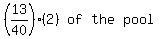 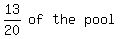 Since 13/20ths of the pool has been emptied, there remain 7/20th of the pool
to be emptied
How long will it take the larger pump to empty the pool?
Now the TIME is an unknown, so we use a letter, say t:
Again, RATE x TIME = FRACTION of the pool EMPTIED, but now, we use only the rate
of the larger pump, 1/5, and only the remaining 7/20 of the pool to be emptied.
Since 13/20ths of the pool has been emptied, there remain 7/20th of the pool
to be emptied
How long will it take the larger pump to empty the pool?
Now the TIME is an unknown, so we use a letter, say t:
Again, RATE x TIME = FRACTION of the pool EMPTIED, but now, we use only the rate
of the larger pump, 1/5, and only the remaining 7/20 of the pool to be emptied.
  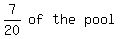 So the equation is
  Multiply both sides by 20
 
 
 hours
1 hour and 45 minutes.
Edwin hours
1 hour and 45 minutes.
Edwin
Answer by MathTherapy(10806) (Show Source):
You can put this solution on YOUR website!
A 5-horsepower (hp) pump can empty a pool in 5 hours.A smaller, 2-hp pump empties the same pool in 8 hours. The pumps are used together to begin emptying this pool.After two hours, the 2-hp pump breaks down. How long will it take the larger pump to empty the pool?
Let hp = horsepower
5hp = 1/5
2hp = 1/8
Let t = time in hours
1/t = time it takes larger pump to empty the pool
My equation is:
(1/5) + (1/8) = 1/t
Is this correct?
No. That's WRONG.
Yes, the rates are  . However, both worked TOGETHER, for 2 hours, so fraction of job completed in 2 hours = . However, both worked TOGETHER, for 2 hours, so fraction of job completed in 2 hours =  And, since the SLOWER pump broke down and the FASTER completed the job, the FASTER completed the remaining fraction:
 , with T being the time taken by the FASTER to complete the job.
Both fractions SUM to 1, so equation is actually: , with T being the time taken by the FASTER to complete the job.
Both fractions SUM to 1, so equation is actually: 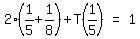 Solve that now for T, the time it takes the LARGER/FASTER to complete the job.
Answer by ikleyn(53749) (Show Source):
Question 1208781: An iron atom has a mass of 1.79 × 10^−22 grams. A sample of iron has a mass of 9. 129 × 10^−3 grams?
Determine how many atoms are in the sample using scientific notation.
a. 7.339 × 10^−25
b. 7.339 × 10^20
c. 5.1 × 10^19
d. 5.1 × 10^−24
Found 3 solutions by ikleyn, math_tutor2020, Edwin McCravy:
Answer by ikleyn(53749) (Show Source):
You can put this solution on YOUR website! .
For your info: Handbooks give the iron atomic mass 9.27*10^(-23) grams.
So, your professor (or your textbook) gives you wrong information.
Answer by math_tutor2020(3835) (Show Source):
You can put this solution on YOUR website!
Answer: C) 5.1 x 10^19
Work Shown
n = number of atoms
(atom's weight)*(number of atoms) = total weight
(atom's weight)*(n) = total weight
n = (total weight)/(atom's weight)
n = 9.129 x 10^(-3) divide 1.79 x 10^(-22)
n = (9.129/1.79) x 10^(-3 - (-22) )
n = 5.1 x 10^(-3+22)
n = 5.1 x 10^19
If you don't have your calculator with you, or you're in a hurry, then you can take advantage of the fact there is multiple choice.
Focus on the 10^(-3) dividing over 10^(-22). As shown above, that evaluates to 10^19 which is present in choice C only. We can rule out the other options and don't need to calculate the 5.1
Another thing to notice:
9.129 is close to 10
1.79 is close to 2
10/2 = 5 which is close to 5.1
Answer by Edwin McCravy(20077)  (Show Source): (Show Source):
Question 1208337: 9b + 15b = 3
Answer by ikleyn(53749) (Show Source):
You can put this solution on YOUR website! .
    9b + 15b = 3


Combine like terms

      24b    = 3


Divide both sides by 24

        b = 3/24 = 1/8.


At this point, the solution procedure is complete.


ANSWER.  b = 1/8.
Solved.
---------------------
If you want to learn on how to solve simple and simplest linear equations, read the lesson
- HOW TO solve a linear equation
in this site.
Consider this lesson as your textbook, handbook, tutorials and (free of charge) home teacher.
Happy learning (!)
Question 1208035: Find the domain, range, and intercepts of the function
A(x) = 4x•sqrt{1 - x^2}. Finally, graph the function.
Found 5 solutions by AnlytcPhil, ikleyn, mccravyedwin, math_tutor2020, Edwin McCravy:
Answer by AnlytcPhil(1810) (Show Source):
You can put this solution on YOUR website!
The student said in a thank-you note to me:

"This is probably your best reply ever."

So I assume s/he is a calculus student.  It seemed likely to me because

teachers do not assign Math Olympiad type problems to students.  But finding

the range makes this a very good maxima and minima problem.  Only a calculus

teacher would assign this.  It requires the factoring of a -1/2 power out of

a 1/2 power, leaving a power of 1, which is a necessary technique in

taking derivatives of expressions involving roots. That's because the

product and quotient rules for differentiation often involve exponents which

differ by one, whenever the power rule is used, which is always the case in

expressions with roots.

Edwin
Answer by ikleyn(53749) (Show Source):
You can put this solution on YOUR website! .
Find the domain, range, and intercepts of the function
A(x) = 4x•sqrt{1 - x^2}. Finally, graph the function.
~~~~~~~~~~~~~~~~~~~
In this problem, finding domain is a simple elementary task: the domain is [-1,1].
Finding x-intercepts is also simple elementary task: they are -1, 0 and 1 on x-axis.
The key issue is to find the range.
Tutor Edwin made it in his post, using derivatives and Calculus; it requires a painstaking technique.
Here I will show another way to find the range, which uses simple elementary Algebra with minimum calculations.
Let real number "t" belongs to the range. It means that
 = t (1)
for some value of x. Square bot sides of (1). You will get = t (1)
for some value of x. Square bot sides of (1). You will get
 = t^2 = t^2
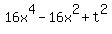 = 0. (2)
You can consider equation (2) as a quadratic equation relative = 0. (2)
You can consider equation (2) as a quadratic equation relative  .
The condition that it has a real solution for is this inequality for the discriminant .
The condition that it has a real solution for is this inequality for the discriminant
 >= 0, or >= 0, or 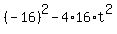 >= 0, or 256 >= >= 0, or 256 >=  .
It implies .
It implies  <= 4; hence, |t| <= 2, or -2 <= t <= 2.
Thus, equation (1) has a real solution if and only if -2 <= t <= 2.
So, the range of the function is this interval -2 <= t <= 2, or t belongs [-2,2]. ANSWER <= 4; hence, |t| <= 2, or -2 <= t <= 2.
Thus, equation (1) has a real solution if and only if -2 <= t <= 2.
So, the range of the function is this interval -2 <= t <= 2, or t belongs [-2,2]. ANSWER
Solved.
Thus, this problem can be solved in this simple way much easier than applying Calculus.
Surely, the Calculus approach is like a heavy army tank: it is universal and works everywhere.
So, if you know Calculus and do not afraid to apply it, boldly go forward.
But if the teacher gave you similar problem long before you learn Calculus,
know and remember that this method from my post probably works.
This problem is a typical Math Olympiad level problem or a Math circle level problem
for 9-th grades high school students, who just know Algebra, but still don't know Calculus.
Answer by mccravyedwin(421)  (Show Source): (Show Source):
You can put this solution on YOUR website!
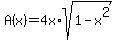 We find the x-intercept(s) by setting A(x) = 0
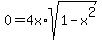
 ; ; 
 ; ; 

 So the x-intercepts are (-1,0), (0,0), (1,0
We find the y-intercept(s) by setting x = 0
So the x-intercepts are (-1,0), (0,0), (1,0
We find the y-intercept(s) by setting x = 0
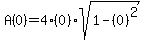
 So the y-intercept is (0,0) which is both an x- and a y-intercept.
Since a square root's radicand cannot be negative
So the y-intercept is (0,0) which is both an x- and a y-intercept.
Since a square root's radicand cannot be negative

 So either both factor are positive or both negative
 OR OR 
 OR OR  So the domain is
  or in interval notation [-1,1] or in interval notation [-1,1]
 For the range, we must find the maxima and minima
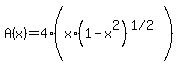


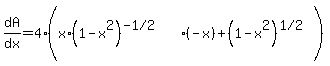
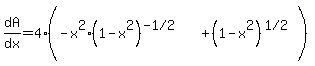 We can factor the -1/2 power out of both terms and since
  ,
we will just have the 1st power of the parenthetical expression: ,
we will just have the 1st power of the parenthetical expression:
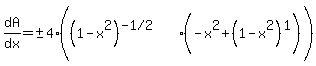 Now I'll let you simplify that down to
 Set that = 0 and you get the x-coordinates of the maximum and minimum points


 Substituting:
 = = 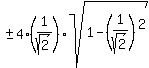 =
=  =
=  =
=  =
=  So the range is
  or in interval notation [-2,2]
Edwin or in interval notation [-2,2]
Edwin
Answer by math_tutor2020(3835) (Show Source):
Answer by Edwin McCravy(20077) (Show Source):
Question 1206670: A ladder, 5cm long leans against a wall so that it makes an angle of 60° with the horizontal ground. Calculate how far up the wall the ladder reaches.
Answer by josgarithmetic(39792) (Show Source):
You can put this solution on YOUR website! Make the drawing. Pythagorean Theorem formula if nothing else;
Notice you should have a special 30-60-90 triangle, which is half of an equilateral triangle.
Question 1206668: Two pencils and one rubber cost $66; five pencils and three rubbers cost $174. How much does each cost?
Answer by josgarithmetic(39792) (Show Source):
Question 1203026: The addition below is incorrect. The display can be made correct by changing one digit d, wherever
it occurs, to another digit e. Find the sum of d and e.
742586
+ 829430
= 1212016
Please help me solve this problem
Found 3 solutions by ikleyn, greenestamps, math_helper:
Answer by ikleyn(53749) (Show Source):
You can put this solution on YOUR website! .
First, we must assume (or the problem must say it explicitly),
that the addends are written correctly.
If so, then all you need to solve this problem is
(a) to add the two given numbers in a correct way (it is assumed that you are able to do it),
and
(b) to compare your calculated sum with the calculations presented in the post
and to detect the difference in some single digit.
So, I honestly do not understand, why a conscientious student comes to the forum
with such question, where everything is as clear as at a sunny day.
Answer by greenestamps(13327) (Show Source):
You can put this solution on YOUR website!
This problem can of course be solved by trial and error; but solving the problem using logical reasoning is a good mental exercise.
  7 4 2 5 8 6
+ 8 2 9 4 3 0
-------------
1 2 1 2 0 1 6
The addition is correct for the final three digits:
  5 8 6
+ 4 3 0
-------
  0 1 6
So it is unlikely that any of the digits in that part of the problem -- 0, 1, 3, 4, 5, 6, and 8 -- is the one that changes. So very probably the digit that changes is 2, 7, or 9.
In the thousands column we have digits 2 and 9 in the addends, plus a carry, yielding digit 2 in the sum. So the 9 can't change; however, the digit 2 can change to any other digit and the addition in the thousands column will still be correct.
In the ten thousands column, we have digits 4 and 2 in the addends yielding digit 1 in the sum. We don't want the 1 or 4 to change, so the 2 MUST change.
There is a carry from the thousands column to the ten thousands column, so the 2 must change to a 6 to make the addition correct in the ten thousands column.
So it appears changing digit 2 to digit 6 is what we need to do. And doing that shows that the addition is now correct.
  7 4 6 5 8 6
+ 8 6 9 4 3 0
-------------
1 6 1 6 0 1 6
ANSWER: d+e = 2+6 = 8
Answer by math_helper(2461)  (Show Source): (Show Source):
You can put this solution on YOUR website!
I see this problem more as a puzzle than a math problem.  It does

require some thought combined with trial-and-error:


If 2 is replaced by 6 you get:


     746586

    +869430

 ------------

    1616016


Also note 1212016 becomes 1616016, as required.


Thus, you have d=2, e=6  so  d+e = 8.
Question 1203013: 1.) X + Y = 48
2.) X - Y = 16
3). X multiplied by Y = 512
4). X divided by Y = 2
Question: X = ?
Y = ?
Answer by MathLover1(20855)  (Show Source): (Show Source):
Question 1201973: In survey of 900 workers 600 owned houses,500 owned cars and 345 owned boat,300 owned cars and houses,250 owned houses and boats and 270 owned cars and boats 200 owned the three.find how many workers don't owned any of items, find how many workers owned only two of the items
Found 2 solutions by ikleyn, math_tutor2020:
Answer by ikleyn(53749) (Show Source):
You can put this solution on YOUR website! .
In survey of 900 workers 600 owned houses, 500 owned cars and 345 owned  boats, boats,
300 owned cars and houses,250 owned houses and boats and 270 owned cars and boats.
200 owned the three.
(a) Find how many workers don't owned any of items.
(b) Find how many workers owned only two of the items.
~~~~~~~~~~~~~~~~~
(a)  You are given a universal set of 900 workers and three its basic subsets

         - H (owned houses) of 600 workers;
         - C (owned cars)   of 500 workers;
         - B (owned boats)  of 345 workers.

     You also are given the info about in-pair intersections of these three subsets

         - CH (owned cars   and houses)  of 300 workers;
         - HB (owned houses and boats)   of 250 workers;
         - CB (owned cars   and boats)   of 270 workers.

     You also are given the info about the triple intersections of these three subsets

         - CHB (owned all three items)  of 200 workers.


     Use the Inclusion-Exlusion principle.  The Inclusion-Exclusion formula is

         n(H U C U B) = n(H) + n(C) + n(B) - n(HC) - n(HB) - n(CB) + n (CHB) =

                      = 600 + 500 + 345 - 300 - 250 - 270 + 200 = 825.

     Thus 825 workers own at least one of three items.

     Hence, the rest  1000-825 = 175  workers don't have any of items.    ANSWER


(b)  To find the number of workers who own only two of the items, subtract triple intersection from
     the corresponding in-pair intersection.

     You will get:

         n(CH_only) = n(CH) - n(CHB) = 300 - 200 = 100  (owned cars   and houses only);

         n(HB_only) = n(HB) - n(CHB) = 250 - 200 =  50  (owned houses and boats only);

         n(CB_only) = n(CB) - n(CHB) = 270 - 200 =  70  (owned cars   and boats only).

     These sets CH_only, HB_only and CB_only are disjoint (i.e. have empty intersection;  THEREFORE

     the number of workers owned only two of the items is the sum  100 + 50 + 70 = 220.    ANSWER
Solved.
-------------------
To see many other similar (and different) solved problems on Inclusion-Exclusion principle, see the lessons
- Counting elements in sub-sets of a given finite set
- Advanced problems on counting elements in sub-sets of a given finite set
- Challenging problems on counting elements in subsets of a given finite set
- Selected problems on counting elements in subsets of a given finite set
- Inclusion-Exclusion principle problems
in this site.
On Inclusion-Exclusion principle, see this Wikipedia article
https://en.wikipedia.org/wiki/Inclusion%E2%80%93exclusion_principle
Answer by math_tutor2020(3835) (Show Source):
You can put this solution on YOUR website!
Set H = houses
Set C = cars
Set B = boats
Let's draw out a venn diagram
The uppercase letters represent the circle names/labels
The lowercase letters are the 8 regions I'll talk about down below.

There are 8 distinct regions- a = houses only
- b = houses and cars, but no boats
- c = cars only
- d = houses and boats, but no cars
- e = all three
- f = cars and boats, but no houses
- g = boats only
- h = none of the three items mentioned
Example: If someone owns a house and a boat, then they are in region d.
We have these given facts
| Number | Statement | | Fact 1 | Survey of 900 workers | | Fact 2 | 600 owned houses | | Fact 3 | 500 owned cars | | Fact 4 | 345 owned boat | | Fact 5 | 300 owned cars and houses | | Fact 6 | 250 owned houses and boats | | Fact 7 | 270 owned cars and boats | | Fact 8 | 200 owned the three. |
Fact 8 is where we'll start.
This tells us that 200 goes in region e at the very center.
It's where all three circles overlap.
We'll then use Fact 7 and Fact 8 to determine there must be 270-200 = 70 people who own a car and a boat, but not a house.
The value 70 goes inside region f.
Next use Fact 6 and Fact 8 together to determine there are 250-200 = 50 people who own a house and a boat, but no car.
The value 50 goes in region d.
Next up will be Fact 5 and Fact 8 used together. We can say there are 300-200 = 100 people who own a house and a car, but no boat.
The value 100 goes in region b.
Here's what we have so far
b = 100
d = 50
e = 200
f = 70

Focus your attention on circle H.
The values in this circle must add to 600 (due to Fact 2)
That means...
a+b+d+e = 600
a+100+50+200 = 600
a+350 = 600
a = 600-350
a = 250
There are 250 people who own a house, but not a car and also not a boat.
Now move your attention to circle C.
We use Fact 3 to say the following:
b+c+e+f = 500
100+c+200+70 = 500
c+370 = 500
c = 500-370
c = 130
Use a similar idea for circle B. Refer to Fact 4
d+e+f+g = 345
50+200+70+g = 345
320+g = 345
g = 345-320
g = 25
We have these values
a = 250, b = 100, c = 130
d = 50, e = 200, f = 70
g = 25
which leads to this nearly completed venn diagram

The last thing to figure out is what we put in region h.
Let's add up all of the values in the circles ('a' through 'g')
a+b+c+d+e+f+g = 250+100+130+50+200+70+25 = 825
This represents the total number of people who have at least one (i.e. one or more) item mentioned.
Then we use Fact 1 to determine how many people have none of those three items
900-825 = 75
There are 75 people who own neither a house, nor a car, nor a boat.
This value goes in region h.
Here's the completed venn diagram

where,
a = 250, b = 100, c = 130
d = 50, e = 200, f = 70
g = 25, h = 75
Now onto the questions:
Question 1) how many workers don't own any of those items?
Answer: 75
Reason: See region h of the venn diagram
Question 2) how many workers own only two of the items?
Answer: 220
Reason: b+d+f = 100+50+70 = 220
Ignore region e because that subset of people own all 3 items.
Question 1201159: PUZZLE CORNER
Enter PIN code
ENTER PIN CODE
O
Albert changed his mobile phone PIN code from 0000 but he has now forgotten it. He remembers that if you multiply it by 4, the answer is the PIN code in reverse.
Can you help him?
Answer by greenestamps(13327) (Show Source):
You can put this solution on YOUR website!
his PIN code is ABCD; and multiplied by 4 it is DCBA.
  ABCD
  x  4
  ----
  DCBA
4 is an even digit; an even digit times any digit yields an even last digit, so A is even.
4 times ABCD is still a 4-digit number; then, since A must be even, A can only be 2.
  2BCD
  x  4
  ----
  DCB2
The multiplication D times 4 yields final digit 2, so D can be only 3 or 8. But 4 times 2BCD yields first digit D, so D must be 8.
  2BC8
  x  4
  ----
  8CB2
8CB2 is a multiple of 4, so the last 2 digits of 8CB2 must be a multiple of 4. That means B is odd.
But 4 times 2BC8 yields a 4-digit product, so B must be 1.
  21C8
  x  4
  ----
  8C12
4 times the last 2 digits C8 yields last 2 digits 12 in the product; that means C can be only 2 or 7. But since 4 times 21C8 yields the product 8C12, C must be 7.
  2178
  x  4
  ----
  8712
ANSWER: His PIN code is 2178
Question 1200270: I woukd like help to solve this(3/4-2/3)+1/2+1/3)
Found 2 solutions by math_tutor2020, josgarithmetic:
Answer by math_tutor2020(3835) (Show Source):
You can put this solution on YOUR website!
Hints:
Get each denominator to the LCD, which in this case is 12.
For instance we multiply top and bottom of 3/4 by 3 to get to 9/12
3/4 = (3*3)/(4*3) = 9/12
2/3 = (2*4)/(3*4) = 8/12
1/2 = (1*6)/(2*6) = 6/12
1/3 = (1*4)/(3*4) = 4/12
In short,
3/4 = 9/12
2/3 = 8/12
1/2 = 6/12
1/3 = 4/12
To see why something like 3/4 = 9/12 is the case, draw a circle and split it into quarters. Shade 3 of them to represent 3/4.
Then split each slice into 3 equal pieces. That gives 4*3 = 12 smaller slices total. 9 of which are shaded.

Similar situations occur for the other fractions.
Answer by josgarithmetic(39792) (Show Source):
Question 1186945: Architect Cristobal made P35,000 during the first year of his job. Each year, he received a 20% raise. What were his total earnings during the first ten years on the job.
Answer by Boreal(15235)  (Show Source): (Show Source):
You can put this solution on YOUR website! a(r^n-1)/(r-1) is the sum of a geometric series, and r here is 1.2 with n 10
so a(1.2^10)-1)(0.2)=25.958a
rounding at the end the amount is P908,553.87
the sum
35000
42000
50400
60480
72576
87091.2
104509.44
125411.33
150493.59
180592.31
Question 1186699: _+(_x_)÷_=4 the numbers are 4, 40, 75 and 15
Answer by josgarithmetic(39792) (Show Source):
You can put this solution on YOUR website! The equation needs four cells filled and you have four numbers to use. You can do this exercise without somebody helping. You may have twenty-four arrangements to check.
Question 1186408: What does "10+" mean?
Answer by ikleyn(53749) (Show Source):
You can put this solution on YOUR website! .
See these GOOGLE links
https://www.esrb.org/privacy-certified-blog/does-an-e-or-e10-rating-mean-a-game-or-app-is-directed-to-children-for-purposes-of-coppa/
https://plandisney.disney.go.com/question/tickets-say-referring-age-children-393106/
Such questions are good to ask GOOGLE.
Question 1184653: An ice cream maker decided that ice cream with 8% butterfat is the best to sell. How many gallons of ice cream with 6% butterfat should be mixed with ice cream that is 16% butterfat to make 300 gallons of the desired blend?
Found 2 solutions by josgarithmetic, ikleyn:
Answer by josgarithmetic(39792) (Show Source):
Answer by ikleyn(53749) (Show Source):
You can put this solution on YOUR website! .
An ice cream maker decided that ice cream with 8% butterfat is the best to sell. How many gallons of ice cream
with 6% butterfat should be mixed with ice cream that is 16% butterfat to make 300 gallons of the desired blend?
~~~~~~~~~~~~~~~~~~~~~~~~~~~~
Mix x gallons of the 16% butterfat with (300-x) gallons of the 8% butterfat.
The equation for butterfat content in the ingredients and the final micture is
0.16x + 0.06*(300-x) = 0.08*300 gallons.
From the equation
x =  = 60 gallons.
ANSWER. 60 gallons of the 16% butterfat and the rest, (300-60) = 240 gallons of the 6% butterfat. = 60 gallons.
ANSWER. 60 gallons of the 16% butterfat and the rest, (300-60) = 240 gallons of the 6% butterfat.
Solved.
------------
It is a standard and typical mixture problem.
For introductory lessons covering various types of mixture word problems see
- Mixture problems
- More Mixture problems
- Solving typical word problems on mixtures for solutions
- Typical word problems on mixtures from the archive
in this site.
You will find there ALL TYPICAL mixture problems with different methods of solutions,
explained at different levels of detalization, from very detailed to very short.
Read them and become an expert in solution mixture word problems.
Also, you have this free of charge online textbook in ALGEBRA-I in this site
- ALGEBRA-I - YOUR ONLINE TEXTBOOK.
The referred lessons are the part of this textbook in the section "Word problems" under the topic "Mixture problems".
Save the link to this online textbook together with its description
Free of charge online textbook in ALGEBRA-I
https://www.algebra.com/algebra/homework/quadratic/lessons/ALGEBRA-I-YOUR-ONLINE-TEXTBOOK.lesson
to your archive and use it when it is needed.
Question 1184329: A student secures 40 % of the maximum marks to pass. He gets 60 marks and fails by 20 marks. Find the maximum marks
Found 2 solutions by ikleyn, MathLover1:
Answer by ikleyn(53749) (Show Source):
You can put this solution on YOUR website! .
The @MathLover1 solution is copied from (or inspired by)
https://brainly.in/question/15533007?tbs_match=2
(which is dated by 22.02.2020)
without making a reference.
Answer by MathLover1(20855) (Show Source):
Question 1184327: Out of a salary of $4500, I kept 1/3 as savings. Out of the remaining money, I spend 50 % on food and 20 % on house rent. How much do I spend on food and house rent?
Found 3 solutions by ikleyn, MathTherapy, Boreal:
Answer by ikleyn(53749) (Show Source):
You can put this solution on YOUR website! .
Out of a salary of $4500, I kept 1/3 as savings.
Out of the remaining money, I spend 50 % on food and 20 % on house rent.
How much do I spend on food and house rent?
~~~~~~~~~~~~~~~~~~~~~~~~~~~~~~~~~~~~~~~~~~~~~~~
I have another solution and another answer, different from that of @Boreal.
Out of the salary of $4500, one third, or $1500 goes to savings.


The remaining amount is $4500 - $1500 = $3000.


Of the remaining $3000, 50%, or $1500, is spent on food,


                    and 20%, or  $600, is spent on rent.


ANSWER.  $1500 is spent on food.   $600  is spent on rent.


         Notice that the sum  $1500 + $1500 + $600 = $3600, which is less than $4500,

         so  (1)  my solution is not self-contradictory, and

             (2)  allows the room for other spendings, like gas, transportation, paying insurances, making gifts etc.
Solved.
Answer by MathTherapy(10806) (Show Source):
Answer by Boreal(15235) (Show Source):
You can put this solution on YOUR website! 1/3 of $4500=$1500.
So you have $1500 to spend.
Half on food is $1500*1/2=$750
20% on rent is $300.
The sum of those is $1050, which is 70% or $1500.
Question 1184330: A pair of shoes was discounted by 15 %. If the amount of discount was $1,350.00, what was the original price of the shoes?
Answer by ikleyn(53749) (Show Source):
You can put this solution on YOUR website! .
Your numbers scare / frighten / panic me . . .
-----------
comment from student: the number values (JMD) are far less than USD
My response : thanks for your clarification.
Question 1184324: A pair of shoes was discounted by 15 %. If the amount of discount was $1,350.00, what was the original price of the shoes?
Answer by Boreal(15235) (Show Source):
Question 1184322: On any particular day, about 12% of students are absent from school. In a school of 840 students, how many would you expect to be absent on a typical day?
Answer by ikleyn(53749) (Show Source):
Question 1184098: At 8:00, the temperature was 6 degrees Celsius (°C). Three hours later, the temperature was -13°C. By how many degrees Celsius did the temperature change?
Answer by greenestamps(13327) (Show Source):
You can put this solution on YOUR website!

ANSWER: 19 degrees
Some students find this easier to understand by looking at the two numbers 6 and -13 on a number line. 6 is 6 units to the right of 0; -13 is 13 units to the left of 0; the distance between them on the number line (i.e., the difference between them) is 6+13=19.
|
Older solutions: 1..45, 46..90, 91..135, 136..180, 181..225, 226..270, 271..315, 316..360, 361..405, 406..450, 451..495, 496..540, 541..585, 586..630, 631..675, 676..720, 721..765, 766..810, 811..855, 856..900, 901..945, 946..990, 991..1035, 1036..1080, 1081..1125, 1126..1170, 1171..1215, 1216..1260, 1261..1305, 1306..1350, 1351..1395, 1396..1440, 1441..1485, 1486..1530, 1531..1575, 1576..1620, 1621..1665, 1666..1710, 1711..1755, 1756..1800, 1801..1845, 1846..1890, 1891..1935, 1936..1980
|
