|
Question 903013: Working together, a man and a woman can do the job for 8 hours. If either had to do it alone, it would take a woman 2 hours longer than a man. How long would it take either person working alone?
Found 2 solutions by ewatrrr, richwmiller:
Answer by ewatrrr(24785)   (Show Source): (Show Source):
Answer by richwmiller(17219)  (Show Source): (Show Source):
You can put this solution on YOUR website!

Multiply by 8x(x+2) to remove denominators
8(x+2) + 8x = x(x+2)
x^2 -14x - 16 = 0
(Reject the negative solution for time)
| Solved by pluggable solver: SOLVE quadratic equation with variable |
Quadratic equation  (in our case (in our case  ) has the following solutons: ) has the following solutons:

For these solutions to exist, the discriminant  should not be a negative number. should not be a negative number.
First, we need to compute the discriminant :  . .
Discriminant d=260 is greater than zero. That means that there are two solutions:  . .


Quadratic expression 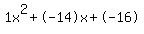 can be factored: can be factored:

Again, the answer is: 15.0622577482985, -1.06225774829855.
Here's your graph:
 |
| Solved by pluggable solver: COMPLETING THE SQUARE solver for quadratics |
Read this lesson on completing the square by prince_abubu, if you do not know how to complete the square.
Let's convert  to standard form by dividing both sides by 1: to standard form by dividing both sides by 1:
We have: .
What we want to do now is to change this equation to a complete square  . How can we find out values of somenumber and othernumber that would make it work? . How can we find out values of somenumber and othernumber that would make it work?
Look at  : :  . Since the coefficient in our equation . Since the coefficient in our equation 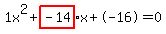 that goes in front of x is -14, we know that -14=2*somenumber, or that goes in front of x is -14, we know that -14=2*somenumber, or 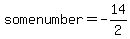 . So, we know that our equation can be rewritten as . So, we know that our equation can be rewritten as 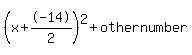 , and we do not yet know the other number. , and we do not yet know the other number.
We are almost there. Finding the other number is simply a matter of not making too many mistakes. We need to find 'other number' such that is equivalent to our original equation 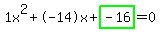 . .

The highlighted red part must be equal to -16 (highlighted green part).
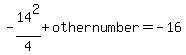 , or , or 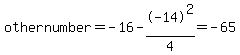 . .
So, the equation converts to 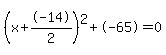 , or , or 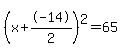 . .
Our equation converted to a square  , equated to a number (65). , equated to a number (65).
Since the right part 65 is greater than zero, there are two solutions:

, or
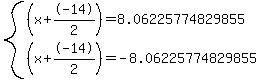
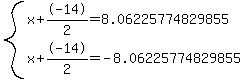
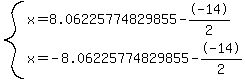
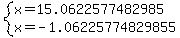
Answer: x=15.0622577482985, -1.06225774829855.
|
|
|
|
| |
