Tutors Answer Your Questions about Polygons (FREE)
Question 1210532: Find the area of the equiangular octagon below.
https://web2.0calc.com/api/ssl-img-proxy?src=https%3A%2F%2Fpreview.redd.it%2F0l2qg3mmy1t51.jpg%3Fwidth%3D960%26crop%3Dsmart%26auto%3Dwebp%26s%3D8643aa9204bef387b574d2d5bbf933a6bb928756
Answer by ikleyn(53748)   (Show Source): (Show Source):
You can put this solution on YOUR website! .
Find the area of the equiangular octagon below.
https://web2.0calc.com/api/ssl-img-proxy?src=https%3A%2F%2Fpreview.redd.it%2F0l2qg3mmy1t51.jpg%3Fwidth%3D960%26crop%3Dsmart%26auto%3Dwebp%26s%3D8643aa9204bef387b574d2d5bbf933a6bb928756
~~~~~~~~~~~~~~~~~~~~~~~~~~~~~~~~~~~~
The shape in the figure is a square with four cut triangles.
The side of the square is 1 + 1 + 1 = 3 units, so its area is 9 square units.
Of four cut triangles, each of them is a right angled isosceles triangle with
leg size of 1 unit, so the area of each such triangle is 1/2.
Thus the area of the shape under the question is 9 - 4 * (1/2) = 9 - 2 = 7 square units.
ANSWER. The area of the shape under the question is 7 square units.
Solved.
Question 740778: I have no clue as to how to answer this question! please help!
If the sum of the measures of the interior angles of a convex n-gon is equal to the sum of the measures of the exterior angles, how many sides does the n-gon have?
Answer by ikleyn(53748) (Show Source):
Question 556147: ABCD is a quadrilateral with AB=8, BC=13, and DC=15. What is the maximum possible integral value of AD?
Answer by ikleyn(53748) (Show Source):
You can put this solution on YOUR website! .
ABCD is a quadrilateral with AB=8, BC=13, and DC=15. What is the maximum possible integral value of AD?
~~~~~~~~~~~~~~~~~~~~~~~~~~~~~~~~~~~~~
The logic and the answer in the post by tutor @Theo are incorrect.
A came to bring a correct solution.
Obviously, the length of AD is always less than the sum AB + BC + CD = 8 + 13 + 15 = 36.
This is true due to the axiom of Geometry, which states that a straight line segment
connecting two points on a plane is always shorter than any polyline connecting these points.
In principle, the length of AD can be as close as desired to the sum of the three sides,
but never reaches the value of the sum (until the quadrilateral is not degenerated).
So, the length of AD has no maximum in the strict mathematical sense, although it is bounded
from the top by the value of the sum, 36.
But since the problem asks about the maximum INTEGRAL value of AD,
this maximum integral length of AD do exist, and is equal to 35 units.
Question 1209520: (39) Square SQUR has sides of length x. If triangle SQE is equilateral, find the area of triangle QAU.
Link to diagram: https://ibb.co/C58rZ09R
Found 4 solutions by Edwin McCravy, greenestamps, ikleyn, CPhill:
Answer by Edwin McCravy(20077)  (Show Source): (Show Source):
Answer by greenestamps(13327)  (Show Source): (Show Source):
Answer by ikleyn(53748) (Show Source):
You can put this solution on YOUR website! .
Square SQUR has sides of length x. If triangle SQE is equilateral, find the area of triangle QAU.
Link to diagram: https://ibb.co/C58rZ09R
~~~~~~~~~~~~~~~~~~~~~~~~~~
The solution in the post by @CPhill is INCORRECT.
I came to bring a correct solution.
I will use coordinate plane (x,y). To avoid missing coordinate x with the side length of the square,
I will use 'a' for the square side length.
Let's place the origin of the coordinate system (x,y) at point S.
The line EQ has an equation
y =  (1)
since its slope is, obviously, (1)
since its slope is, obviously,  . To find 'b' in this equation, substitute coordinates of
the vertex Q = {a,0) of the square into this equation
0 = . To find 'b' in this equation, substitute coordinates of
the vertex Q = {a,0) of the square into this equation
0 =  .
It gives b = .
It gives b =  . So, equation of the line EQ is
y = . So, equation of the line EQ is
y =  = =  . (2)
We want to find the point A as the intersection of the line SU and the line EQ.
The line SU has the equation y = -x; so, we substitute y = -x into equation (2). It gives
-x = . (2)
We want to find the point A as the intersection of the line SU and the line EQ.
The line SU has the equation y = -x; so, we substitute y = -x into equation (2). It gives
-x =  ,
or
-x = ,
or
-x =  , ,
 = =  ,
x = ,
x =  .
Thus we know now the x-coordinate of the point A.
So, now we can find the height h of the triangle QAU as the difference a-x:
h = a-x = a - = .
Thus we know now the x-coordinate of the point A.
So, now we can find the height h of the triangle QAU as the difference a-x:
h = a-x = a - =  = =  .
You can rationalize the denominator
h = .
You can rationalize the denominator
h =  = =  = =  .
Now the area of the triangle QAU is half the product of its base 'a' by its height h =
The ANSWER is : the area of the triangle QAU is .
Now the area of the triangle QAU is half the product of its base 'a' by its height h =
The ANSWER is : the area of the triangle QAU is
 = = 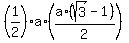 = =  . .
Solved.
\\\\\\\\\\\\\\\\\\\\\\\\\\\\\\\\\\\\\
Regarding the post by @CPhill . . .
Keep in mind that @CPhill is a pseudonym for the Google artificial intelligence.
The artificial intelligence is like a baby now. It is in the experimental stage
of development and can make mistakes and produce nonsense without any embarrassment.
It has no feeling of shame - it is shameless.
This time, again, it made an error.
Although the @CPhill' solution are copy-paste Google AI solutions, there is one essential difference.
Every time, Google AI makes a note at the end of its solutions that Google AI is experimental
and can make errors/mistakes.
All @CPhill' solutions are copy-paste of Google AI solutions, with one difference:
@PChill never makes this notice and never says that his solutions are copy-past that of Google.
So, he NEVER SAYS TRUTH.
Every time, @CPhill embarrassed to tell the truth.
But I am not embarrassing to tell the truth, as it is my duty at this forum.
And the last my comment.
When you obtain such posts from @CPhill, remember, that NOBODY is responsible for their correctness,
until the specialists and experts will check and confirm their correctness.
Without it, their reliability is ZERO and their creadability is ZERO, too.
Answer by CPhill(2189)  (Show Source): (Show Source):
You can put this solution on YOUR website! Here's how to find the area of triangle QAU:
**1. Visualize the problem:**
It's helpful to draw a diagram. You have a square SQUR with side length *x*. Triangle SQE is equilateral, meaning all its sides are also of length *x*. Point A is likely somewhere related to the geometry of the square and triangle. We need more information about the location of point A to solve the problem. Let's assume A is the intersection of lines RE and QU.
**2. Find the coordinates of the points (assuming a coordinate system):**
Let's place the square in a coordinate system. Put S at the origin (0,0), Q at (x,0), U at (x,x), and R at (0,x).
Since SQE is equilateral, point E will be at (x/2, (x√3)/2).
**3. Find the equations of lines RE and QU:**
* **Line RE:** We have points R(0,x) and E(x/2, (x√3)/2). The slope of RE is:
m_RE = [(x√3)/2 - x] / [x/2 - 0] = (√3 - 2)x / x = √3 - 2
The equation of line RE (using point-slope form) is:
y - x = (√3 - 2)(x - 0)
y = (√3 - 2)x + x
y = (√3 - 1)x
* **Line QU:** We have points Q(x,0) and U(x,x). The slope of QU is undefined since it is a vertical line. The equation of the line is x=x.
**4. Find the coordinates of point A (the intersection of RE and QU):**
Since QU is the vertical line x = x, the x-coordinate of point A is *x*. Substitute *x* for x in the equation of line RE to find the y-coordinate:
y = (√3 - 1)x
So, point A is at (x, (√3 - 1)x).
**5. Find the area of triangle QAU:**
The base of triangle QAU is QU, which has length *x*. The height of the triangle is the perpendicular distance from A to the line QU. Since QU is a vertical line, the height is the horizontal distance from x to x, which is 0. The height of the triangle is the difference in the y-coordinates of A and Q. Thus the height is (√3 - 1)x - 0 = (√3 - 1)x.
Area of triangle QAU = (1/2) * base * height
Area = (1/2) * x * (√3 - 1)x
Area = (x²(√3 - 1))/2
Therefore, the area of triangle QAU is (x²(√3 - 1))/2.
Question 1167926: 2. A parallelogram has diagonals 34 in and 20 in and one side measures 15 in.
a. Find the length of the other side
b. Find the area
c. Find the largest interior angle of the parallelogram
Answer by ikleyn(53748) (Show Source):
You can put this solution on YOUR website! .
A parallelogram has diagonals 34 in and 20 in and one side measures 15 in.
(a) Find the length of the other side
(b) Find the area
(c) Find the largest interior angle of the parallelogram
~~~~~~~~~~~~~~~~~~~~~~~~~~~~~~~~~~~~~~~~~~
(a) Find the length of the other side
The diagonals of a parallelogram bisect each other and divide the parallelogram
in 4 (four) small triangles.
Let's consider one of four small triangles, formed by two intersecting diagonals and the given side.
This triangle has the sides of 34/2 = 17 in, 20/2 = 10 in and 15 in.
Write the cosine law for this triangle to find the cosine of the angle 'a' between the diagonals
opposite to the side of 15 inches long
15^2 = 17^2 + 10^2 - 2*17*10*cos(a),
cos(a) = 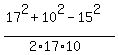 = =  = =  .
The other angle between the diagonals, 'b', is supplementary to angle 'a'.
Hence, angle 'b' has the cosine .
The other angle between the diagonals, 'b', is supplementary to angle 'a'.
Hence, angle 'b' has the cosine  .
Therefore, the square of the side of the parallelogram, opposite to angle 'b', according the cosine law, is
17^2 + 10^2 - 2*17*10*cos(b) = .
Therefore, the square of the side of the parallelogram, opposite to angle 'b', according the cosine law, is
17^2 + 10^2 - 2*17*10*cos(b) = 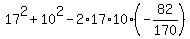 = 17^2 + 10^2 + 2*82 = 553.
Hence, the opposite side of the parallelogram to angle 'b' is = 17^2 + 10^2 + 2*82 = 553.
Hence, the opposite side of the parallelogram to angle 'b' is  = 23.51595203.
It is the ANSWER to question (a).
(b) Find the area
For any parallelogram, its diagonals bisect each other
and divide a parallelogram in 4 (four) small triangles.
So, one of such triangles has the sides 34/2 = 17 inches, 20/2 = 10 inches
and 15 inches.
Having three sides of this triangle, we can find its area using the Heron's formula.
For shortness, I will not write the formulas, since they are in each textbook.
I simply will use one of many existing online calculators for it.
So, the area of this specific triangle is = 23.51595203.
It is the ANSWER to question (a).
(b) Find the area
For any parallelogram, its diagonals bisect each other
and divide a parallelogram in 4 (four) small triangles.
So, one of such triangles has the sides 34/2 = 17 inches, 20/2 = 10 inches
and 15 inches.
Having three sides of this triangle, we can find its area using the Heron's formula.
For shortness, I will not write the formulas, since they are in each textbook.
I simply will use one of many existing online calculators for it.
So, the area of this specific triangle is
 = 74.458 in^2.
The entire parallelogram is the union of small triangles.
The interesting fact is that the areas of all these triangles are equal.
You can easy prove it for yourself, if you draw a perpendicular from one of the vertex
of the parallelogram to the opposite diagonal. This perpendicular then will be the common
altitude of two small triangles. The bases of these small triangle are equal
and the altitude is common - so, the areas of these triangles are the same.
The similar proof works for the opposite vertex and two other triangles.
Thus the area of the parallelogram is 4 times the area of any of small triangles
of the subdivision. Thus the area of the parallelogram is = 74.458 in^2.
The entire parallelogram is the union of small triangles.
The interesting fact is that the areas of all these triangles are equal.
You can easy prove it for yourself, if you draw a perpendicular from one of the vertex
of the parallelogram to the opposite diagonal. This perpendicular then will be the common
altitude of two small triangles. The bases of these small triangle are equal
and the altitude is common - so, the areas of these triangles are the same.
The similar proof works for the opposite vertex and two other triangles.
Thus the area of the parallelogram is 4 times the area of any of small triangles
of the subdivision. Thus the area of the parallelogram is  = 297.832 in^2.
It is the ANSWER to question (b).
(c) Find the largest interior angle of the parallelogram
Let 'C' be the largest interior angle of the parallelogram.
For any two adjacent sides s1 and s2 of a parallelogram, the area of the parallelogram is
area = s1*s2*sin(C), where C is the angle concluded between these sides.
We just found the area of the parallelogram in section )b) above and we know that the area is 297.832 in^2.
So, we can write this equation
297.832 = 15*23.51595203*sin(C).
It gives sin(C) = = 297.832 in^2.
It is the ANSWER to question (b).
(c) Find the largest interior angle of the parallelogram
Let 'C' be the largest interior angle of the parallelogram.
For any two adjacent sides s1 and s2 of a parallelogram, the area of the parallelogram is
area = s1*s2*sin(C), where C is the angle concluded between these sides.
We just found the area of the parallelogram in section )b) above and we know that the area is 297.832 in^2.
So, we can write this equation
297.832 = 15*23.51595203*sin(C).
It gives sin(C) = 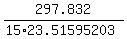 = 0.844340329.
Since 'C' is the largest interior angle, it is obtuse angle, so we can write
C = 180° - arcsin(0.844340329) = 180° - 57.6013263° = 122.3986737°.
Thus the greatest angle of the parallelogram is about 122.399°.
It is the ANSWER to question (c).
Question (c) can be answered/solved in other way.
Write the cosine law for angle C and the opposite to it longest diagonal of 34 inches
34^2 = 15^2 + 23.51595203^2 - 2*15*23.51595203*cos(C),
cos(C) = = 0.844340329.
Since 'C' is the largest interior angle, it is obtuse angle, so we can write
C = 180° - arcsin(0.844340329) = 180° - 57.6013263° = 122.3986737°.
Thus the greatest angle of the parallelogram is about 122.399°.
It is the ANSWER to question (c).
Question (c) can be answered/solved in other way.
Write the cosine law for angle C and the opposite to it longest diagonal of 34 inches
34^2 = 15^2 + 23.51595203^2 - 2*15*23.51595203*cos(C),
cos(C) =  = -0.535806502.
Hence,
C = arccos(-0.535806502) = 122.399°,
which is consistent with we had above. = -0.535806502.
Hence,
C = arccos(-0.535806502) = 122.399°,
which is consistent with we had above.
At this point, the problem is solved in full.
Question 1167924: A rhombus has an area of 200 cm^2 and one of its interior angles is 110 degrees
a. Find the length of the sides
b. Find the length of the longer diagonal
c. Find the altitude of the rhombus
Answer by ikleyn(53748) (Show Source):
You can put this solution on YOUR website! .
A rhombus has an area of 200 cm^2 and one of its interior angles is 110 degrees
(a) Find the length of the sides
(b) Find the length of the longer diagonal
(c) Find the altitude of the rhombus
~~~~~~~~~~~~~~~~~~~~~~~~~~~~~~~~~~~~~~~
Each rhombus has all its 4 sides of the same length.
Let x be the length of a side of this rhombus.
For any parallelogram, including rhombi, the area is half the product of the adjacent sides
by the sine of angle between them.
So, for the area of our rhombus, we have this equation
x*x*sin(110°) = 200,
or
x^2*sin(110°) = 200.
Hence, x = 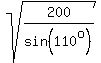 = = 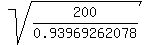 = 14.5889 cm, approximately.
So, question (a) is answered.
To answer question (b), use the cosine law. Notice that the angle of the rhombus opposite to its longest
diagonal, is 110° (given).
So, the length of the longer diagonal is = 14.5889 cm, approximately.
So, question (a) is answered.
To answer question (b), use the cosine law. Notice that the angle of the rhombus opposite to its longest
diagonal, is 110° (given).
So, the length of the longer diagonal is
 = =  = 23.90105 cm, approximately.
Thus, question (b) is answered.
The altitude of the rhombus is its area 200 cm^2 divided by the side
the altitude = = 23.90105 cm, approximately.
Thus, question (b) is answered.
The altitude of the rhombus is its area 200 cm^2 divided by the side
the altitude =  = 13.70905277 cm (approximately). = 13.70905277 cm (approximately).
Thus the problem is solved completely: all questions are answered.
Question 1167917: The diagonals of a parallelogram measure 16 cm and 24 cm. The shorter side measures 10 cm.
1. Find the area of the parallelogram.
2. Find the measure of the longer side.
3. Find the measure of the smaller angle of the parallelogram.
Answer by ikleyn(53748) (Show Source):
You can put this solution on YOUR website! .
The diagonals of a parallelogram measure 16 cm and 24 cm. The shorter side measures 10 cm.
1. Find the area of the parallelogram.
2. Find the measure of the longer side.
3. Find the measure of the smaller angle of the parallelogram.
~~~~~~~~~~~~~~~~~~~~~~~~
Diagonals of a parallelogram bisect each other.
They divide a parallelogram in 4 (four) small triangles.
The angles between the diagonals are vertical and supplementary.
So, if  is an acute angle between the diagonals,
then the other, supplementary angle is an acute angle between the diagonals,
then the other, supplementary angle  is is  .
Let's find an acute angle between the diagonals for the given parallelogram.
Obviously, this angle is opposite to the shorter side of the parallelogram.
The halves of diagonals are 16/2 = 8 cm and 24/2 = 12 cm long, and acute angle
is a concluded angle between the halves of diagonals.
Write the cosine law for such a triangle
10^2 = .
Let's find an acute angle between the diagonals for the given parallelogram.
Obviously, this angle is opposite to the shorter side of the parallelogram.
The halves of diagonals are 16/2 = 8 cm and 24/2 = 12 cm long, and acute angle
is a concluded angle between the halves of diagonals.
Write the cosine law for such a triangle
10^2 =  + +  - -  .
It gives .
It gives
 = = 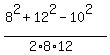 = =  = =  .
These four small triangles of the subdivision have a remarkable property:
their areas are all the same.
It is easy to prove: the area of each such a triangle is half the product of the sides
that are halves of diagonals, by the sine of the angle between them.
area = .
These four small triangles of the subdivision have a remarkable property:
their areas are all the same.
It is easy to prove: the area of each such a triangle is half the product of the sides
that are halves of diagonals, by the sine of the angle between them.
area = 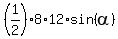 for the acute angle between diagonals
and
area = for the acute angle between diagonals
and
area = 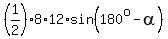 for the obtuse angle between diagonals.
But the acute angle and the obtuse angle are SUPPLEMENTARY, so, they have the same value of sine.
GREAT !
Let's calculate the sine of an angle between the diagonals.
For the acute angle, it is for the obtuse angle between diagonals.
But the acute angle and the obtuse angle are SUPPLEMENTARY, so, they have the same value of sine.
GREAT !
Let's calculate the sine of an angle between the diagonals.
For the acute angle, it is
 = = 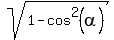 = =  = =  = =  = =  .
For the obtuse angle, the sine value is the same, .
So, each of the four small triangle of the subdivision has the area
= .
For the obtuse angle, the sine value is the same, .
So, each of the four small triangle of the subdivision has the area
= 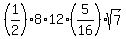 = =  .
The area of the whole parallelogram is then four times the area of each separate small triangle
of the subdivision.
So, the area of the parallelogram is .
The area of the whole parallelogram is then four times the area of each separate small triangle
of the subdivision.
So, the area of the parallelogram is  = =  , or about 158.7450787 cm^2.
To find the measure of the longer side, apply the cosine law again.
Use the obtuse-angled triangle of the subdivision.
Its sides are 8 cm and 12 cm; the cosine of the obtuse concluded angle = , or about 158.7450787 cm^2.
To find the measure of the longer side, apply the cosine law again.
Use the obtuse-angled triangle of the subdivision.
Its sides are 8 cm and 12 cm; the cosine of the obtuse concluded angle =  is
is  = =  .
So, we write for the square of the longer side of the parallelogram .
So, we write for the square of the longer side of the parallelogram
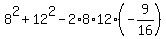 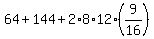 = 64+144+108 = 316.
Thus the longer side of the parallelogram is = 64+144+108 = 316.
Thus the longer side of the parallelogram is  = 17.77638883 cm (approximately).
The last question is to find the smaller angle of the parallelogram, = 17.77638883 cm (approximately).
The last question is to find the smaller angle of the parallelogram,  .
Let's find it, using the shorter side of 10 cm and what we just learned about this parallelogram:
its area is and its longer side is .
The area of any parallelogram is the product of any two adjacent sides by the sine of the concluded angle.
So, for .
Let's find it, using the shorter side of 10 cm and what we just learned about this parallelogram:
its area is and its longer side is .
The area of any parallelogram is the product of any two adjacent sides by the sine of the concluded angle.
So, for  we can write this equation we can write this equation
 } = .
Thus = } = .
Thus =  = =  = 0.893010837.
Hence, = arcsin(0.893010837) = 63.2540602 degrees.
ANSWER. The area of the parallelogram is , or about 158.7450787 cm^2.
The measure of the longer side is , or 17.77638883 cm (approximately).
The measure of the smaller angle of the parallelogram is arcsin(0.893010837), or about 63.2540602 degrees. = 0.893010837.
Hence, = arcsin(0.893010837) = 63.2540602 degrees.
ANSWER. The area of the parallelogram is , or about 158.7450787 cm^2.
The measure of the longer side is , or 17.77638883 cm (approximately).
The measure of the smaller angle of the parallelogram is arcsin(0.893010837), or about 63.2540602 degrees.
Solved.
Question 1168879: A1A2A3...An is a regular n-gon.
(a) Prove that A1A2A3A4 is a trapezoid.
(b) Prove that angle A2A1A4=360°/n
I don't know how to start or how to read the question. Thanks for your help.
Answer by CPhill(2189) (Show Source):
You can put this solution on YOUR website! Let's break down this geometry problem step by step.
**Understanding the Problem**
* **Regular n-gon:** This means a polygon with 'n' sides, where all sides are equal in length, and all interior angles are equal.
* **A1A2A3...An:** This notation refers to the vertices (corners) of the n-gon, labeled in order.
* **(a) Prove A1A2A3A4 is a trapezoid:** This asks you to show that the quadrilateral formed by the first four vertices of the n-gon has at least one pair of parallel sides.
* **(b) Prove angle A2A1A4=360°/n:** This asks you to find the measure of a specific angle within the n-gon.
**Visualizing the Problem**
It's helpful to draw a diagram. Let's start with a regular hexagon (n=6) to get an idea.
```
A6
/ \
/ \
A1-----A5
/ \ /
/ \ /
A2-----A4
\ /
\ /
A3
```
**Part (a): Proving A1A2A3A4 is a Trapezoid**
1. **Properties of Regular Polygons:**
* All sides are equal.
* All interior angles are equal.
* The measure of each interior angle is (n-2) * 180° / n.
2. **Angle Relationships:**
* In a regular n-gon, the arcs between consecutive vertices are equal.
* Angles subtended by equal arcs are equal.
3. **Trapezoid Definition:**
* A trapezoid is a quadrilateral with at least one pair of parallel sides.
4. **Proof:**
* Consider the arcs A1A2, A2A3, A3A4, etc. Because we have a regular n-gon, all of these arcs are equal.
* Angle A2A1An is equal to angle A4A3An-2. This is because they are subtended by the same number of arcs.
* Because of the equal arcs, and the equal interior angles, the line A1A2, and the line A3A4 are symmetrical in relation to the center of the n-gon.
* Therefore, the line A1A2 and the line A3A4 are parallel.
* Since A1A2A3A4 has one pair of parallel sides (A1A2 and A3A4), it is a trapezoid.
**Part (b): Proving Angle A2A1A4=360°/n**
1. **Central Angles:**
* The central angle subtended by each side of a regular n-gon is 360° / n.
2. **Inscribed Angles:**
* An inscribed angle is an angle formed by two chords in a circle (or in this case, a regular n-gon).
* The measure of an inscribed angle is half the measure of the intercepted arc (or the central angle that subtends the same arc).
3. **Proof:**
* The arc A2A4 subtends a central angle of 2 * (360° / n) because it spans two sides of the n-gon.
* Angle A2A1A4 is an inscribed angle that intercepts the arc A2A4.
* Therefore, angle A2A1A4 = (1/2) * [2 * (360° / n)] = 360° / n.
**Key Points**
* Understanding the properties of regular polygons is crucial.
* Visualizing the problem with a diagram helps.
* Remember the relationships between central angles and inscribed angles.
I hope this helps!
Question 1164857: If XY= XZ= XV and VX // YZ, find a,b, and c.
angle x= 40°
supplementary
Answer by ikleyn(53748) (Show Source):
Question 1209527: (57) The diagonal of a square has length 7. Find the perimeter of a square with twice the area.
Found 2 solutions by ikleyn, josgarithmetic:
Answer by ikleyn(53748) (Show Source):
Answer by josgarithmetic(39792) (Show Source):
Question 1209330: Given regular heptagon ABCDEFG, a circle can be drawn that is tangent to DC at C and to EF at F. What is radius of the circle if the side length of the heptagon is 1?
Found 5 solutions by Edwin McCravy, math_tutor2020, greenestamps, ikleyn, ElectricPavlov:
Answer by Edwin McCravy(20077) (Show Source):
You can put this solution on YOUR website!
Since no one has drawn the figure, and also has not given an exact value
for the radius, I thought I would do so, with an exact solution in terms
of trigonometric values.
We draw perpendiculars to DC at C and to EF at F, and they must intersect
at the center of the circle. We also draw FC to make an isosceles trapezoid
from which we can get the measurements for the angles, in particular angle CFE,
which turns out to be  radians.
The sum of the interior angles of a polygon with n-sides = radians.
The sum of the interior angles of a polygon with n-sides =  So each interior angle of the regular heptagon is
 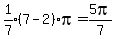 , so angles E and D are , so angles E and D are  each.
Isosceles trapezoid FEDC has sum of interior angles each.
Isosceles trapezoid FEDC has sum of interior angles  so angles EFC and
FCD are each so angles EFC and
FCD are each 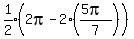 
 Next we'll draw in 3 perpendiculars to FC, namely EH, DJ, and OI.
Notice that angles EFH and FOI have equal measures because they are both
complements of the same angle IFO. Therefore angle FOI also measures .
Next we'll draw in 3 perpendiculars to FC, namely EH, DJ, and OI.
Notice that angles EFH and FOI have equal measures because they are both
complements of the same angle IFO. Therefore angle FOI also measures .
 Since each side of the heptagon is 1,
(a) the hypotenuse EF of right triangle EFH is 1 and
Since each side of the heptagon is 1,
(a) the hypotenuse EF of right triangle EFH is 1 and  (b)
(b)  because HJ=ED=1 and HI is 1/2 of HJ
(c) because HJ=ED=1 and HI is 1/2 of HJ
(c) 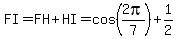 So from right triangle FIO, we can now find the desired radius FO
 and and 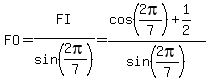 So the exact answer for the radius is
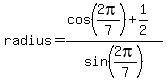 which can also be written as which can also be written as
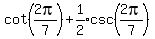 <--EXACT SOLUTION!
That's approximately 1.436997393, which approximately agrees with Ikleyn's,
and is even closer to Greenestamps', approximate solution.
Edwin <--EXACT SOLUTION!
That's approximately 1.436997393, which approximately agrees with Ikleyn's,
and is even closer to Greenestamps', approximate solution.
Edwin
Answer by math_tutor2020(3835) (Show Source):
You can put this solution on YOUR website!
I'll discuss a method of how to verify the answers that tutors ikleyn and greenestamps got.
I'm using GeoGebra to verify.
You can use the web version or you can download it to your computer.
Open up a new workbook.
Select the "regular polygon" tool.
Click anywhere on the xy grid to form the first point.
Then one unit to the right of that location is the next point.
Let's say for example the two points are at A(1,1) and B(2,1)
AB is 1 unit long.
Once A and B are in place, a dialog prompt will ask how many vertices you want. Type in 7.
This generates regular heptagon ABCDEFG where each side is 1 unit long.
Select the line tool to form lines CD and EF.
Use the perpendicular line tool to form lines HC and HF, where H is the intersection of these new perpendicular lines.
H is also the center of the circle we're after.
This circle is tangent to segment CD at point C; and tangent to segment EF at F.
The last step is to use the radius command to have GeoGebra tell us the radius of the circle.
This is approximately 1.4369973927
This value will slightly vary depending how you rounded your intermediate scratch work.
Here's the GeoGebra workbook that I used to verify
https://www.geogebra.org/calculator/xrdjx482
Let me know if you have a question about a particular construction step.
Answer by greenestamps(13327) (Show Source):
You can put this solution on YOUR website!
The AI-produced "solution" to the problem is incorrect.
If you try to follow it, you will see that it says segment CF is a side of the heptagon, which it is not.
You should also recognize that, with the side length of the heptagon being 1, it is absurd that the answer would be that the radius of the circle tangent to DC at C and to EF at F is less than 1/2....
Following is a correct solution to the problem. In that solution, I only outline the calculations, and I only show numbers to a few decimal places. In order to learn anything from the problem, the student should go through the detailed calculations himself (I used a TI-84 calculator), and he should not do any rounding until the final answer.
Let O be the center of the circle. Then, according to the given information, OC is a radius of the circle and is perpendicular to CD, and OF is a radius of the circle perpendicular to FE.
Each exterior angle of the heptagon has a measure of 360/7 degrees, so each interior angle has a measure of 180 - (360/7) = 900/7 degrees.
Use the law of cosines in triangle DEF with DE=EF=1 and angle E having a measure of 900/7 degrees to find that the length of DF is about 1.8018.
In isosceles triangle DEF, angle DEF has measure 900/7 degrees, so each of the other two angles has measure (1/2) of (180 - (900/7)) = 180/7 degrees. That makes the measure of angle CDF 900/7 - 180/7 = 720/7 degrees.
Use the law of cosines in triangle CDF, knowing the lengths of CD and DF and the measure of angle CDF, to find that the length of CF is about 2.24698.
In pentagon OCDEF, use the known measures of angles OCD, CDE, DEF, and EFO to determine that the measure of angle COF is 720/7 degrees. Then use the law of cosines in triangle OCF, with OC and OF being radii of the circle, to find that the radius of the circle is about 1.437.
ANSWER (approximately): 1.437
Answer by ikleyn(53748) (Show Source):
Answer by ElectricPavlov(122) (Show Source): (Show Source):
You can put this solution on YOUR website! Certainly, let's find the radius of the circle.
**1. Find the interior angle of the heptagon:**
* The interior angle of a regular heptagon is given by:
* (n - 2) * 180° / n
* where n is the number of sides (n = 7)
* Interior angle = (7 - 2) * 180° / 7 = 900° / 7 ≈ 128.57°
**2. Find the angle at the center of the heptagon:**
* The central angle of a regular heptagon is given by:
* 360° / n
* Central angle = 360° / 7 ≈ 51.43°
**3. Find the angle ∠DCF:**
* ∠DCF = 2 * (Interior angle) - 360°
* ∠DCF = 2 * 128.57° - 360° = 257.14° - 360° = -102.86°
* Since we're dealing with angles on a circle, we can consider ∠DCF = 360° - 102.86° = 257.14°
**4. Find the angle ∠CDF:**
* ∠CDF = 180° - Interior angle = 180° - 128.57° = 51.43°
**5. Construct the circle:**
* Draw the circle tangent to DC at C and EF at F.
* Let O be the center of the circle.
* Let R be the radius of the circle.
**6. Find the distance OC:**
* In triangle ODC, ∠OCD = 90° (tangent to the circle)
* OC = R (radius of the circle)
**7. Find the distance OF:**
* In triangle OEF, ∠OFE = 90° (tangent to the circle)
* OF = R (radius of the circle)
**8. Find the distance CF:**
* CF = side length of the heptagon = 1
**9. Use the Law of Cosines in triangle OCF:**
* CF² = OC² + OF² - 2 * OC * OF * cos(∠DCF)
* 1² = R² + R² - 2 * R * R * cos(257.14°)
* 1 = 2R² - 2R² * cos(257.14°)
* 1 = 2R² * (1 - cos(257.14°))
* R² = 1 / [2 * (1 - cos(257.14°))]
* R = √[1 / [2 * (1 - cos(257.14°))]]
* R ≈ 0.4339
**Therefore, the radius of the circle is approximately 0.4339.**
**Note:**
* This calculation assumes that the circle is externally tangent to both DC and EF.
* If the circle is internally tangent to one of the sides, the calculation would be different.
Question 1209358: Two runners start at vertices A and B simultaneously and run clockwise around the perimeter of square ABCD at the same speed. A drone flies so that it is always at the midpoint of the two runners. What is the minimum distance between the two runners? What is the maximum distance between the two runners?
Answer by ikleyn(53748) (Show Source):
You can put this solution on YOUR website! .
Two runners start at vertices A and B simultaneously and run clockwise around the perimeter of square ABCD
at the same speed. A drone flies so that it is always at the midpoint of the two runners.
(a) What is the minimum distance between the two runners?
(b) What is the maximum distance between the two runners?
~~~~~~~~~~~~~~~~~~~~~~
It is clear that without loss generality, we may think that the square side length is 1 unit.
Imagine that the square ABCD is placed in a coordinate plane such that
point A is at the origin (0,0) and point B is (1,0).
Let first runner starts from A; second runner starts from B.
Let first runner is now on his way from A to B x units from A.
Then second runner is on his way from B to C x units from B vertically.
The distance between them is now
d(x) = (1-x)^2 + x^2 = 1 - 2x + x^ + x^ = 1 - 2x + 2x^2.
So, the distance between them is this quadratic function d(x).
It has positive leading coefficient 2 at x^2 - so this parabola is opened upward and has a minimum.
The minimum is at  = =  = =  = 1/2,
when both runners are in the mid of their sides.
Then the distance between them is, OBVIOUSLY, half the diagonal of the square.
If the minimum of this quadratic function is at mid-point of the side x= 1/2 (the position of the vertex),
then it is OBVIOUS that the maximum distance, d(x), will be at vertices x= 0 and/or x= 1.
The situation will repeats from side to side; so, it is enough to consider the movement
of runners along AB (for first runner) and along BC (for second runner).
ANSWER. The minimum distance is when the runners are at midpoints of adjacent sides;
the minimum value of the distance is half of the diagonal of the square.
The maximum distance is when the runners are in vertices of the square,
along one common side.
The maximum distance is the length of the square side. = 1/2,
when both runners are in the mid of their sides.
Then the distance between them is, OBVIOUSLY, half the diagonal of the square.
If the minimum of this quadratic function is at mid-point of the side x= 1/2 (the position of the vertex),
then it is OBVIOUS that the maximum distance, d(x), will be at vertices x= 0 and/or x= 1.
The situation will repeats from side to side; so, it is enough to consider the movement
of runners along AB (for first runner) and along BC (for second runner).
ANSWER. The minimum distance is when the runners are at midpoints of adjacent sides;
the minimum value of the distance is half of the diagonal of the square.
The maximum distance is when the runners are in vertices of the square,
along one common side.
The maximum distance is the length of the square side.
Solved.
Question 1209347: We cut a regular octagon ABCDEFGH out of a piece of cardboard. If $AB = 1$, then what is the area of the octagon?
Found 3 solutions by ikleyn, greenestamps, math_tutor2020:
Answer by ikleyn(53748) (Show Source):
Answer by greenestamps(13327) (Show Source):
Answer by math_tutor2020(3835) (Show Source):
Question 1198241: A square pyramid whose lateral edge is 3 ¼ times its base edge can hold 250 cubic inches of sand when level full. How many square inches are there in its lateral surface?
Found 2 solutions by ikleyn, onyulee:
Answer by ikleyn(53748) (Show Source):
You can put this solution on YOUR website! .
The solution to this problem in the post by @onynlee is incorrect.
First error is in n.3, where they say
"We know that the lateral edge, base edge, and height form a right triangle".
This statement is incorrect, and all associated with it calculations in n.3
are incorrect. These three elements do not form any triangle.
They pull along with them incorrect calculations in the rest of the post.
Answer by onyulee(41) (Show Source): (Show Source):
You can put this solution on YOUR website! **1. Define Variables**
* Let 's' be the side length of the square base.
* Let 'l' be the length of the lateral edge (l = 3.25s).
* Let 'h' be the height of the pyramid.
**2. Find the Volume of the Pyramid**
The volume of a square pyramid is given by:
* Volume = (1/3) * Base Area * Height
* 250 = (1/3) * s^2 * h
**3. Find the Height of the Pyramid**
* We know that the lateral edge, base edge, and height form a right triangle.
* Using the Pythagorean Theorem:
* h^2 + (s/2)^2 = l^2
* h^2 + (s^2)/4 = (3.25s)^2
* h^2 = (3.25s)^2 - (s^2)/4
* h^2 = 10.5625s^2 - 0.25s^2
* h^2 = 10.3125s^2
* h = √(10.3125s^2)
* h = s√10.3125
**4. Substitute 'h' in the Volume Equation**
* 250 = (1/3) * s^2 * (s√10.3125)
* 250 = (√10.3125/3) * s^3
* s^3 = 250 / (√10.3125/3)
* s^3 ≈ 22.81
* s ≈ 2.84 inches
**5. Calculate the Lateral Edge Length**
* l = 3.25s
* l = 3.25 * 2.84
* l ≈ 9.21 inches
**6. Calculate the Slant Height**
* Let 'L' be the slant height.
* L^2 = h^2 + (s/2)^2
* L^2 = (s√10.3125)^2 + (s/2)^2
* L^2 = 10.3125s^2 + 0.25s^2
* L^2 = 10.5625s^2
* L = s√10.5625
* L = 2.84 * √10.5625
* L ≈ 9.31 inches
**7. Calculate the Lateral Surface Area**
* Lateral Surface Area = 4 * (1/2) * Base Edge * Slant Height
* Lateral Surface Area = 4 * (1/2) * s * L
* Lateral Surface Area = 4 * (1/2) * 2.84 * 9.31
* Lateral Surface Area ≈ 52.89 square inches
**Therefore, the lateral surface area of the square pyramid is approximately 53 square inches.**
Question 1198257: How many inches long is the altitude of a regular triangular pyramid the base is 12 inches on a side and its volume is 103.8 cubic inches. Round off the answer to the nearest integer.
Answer by onyulee(41) (Show Source):
You can put this solution on YOUR website! **1. Find the Area of the Base**
* The base is an equilateral triangle with side length 12 inches.
* Area of an equilateral triangle = (√3/4) * side²
* Area of the base = (√3/4) * 12² = 36√3 square inches
**2. Use the Volume Formula**
* Volume of a pyramid = (1/3) * Base Area * Height
* 103.8 = (1/3) * 36√3 * Height
* Height = (103.8 * 3) / (36√3)
* Height ≈ 5 inches
**Therefore, the altitude of the regular triangular pyramid is approximately 5 inches.**
Question 1198364: V-QRST is a rectangular pyramid with an edge VS, base QRST. QR = 3/8 m, RS = 5/8 M, and VS = 2/3 m. How many square centimeters are there on its lateral surface? Round off the answer to the nearest integer.
Answer by onyulee(41) (Show Source):
You can put this solution on YOUR website! **1. Understand the Problem**
* We have a rectangular pyramid.
* We know the base dimensions (QR = 3/8 m, RS = 5/8 m) and the slant height (VS = 2/3 m).
* We need to find the lateral surface area in square centimeters.
**2. Convert Units**
* Convert the given dimensions from meters to centimeters:
* QR = (3/8) * 100 = 37.5 cm
* RS = (5/8) * 100 = 62.5 cm
* VS = (2/3) * 100 = 66.67 cm (approximately)
**3. Calculate Slant Heights**
* The rectangular pyramid has four triangular faces. We need to find the slant height of each triangle.
* **For the two triangles with base QR:**
* Slant height (l1) = √(VS^2 - (RS/2)^2)
* l1 = √(66.67^2 - (62.5/2)^2)
* l1 ≈ 56.69 cm
* **For the two triangles with base RS:**
* Slant height (l2) = √(VS^2 - (QR/2)^2)
* l2 = √(66.67^2 - (37.5/2)^2)
* l2 ≈ 64.04 cm
**4. Calculate the Area of Each Triangle**
* **For the two triangles with base QR:**
* Area = (1/2) * base * height = (1/2) * QR * l1
* Area = (1/2) * 37.5 * 56.69
* Area ≈ 1062.81 cm²
* **For the two triangles with base RS:**
* Area = (1/2) * base * height = (1/2) * RS * l2
* Area = (1/2) * 62.5 * 64.04
* Area ≈ 2001.25 cm²
**5. Calculate the Total Lateral Surface Area**
* Lateral Surface Area = 2 * (Area of triangle with base QR) + 2 * (Area of triangle with base RS)
* Lateral Surface Area = 2 * 1062.81 + 2 * 2001.25
* Lateral Surface Area ≈ 6128.12 cm²
**6. Round Off the Answer**
* Rounding to the nearest integer: 6128.12 ≈ 6128
**Therefore, the lateral surface area of the rectangular pyramid is approximately 6128 square centimeters.**
Question 1198258: A square pyramid whose lateral edge is 3 ¼ times its base edge can hold 250 cubic inches of sand when level full. How many square inches are there in its lateral surface? Round off the answer to the nearest integer.
Answer by onyulee(41) (Show Source):
You can put this solution on YOUR website! Certainly, let's find the lateral surface area of the square pyramid.
**1. Define Variables**
* Let 's' be the side length of the square base.
* Let 'l' be the length of the lateral edge (l = 3.25s).
* Let 'h' be the height of the pyramid.
**2. Find the Volume of the Pyramid**
The volume of a square pyramid is given by:
* Volume = (1/3) * Base Area * Height
* 250 = (1/3) * s^2 * h
**3. Find the Height of the Pyramid**
* We know that the lateral edge, base edge, and height form a right triangle.
* Using the Pythagorean Theorem:
* h^2 + (s/2)^2 = l^2
* h^2 + (s^2)/4 = (3.25s)^2
* h^2 = (3.25s)^2 - (s^2)/4
* h^2 = 10.5625s^2 - 0.25s^2
* h^2 = 10.3125s^2
* h = √(10.3125s^2)
* h = s√10.3125
**4. Substitute 'h' in the Volume Equation**
* 250 = (1/3) * s^2 * (s√10.3125)
* 250 = (√10.3125/3) * s^3
* s^3 = 250 / (√10.3125/3)
* s^3 ≈ 22.81
* s ≈ 2.84 inches
**5. Calculate the Lateral Edge Length**
* l = 3.25s
* l = 3.25 * 2.84
* l ≈ 9.21 inches
**6. Calculate the Slant Height**
* Let 'L' be the slant height.
* L^2 = h^2 + (s/2)^2
* L^2 = (s√10.3125)^2 + (s/2)^2
* L^2 = 10.3125s^2 + 0.25s^2
* L^2 = 10.5625s^2
* L = s√10.5625
* L = 2.84 * √10.5625
* L ≈ 9.31 inches
**7. Calculate the Lateral Surface Area**
* Lateral Surface Area = 4 * (1/2) * Base Edge * Slant Height
* Lateral Surface Area = 4 * (1/2) * s * L
* Lateral Surface Area = 4 * (1/2) * 2.84 * 9.31
* Lateral Surface Area ≈ 52.89 square inches
**Therefore, the lateral surface area of the square pyramid is approximately 53 square inches.**
Question 1198259: How many square inches are there in the lateral surface of a regular octagonal pyramid with 12 and 18 inches basal and lateral edges. Round off the answer to the nearest integer.
Answer by CPhill(2189) (Show Source):
You can put this solution on YOUR website! **1. Find the Slant Height**
* We can use the Pythagorean theorem to find the slant height (the height of each triangular face of the pyramid).
* Imagine a right triangle formed by:
* The base: Half the base edge of the octagon (12 inches / 2 = 6 inches)
* The height: The slant height (which we'll call 's')
* The hypotenuse: The lateral edge (18 inches)
* Using Pythagorean Theorem:
* s² = 18² - 6²
* s² = 324 - 36
* s² = 288
* s = √288
* s ≈ 16.97 inches
**2. Calculate the Area of One Triangular Face**
* Area of a triangle = (1/2) * base * height
* Area of one triangular face = (1/2) * base edge * slant height
* Area of one triangular face = (1/2) * 12 inches * 16.97 inches ≈ 101.82 square inches
**3. Calculate the Lateral Surface Area**
* The octagonal pyramid has 8 triangular faces.
* Lateral Surface Area = 8 * Area of one triangular face
* Lateral Surface Area = 8 * 101.82 square inches ≈ 814.58 square inches
**4. Round to the Nearest Integer**
* Lateral Surface Area ≈ 815 square inches
**Therefore, the lateral surface area of the regular octagonal pyramid is approximately 815 square inches.**
Question 1209323: Regular hexagon ABCDEF is inscribed in rectangle PQRS. If [AFP] = 20 and [ABC] = 25, then find [ABCDEF].
Answer by mccravyedwin(421)  (Show Source): (Show Source):
You can put this solution on YOUR website!
Something's wrong! All the right triangles shown in the figure below are
congruent because they are all 30-60-90 right triangles, and each has a
hypotenuse which is a side of the regular hexagon. If you are using
brackets to denote AREA, then you must either have
[AFP] = 20 and [ABC] = 40
or
[AFP] = 12.5 and [ABC] = 25
but not
[AFP] = 20 and [ABC] = 25
 Edwin
Edwin
Question 1208287: 4/3x-1/3=x+7
Answer by ikleyn(53748) (Show Source):
You can put this solution on YOUR website! .
4/3x-1/3=x+7
~~~~~~~~~~~~~~~~~~~~
Your starting equation is
 - -  = x + 7. (1)
In my previous post I solved this equation keeping the fractions
and manipulating fractions to the last point, where I multiplied equation = x + 7. (1)
In my previous post I solved this equation keeping the fractions
and manipulating fractions to the last point, where I multiplied equation
 = 7
by 3 and got the answer x = 22.
Another way is to multiply equation (1) by 3 from the very beginning
to rid of the denominator. Doing it, we get equation
4x - 1 = 3x + 21.
Now move 3x from right side to left side changing the sign;
move -1 from left side to right side changing the sign.
You will get
4x - 3x = 21 + 1.
Combine like term in each side
x = 22.
Thus you got the same answer. = 7
by 3 and got the answer x = 22.
Another way is to multiply equation (1) by 3 from the very beginning
to rid of the denominator. Doing it, we get equation
4x - 1 = 3x + 21.
Now move 3x from right side to left side changing the sign;
move -1 from left side to right side changing the sign.
You will get
4x - 3x = 21 + 1.
Combine like term in each side
x = 22.
Thus you got the same answer.
Solved.
-----------------
So, these two ways, one from my previous post and other which is above, are equivalent.
They both produce the same answer.
You may choose any one from these two, which you like more.
For mature student, these ways are the same, and the choice is the matter of taste.
--------------------
If you want to learn on how to solve simple and simplest linear equations, read the lesson
- HOW TO solve a linear equation
in this site.
Consider this lesson as your textbook, handbook, tutorials and (free of charge) home teacher.
Happy learning (!)
Question 1208286: 4/3x-1/3=x+7
Answer by ikleyn(53748) (Show Source):
Question 1208232: what is the largest diameter circle that will fit inside a regular pentagon with 2-inch sides
Answer by ikleyn(53748) (Show Source):
You can put this solution on YOUR website! .
what is the  diameter of the circle that will fit inside a regular pentagon with 2-inch sides diameter of the circle that will fit inside a regular pentagon with 2-inch sides
~~~~~~~~~~~~~~~~~~~~~~~~
I crossed above, since there is NO the largest diameter.
All diameters of a circle have the same length.
Consider one of 5 isosceles triangles that make this pentagon.
The base of this triangle is 2 inches, hence, half of the base is 1 inch long.
The angle of the triangle, opposite to the base, is 360/5 = 72 degrees;
half of this angle is 36 degrees.
Let r be the radius of the circle, inscribed in this pentagon (in inches).
Then  = tan(36).
Hence, r = = tan(36).
Hence, r =  = =  = 1.3763819 inches.
For tan(36), there is special formula tan(36) = = 1.3763819 inches.
For tan(36), there is special formula tan(36) =  .
For deriving this formula, see, for example, this source
https://www.cuemath.com/trigonometry/tan-36-degrees/
or many others (it is a classic in Trigonometry).
So, the answer to your question for the diameter is
D = .
For deriving this formula, see, for example, this source
https://www.cuemath.com/trigonometry/tan-36-degrees/
or many others (it is a classic in Trigonometry).
So, the answer to your question for the diameter is
D =  = =  = 2.752763841 inches. = 2.752763841 inches.
Solved.
Question 1207772: "There are two windows in Elana's bedroom, each of which has four
right angles. One of her windows has four congruent sides.
The other window contains two pairs of opposite sides that are
equal, but all four sides are not congruent. Which statement
about Elana's windows is true?"
1). Both windows are squares.
2). Both windows are pentagons.
3). Both windows are rectangles.
4). Both windows are rhombuses.
Answer by MathLover1(20855)  (Show Source): (Show Source):
You can put this solution on YOUR website!
One of her windows has four congruent sides. => square (which is a special case of rectangle)
The other window contains two pairs of opposite sides that are equal, but all four sides are not congruent.=> rectangle
answer:
3). Both windows are rectangles
Question 1206859: The base of right pyramid ABCDF is
rhombus ABCD. Segment FK is the
altitude of the pyramid. The angle
between the lateral edge FB and FK is
36°. Find the area and the perimeter of
△BFD if the length of the smaller
diagonal BD is 10 cm. Round your
answer to the nearest cm .
Found 2 solutions by mccravyedwin, Edwin McCravy:
Answer by mccravyedwin(421) (Show Source):
Answer by Edwin McCravy(20077) (Show Source):
Question 1206843: Solve the equation 643x-1÷16x+2=256x÷42x
Answer by Edwin McCravy(20077) (Show Source):
Question 1206466: The diagram shows a small regular octagram (an eight-sided star) surrounded by eight squares (dark gray) and eight kites (light gray) to make a large regular octagram. Each square has area 1. What is the area of one of the light gray kites?
Answer by mananth(16949)  (Show Source): (Show Source):
Question 1205790: 4 sided polygon with angles of 20x, 8(2x+9degrees), 36x . Determine the value of angle x
Found 3 solutions by ikleyn, MathLover1, josgarithmetic:
Answer by ikleyn(53748) (Show Source):
You can put this solution on YOUR website! .
4 sided polygon with angles of 20x, 8(2x+9degrees), 36x . Determine the value of angle x
~~~~~~~~~~~~~~~~~~~~~~~~~
Regarding your problem, I have two messages for you.
First message is that the problem's formulation in the post is FATALLY DEFECTIVE, or FATALLY INCOMPLETE.
With this formulation, the problem can not be solved.
Second message is that the "solution" in the post by @MathLover1 is INCORRECT.
Simply ignore her post, for safety of your mind.
Answer by MathLover1(20855) (Show Source):
Answer by josgarithmetic(39792) (Show Source):
Question 1205049: Find the area of the shaded region.
https://imgur.com/a/IaHCHvI
Found 2 solutions by Edwin McCravy, mananth:
Answer by Edwin McCravy(20077) (Show Source):
Answer by mananth(16949) (Show Source):
Question 1203593: George took out a piece of paper and placed it on his desk. He then drew a polygon. All the angles in the polygon were obtuse. What type of polygon could could he have drawn?
A. quadrilateral
B. rectangle
C. triangle
D. hexagon (the correct answer)
I need to know how to determine this answer (hexagon).
Answer by greenestamps(13327) (Show Source):
Question 1203594: Juan cut out a polygon with scissors and card board. All the angles in the polygon were acute. What type of polygon could he have drawn?
A. pentagon
B. octagon
C. triangle (correct answer)
D. hexagon
I need to know how to determine the correct answer.
Answer by greenestamps(13327) (Show Source):
You can put this solution on YOUR website!
"acute" means the measure of an angle is less than 90 degrees.
For a triangle, the sum of the angle measures is 180 degrees, so the average of the angle measures is 180/3 = 60 degrees. Since that is less than 90 degrees, the polygon he drew could have been a triangle.
For a quadrilateral, the sum of the angle measures is 360 degrees, so the average of the angle measures is 360/4 = 90 degrees. Since that is not less than 90 degrees, the polygon he drew could not have been a quadrilateral.
For polygons with more than 4 sides, the average of the angle measures is always greater then 90 degrees, so it is not possible that the polygon he drew has more then 4 sides.
ANSWER: triangle
|
Older solutions: 1..45, 46..90, 91..135, 136..180, 181..225, 226..270, 271..315, 316..360, 361..405, 406..450, 451..495, 496..540, 541..585, 586..630, 631..675, 676..720, 721..765, 766..810, 811..855, 856..900, 901..945, 946..990, 991..1035, 1036..1080, 1081..1125, 1126..1170, 1171..1215, 1216..1260, 1261..1305, 1306..1350, 1351..1395, 1396..1440, 1441..1485, 1486..1530, 1531..1575, 1576..1620, 1621..1665, 1666..1710, 1711..1755, 1756..1800, 1801..1845, 1846..1890, 1891..1935, 1936..1980, 1981..2025, 2026..2070, 2071..2115, 2116..2160, 2161..2205, 2206..2250, 2251..2295, 2296..2340, 2341..2385, 2386..2430, 2431..2475, 2476..2520, 2521..2565, 2566..2610, 2611..2655, 2656..2700, 2701..2745, 2746..2790, 2791..2835, 2836..2880, 2881..2925, 2926..2970, 2971..3015, 3016..3060, 3061..3105, 3106..3150, 3151..3195, 3196..3240, 3241..3285
|
 .
.
