Question 591026: Please help me solve.
1. (x^2-6x)^2 - 11(x^2-6x)-80=0
2. x-1/x-3>0
3. absolute value x^2+x-15=15
Answer by Theo(13342)   (Show Source): (Show Source):
You can put this solution on YOUR website! problem number 1:
(x^2 - 6x)^2 - 11(x^2-6x)-80 = 0
let y = x^2 - 6x
equation becomes:
y^2 - 11y - 80 = 0
this is a quadratic equation that can be solved in the normal manner that you solve quadratic equations.
80 = 1 * 80 or 2 * 40 or 4 * 20 or 5 * 16 or 10 * 20
1 +/- 80 = 81 or 79
2 +/- 40 = 42 or 38
4 +/- 20 = 24 or 16
5 +/- 16 = 21 or 11 *****
10 +/- 20 = 30 or 10
looks like the combination of 5 * 16 is going to work because 5 * 16 = 80 and 16 - 5 = 11
the 80 is the c term and the 11 is the b term.
our factors are going to be (y + 5) * (y - 16) = 0
if you multiply these factors out you will get:
y^2 + 5y - 16y - 80 which will be equal to y^2 - 11y - 80 which is the quadratic equation we are trying to factor after we let (x^2-6x) equal to y.
since (y+5) * (y-16) = 0, we set each equal to 0 to solve for y.
we get:
y + 5 = 0 which becomes y = -5
y - 16 = 0 which becomes y = 16
those are our solutions for y.
we now need to convert those solutions of y to solutions of x.
we had originally set y = (x^2-6x), so we now substitute (x^2 - 6x) for y to get:
x^2 - 6x = -5
and:
x^2 - 6x = 16
we now need to solve for x.
x^2 - 6x = -5 becomes x^2 - 6x + 5 = 0 after we add 5 to both sides of the equation.
x^2 - 6x = 16 becomes x^2 - 6x - 16 = 0 after we subtract 11 from both sides of the equation.
x^2 - 6x + 5 factors are (x-5) * (x-1)
x^2 - 6x - 16 factors are (x-8) * (x+2)
we set each of these factors = to 0 to get:
x = 5
x = 1
x = 8
x = -2
those are our possible solutions.
we need to confirm those solutions are good by substituting for x in our original equation.
that equation is:
(x^2 - 6x)^2 - 11(x^2-6x)-80 = 0
i used a graphing calculator to confirm those solutions were good.
they are.
without a graphing calculator you need to substitute each of those values for x in turn in the equation and solve the equation to see if the result is 0.
example:
when x = 1, original equation of (x^2 - 6x)^2 - 11(x^2-6x)-80 = 0 becomes:
(1^2 - 6(1))^2 - 11(1^2 - 6(1)) - 80 = 0
this simplifies to:
(1 - 6)^2 - 11(1 - 6) - 80 = 0 which further simplifies to:
(-5)^2 - 11(-5) - 80 = 0 which further simplifies to:
25 + 55 - 80 = 0 which further simplifies to:
80 - 80 = 0 which is true, confirming the value of 1 for x is good.
your solutions to this equation are:
x = -2
x = 1
x = 5
x = 8
problem number 2:
(x-1)/(x-3)>0
you can try to solve this by doing the following:
(x-1) / (x-3) > 0
multiply both sides of the equation by (x-3) to get:
(x-1) = 0
solve for x to get x > 0
that, however, leads to only a partial solution if at all.
these types of equations need to address the numerator and the denominator separately.
find out when the numerator is equal to 0 and find out when the denominator is equal to 0.
the numerator is equal to 0 when x = 1
the denominator is equal to 0 when x = 3
the fraction (x-1) / (x-3) will be positive when the numerator is plus and the denominator is plus or when the numerator is minus and the denominator is minus.
the numerator is positive when x > 1 and the denominator is positive when x > 3.
since 3 > 1, then both numerator and denominator will be positive when x > 3.
the numerator is negative when x < 1 and the denominator is negative when x < 3.
since 1 < 3, then both numerator and denominator will be negative when x < 1
put these facts together and the fraction will be positive when x < 1 and when x > 3.
you can graph this equation to visually see what's going on.
graph the equations of y = (x-1) / (x-3) as shown below:
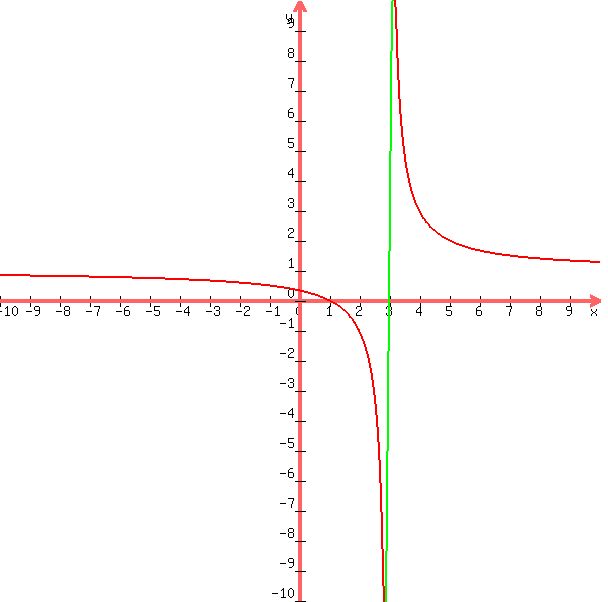
as you can see from the graph, there is a vertical asymptote at x = 3.
this happens because the denominator of the equation becomes 0 when x = 3.
i drew a vertical line there to show you where that happens.
you can also see the the lines of the equation are positive when x is smaller than 1 and when x is greater than 3.
problem number 3:
absolute value of (x^2+x-15) = 15
the definition of an absolute value says that:
if absolute value of (x) = y, then:
x = y if x is positive and:
-x = y if x is negative.
x represents an expression that is within the absolute value signs.
those are vertical lines as shown below:
absolute value of (x) is shown as |x|.
your equation is:
absolute value of (x^2+x-15) = 15
this can also be shown as:
|x^2 + x - 15| = 15
the expression within the absolute value signs is x^2 + x - 15
when that expression is positive, you get:
x^2 + x - 15 = 15
solve as you would any normal quadratic equation.
subtract 15 from both sides of the equation to get:
x^2 + x - 30 = 0
factor to get:
(x-5) * (x+6) = 0
solve for x to get:
x = 5 or x = -6
when that expression is negative, you get:
-(x^2 + x - 15) = 15
multiply both sides of this equation by -1 to get:
x^2 + x - 15 = -15
add 15 to both sides of this equation to get:
x^2 + x = 0
factor to get:
x * (x+1) = 0
solve for x to get:
x = 0 or x = -1
put both solutions together to get:
x = 0 or x = -1 or x = 5 or x = -6
these are the possible solutions to your equation.
you need to confirm these solutions are good by substituting in the original equation.
that equation is:
|x^2 + x - 15| = 15
when x = 0, |x^2 + x - 15| = 15 becomes:
|0 + 0 - 15| = 15 which becomes:
|-15| = 15 which is true by definition of absolute value.
when x = -1, |x^2 + x - 15| = 15 becomes:
|(-1)^2 + (-1) - 15) = 15 which becomes:
|1 - 1 - 15| = 15 which becomes:
|-15| = 15 which is true by definition of absolute value.
when x = 5, |x^2 + x - 15| = 15 becomes:
|5^2 + 5 - 15| = 15 which becomes:
|25 + 5 - 15| = 15 which becomes:
|30 - 15| = 15 which becomes:
|15| = 15 which is true by definition of absolute value.
when x = -6, |x^2 + x - 15| = 15 becomes:
|(-6)^2 + (-6) - 15| = 15 which becomes:
|36 - 6 - 15| = 15 which becomes:
|30 - 15| = 15 which becomes:
|15| = 15 which is true by definition of absolute value.
definition of absolute value states:
|x| = y means:
x = y if x is positive.
-x = y if x is negative.
in our equation of |-15| = 15, 15 is negative, so we get -(-15) = 15 which becomes 15 = 15.
in our equation of |15| = 15, 15 is positive, so we get 15 = 15 which is self evidently true.
you can also graph the equation of |x^2 + x - 15| = 15 so see what it looks like on a graph.
subtract 15 from both sides of that equation to get:
|x^2 + x - 15| - 15 = 0
replace 0 with y in that equation to get:
y = |x^2 + x - 15| = 0 and graph that equation.
you will get:
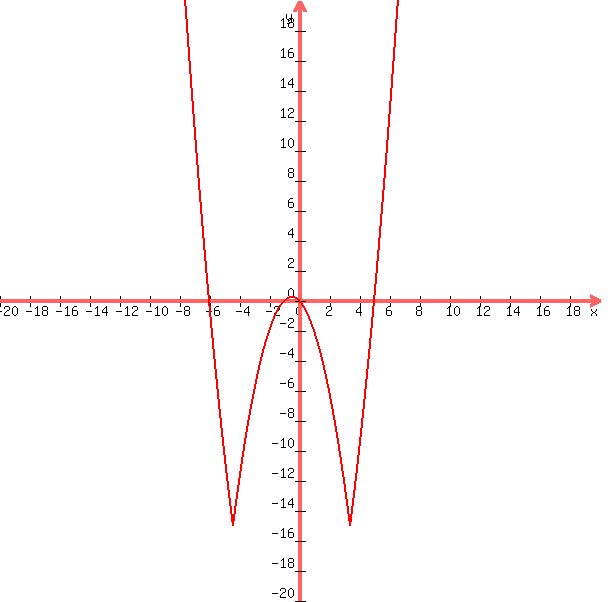
we'll take a closer in look so you can see the points where the graph crosses the x-axis.
those points are your solution points.
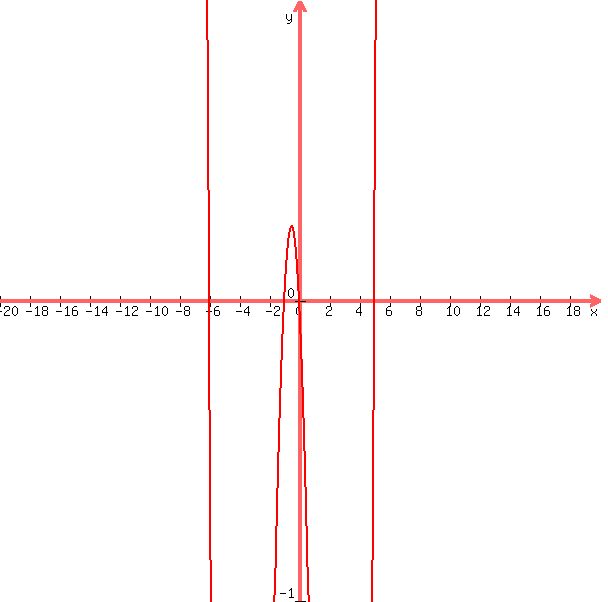
you can see that the graph crosses the x-axis at x = -6, -1, 0, and 5.
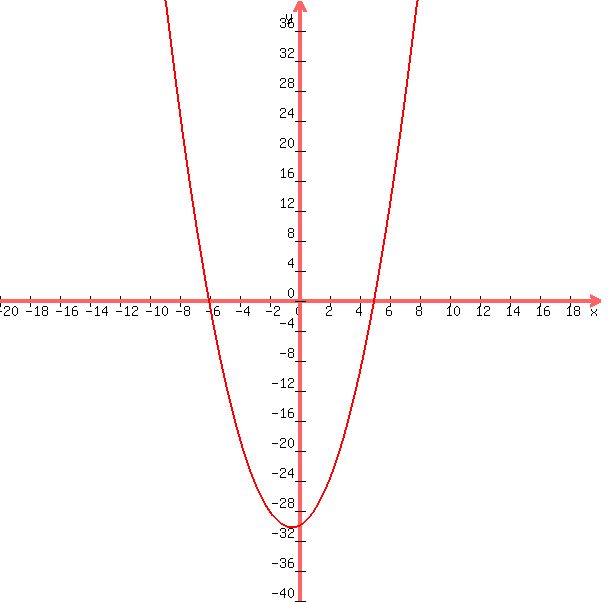
this graph is the graph of the absolute value of (x^2 + x - 15) - 15.
this is not the same as the graph of x^2 + x - 15 - 15 = 0
the graph of that equation looks like this:
|
|
|
