|
Tutors Answer Your Questions about Coordinate-system (FREE)
Question 1210580: graph the function g(x)=-0.5x^2 then describe g(x) when compared to f(x)=x^2
Answer by MathLover1(20855)   (Show Source): (Show Source):
Question 729621: to draw the quadrilateral abcd whose vetices are A(-5,-7),B(5,7),C(-2,1)and D((-2,1) and draw at least three lines passing through origin?
Answer by ikleyn(53748)  (Show Source): (Show Source):
You can put this solution on YOUR website! .
to draw the quadrilateral abcd whose vetices are A(-5,-7), B(5,7), C(-2,1) and D((-2,1)
and draw at least three lines passing through origin?
~~~~~~~~~~~~~~~~~~~~~~~
I am not going to draw for you, because, due my deep conviction,
any student must do such a primitive job on his/her own, without asking help from outside.
I only want to notice that points C and D in your post are identical, i.e.
represent the same point, so, it is, probably, a TRAP, which you prepared for us, the tutors.
Do not fall yourself into this trap.
Question 734984: Two lines in a coordinate plane have no points of intersection. Which of these could be the equations of the lines?
A. 4x+2y=6 C.4x+=6
10x+5y=7 5x-10y=6
B. 4x+2y=6 D. 5x+10y=6
10x+5y=15 5x-10y=6
Answer by ikleyn(53748) (Show Source):
You can put this solution on YOUR website! .
Two lines in a coordinate plane have no points of intersection.
Which of these could be the equations of the lines?
A.  4x + 2y =  6   C. 4x +     = 6
   10x + 5y =  7      5x - 10y = 6

B.  4x + 2y =  6   D. 5x + 10y = 6
   10x + 5y = 15      5x - 10y = 6
~~~~~~~~~~~~~~~~~~~~~~
(A)  The lines have the same slope, but different y-intercepts.
     So, these lines are parallel and have no common points.


(B)  The lines have the same slope and the same y-intercepts.
     So, these lines coincide.


(C)  System (C) is written incorrectly, so I will not discuss/consider it.


(D)  The lines have different slopes, so they intersect each other.


ANSWER.  As far as I can make a conclusion considering cases (A), (B), and (D), lines (A) have no intersection points.
Solved.
Answer in the post by @lynnlo is incorrect.
Question 751568: Determine whether the lines y-4=3x and 2y-6x=8 are parallel, perpendicular, or neither.
Answer by ikleyn(53748) (Show Source):
You can put this solution on YOUR website! .
Determine whether the lines y-4=3x and 2y-6x=8 are parallel, perpendicular, or neither.
~~~~~~~~~~~~~~~~~~~~~~~~~~~~~~
The response in the post by @lynnlo is incorrect.
I came to bring a correct solution.
Write equations for both lines in the form y = ax + b.


For the first line, this equation is  y = 3x + 4.


For the second line, this equation is y = 3x + 4.


Now you see that the equations for both lines are identical, so, the lines coincide.


They are neither parallel nor perpendicular.    <<<---===  ANSWER
Solved and explained.
Question 550844: The points A(-1,2),B(x,y) and C=(4,5) are such that BA=BC.Find a linear relation between x and y.
Answer by ikleyn(53748) (Show Source):
You can put this solution on YOUR website! .
The points A(-1,2), B(x,y) and C(4,5) are such that BA=BC. Find a linear relation between x and y.
~~~~~~~~~~~~~~~~~~~~~~~~~
This problem has a nice Algebra solution.
The square of the length of AB is

    |AB|^2 = (x-(-1))^2 + (y-2)^2 = (x+1)^2 + (y-2)^2 = x^2 + 2x + 1 + y^2 - 4y + 4 = x^2 + 2x + y^2 - 4y + 5.


The square of the length of BC is

    |BC|^2 = (x-4)^2 + (y-5)^2 = x^2 - 8x + 16 + y^2 - 10y + 25 = x^2 - 8x + y^2 - 10y + 41.


The condition  |BA| = |BC|  is the same as  |AB|^2 = |BC|^2.  It gives this equation

    x^2 + 2x + y^2 - 4y + 5 = x^2 - 8x + y^2 - 10y + 41.


Combine like terms.  The final equation is

    10x + 6y = 36,

or

    5x + 3y = 18,

or

y =  . <<<---=== ANSWER . <<<---=== ANSWER
Solved.
Question 1167905: The region R in the first quadrant is bounded by y=6sin(πx/2), y=6(x-2)^2 and y=4x+2, and contains the point (2,6)
The volume of the solid generated by rotating R about the x-axis is:
The volume of the solid generated by rotating R about the y-axis is:
The volume of the solid with R as its base and square cross-sections perpendicular to the x-axis (and to the xy-plane) is:
Answer by CPhill(2189)  (Show Source): (Show Source):
You can put this solution on YOUR website! The region R is bounded by three curves in the first quadrant:
1. $y = f(x) = 6\sin(\pi x / 2)$
2. $y = g(x) = 6(x-2)^2$
3. $y = h(x) = 4x + 2$
First, let's find the intersection points of these curves to define the vertices of region R:
* **Intersection of $y=6\sin(\pi x/2)$ and $y=4x+2$:**
At $x=1$, $y = 6\sin(\pi/2) = 6$. And $y = 4(1)+2 = 6$. So, $(1,6)$ is an intersection point.
* **Intersection of $y=6(x-2)^2$ and $y=4x+2$:**
$6(x-2)^2 = 4x+2$
$6(x^2 - 4x + 4) = 4x+2$
$6x^2 - 24x + 24 = 4x+2$
$6x^2 - 28x + 22 = 0$
$3x^2 - 14x + 11 = 0$
Using the quadratic formula, $x = \frac{14 \pm \sqrt{(-14)^2 - 4(3)(11)}}{2(3)} = \frac{14 \pm \sqrt{196 - 132}}{6} = \frac{14 \pm \sqrt{64}}{6} = \frac{14 \pm 8}{6}$.
This gives $x=1$ (where $y=6$) and $x=11/3$.
For $x=11/3$, $y = 4(11/3)+2 = 44/3 + 6/3 = 50/3$. So, $(11/3, 50/3)$ is an intersection point.
* **Intersection of $y=6\sin(\pi x/2)$ and $y=6(x-2)^2$:**
At $x=1$, $y = 6\sin(\pi/2) = 6$ and $y = 6(1-2)^2 = 6$. So, $(1,6)$ is an intersection point.
At $x=2$, $y = 6\sin(\pi) = 0$ and $y = 6(2-2)^2 = 0$. So, $(2,0)$ is an intersection point.
The three vertices of the region R are $(1,6)$, $(2,0)$, and $(11/3, 50/3)$. The region contains the point $(2,6)$.
Based on these vertices and the condition that the point $(2,6)$ is contained within the region, the boundaries of the region R are defined as:
* **Upper boundary ($y_U(x)$):** $y = 4x+2$ (from $x=1$ to $x=11/3$).
* **Lower boundary ($y_L(x)$):** This is piecewise.
* From $x=1$ to $x=2$: $y = 6\sin(\pi x/2)$ (connects $(1,6)$ to $(2,0)$).
* From $x=2$ to $x=11/3$: $y = 6(x-2)^2$ (connects $(2,0)$ to $(11/3, 50/3)$).
---
### 1. Volume of the solid generated by rotating R about the x-axis (Washer Method)
The volume $V_x$ is given by $V_x = \pi \int_{x_1}^{x_2} (y_{U}(x)^2 - y_{L}(x)^2) dx$.
We split the integral into two parts based on the piecewise lower boundary:
$V_x = \pi \left[ \int_{1}^{2} ((4x+2)^2 - (6\sin(\pi x/2))^2) dx + \int_{2}^{11/3} ((4x+2)^2 - (6(x-2)^2)^2) dx \right]$
**Part 1: $\int_{1}^{2} ((4x+2)^2 - 36\sin^2(\pi x/2)) dx$**
$(4x+2)^2 = 16x^2 + 16x + 4$
$36\sin^2(\pi x/2) = 36 \frac{1-\cos(\pi x)}{2} = 18 - 18\cos(\pi x)$
Integral 1 = $\int_{1}^{2} (16x^2 + 16x + 4 - (18 - 18\cos(\pi x))) dx$
$= \int_{1}^{2} (16x^2 + 16x - 14 + 18\cos(\pi x)) dx$
$= \left[ \frac{16x^3}{3} + 8x^2 - 14x + \frac{18\sin(\pi x)}{\pi} \right]_{1}^{2}$
$= \left( \frac{16(2)^3}{3} + 8(2)^2 - 14(2) + \frac{18\sin(2\pi)}{\pi} \right) - \left( \frac{16(1)^3}{3} + 8(1)^2 - 14(1) + \frac{18\sin(\pi)}{\pi} \right)$
$= \left( \frac{128}{3} + 32 - 28 + 0 \right) - \left( \frac{16}{3} + 8 - 14 + 0 \right)$
$= \left( \frac{128}{3} + 4 \right) - \left( \frac{16}{3} - 6 \right)$
$= \frac{140}{3} - \left(-\frac{2}{3}\right) = \frac{142}{3}$
**Part 2: $\int_{2}^{11/3} ((4x+2)^2 - (6(x-2)^2)^2) dx$**
$(6(x-2)^2)^2 = 36(x-2)^4$
Integral 2 = $\int_{2}^{11/3} (16x^2 + 16x + 4 - 36(x-2)^4) dx$
$= \left[ \frac{16x^3}{3} + 8x^2 + 4x - \frac{36(x-2)^5}{5} \right]_{2}^{11/3}$
$= \left( \frac{16(11/3)^3}{3} + 8(11/3)^2 + 4(11/3) - \frac{36}{5}(\frac{11}{3}-2)^5 \right) - \left( \frac{16(2)^3}{3} + 8(2)^2 + 4(2) - \frac{36}{5}(2-2)^5 \right)$
$= \left( \frac{16 \cdot 1331}{81} + \frac{8 \cdot 121}{9} + \frac{44}{3} - \frac{36}{5}(\frac{5}{3})^5 \right) - \left( \frac{128}{3} + 32 + 8 - 0 \right)$
$= \left( \frac{21296}{81} + \frac{968}{9} + \frac{44}{3} - \frac{36}{5} \frac{3125}{243} \right) - \left( \frac{128}{3} + 40 \right)$
$= \left( \frac{21296}{81} + \frac{8712}{81} + \frac{1188}{81} - \frac{7500}{81} \right) - \left( \frac{128}{3} + \frac{120}{3} \right)$
$= \frac{23696}{81} - \frac{248}{3} = \frac{23696}{81} - \frac{6696}{81} = \frac{17000}{81}$
Total Volume $V_x = \pi \left( \frac{142}{3} + \frac{17000}{81} \right) = \pi \left( \frac{142 \cdot 27}{81} + \frac{17000}{81} \right)$
$V_x = \pi \left( \frac{3834}{81} + \frac{17000}{81} \right) = \frac{20834\pi}{81}$
The volume of the solid generated by rotating R about the x-axis is: $\boxed{\frac{20834\pi}{81}}$
---
### 2. Volume of the solid generated by rotating R about the y-axis (Shell Method)
The volume $V_y$ is given by $V_y = 2\pi \int_{x_1}^{x_2} x (y_{U}(x) - y_{L}(x)) dx$.
$V_y = 2\pi \left[ \int_{1}^{2} x((4x+2) - 6\sin(\pi x/2)) dx + \int_{2}^{11/3} x((4x+2) - 6(x-2)^2) dx \right]$
**Part 1: $\int_{1}^{2} x(4x+2 - 6\sin(\pi x/2)) dx = \int_{1}^{2} (4x^2 + 2x - 6x\sin(\pi x/2)) dx$**
$\int (4x^2 + 2x) dx = \frac{4x^3}{3} + x^2$
$\int -6x\sin(\pi x/2) dx$. Use integration by parts for $\int x\sin(ax)dx = -\frac{x\cos(ax)}{a} + \frac{\sin(ax)}{a^2}$. Here $a=\pi/2$.
So, $-6 \left[ -\frac{2x}{\pi}\cos(\frac{\pi x}{2}) + \frac{4}{\pi^2}\sin(\frac{\pi x}{2}) \right]_{1}^{2}$
$= -6 \left[ \left(-\frac{4}{\pi}\cos(\pi) + \frac{4}{\pi^2}\sin(\pi) \right) - \left(-\frac{2}{\pi}\cos(\frac{\pi}{2}) + \frac{4}{\pi^2}\sin(\frac{\pi}{2}) \right) \right]$
$= -6 \left[ \left(\frac{4}{\pi} + 0 \right) - \left(0 + \frac{4}{\pi^2} \right) \right]$
$= -6 \left( \frac{4}{\pi} - \frac{4}{\pi^2} \right) = -\frac{24}{\pi} + \frac{24}{\pi^2}$
For the polynomial part: $\left[ \frac{4x^3}{3} + x^2 \right]_{1}^{2} = \left(\frac{4(2)^3}{3} + (2)^2 \right) - \left(\frac{4(1)^3}{3} + (1)^2 \right) = \left(\frac{32}{3} + 4 \right) - \left(\frac{4}{3} + 1 \right) = \frac{44}{3} - \frac{7}{3} = \frac{37}{3}$
Integral 1 Value = $\frac{37}{3} - \frac{24}{\pi} + \frac{24}{\pi^2}$
**Part 2: $\int_{2}^{11/3} x((4x+2) - 6(x-2)^2) dx$**
$= \int_{2}^{11/3} x(4x+2 - 6(x^2-4x+4)) dx$
$= \int_{2}^{11/3} x(4x+2 - 6x^2+24x-24) dx$
$= \int_{2}^{11/3} (-6x^3 + 28x^2 - 22x) dx$
$= \left[ -\frac{6x^4}{4} + \frac{28x^3}{3} - \frac{22x^2}{2} \right]_{2}^{11/3}$
$= \left[ -\frac{3x^4}{2} + \frac{28x^3}{3} - 11x^2 \right]_{2}^{11/3}$
$= \left( -\frac{3(11/3)^4}{2} + \frac{28(11/3)^3}{3} - 11(11/3)^2 \right) - \left( -\frac{3(2)^4}{2} + \frac{28(2)^3}{3} - 11(2)^2 \right)$
$= \left( -\frac{3 \cdot 14641}{2 \cdot 81} + \frac{28 \cdot 1331}{3 \cdot 27} - \frac{11 \cdot 121}{9} \right) - \left( -\frac{3 \cdot 16}{2} + \frac{28 \cdot 8}{3} - 11 \cdot 4 \right)$
$= \left( -\frac{14641}{54} + \frac{37268}{81} - \frac{1331}{9} \right) - \left( -24 + \frac{224}{3} - 44 \right)$
$= \left( \frac{-43923 + 74536 - 23958}{162} \right) - \left( \frac{-72 + 224 - 132}{3} \right)$
$= \frac{6655}{162} - \frac{20}{3} = \frac{6655}{162} - \frac{1080}{162} = \frac{5575}{162}$
Total Volume $V_y = 2\pi \left( \left( \frac{37}{3} - \frac{24}{\pi} + \frac{24}{\pi^2} \right) + \frac{5575}{162} \right)$
$V_y = 2\pi \left( \frac{1998}{162} + \frac{5575}{162} - \frac{24}{\pi} + \frac{24}{\pi^2} \right)$
$V_y = 2\pi \left( \frac{7573}{162} - \frac{24}{\pi} + \frac{24}{\pi^2} \right)$
The volume of the solid generated by rotating R about the y-axis is: $\boxed{2\pi \left( \frac{7573}{162} - \frac{24}{\pi} + \frac{24}{\pi^2} \right)}$
---
### 3. Volume of the solid with R as its base and square cross-sections perpendicular to the x-axis (and to the xy-plane)
The volume $V_s$ is given by $V_s = \int_{x_1}^{x_2} (y_{U}(x) - y_{L}(x))^2 dx$.
This is the same integral as for $V_x$, but without the $\pi$ factor.
$V_s = \left[ \int_{1}^{2} ((4x+2)^2 - (6\sin(\pi x/2))^2) dx + \int_{2}^{11/3} ((4x+2)^2 - (6(x-2)^2)^2) dx \right]$
Using the results from the $V_x$ calculation:
$V_s = \frac{142}{3} + \frac{17000}{81} = \frac{3834}{81} + \frac{17000}{81} = \frac{20834}{81}$
The volume of the solid with R as its base and square cross-sections perpendicular to the x-axis (and to the xy-plane) is: $\boxed{\frac{20834}{81}}$
Question 1210191: What is the distance between the points (\cos 37^{\circ}, \sin 37^{\circ}) and (\cos 127^{\circ}, \sin 127^{\circ})?
Found 2 solutions by ikleyn, CPhill:
Answer by ikleyn(53748) (Show Source):
You can put this solution on YOUR website! .
What is the distance between the points (cos 37°, sin 37°) and (cos 127°,sin 127°)?
~~~~~~~~~~~~~~~~~~~~~~~~~~~~~~~~~~~~~~~~~~~~
This problem is a joking Math problem to solve it in 6 seconds mentally.
For it, notice that the difference 127° - 37° is 90°.
So, we have two intervals in the coordinate plane of the length 1 each,
emanated from the origin of the coordinate plane and perpendicular to each other.
The distance between their endpoints is the hypotenuse of a right angled triangle
and has the length  = =  . <<<---=== ANSWER . <<<---=== ANSWER
Solved.
-------------------------
It is a typical Math problem of Math mental competitions on solving Math problems quickly
in seconds, where the winner is a student who gives a correct answer quicker than others.
In such competitions, every second counts.
The winner is a student, who sees the simplest,
the shortest and the most straightforward/effective way to solve.
The same as at any professional job interview.
Answer by CPhill(2189) (Show Source):
You can put this solution on YOUR website! Let's find the distance between the two points.
**1. Recall the Distance Formula**
The distance between two points (x₁, y₁) and (x₂, y₂) is given by:
d = √((x₂ - x₁)² + (y₂ - y₁)²)
**2. Apply the Distance Formula**
In this case:
* (x₁, y₁) = (cos 37°, sin 37°)
* (x₂, y₂) = (cos 127°, sin 127°)
So, the distance is:
d = √((cos 127° - cos 37°)² + (sin 127° - sin 37°)²)
**3. Expand the Squares**
d = √(cos² 127° - 2cos 127° cos 37° + cos² 37° + sin² 127° - 2sin 127° sin 37° + sin² 37°)
**4. Use Trigonometric Identities**
* cos² θ + sin² θ = 1
* So, cos² 127° + sin² 127° = 1 and cos² 37° + sin² 37° = 1
d = √(1 + 1 - 2(cos 127° cos 37° + sin 127° sin 37°))
d = √(2 - 2(cos 127° cos 37° + sin 127° sin 37°))
**5. Apply the Cosine Difference Formula**
* cos(A - B) = cos A cos B + sin A sin B
* In our case, A = 127° and B = 37°
d = √(2 - 2cos(127° - 37°))
d = √(2 - 2cos(90°))
**6. Evaluate cos(90°)**
* cos(90°) = 0
d = √(2 - 2(0))
d = √2
**Therefore, the distance between the points is √2.**
Question 1210148: Three unit squares and two line segments connecting two pairs of vertices are shown. What is the area of triangle ABC?
A is at (0,0), B is at (1,0), and C is at (1,1).
Found 2 solutions by ikleyn, CPhill:
Answer by ikleyn(53748) (Show Source):
Answer by CPhill(2189) (Show Source):
You can put this solution on YOUR website! Let the coordinates of the vertices be $A=(0,0)$, $B=(1,0)$, and $C=(1,1)$.
We need to find the area of triangle $ABC$.
The coordinates of the vertices are given as $A=(0,0)$, $B=(1,0)$, and $C=(1,1)$.
We can use the formula for the area of a triangle given the coordinates of its vertices:
Area = $\frac{1}{2} |x_1(y_2-y_3) + x_2(y_3-y_1) + x_3(y_1-y_2)|$
where $(x_1, y_1) = (0, 0)$, $(x_2, y_2) = (1, 0)$, and $(x_3, y_3) = (1, 1)$.
Area = $\frac{1}{2} |0(0-1) + 1(1-0) + 1(0-0)|$
Area = $\frac{1}{2} |0 + 1 + 0|$
Area = $\frac{1}{2} |1|$
Area = $\frac{1}{2}$
Alternatively, we can notice that the triangle $ABC$ is a right triangle with base $AB$ and height $BC$.
The length of $AB$ is $1-0 = 1$.
The length of $BC$ is $1-0 = 1$.
The area of a triangle is $\frac{1}{2} \times \text{base} \times \text{height}$.
Area = $\frac{1}{2} \times 1 \times 1 = \frac{1}{2}$.
Final Answer: The final answer is $\boxed{\frac{1}{2}}$
Question 1210146: What is the equation of the reflection of the line y = 2x + 1 across the line y = 5x - 3? Give your answer in slope-intercept form.
Answer by CPhill(2189) (Show Source):
You can put this solution on YOUR website! Let $L_1$ be the line $y = 2x + 1$, and let $L_2$ be the line $y = 5x - 3$.
We want to find the equation of the reflection of $L_1$ across $L_2$.
Let $P(x_1, y_1)$ be a point on $L_1$, so $y_1 = 2x_1 + 1$.
Let $P'(x_2, y_2)$ be the reflection of $P$ across $L_2$.
The midpoint of $PP'$ lies on $L_2$, and $PP'$ is perpendicular to $L_2$.
The midpoint of $PP'$ is $M = \left(\frac{x_1+x_2}{2}, \frac{y_1+y_2}{2}\right)$.
Since $M$ lies on $L_2$, we have
$$\frac{y_1+y_2}{2} = 5\left(\frac{x_1+x_2}{2}\right) - 3$$
$$y_1+y_2 = 5(x_1+x_2) - 6$$
$$y_1+y_2 = 5x_1+5x_2 - 6$$
Substituting $y_1 = 2x_1 + 1$, we get
$$2x_1+1+y_2 = 5x_1+5x_2 - 6$$
$$y_2 = 3x_1+5x_2 - 7 \quad (*)$$
Since $PP'$ is perpendicular to $L_2$, the slope of $PP'$ is the negative reciprocal of the slope of $L_2$.
The slope of $L_2$ is 5, so the slope of $PP'$ is $-\frac{1}{5}$.
Thus,
$$\frac{y_2-y_1}{x_2-x_1} = -\frac{1}{5}$$
$$5(y_2-y_1) = -(x_2-x_1)$$
$$5y_2 - 5y_1 = -x_2 + x_1$$
Substituting $y_1 = 2x_1 + 1$, we get
$$5y_2 - 5(2x_1+1) = -x_2 + x_1$$
$$5y_2 - 10x_1 - 5 = -x_2 + x_1$$
$$5y_2 = 11x_1 - x_2 + 5 \quad (**)$$
From (*), we have $3x_1 = y_2 - 5x_2 + 7$.
Substituting this into (**), we get
$$5y_2 = \frac{11}{3}(y_2 - 5x_2 + 7) - x_2 + 5$$
$$15y_2 = 11y_2 - 55x_2 + 77 - 3x_2 + 15$$
$$4y_2 = -58x_2 + 92$$
$$y_2 = -\frac{58}{4}x_2 + \frac{92}{4}$$
$$y_2 = -\frac{29}{2}x_2 + 23$$
Thus, the equation of the reflected line is $y = -\frac{29}{2}x + 23$.
Final Answer: The final answer is $\boxed{y = -\frac{29}{2} x + 23}$
Question 1210144: Let R=(a,b) be the image of rotating point P=(7,2) clockwise by 150^\circ degrees around Q=(12,-5). What is b?
Answer by CPhill(2189) (Show Source):
You can put this solution on YOUR website! Let $P = (7, 2)$ and $Q = (12, -5)$. We want to rotate $P$ clockwise by $150^\circ$ around $Q$ to obtain point $R = (a, b)$.
First, let's find the vector $\vec{QP} = P - Q = (7-12, 2-(-5)) = (-5, 7)$.
We want to rotate this vector clockwise by $150^\circ$. This is equivalent to rotating counterclockwise by $-150^\circ$.
We can represent the vector $\vec{QP}$ as a complex number: $z = -5 + 7i$.
To rotate $z$ counterclockwise by $-150^\circ$, we multiply it by $e^{-i5\pi/6} = \cos(-150^\circ) + i\sin(-150^\circ) = \cos(210^\circ) + i\sin(210^\circ) = -\frac{\sqrt{3}}{2} - \frac{1}{2}i$.
The rotated vector is:
$$z' = z \cdot e^{-i5\pi/6} = (-5 + 7i)\left(-\frac{\sqrt{3}}{2} - \frac{1}{2}i\right) = \frac{5\sqrt{3}}{2} + \frac{5}{2}i - \frac{7i\sqrt{3}}{2} + \frac{7}{2} = \left(\frac{5\sqrt{3}}{2} + \frac{7}{2}\right) + i\left(\frac{5}{2} - \frac{7\sqrt{3}}{2}\right)$$
This corresponds to the vector $\vec{QR} = \left(\frac{5\sqrt{3}}{2} + \frac{7}{2}, \frac{5}{2} - \frac{7\sqrt{3}}{2}\right)$.
So, $R = Q + \vec{QR} = \left(12 + \frac{5\sqrt{3}}{2} + \frac{7}{2}, -5 + \frac{5}{2} - \frac{7\sqrt{3}}{2}\right) = \left(\frac{31}{2} + \frac{5\sqrt{3}}{2}, -\frac{5}{2} - \frac{7\sqrt{3}}{2}\right)$.
We want to find $b$, which is the $y$-coordinate of $R$.
$$b = -\frac{5}{2} - \frac{7\sqrt{3}}{2} = \frac{-5 - 7\sqrt{3}}{2}$$
Final Answer: The final answer is $\boxed{\frac{-5-7\sqrt{3}}{2}}$
Question 1210142: Point B is the reflection of point A=(2,-1) over the line y=1. Point C is the reflection of point B over the line x + 2y = a. If C=(-5,8), what is a?
Answer by CPhill(2189) (Show Source):
You can put this solution on YOUR website! Let $A = (2, -1)$.
Since $B$ is the reflection of $A$ over the line $y=1$, the $x$-coordinate of $B$ is the same as the $x$-coordinate of $A$, and the $y$-coordinate of $B$ is such that the midpoint of $AB$ lies on the line $y=1$.
Let $B = (x_B, y_B)$.
The midpoint of $AB$ is $\left(\frac{2+x_B}{2}, \frac{-1+y_B}{2}\right)$.
Since this midpoint lies on $y=1$, we have $\frac{-1+y_B}{2} = 1$, so $-1+y_B = 2$, and $y_B = 3$.
Thus, $B = (2, 3)$.
Now, $C = (-5, 8)$ is the reflection of $B = (2, 3)$ over the line $x + 2y = a$.
Let the midpoint of $BC$ be $M = \left(\frac{2+(-5)}{2}, \frac{3+8}{2}\right) = \left(-\frac{3}{2}, \frac{11}{2}\right)$.
Since $M$ lies on the line $x + 2y = a$, we have
$$-\frac{3}{2} + 2\left(\frac{11}{2}\right) = a$$
$$-\frac{3}{2} + 11 = a$$
$$-\frac{3}{2} + \frac{22}{2} = a$$
$$a = \frac{19}{2}$$
The line $BC$ is perpendicular to the line $x + 2y = a$.
The slope of $x + 2y = a$ is $-\frac{1}{2}$.
The slope of $BC$ is $\frac{8-3}{-5-2} = \frac{5}{-7} = -\frac{5}{7}$.
Since the slopes are not negative reciprocals, our midpoint calculation is sufficient.
Therefore, $a = \frac{19}{2}$.
Final Answer: The final answer is $\boxed{\frac{19}{2}}$
Question 1209889: How to put this on a graph (0.5,2)(3,3.5)(6,2)(3.5,0.5)
Answer by CPhill(2189) (Show Source):
You can put this solution on YOUR website! It's easy to plot these points on a graph! Here's how you do it, and how to visualize it:
**Understanding Coordinate Pairs**
Each pair of numbers (like (0.5, 2)) represents a point on a graph. The first number is the x-coordinate, and the second number is the y-coordinate.
**Steps to Plot the Points**
1. **Draw Your Axes:**
* Draw a horizontal line (the x-axis).
* Draw a vertical line that intersects the x-axis (the y-axis). The intersection point is (0, 0), the origin.
* Mark numbers on the x-axis going to the right from the origin (1, 2, 3, etc.).
* Mark numbers on the y-axis going upwards from the origin (1, 2, 3, etc.).
2. **Plot Each Point:**
* **(0.5, 2):**
* Go to 0.5 on the x-axis (halfway between 0 and 1).
* Go up to 2 on the y-axis.
* Place a dot or an "x" at that location.
* **(3, 3.5):**
* Go to 3 on the x-axis.
* Go up to 3.5 on the y-axis (halfway between 3 and 4).
* Place a dot or an "x" at that location.
* **(6, 2):**
* Go to 6 on the x-axis.
* Go up to 2 on the y-axis.
* Place a dot or an "x" at that location.
* **(3.5, 0.5):**
* Go to 3.5 on the x-axis (halfway between 3 and 4).
* Go up to 0.5 on the y-axis (halfway between 0 and 1).
* Place a dot or an "x" at that location.
**Tips for Graphing**
* **Use Graph Paper:** Graph paper makes it much easier to keep your lines and points accurate.
* **Label Your Axes:** Always label the x-axis and y-axis with what they represent (if applicable).
* **Scale Your Axes:** Choose a scale that allows all your points to fit comfortably on the graph.
* **Be Neat:** Neatness is important for accurate graphing.
**Visualization**
If you follow these steps, you'll see the points scattered on the graph. They don't form a straight line or a simple curve, but they represent the data you provided.
Let me know if you'd like me to provide a simple visual representation or if you have any other questions!
Question 1209886: Find the area of the region determined by the system
y \ge |x|, \\
y \le -|2x + 1| + 6.
Answer by CPhill(2189) (Show Source):
You can put this solution on YOUR website! Let's analyze the inequalities to determine the region.
1. **$y \ge |x|$**
* This represents the region above the V-shaped graph of $y = |x|$.
* $y = x$ for $x \ge 0$
* $y = -x$ for $x < 0$
2. **$y \le -|2x + 1| + 6$**
* This represents the region below the inverted V-shaped graph of $y = -|2x + 1| + 6$.
* To find the vertex of $y = -|2x + 1| + 6$, we set $2x + 1 = 0$, which gives $x = -\frac{1}{2}$.
* When $x = -\frac{1}{2}$, $y = -|0| + 6 = 6$. So, the vertex is $(-\frac{1}{2}, 6)$.
* For $2x + 1 \ge 0$, i.e., $x \ge -\frac{1}{2}$, $y = -(2x + 1) + 6 = -2x + 5$.
* For $2x + 1 < 0$, i.e., $x < -\frac{1}{2}$, $y = -(-2x - 1) + 6 = 2x + 7$.
Now, we need to find the intersection points of the graphs.
**Intersection of $y = |x|$ and $y = -|2x + 1| + 6$:**
* **Case 1: $x \ge 0$ and $x \ge -\frac{1}{2}$ (i.e., $x \ge 0$)**
* $x = -2x + 5$
* $3x = 5$
* $x = \frac{5}{3}$
* $y = \frac{5}{3}$
* Intersection point: $(\frac{5}{3}, \frac{5}{3})$
* **Case 2: $x < 0$ and $x \ge -\frac{1}{2}$ (i.e., $-\frac{1}{2} \le x < 0$)**
* $-x = -2x + 5$
* $x = 5$ (This is not in the interval, so no intersection)
* **Case 3: $x \ge 0$ and $x < -\frac{1}{2}$ (Impossible)**
* **Case 4: $x < 0$ and $x < -\frac{1}{2}$ (i.e., $x < -\frac{1}{2}$) **
* $-x = 2x + 7$
* $-3x = 7$
* $x = -\frac{7}{3}$
* $y = \frac{7}{3}$
* Intersection point: $(-\frac{7}{3}, \frac{7}{3})$
The intersection points are $(\frac{5}{3}, \frac{5}{3})$ and $(-\frac{7}{3}, \frac{7}{3})$.
Now, we need to find the area of the region.
We can split the area into two triangles.
* Triangle 1: Vertices $(-\frac{7}{3}, \frac{7}{3})$, $(-\frac{1}{2}, 6)$, and $(0, 0)$.
* Triangle 2: Vertices $(0, 0)$, $(-\frac{1}{2}, 6)$, and $(\frac{5}{3}, \frac{5}{3})$.
Area of Triangle 1:
Using the determinant formula:
$$ \frac{1}{2} \left| (-\frac{7}{3})(6 - 0) + (-\frac{1}{2})(0 - \frac{7}{3}) + 0(\frac{7}{3} - 6) \right| $$
$$ \frac{1}{2} \left| -14 + \frac{7}{6} \right| = \frac{1}{2} \left| \frac{-84 + 7}{6} \right| = \frac{1}{2} \left| \frac{-77}{6} \right| = \frac{77}{12} $$
Area of Triangle 2:
$$ \frac{1}{2} \left| 0(6 - \frac{5}{3}) + (-\frac{1}{2})(\frac{5}{3} - 0) + (\frac{5}{3})(0 - 6) \right| $$
$$ \frac{1}{2} \left| -\frac{5}{6} - 10 \right| = \frac{1}{2} \left| \frac{-5 - 60}{6} \right| = \frac{1}{2} \left| \frac{-65}{6} \right| = \frac{65}{12} $$
Total area:
$$ \frac{77}{12} + \frac{65}{12} = \frac{142}{12} = \frac{71}{6} $$
Final Answer: The final answer is $\boxed{\frac{71}{6}}$
Question 1172925: Mrs. Diez has savings account in two banks. The combined amount of these savings is at least Php 150,000. One bank gives an interest of 4% while the other bank gives 6%. In a year, Mrs. Diez receives at most Php12,000.
a. What mathematical statements represent the given situation?
b. Draw the graphs of the mathematical statements.
c. How will you determine the amount of savings in each bank account?
d. Give one possible amount of savings in both accounts.
Answer by CPhill(2189) (Show Source):
You can put this solution on YOUR website! Absolutely! Let's break down this problem step-by-step.
**a. Mathematical Statements**
Let:
* `x` = amount of savings in the bank with 4% interest
* `y` = amount of savings in the bank with 6% interest
1. **Combined savings:**
* The combined amount of savings is at least Php 150,000.
* Mathematical statement: `x + y ≥ 150000`
2. **Total interest:**
* The total interest received is at most Php 12,000.
* Interest from the 4% bank: 0.04x
* Interest from the 6% bank: 0.06y
* Mathematical statement: `0.04x + 0.06y ≤ 12000`
3. **Non-negative savings:**
* Savings cannot be negative.
* Mathematical statements: `x ≥ 0` and `y ≥ 0`
**b. Graphs of the Mathematical Statements**
1. **x + y ≥ 150000:**
* To graph this, we first graph the line `x + y = 150000`.
* Find the intercepts:
* If x = 0, then y = 150000. (0, 150000)
* If y = 0, then x = 150000. (150000, 0)
* Draw the line connecting these points.
* Since it's `x + y ≥ 150000`, we shade the region above the line.
2. **0.04x + 0.06y ≤ 12000:**
* To make it easier, multiply by 100 to remove decimals: `4x + 6y ≤ 1200000`
* Divide by 2 to simplify: `2x + 3y ≤ 600000`
* Graph the line `2x + 3y = 600000`.
* Find the intercepts:
* If x = 0, then 3y = 600000, so y = 200000. (0, 200000)
* If y = 0, then 2x = 600000, so x = 300000. (300000, 0)
* Draw the line connecting these points.
* Since it's `2x + 3y ≤ 600000`, we shade the region below the line.
3. **x ≥ 0 and y ≥ 0:**
* This means we are only considering the first quadrant of the coordinate plane.
To fully graph this, plot the points and shade the appropriate regions. The solution region is where all shaded areas overlap within the first quadrant.
**c. Determining the Amount of Savings**
1. **Graphing and Intersection:**
* The solution to the system of inequalities is the region where the graphs of all inequalities overlap.
* The corner points of this region are important. They represent possible solutions.
* The exact amounts of savings can be determined by finding the coordinates of the intersection point of the lines `x + y = 150000` and `2x + 3y = 600000`.
2. **Solving the System of Equations:**
* Solve the system of equations:
* `x + y = 150000`
* `2x + 3y = 600000`
* From the first equation, `x = 150000 - y`.
* Substitute this into the second equation: `2(150000 - y) + 3y = 600000`
* `300000 - 2y + 3y = 600000`
* `y = 300000`
* Substitute `y = 300000` back into `x = 150000 - y`: `x = 150000 - 300000 = -150000`
* Because x is negative, this corner point is outside of the feasible region. Therefore the intersection of the two lines is outside of the solution set. We must find another method.
* Test corner points that are created by the intersection of the individual lines, with the x or y axis.
* Test the point (150000,0).
* 150000+0 = 150000. 0.04(150000) + 0.06(0) = 6000. This point is valid.
* Test the point (0,150000).
* 0+150000 = 150000. 0.04(0) + 0.06(150000) = 9000. This point is valid.
* Test the point (300000,0).
* 300000+0 = 300000. 0.04(300000) + 0.06(0) = 12000. This point is valid.
* Test the point (0,200000).
* 0+200000 = 200000. 0.04(0)+0.06(200000) = 12000. This point is valid.
**d. Possible Amounts of Savings**
Here's one possible solution:
* Mrs. Diez could have Php 150,000 in the 4% bank (x = 150000) and Php 0 in the 6% bank (y = 0).
* Total savings: 150000 + 0 = 150000
* Total interest: (0.04 * 150000) + (0.06 * 0) = 6000
Another possible solution.
* Mrs. Diez could have Php 0 in the 4% bank (x = 0) and Php 150,000 in the 6% bank (y = 150000).
* Total savings: 0 + 150000 = 150000
* Total interest: (0.04 * 0) + (0.06 * 150000) = 9000.
Another possible solution.
* Mrs. Diez could have Php 300,000 in the 4% bank (x=300000) and Php 0 in the 6% bank (y=0).
* Total savings: 300000+0=300000
* Total interest: (0.04 * 300000) + (0.06 * 0) = 12000.
Another possible solution.
* Mrs. Diez could have Php 0 in the 4% bank (x=0) and Php 200000 in the 6% bank (y=200000).
* Total savings: 0+200000=200000
* Total interest: (0.04 * 0) + (0.06 * 200000) = 12000.
Question 1209537: Let k be a positive real number. The line x + y = k/2 and the circle x^2 + y^2 = 3x - 6y + k are drawn. Find k so that the line is tangent to the circle.
Answer by CPhill(2189) (Show Source):
You can put this solution on YOUR website! Here's how to find the value of k for which the line x + y = k/2 is tangent to the circle x² + y² = 3x - 6y + k:
**1. Rewrite the circle equation:**
Complete the square for both x and y terms in the circle equation:
x² - 3x + y² + 6y = k
(x² - 3x + 9/4) + (y² + 6y + 9) = k + 9/4 + 9
(x - 3/2)² + (y + 3)² = k + 45/4
This shows that the circle has center (3/2, -3) and radius √(k + 45/4).
**2. Express the line in terms of y:**
The line equation x + y = k/2 can be rewritten as y = -x + k/2.
**3. Condition for tangency:**
A line is tangent to a circle if the distance from the center of the circle to the line is equal to the radius of the circle.
**4. Distance from a point to a line:**
The distance from a point (x₁, y₁) to a line ax + by + c = 0 is given by:
Distance = |ax₁ + by₁ + c| / √(a² + b²)
In our case, the point is (3/2, -3) and the line is x + y - k/2 = 0. So, a=1, b=1, c=-k/2, x₁=3/2, and y₁=-3.
Distance = |(1)(3/2) + (1)(-3) - k/2| / √(1² + 1²)
Distance = |3/2 - 3 - k/2| / √2
Distance = |-3/2 - k/2| / √2
Distance = |(-3 - k)/2| / √2
Distance = |k + 3| / (2√2)
**5. Set distance equal to radius:**
Now, set the distance equal to the radius:
|k + 3| / (2√2) = √(k + 45/4)
**6. Solve for k:**
Square both sides to get rid of the square roots:
(k + 3)² / 8 = k + 45/4
(k² + 6k + 9) / 8 = (4k + 45) / 4
k² + 6k + 9 = 2(4k + 45)
k² + 6k + 9 = 8k + 90
k² - 2k - 81 = 0
Use the quadratic formula to solve for k:
k = (-b ± √(b² - 4ac)) / 2a
k = (2 ± √((-2)² - 4(1)(-81))) / 2(1)
k = (2 ± √(4 + 324)) / 2
k = (2 ± √328) / 2
k = (2 ± 2√82) / 2
k = 1 ± √82
Since k must be positive, we take the positive solution:
k = 1 + √82
Therefore, the value of k for which the line is tangent to the circle is 1 + √82.
Question 1196733: Venus Orbit Problem
Venus orbits the sun in an approximately circular path. Venus is about 67 million miles
from the sun. A comet is located 80 million miles north and 73 million miles west of the
sun. The comet follows a straight-line path and exits Venus's orbit at the east most edge.
(Draw a picture and impose a coordinate system with the sun at (0, 0))
a) Find the location where the comet enters Venus's orbit to the nearest tenth.
Describe the location relative to the sun.
b) What is the closest distance the comet comes to the sun. Give your distance to the
nearest tenth,
c) If the comet travels at a constant speed of 0.02 million miles per hour, then how long
does the comet stay in Venus's orbit?
Answer by ElectricPavlov(122) (Show Source): (Show Source):
You can put this solution on YOUR website! **1. Set up the Coordinate System**
* **Origin:** Place the Sun at the origin (0, 0).
* **Venus's Orbit:** Represent Venus's orbit as a circle centered at the Sun with a radius of 67 million miles.
* **Comet's Initial Position:** The comet starts at the point (-73, 80) million miles.
* **Comet's Path:** The comet travels along a straight line.
**2. Find the Equation of the Comet's Path**
* **Slope of the Comet's Path:**
* Slope = (Change in y) / (Change in x) = (0 - 80) / (67 - (-73)) = -80 / 140 = -4/7
* **Equation of the Comet's Path (Point-Slope Form):**
* y - y1 = m(x - x1)
* y - 80 = (-4/7)(x + 73)
* y = (-4/7)x - 32.57 + 80
* y = (-4/7)x + 47.43
**3. Find the Entry Point of the Comet into Venus's Orbit**
* The comet enters Venus's orbit when its distance from the Sun is 67 million miles.
* We need to find the points on the comet's path that are 67 million miles from the Sun.
* **Equation of a Circle (Venus's Orbit):**
* x^2 + y^2 = 67^2
* **Substitute the equation of the comet's path into the equation of the circle:**
* x^2 + (-4/7)x + 47.43)^2 = 67^2
* x^2 + (16/49)x^2 - (379.44/7)x + 2249.74 = 4489
* (65/49)x^2 - (379.44/7)x - 2249.26 = 0
* **Solve the quadratic equation for x:**
* Using the quadratic formula, we get two solutions for x.
* One solution will be the entry point, and the other will be the exit point.
* **Find the corresponding y-coordinates:**
* Substitute the x-values into the equation of the comet's path to find the y-coordinates.
* **Determine the Entry Point:**
* The entry point will be the point where the comet first intersects Venus's orbit.
**4. Calculate the Closest Distance to the Sun**
* The closest distance to the Sun will occur at the point on the comet's path that is perpendicular to a line drawn from the Sun to the comet's initial position.
* **Find the equation of the line perpendicular to the comet's path:**
* Slope of perpendicular line = 7/4
* Equation of perpendicular line: y = (7/4)x
* **Find the intersection point of the perpendicular line and the comet's path:**
* Solve the system of equations:
* y = (-4/7)x + 47.43
* y = (7/4)x
* **Calculate the distance from the Sun to the intersection point:**
* Use the distance formula: Distance = √(x^2 + y^2)
**5. Calculate the Time Spent in Venus's Orbit**
* **Find the distance traveled within Venus's orbit:**
* This is the distance between the entry and exit points.
* **Use the formula: Time = Distance / Speed**
* Time = (Distance within Venus's orbit) / 0.02 million miles/hour
**Note:**
* This problem involves several steps of algebraic calculations and may require the use of a calculator or computer software to solve the equations accurately.
**I recommend using a graphing calculator or a computer program (like GeoGebra or Desmos) to visualize the problem and assist with the calculations.**
I hope this comprehensive approach helps you solve the Venus Orbit problem!
Question 1209308: Let c be a real number. What is the maximum value of c such that the graph of the parabola y = 2x^2 has at most one point of intersection with the line y = x+c?
Answer by math_tutor2020(3835) (Show Source):
You can put this solution on YOUR website!
We can set those two right hand sides equal to each other
x+c = 2x^2
-2x^2+x+c = 0
We have a quadratic that fits the template ax^2+bx+c = 0
a = -2
b = 1
c = some real number constant
We'll generate exactly one solution to -2x^2+x+c = 0 when the discriminant is zero.
d = b^2-4ac = discriminant
b^2-4ac = 0
(1)^2-4(-2)c = 0
1+8c = 0
8c = -1
c = -1/8 = -0.125
This is the largest possible value of c such that x+c and 2x^2 have at most one point of intersection.
If c > -0.125 then the two curves intersect at two different locations.
If c < -0.125 then the two curves don't intersect at all.
Here's an interactive Desmos graph to explore.
https://www.desmos.com/calculator/kq2vvhcccx
Move the slider around for the parameter c to see how the red line moves.
Answer: -1/8 = -0.125
Question 1209279: The graph of y = ax^2 + bx + c has an axis of symmetry of x = -3. If y = a(x - h)^2 + k, then find h.
Answer by ikleyn(53748) (Show Source):
You can put this solution on YOUR website! .
The graph of y = ax^2 + bx + c has an axis of symmetry of x = -3. If y = a(x - h)^2 + k, then find h.
~~~~~~~~~~~~~~~~~~~~~~~~
In this problem, "h" is the the coordinate of the axis of symmetry, which is given

    h = -3.     ANSWER
Solved.
Question 1209280: Graph a parabola with axis of symmetry x = 0, an x-intercept at x = 7, and y-intercept at y=3.
Answer by ikleyn(53748) (Show Source):
You can put this solution on YOUR website! .
Graph a parabola with axis of symmetry x = 0, an x-intercept at x = 7, and y-intercept at y=3.
~~~~~~~~~~~~~~~~~~~~~~~~~~
Since x= 0 is the axis of symmetry, with x-interception x= 7, the parabola has
second x-interception at symmetric point x= -7.
So, the parabola has the form
y = a*(x-7)*(x+7 = a*(x^2-49),
where "a" is an unknown real coefficient.
Find it from the condition y = 3 at x = 0
a*(0^2-49) = 3,
-49a = 3,
a =  .
Thus the equation for the parabola is y = .
Thus the equation for the parabola is y = 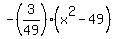 .
To get the graph, go to website
www.desmos.com/calculator
find there free of charge online plotting tool for common use,
print there the found equation of the parabola and obtain
the desired plot in the next instance. .
To get the graph, go to website
www.desmos.com/calculator
find there free of charge online plotting tool for common use,
print there the found equation of the parabola and obtain
the desired plot in the next instance.
Solved.
Question 1209278: Find the area of the region enclosed by the graph of x^2 + y^2 = 2x - 6y + 6.
Answer by ikleyn(53748) (Show Source):
Question 1209271: Find the vertex of the graph of the equation y = -2x^2 + 8x - 15 - 5x^2 + 17x + 20.
Answer by asinus(45) (Show Source): (Show Source):
You can put this solution on YOUR website! **1. Combine Like Terms**
* y = -2x² + 8x - 15 - 5x² + 17x + 20
* y = -7x² + 25x + 5
**2. Find the Vertex**
* **Vertex Formula:** For a parabola in the form y = ax² + bx + c, the vertex is given by:
* x-coordinate of the vertex: x = -b / 2a
* **In this case:**
* a = -7
* b = 25
* x = -25 / (2 * -7) = 25/14
* **Find the y-coordinate of the vertex:**
* Substitute the x-coordinate of the vertex back into the equation:
* y = -7(25/14)² + 25(25/14) + 5
* y = -7(625/196) + 625/14 + 5
* y = -225/28 + 625/14 + 5
* y = 225/7 + 5
* y = 265/7
**Therefore, the vertex of the graph is (25/14, 265/7).**
Question 1209270: Find the vertex of the graph of the equation x - y^2 + 8y = -4y^2 + 15y + 16.
Answer by asinus(45) (Show Source):
You can put this solution on YOUR website! **1. Rewrite the Equation**
* Start by rearranging the equation to isolate 'x':
x = y² - 8y + 4y² - 15y + 16
x = 3y² - 23y + 16
**2. Complete the Square**
* **Factor out the coefficient of y²:**
x = 3(y² - (23/3)y) + 16
* **Inside the parentheses, add and subtract the square of half the coefficient of y:**
x = 3(y² - (23/3)y + (23/6)² - (23/6)²) + 16
* **Rewrite as a perfect square trinomial:**
x = 3[(y - 23/6)² - 529/36] + 16
* **Distribute the 3:**
x = 3(y - 23/6)² - 529/12 + 16
* **Simplify:**
x = 3(y - 23/6)² - 145/12
**3. Identify the Vertex**
* The equation is now in vertex form: x = a(y - k)² + h
* Where (h, k) represents the vertex of the parabola.
* In this case:
* h = -145/12
* k = 23/6
**Therefore, the vertex of the graph is (-145/12, 23/6).**
Question 1209269: The parabola y = ax^2 + bx + c is graphed below. Find a+b+c. (The grid lines are one unit apart.)
The parabola passes through the points (-3,8), (2,5), and (6,18).
Answer by asinus(45) (Show Source):
You can put this solution on YOUR website! **1. Set up the System of Equations**
Since the parabola passes through the points (-3, 8), (2, 5), and (6, 18), we can substitute these points into the equation y = ax² + bx + c to get a system of equations:
* **For point (-3, 8):** 8 = a(-3)² + b(-3) + c
=> 9a - 3b + c = 8
* **For point (2, 5):** 5 = a(2)² + b(2) + c
=> 4a + 2b + c = 5
* **For point (6, 18):** 18 = a(6)² + b(6) + c
=> 36a + 6b + c = 18
**2. Solve the System of Equations**
You can solve this system of equations using various methods, such as:
* **Substitution:** Solve one equation for one variable and substitute it into the other equations.
* **Elimination:** Eliminate one variable at a time by adding or subtracting multiples of the equations.
* **Matrix methods:** Use matrix operations (e.g., Gaussian elimination) to solve the system.
**Using a calculator or software (like Python with NumPy), you can find the values of a, b, and c:**
* a = 1/2
* b = -1/2
* c = 9
**3. Calculate a + b + c**
* a + b + c = 1/2 - 1/2 + 9 = 9
**Therefore, a + b + c = 9**
Question 1208819: Find all points $(x,y)$ that are $5$ units away from the point $(2,7)$ and that lie on the line $y = 5x - 28.$
Answer by timofer(155) (Show Source):
Question 1208377: Find the equation of the circle passing through the points (1,2),(3,6),(5,4).
Found 5 solutions by MathTherapy, math_tutor2020, timofer, ikleyn, josgarithmetic:
Answer by MathTherapy(10806)  (Show Source): (Show Source):
You can put this solution on YOUR website!
Find the equation of the circle passing through the points (1,2),(3,6),(5,4).
We start with: 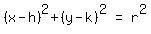 <==== Standard form of the equation of a CIRCLE:
Point: (1, 2)
---- Standard form of the equation of a CIRCLE <==== Standard form of the equation of a CIRCLE:
Point: (1, 2)
---- Standard form of the equation of a CIRCLE
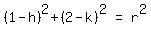 ---- Substituting (1, 2) for (x, y)
1 - 2h + h2 + 4 - 4k + k2 = r2
h2 - 2h + k2 - 4k + 5 = r2 ----- eq (i)
Point: (3, 6)
---- Standard form of the equation of a CIRCLE ---- Substituting (1, 2) for (x, y)
1 - 2h + h2 + 4 - 4k + k2 = r2
h2 - 2h + k2 - 4k + 5 = r2 ----- eq (i)
Point: (3, 6)
---- Standard form of the equation of a CIRCLE
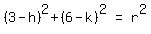 ---- Substituting (3, 6) for (x, y)
9 - 6h + h2 + 36 - 12k + k2 = r2
h2 - 6h + k2 - 12k + 45 = r2 ----- eq (ii)
Point: (5, 4)
---- Standard form of the equation of a CIRCLE ---- Substituting (3, 6) for (x, y)
9 - 6h + h2 + 36 - 12k + k2 = r2
h2 - 6h + k2 - 12k + 45 = r2 ----- eq (ii)
Point: (5, 4)
---- Standard form of the equation of a CIRCLE
 ---- Substituting (5, 4) for (x, y)
25 - 10h + h2 + 16 - 8k + k2 = r2
h2 - 10h + k2 - 8k + 41 = r2 ----- eq (iii)
h2 - 2h + k2 - 4k + 5 = r2 ----- eq (i)
h2 - 6h + k2 - 12k + 45 = r2 ----- eq (ii)
h2 - 10h + k2 - 8k + 41 = r2 ----- eq (iii)
4h + 8k - 40 = 0 ----- Subtracting eq (ii) from eq (i)
4h + 8k = 40
4(h + 2k) = 4(10)
h + 2k = 10 ---- eq (iv)
4h - 4k + 4 = 0 ----- Subtracting eq (iii) from eq (ii)
4h - 4k = - 4
4(h - k) = 4(- 1)
h - k = - 1 --- eq (v)
h + 2k = 10 ---- eq (iv)
h - k = - 1 --- eq (v)
3k = 11 ---- Subtracting eq (v) from eq (iv) ---- Substituting (5, 4) for (x, y)
25 - 10h + h2 + 16 - 8k + k2 = r2
h2 - 10h + k2 - 8k + 41 = r2 ----- eq (iii)
h2 - 2h + k2 - 4k + 5 = r2 ----- eq (i)
h2 - 6h + k2 - 12k + 45 = r2 ----- eq (ii)
h2 - 10h + k2 - 8k + 41 = r2 ----- eq (iii)
4h + 8k - 40 = 0 ----- Subtracting eq (ii) from eq (i)
4h + 8k = 40
4(h + 2k) = 4(10)
h + 2k = 10 ---- eq (iv)
4h - 4k + 4 = 0 ----- Subtracting eq (iii) from eq (ii)
4h - 4k = - 4
4(h - k) = 4(- 1)
h - k = - 1 --- eq (v)
h + 2k = 10 ---- eq (iv)
h - k = - 1 --- eq (v)
3k = 11 ---- Subtracting eq (v) from eq (iv)
 h -
h -  = - 1 ---- Substituting for k in eq (v) = - 1 ---- Substituting for k in eq (v)
 (x - h)2 + (y - k)2 = r2
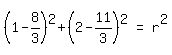 -- Substituting (1, 2) for (x, y), and ( -- Substituting (1, 2) for (x, y), and ( ) for (h, k) ) for (h, k)
 <==== Standard form of the equation of a CIRCLE
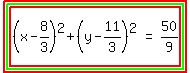 --- Substituting () for (h, k), and --- Substituting () for (h, k), and  for r2 for r2
Answer by math_tutor2020(3835) (Show Source):
You can put this solution on YOUR website!
Answer: 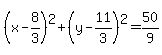
Explanation
Let
A = (1,2)
B = (3,6)
C = (5,4)
The order of the points does not matter.
The labels are there to help set up the other items mentioned in this solution page.
The circle you're trying to find is known as a circumcircle aka circumscribed circle.
The circumcenter is the center of the circumcircle.
The circumcenter is at the intersection of the perpendicular bisectors.
Check out this page to see how to find the equation of the perpendicular bisector of AB.
That page concludes with the equations x+2y=10 and y=(-1/2)x+5.
The equation I'll use is x+2y=10.
Follow a similar process to determine an equation for the perpendicular bisector of BC is x-y=-1.
Solving this system  will pinpoint the circumcenter. will pinpoint the circumcenter.
Subtract the equations.
This is to cancel the x terms so you can solve for y.
You should get 3y = 11 which solves to y = 11/3.
This is the y coordinate of the center of the circle.
Plug y = 11/3 into either x+2y=10 or x-y=-1. Solve for x. You should get x = 8/3.
I'll leave the scratch work for the student to do.
The center of the circle is located at (h,k) = (8/3,11/3)
h = 8/3 = 2.6667 approximately
k = 11/3 = 3.6667 approximately
For each decimal the '6's go on forever but we have to round at some point.
So we have the center of this circle.
We now need the radius.
Use the distance formula
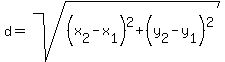
to calculate the distance from the center (8/3,11/3) to any of the three points A,B or C.
This will yield the radius r.
I'll let the student do the scratch work.
You should get 
Square both sides to get 
Side note: 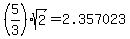 approximately and approximately and  approximately approximately
The decimal 5.55556 should have the '5's go on forever, but we have to round at some point.
--------------------------------------------------------------------------
Summary:
(h,k) = (8/3, 11/3) is the center
is the radius which has both sides square to
The circle template  updates to the final answer updates to the final answer
You can verify by using GeoGebra or Desmos
There are many other similar tools.
Another way to verify would be to plug the coordinates of points A,B,C into the answer equation. Simplifying everything should lead to the same number on each side.
Answer by timofer(155) (Show Source):
Answer by ikleyn(53748) (Show Source):
You can put this solution on YOUR website! .
90% of "solutions" produced by @josgarithmetic at this forum are INCORRECT.
This one is not an exclusion: it is INCORRECT, too.
His equation  + +  = 5 is wrong. = 5 is wrong.
To convince yourself, check the point (3,6).
My advise to all visitors is: do not even touch his solutions.
Blindfold your eyes and plug your ears so as not to see
and not to hear his absurdist solutions.
They all are toxic and dangerous for your mental health.
This person does not know elementary Math, despite his
self-praise description in his self-description section.
The amazing fact is that he gets a huge amount of applauses and gratitude
from his fans for his wrong solutions, which I cannot understand at all.
Loud, unceasing applause, everyone stands up, ovation.
It tells a lot about mathematical level of his admirers (which level is about zero from the negative side).
People call this level "below the baseboard".
---------------------
Thanks to god, after seeing my reaction, he removed his absurdist solution
from his post, which is good. So, my protest was effective, is counted,
and I successively cleaned the Internet.
@josgarithmetic, your solution method was wrong
independently on drawing the points on graph.
There is no need to draw the points on graph to see
that your solution method is wrong.
It is/was wrong by itself.
Answer by josgarithmetic(39792) (Show Source):
Question 1208165: I understand that the x-coordinate of the point (x,y) represents the x-axis and the y-coordinate represents the y-axis.
I also understand that the x-coordinate represents the domain of a function and the y-coordinate the range of a function.
Agree?
Found 2 solutions by ikleyn, josgarithmetic:
Answer by ikleyn(53748) (Show Source):
You can put this solution on YOUR website! .
In general, probably, your understanding is correct, but wording is far from to be perfect.
More accurate mathematical wording is something like this
    x-coordinate of the point (x,y) represents the position of the point with reference to the x-axis, and
    y-coordinate of the point (x,y) represents the position of the point with reference to the y-axis.
Look into this source
https://www.cuemath.com/calculus/x-and-y-coordinates/
and read/learn from there.
Does your lovely textbook by Sullivan say something / (teach you) about it ?
Did you study Sullivan for this issue as thoroughly as we expect it from you ?
Answer by josgarithmetic(39792) (Show Source):
Question 1208166: The domain and range of a relation are the sets of all the x-coordinates and all the y-coordinates of ordered pairs respectively.
Given set A = {(2,3), (4,5),(7,6), (8,9),find the domain D and the range R.
I say the following:
D = {2, 4, 7, 8}
R = {3, 5, 6, 9}
You say?
Answer by ikleyn(53748) (Show Source):
You can put this solution on YOUR website! .
The domain and range of a relation are the sets of all the x-coordinates and all the y-coordinates of ordered pairs respectively.
Given set A = {(2,3), (4,5),(7,6), (8,9),find the domain D and the range R.
I say the following:
D = {2, 4, 7, 8}
R = {3, 5, 6, 9}
You say?
~~~~~~~~~~~~~~~~~~~~~
You correctly determined the sets D (domain) and R (range).
Notice that in your post you opened the curved bracket { for set A,
but forgot to close it using closing bracket }.
In this connection, let me tell you one ancient story about accuracy of writing.
In one country, a ruler was presented with a petition for clemency from a man sentenced to death.
On the petition, the ruler wrote his decision/directive:
" To execute is impossible to pardon ",
but forgot to put a comma in the right place.
Those who were supposed to carry out the directive were perplexed - what should they do?
Since then, this story became an historical anecdote
to teach those who write inaccurately.
Question 1207282: Rewrite the following equation in standard form.
y = - 8x + 9
Answer by ikleyn(53748) (Show Source):
Question 1207276: In the coordinate plane, the point X(1, 0) is translated to the point X'(-3, 1). Under the same translation, the points Y(5, -2) and Z(4, 4) are translated to Y' and Z', respectively. What are the coordinates of Y' and Z'?
Answer by MathLover1(20855) (Show Source):
You can put this solution on YOUR website!
In the coordinate plane, the point X( , , ) is translated to the point X'( ) is translated to the point X'( , ). , ).
the translation vector is
Δ
and
Δ
This means that every point is translated  units to the left (negative x-direction) and units up (positive y-direction). units to the left (negative x-direction) and units up (positive y-direction).
if under the same translation the points Y( , ,  ) and Z(, ) and Z(, ) are translated to Y' and Z', we have ) are translated to Y' and Z', we have
Y' ( , , )=(, )=(, ) )
and
Z'( , , )=( )=( ,) ,)
Question 1206218: plot -8,0 and -4,6
Answer by MathLover1(20855) (Show Source):
Question 1206193: Given (20,8) and (x,−1), find all x such that the distance between these two points is 15. Separate multiple answers with a comma.
Answer by Theo(13342)  (Show Source): (Show Source):
You can put this solution on YOUR website! formula for distance between two point is sqrt((x1-x2)^2 + (y1-y2)^2).
(x1,y1) = (20,8)
x2,y2) = (x,-1)
distance between the two points is 15.
formula becomes sqrt((20-x)^2 + (8--1)^2) = 15.
square both sides of this equation to get (20-x)^2 + (8--1)^2 = 225.
simplify to get 400 -40x + x^2 + 81 = 225.
combine like terms and rearrange the equation in descending order of degree to get x^2 - 40x + 481 = 225.
subtract 225 from both sides of the equation to get x^2 - 40x + 256 = 0.
factor this quadratic equation to get (x-8) * (x-32) = 0.
solve for x to get x = 32 or x = 8.
when x = 8, sqrt((20-x)^2 + (8--1)^2) = 15 becomes sqrt((20-8)^2 + 81) = 15 which becomes sqrt(12^2 + 81) = 15 which becomes sqrt(144 + 81 = 15 which becomes sqrt(225) = 15 which is true.
when x = 32, sqrt((20-x)^2 + (8--1)^2) = 15 becomes sqrt((20-32)^2 + 81) = 15 which becomes sqrt((-12)^2 + 81) = 15 which becomes sqrt(144 + 81) = 15 which becomes sqrt(225) = 15 which is also true.
your solution is that x = 32 or x = 8.
you can also show as x = 32,8.
Question 1205911: A tennis ball is thrown on an incline off a 8m high ledge. if the height of the ball can be represented by the equation  , where h is equal to the height of the ball in meters, and t is equal to the time in seconds for it to reach the ground, find out how long the ball will take to hit the ground, and the maximum height it can reach before it hits the ground. , where h is equal to the height of the ball in meters, and t is equal to the time in seconds for it to reach the ground, find out how long the ball will take to hit the ground, and the maximum height it can reach before it hits the ground.
Answer by Alan3354(69443)  (Show Source): (Show Source):
You can put this solution on YOUR website! A tennis ball is thrown on an incline off a 8m high ledge. if the height of the ball can be represented by the equation , where h is equal to the height of the ball in meters, and t is equal to the time in seconds for it to reach the ground, find out how long the ball will take to hit the ground, and the maximum height it can reach before it hits the ground.
-------------------
"thrown on an incline" ???
==============
{{ h= t^2+2t+8 }}}
h will never equal zero for positive values of t
Question 1205863: Below was a school assessment question.
"Where is the point (0,8) located on the coordinate plane?
1). along the x-axis
2). along the y-axis
3). at the intersection of the axes
4). at the intersection of the axes at the origin.
Please explain why which answer is correct.
Answer by MathLover1(20855) (Show Source):
Question 1205820: A point T on a segment with endpoints D (1, 4) and F (7, 1) partitions the segment in a 3:1 ratio. Find T. You must show all work to receive credit.
Found 3 solutions by greenestamps, ikleyn, MathLover1:
Answer by greenestamps(13327)  (Show Source): (Show Source):
You can put this solution on YOUR website!
As tutor @ikleyn points out, the statement of the problem is deficient, allowing two different answers.
As tutor MathLover1 shows, you can find the answers (she only found one of them) by plugging numbers into a formula. That tutor loves solving problems by plugging numbers into formulas... but that doesn't help the student learn much.
Let's find one of the answers assuming DT is the longer portion -- that is, DT:TF = 3:1.
Dividing segment DF into two parts with lengths in the ratio 3:1 means T is 3/4 of the way from D to F. Because DF is part of a straight line, the x coordinate of T is 3/4 of the way from the x coordinate of D to the x coordinate of F, and similarly for the y coordinate.
The x coordinate of D is 1; the x coordinate of F is 7; the difference is 6. 3/4 of that difference is 4.5, so the x coordinate of T is 1+4.5 = 5.5.
The y coordinate of D is 4; the y coordinate of F is 1; the difference is -3. 3/4 of that difference is -2.25, so the y coordinate of T is 4-2.25 = 1.75.
ANSWER (1 of them!): T(5.5,1.75)
Answer by ikleyn(53748) (Show Source):
You can put this solution on YOUR website! .
I want to point out a significant flaw of this formulation.
Under this formulation, there are TWO different ways to make partition of the segment
in the 3:1 ratio.
One partition is 3:1 in direction from D to F,
and totally different partition is 3:1 in direction from F to D.
THEREFORE, an accurate mathematical formulation must indicate the direction of a partition.
Without it, the problem is a garbage for trash can.
Answer by MathLover1(20855) (Show Source):
Question 1205793: 20x−8y=40
Found 2 solutions by josgarithmetic, MathLover1:
Answer by josgarithmetic(39792) (Show Source):
Answer by MathLover1(20855) (Show Source):
|
Older solutions: 1..45, 46..90, 91..135, 136..180, 181..225, 226..270, 271..315, 316..360, 361..405, 406..450, 451..495, 496..540, 541..585, 586..630, 631..675, 676..720, 721..765, 766..810, 811..855, 856..900, 901..945, 946..990, 991..1035, 1036..1080, 1081..1125, 1126..1170, 1171..1215, 1216..1260, 1261..1305, 1306..1350, 1351..1395, 1396..1440, 1441..1485, 1486..1530, 1531..1575, 1576..1620, 1621..1665, 1666..1710, 1711..1755, 1756..1800, 1801..1845, 1846..1890, 1891..1935, 1936..1980, 1981..2025, 2026..2070, 2071..2115, 2116..2160, 2161..2205, 2206..2250, 2251..2295, 2296..2340, 2341..2385, 2386..2430, 2431..2475, 2476..2520, 2521..2565, 2566..2610, 2611..2655, 2656..2700, 2701..2745, 2746..2790, 2791..2835, 2836..2880, 2881..2925, 2926..2970, 2971..3015, 3016..3060, 3061..3105, 3106..3150, 3151..3195, 3196..3240, 3241..3285, 3286..3330, 3331..3375, 3376..3420, 3421..3465, 3466..3510, 3511..3555, 3556..3600, 3601..3645, 3646..3690, 3691..3735, 3736..3780, 3781..3825, 3826..3870, 3871..3915, 3916..3960, 3961..4005, 4006..4050, 4051..4095, 4096..4140, 4141..4185, 4186..4230, 4231..4275, 4276..4320, 4321..4365, 4366..4410, 4411..4455, 4456..4500, 4501..4545, 4546..4590, 4591..4635, 4636..4680
|
| |
