SOLUTION: how to find the measures of the consecutive angles of a quadrilateral in the ratio form of 5:7:11:13. How do you find the measure of each angle, draw a quadrilateral, and explain w
Algebra ->
Angles
-> SOLUTION: how to find the measures of the consecutive angles of a quadrilateral in the ratio form of 5:7:11:13. How do you find the measure of each angle, draw a quadrilateral, and explain w
Log On
Question 463054: how to find the measures of the consecutive angles of a quadrilateral in the ratio form of 5:7:11:13. How do you find the measure of each angle, draw a quadrilateral, and explain why two sides must be parallel? Answer by Theo(13342) (Show Source):
You can put this solution on YOUR website! the sum of the angles of a quadrilateral = 360.
since your angles are in the ratio of 5:7:11:13, you can use the general formula of 5x + 7x + 11x + 13x = 360 to solve for x and, from that, to derive each angle.
you get 36x = 360 which gets you x = 10 degrees.
this makes your angles 50, 70, 110 and 130 respectively.
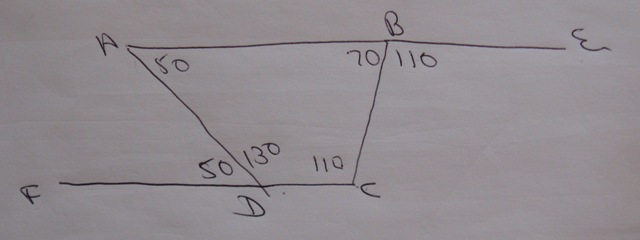
label your quadrilateral starting from the top left and working to the top right and then to the bottom right and then to the bottom left ABCD.
A is top left
B is top right
C is bottom right
D is bottom left
Angle A is 50 degrees
Angle B is 70 degrees
Angle C is 110 degrees
Angle D is 130 degrees.
Extend AB a little more to the right and stop at E.
You have angle ABC which is equal to 70 degrees.
You have angle EBC which is the supplement of ABC which is equal to 110 degrees.
The sides that will be shown to be parallel are sides AB and CD.
The line BC is a transversal that intersects both AB and CD.
The 2 alternate interior angles of these intersections are angles EBC and angle BCD.
Both these angles are 110 degrees.
If the alternate interior angles of 2 lines cut by a transversal are equal, then the lines are parallel. This is either a theorem or a postulate that you should be able to find in your geometry text.
You can also prove AB is parallel to CD by extending line CD further to the left to stop at F.
The angle ADC is 130 (previously called angle D).
The angle ADF is equal to 50 degrees (supplement of 130 degrees).
Angle BAD = 50 degrees and angle ADF = 50 degrees.
These are alternate interior angles and they are equal, therefore the lines AB and CD are parallel to each other.
A picture of the arrangement is shown below: