

You can put this solution on YOUR website!
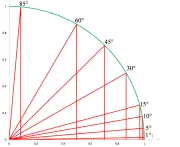
The way most people first encounter sine is as a ratio of two sides of a triangle.\r
\n" ); document.write( "
\n" ); document.write( "\n" ); document.write( "
 \r
\r\n" ); document.write( "
\n" ); document.write( "\n" ); document.write( "In this case:\r
\n" ); document.write( "\n" ); document.write( "1. the sloping lines are all radii of the circle and represent the hypotenuse
\n" ); document.write( "2. the vertical lines are the ‘opposite’ side of the various triangles\r
\n" ); document.write( "\n" ); document.write( "As you can clearly see, as the angle reduces from \r
\n" ); document.write( "\n" ); document.write( "
\n" ); document.write( "
\n" ); document.write( "\n" ); document.write( "the height of the vertical line (’opposite’) shrinks while the sloping line (‘hypotenuse’) remains constant \r
\n" ); document.write( "\n" ); document.write( " So the fraction opposite hypotenuse will, does and indeed
\n" ); document.write( "
\n" ); document.write( "\n" ); document.write( "The more modern way to define sine is with an infinite series:\r
\n" ); document.write( "
\n" ); document.write( "\n" ); document.write( "
\n" ); document.write( "\n" ); document.write( "
\n" ); document.write( "\n" ); document.write( "But you can see how that also goes to zero as
\n" ); document.write( "
\n" ); document.write( "
\n" ); document.write( "\n" ); document.write( " \n" ); document.write( "