Algebra.Com's Answer #667950 by josgarithmetic(39838)  
You can put this solution on YOUR website!
Why? What happens NEAR the asymptotes? \r
\n" );
document.write( "
\n" );
document.write( "\n" );
document.write( "The best way to figure how to sketch a graph is to identify the critical x values. Those would be any zeros of g(x) and any vertical asymptotes. These cut the x-axis into intervals for you to check how g(x) behaves.\r
\n" );
document.write( "\n" );
document.write( "\r\n" );
document.write( "x value significance\r\n" );
document.write( "-3 vertical asymptote\r\n" );
document.write( "0 root or zero\r\n" );
document.write( "3 vertical asymptote\r\n" );
document.write( " \r
\n" );
document.write( "\n" );
document.write( "Next look at the signs for g in each interval on x. Pick any x value in each interval.
\n" );
document.write( "\r\n" );
document.write( "INTERVAL pick x sign of g\r\n" );
document.write( "(-infinity,-3) -4 -5(-4)/((-4-3)(-4+3))=(+)/((-)(-))=POSITIVE\r\n" );
document.write( "(-3,0] -1 -k(-1)/((-)(+))=NEGATIVE\r\n" );
document.write( "[0,3] 1 -k(+)/((-)(+))=POSITIVE\r\n" );
document.write( "[3,infinity) 10 -k(+)/((+)(+))=NEGATIVE\r\n" );
document.write( " \r
\n" );
document.write( "
\n" );
document.write( "
\n" );
document.write( "\n" );
document.write( "Think about g in those four intervals.
\n" );
document.write( "Starting very far from the left, approaching -3, g is positive, changing from very small to very large, and large without bound toward this asymptote.
\n" );
document.write( "Immediately to the right of this x=-3 asymptote, suddenly g is very large BUT NEGATIVE..., Do you see how this works? \r
\n" );
document.write( "\n" );
document.write( "Also notice change from negative to positive as g crosses the x-axis at 0.
\n" );
document.write( ",...\r
\n" );
document.write( "
\n" );
document.write( "
\n" );
document.write( "\n" );
document.write( "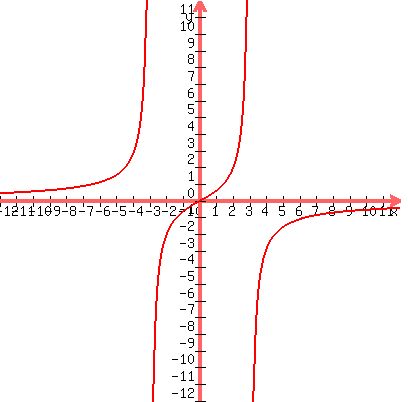 \r \r
\n" );
document.write( "
\n" );
document.write( "
\n" );
document.write( "\n" );
document.write( "The horizontal asymptote is y=0. \n" );
document.write( " |