Algebra.Com's Answer #276916 by robertb(5830)  
You can put this solution on YOUR website!
Let  . We have to restrict the domain of y to (0, . We have to restrict the domain of y to (0,  ), otherwise we encounter a densely infinite number of problems, haha.(E.g., ), otherwise we encounter a densely infinite number of problems, haha.(E.g., 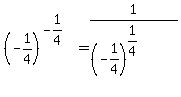 , or , or 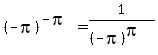 ). Note also that y > 0 for all x in the domain.\r ). Note also that y > 0 for all x in the domain.\r
\n" );
document.write( "\n" );
document.write( "That said, we can take ln of both sides of :
\n" );
document.write( "ln y = x lnx.
\n" );
document.write( "Differentiating both sides:
\n" );
document.write( " <-----(A) <-----(A)
\n" );
document.write( "Set  , so that the equation (A) becomes lnx = -1, or , so that the equation (A) becomes lnx = -1, or  . Since there is only 1 critical value this is either an absolute min or absolute max. We find out using the 2nd derivative test.\r . Since there is only 1 critical value this is either an absolute min or absolute max. We find out using the 2nd derivative test.\r
\n" );
document.write( "\n" );
document.write( "Differentiate (A) again:
\n" );
document.write( "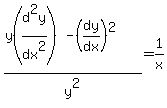 . .
\n" );
document.write( "When x = 1/e, the equation becomes  , or , or  . Thus the graph of the function y is concave up at x=1/e, and so there is an absolute minimum there for y. \n" );
document.write( " . Thus the graph of the function y is concave up at x=1/e, and so there is an absolute minimum there for y. \n" );
document.write( " |