|
Question 118012: Write the equation of each line. Give the answer in standard formusing only integers as the coefficients.
The line through (2,-3) that is perpendicular to the line y=-3x+12
The answer is x-3y=11
How do I work the problem to find the answer given?
Answer by jim_thompson5910(35256)   (Show Source): (Show Source):
You can put this solution on YOUR website!
| Solved by pluggable solver: Finding the Equation of a Line Parallel or Perpendicular to a Given Line |
Remember, any two perpendicular lines are negative reciprocals of each other. So if you're given the slope of  , you can find the perpendicular slope by this formula: , you can find the perpendicular slope by this formula:
 where where  is the perpendicular slope is the perpendicular slope
 So plug in the given slope to find the perpendicular slope So plug in the given slope to find the perpendicular slope
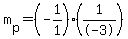 When you divide fractions, you multiply the first fraction (which is really When you divide fractions, you multiply the first fraction (which is really  ) by the reciprocal of the second ) by the reciprocal of the second
 Multiply the fractions. Multiply the fractions.
So the perpendicular slope is 
So now we know the slope of the unknown line is (its the negative reciprocal of from the line  ).
Also since the unknown line goes through (2,-3), we can find the equation by plugging in this info into the point-slope formula ).
Also since the unknown line goes through (2,-3), we can find the equation by plugging in this info into the point-slope formula
Point-Slope Formula:
 where m is the slope and ( where m is the slope and ( , , ) is the given point ) is the given point
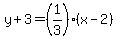 Plug in Plug in  , ,  , and , and 
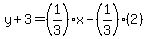 Distribute Distribute
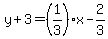 Multiply Multiply
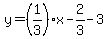 Subtract from both sides to isolate y Subtract from both sides to isolate y
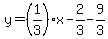 Make into equivalent fractions with equal denominators Make into equivalent fractions with equal denominators
 Combine the fractions Combine the fractions
Reduce any fractions
So the equation of the line that is perpendicular to and goes through ( ,) is ,) is
So here are the graphs of the equations and
 graph of the given equation (red) and graph of the line (green) that is perpendicular to the given graph and goes through (,) graph of the given equation (red) and graph of the line (green) that is perpendicular to the given graph and goes through (,)
|
Now let's convert  to standard form to standard form
| Solved by pluggable solver: Converting Linear Equations in Standard form to Slope-Intercept Form (and vice versa) |
Convert from slope-intercept form (y = mx+b) to standard form (Ax+By = C)
 Start with the given equation Start with the given equation
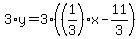 Multiply both sides by the LCD 3 Multiply both sides by the LCD 3
 Distribute and multiply Distribute and multiply
 Subtract 1x from both sides Subtract 1x from both sides
 Simplify Simplify
 Multiply both sides by -1 to make the A coefficient positive (note: this step may be optional; it will depend on your teacher and/or textbook) Multiply both sides by -1 to make the A coefficient positive (note: this step may be optional; it will depend on your teacher and/or textbook)
 Distribute and simplify Distribute and simplify
The original equation (slope-intercept form) is equivalent to (standard form where A > 0)
The equation is in the form  where where  , ,  and and 
|
Since the answer is  , I'm assuming that the book wants A to be positive. , I'm assuming that the book wants A to be positive.
 Multiply both sides of Multiply both sides of  by -1 by -1
Distribute and multiply
So the answer is
| |
|
| |
