Tutors Answer Your Questions about expressions (FREE)
Question 833276: Here's the problem
(1/2) to the 4th power + 5+4 divided by 3
This is what I have so far
1/16 + 9 divided by 3, I get 4/16, however the answer is 49/16 and I don't know how to get there
Help
Answer by MathTherapy(10858)   (Show Source): (Show Source):
You can put this solution on YOUR website!
Here's the problem
(1/2) to the 4th power + 5+4 divided by 3
This is what I have so far
1/16 + 9 divided by 3, I get 4/16, however the answer is 49/16 and I don't know how to get there
Help
================
This is what I have so far
1/16 + 9 divided by 3, I get 4/16
=================================
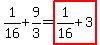 .
However, you can't ADD the numerator in the fraction (1) to the whole number, 3, to get a numerator of 4,
and then get .
However, you can't ADD the numerator in the fraction (1) to the whole number, 3, to get a numerator of 4,
and then get  for your answer!! It just doesn't work like that!
You have to CONVERT the whole number, 3, into a FRACTION with the SAME denominator as the other fraction
(16, from for your answer!! It just doesn't work like that!
You have to CONVERT the whole number, 3, into a FRACTION with the SAME denominator as the other fraction
(16, from  ), and then ADD the 2 fractions, as both now have the same denominator.
This is: ), and then ADD the 2 fractions, as both now have the same denominator.
This is: 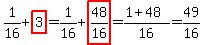 .
There's your answer, CLEAR as day!! .
There's your answer, CLEAR as day!!
Question 1077647: Write cuberoot(16) in its simplest surd form.
The answer is 2 times cuberoot(2), but how? I'm asking for an explanation. Thanks so much.
Answer by MathTherapy(10858) (Show Source):
Question 730282: Solve the following equation for x:(1/8)^x=25
Thanks!
Answer by ikleyn(53937)  (Show Source): (Show Source):
Question 1209861: How much would you need to deposit in an account each month in order to have $20,000 in the account in 6 years? Assume the account earns 4% annual interest, compounded monthly. (Enter your answer to 2 decimal places.)
Found 2 solutions by CPhill, ikleyn:
Answer by CPhill(2264)  (Show Source): (Show Source):
You can put this solution on YOUR website! Here's how to calculate the monthly deposit amount:
**1. Convert Annual Interest Rate to Monthly Rate:**
* Annual interest rate: 4% = 0.04
* Monthly interest rate: 0.04 / 12 = 0.003333...
**2. Calculate the Total Number of Months:**
* Savings period: 6 years
* Total months: 6 years * 12 months/year = 72 months
**3. Use the Future Value of an Ordinary Annuity Formula (Solve for PMT):**
* FV = PMT * [((1 + r)^n - 1) / r]
* FV = Future Value ($20,000)
* PMT = Payment (monthly deposit)
* r = Monthly interest rate (0.003333...)
* n = Number of months (72)
* Rearrange the formula to solve for PMT:
* PMT = FV / [((1 + r)^n - 1) / r]
* PMT = FV * [r / ((1 + r)^n - 1)]
**4. Plug in the Values and Calculate:**
* PMT = 20000 * [0.003333 / ((1 + 0.003333)^72 - 1)]
* PMT ≈ $246.24
**Answer:** You would need to deposit approximately $246.24 each month.
Answer by ikleyn(53937) (Show Source):
You can put this solution on YOUR website! .
How much would you need to deposit in an account each month in order to have $20,000 in the account in 6 years?
Assume the account earns 4% annual interest, compounded monthly. (Enter your answer to 2 decimal places.)
~~~~~~~~~~~~~~~~~~~~~~~~~~~
It is a classic Ordinary Annuity saving plan (assuming that the deposits are made at the end of each month).
The general formula is
FV =  ,
where FV is the future value of the account; P is the monthly payment (deposit);
r is the effective monthly compounding rate presented as a decimal;
n is the number of deposits (= the number of years multiplied by 12, in this case).
From this formula, you get for the monthly payment
P = ,
where FV is the future value of the account; P is the monthly payment (deposit);
r is the effective monthly compounding rate presented as a decimal;
n is the number of deposits (= the number of years multiplied by 12, in this case).
From this formula, you get for the monthly payment
P =  . (1)
Under the given conditions, FV = $20,000; r = 0.04/12; n = 6*12 = 72. So, according to the formula (1), you get
for the monthly payment
P = . (1)
Under the given conditions, FV = $20,000; r = 0.04/12; n = 6*12 = 72. So, according to the formula (1), you get
for the monthly payment
P = 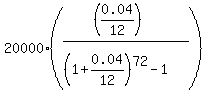 = $246.24 (rounded).
Answer. The necessary monthly deposit value is $246.24. = $246.24 (rounded).
Answer. The necessary monthly deposit value is $246.24.
Solved.
-----------------
On Ordinary Annuity saving plans, see the lessons
- Ordinary Annuity saving plans and geometric progressions
- Solved problems on Ordinary Annuity saving plans
in this site.
The lessons contain EVERYTHING you need to know about this subject, in clear and compact form.
When you learn from these lessons, you will be able to do similar calculations in semi-automatic mode.
/////////////////////
To make such complicated calculations as they are in this problem,
you should have/use an appropriate calculator for such long formulas.
Ideal choice is MS Excel, or Google spreadsheets, if you have it in your computer.
Then you write a formula in a text editor, copy-paste it
into an Excel worksheet cell and click "enter" - the result is ready
in the next second.
If you have no MS Excel in your computer, you may find similar
free of charge online calculators in the Internet. One such calculator is
www.desmos.com/calculator
It allows you to do the same thing: you write a formula in a text editor,
copy-paste it into this calculator and click "enter" - the result is ready
in the next second.
Question 1209862: Scarlett has $700,000 saved for retirement in an account earning 3.95% interest, compounded weekly. How much will she be able to withdraw each week if she wants to take withdrawals for 23 years? Round your answer to the nearest dollar.
Answer by CPhill(2264) (Show Source):
You can put this solution on YOUR website! Here's how to calculate the weekly withdrawal amount:
**1. Convert Annual Interest Rate to Weekly Rate:**
* Annual interest rate: 3.95% = 0.0395
* Weekly interest rate: 0.0395 / 52 weeks ≈ 0.00076
**2. Calculate the Total Number of Withdrawals:**
* Withdrawal period: 23 years
* Total withdrawals: 23 years * 52 weeks/year = 1196 weeks
**3. Use the Present Value of an Ordinary Annuity Formula:**
* This formula helps determine the regular withdrawal amount from a present lump sum, considering compound interest.
* The formula is: PMT = PV \* \[r(1 + r)^n] / \[(1 + r)^n - 1]
* PMT = Payment (weekly withdrawal)
* PV = Present Value ($700,000)
* r = Weekly interest rate (0.00076)
* n = Number of withdrawals (1196)
**4. Plug in the Values and Calculate:**
* PMT = $700,000 \* \[0.00076(1 + 0.00076)^1196] / \[(1 + 0.00076)^1196 - 1]
* PMT ≈ $891
**Answer:** Scarlett will be able to withdraw approximately $891 each week.
Question 1173078: The Candido PILI Delicacies has 3 stores (A, B, C) which supplies it's 3 provincial customers (D, E, F) with their best selling product. Below is a table showing the capacity of each store, the requirements of each customer, and the cost for shipping to each customer.
Store D E F CAPACITY
A 30 40 10 150
B 20 10 50 100
C 70 20 20 250
Demand 200 160 140
Find the optimal strategy and minimum cost of transporting their best selling product from store to customer.
Answer by CPhill(2264) (Show Source):
You can put this solution on YOUR website! This is a classic transportation problem, solvable using linear programming methods. We'll outline the steps to find the optimal strategy and minimum cost.
**1. Define Variables**
Let `x_ij` represent the number of units shipped from store `i` to customer `j`.
* `x_AD` = Units from Store A to Customer D
* `x_AE` = Units from Store A to Customer E
* `x_AF` = Units from Store A to Customer F
* `x_BD` = Units from Store B to Customer D
* `x_BE` = Units from Store B to Customer E
* `x_BF` = Units from Store B to Customer F
* `x_CD` = Units from Store C to Customer D
* `x_CE` = Units from Store C to Customer E
* `x_CF` = Units from Store C to Customer F
**2. Formulate the Objective Function**
The objective is to minimize the total transportation cost.
Minimize Z = 30`x_AD` + 40`x_AE` + 10`x_AF` + 20`x_BD` + 10`x_BE` + 50`x_BF` + 70`x_CD` + 20`x_CE` + 20`x_CF`
**3. Formulate the Constraints**
* **Supply Constraints (Store Capacities):**
* `x_AD` + `x_AE` + `x_AF` ≤ 150 (Store A Capacity)
* `x_BD` + `x_BE` + `x_BF` ≤ 100 (Store B Capacity)
* `x_CD` + `x_CE` + `x_CF` ≤ 250 (Store C Capacity)
* **Demand Constraints (Customer Requirements):**
* `x_AD` + `x_BD` + `x_CD` = 200 (Customer D Demand)
* `x_AE` + `x_BE` + `x_CE` = 160 (Customer E Demand)
* `x_AF` + `x_BF` + `x_CF` = 140 (Customer F Demand)
* **Non-negativity Constraints:**
* `x_ij` ≥ 0 for all `i` and `j`
**4. Solve the Linear Program**
This problem can be solved using various methods, including:
* **Software Solutions:**
* Excel Solver
* Dedicated Linear Programming software (e.g., LINGO, CPLEX)
* Online Linear Programming solvers
* **Transportation Algorithm:**
* Northwest Corner Rule
* Least Cost Method
* Vogel's Approximation Method (VAM)
* Then using the stepping stone or MODI method to reach optimality.
**Using a Solver (Example with Excel Solver)**
1. **Set up the spreadsheet:**
* Create a table representing the shipping quantities (`x_ij`).
* Create a table for the costs.
* Calculate the total cost using the objective function formula.
* Calculate the total shipped from each store and the total received by each customer.
2. **Use Solver:**
* Set the objective cell (total cost) to "Minimize."
* Set the changing variable cells (shipping quantities).
* Add the supply and demand constraints.
* Set the non-negativity constraint.
* Select a solving method (e.g., Simplex LP).
* Solve.
**Expected Outcome**
The solver will provide the optimal shipping quantities (`x_ij`) that minimize the total transportation cost.
**Important Notes**
* The total supply (150 + 100 + 250 = 500) equals the total demand (200 + 160 + 140 = 500), so this is a balanced transportation problem.
* The solution will provide the number of units to ship from each store to each customer.
* The objective function value will give the minimum total transportation cost.
By plugging the values that the solver provides into the objective function, you will arrive at the minimum cost.
Question 1176049: a client of UMOJA microfinance institution took a loan of TZS 20000000 on 2 January 2018 which charges 24% interest per annum.using reducing balance method.the loan contract indicated that the loan was supposed to be repaid in 3 months period on loan is to be charged upfront as compulsory saving.required
(a) calculate the total payment (PMT) made each period by the client.
(b) determine the interest which a client is actually paying.
Answer by CPhill(2264) (Show Source):
You can put this solution on YOUR website! Let's break down this loan problem step-by-step.
**Given Information:**
* Loan amount (Principal, P): TZS 20,000,000
* Annual interest rate (r): 24% (0.24)
* Loan term: 3 months
* Interest charged upfront as compulsory savings.
**Calculations:**
**(a) Calculate the total payment (PMT) made each period by the client.**
1. **Monthly Interest Rate:**
* Since the loan is repaid monthly, we need to find the monthly interest rate.
* Monthly interest rate (i) = Annual interest rate / 12
* i = 0.24 / 12 = 0.02 (or 2%)
2. **Loan Term in Months:**
* The loan term is 3 months (n = 3).
3. **Upfront Interest (Compulsory Saving):**
* The interest for the entire loan period is charged upfront.
* Total interest = P * i * n = 20,000,000 * 0.02 * 3 = TZS 1,200,000
4. **Effective Loan Amount:**
* The amount the client effectively receives is the original loan amount minus the upfront interest.
* Effective loan amount = 20,000,000 - 1,200,000 = TZS 18,800,000
5. **Monthly Payment (PMT) Using Reducing Balance Method:**
* We can use the loan payment formula:
* PMT = P * [i(1 + i)^n] / [(1 + i)^n - 1]
* Where:
* PMT = Monthly payment
* P = Effective loan amount (TZS 18,800,000)
* i = Monthly interest rate (0.02)
* n = Number of months (3)
* PMT = 18,800,000 * [0.02(1 + 0.02)^3] / [(1 + 0.02)^3 - 1]
* PMT = 18,800,000 * [0.02(1.02)^3] / [(1.02)^3 - 1]
* PMT = 18,800,000 * [0.02(1.061208)] / [1.061208 - 1]
* PMT = 18,800,000 * [0.02122416] / [0.061208]
* PMT = 18,800,000 * 0.346757
* PMT = 6,518,031.6
* Therefore, the monthly payment is approximately TZS 6,518,031.60
**(b) Determine the interest which a client is actually paying.**
1. **Total Amount Paid:**
* Total amount paid = Monthly payment * Number of months
* Total amount paid = 6,518,031.6 * 3 = TZS 19,554,094.80
2. **Total Interest Paid:**
* Total interest paid = Total amount paid + Upfront interest - Original loan amount.
* Total interest paid = 19,554,094.80 + 1,200,000 - 20,000,000
* Total interest paid = 754,094.80
3. **Actual interest rate.**
* Total interest = 754,094.80
* Total amount received = 18,800,000
* Percentage of interest = (754,094.80/18,800,000)*100 = 4.01%
* 4.01% for 3 months.
* Annual interest rate = 4.01%*4 = 16.04%
* The client is actually paying TZS 754,094.80 in interest on top of the upfront interest, and the actual annual interest rate is 16.04%.
**Answers:**
* **(a) Total payment (PMT) made each period:** Approximately TZS 6,518,031.60
* **(b) Interest which a client is actually paying:** TZS 754,094.80 and the actual annual interest rate is 16.04%.
Question 1181228: Each month ZV Corp (Zebra Vehicles where all paint jobs are striped) makes 230 A vehicles which get 10mpg,500 B vehicles which get 20mpg,and 70 C vehicles which get 40mpg. Unfortunately, the government sets a standard where companies must “average”30mpg[this is called a CAFElaw]. Any company that falls short of the 30mpg standard must pay a penalty. The penalty is calculated as $55times number of vehicles sold each month times the deficit in their average mpg from the 30mpg standard.
Compute ZV Corp’s monthly penalty if the government incorrectly uses (weighted) arithmetic mean to compute average mpg.
Answer by CPhill(2264) (Show Source):
You can put this solution on YOUR website! Here's how to calculate ZV Corp's monthly penalty using the weighted arithmetic mean:
1. **Calculate the weighted average mpg:**
The weighted average mpg is calculated by multiplying each vehicle type's mpg by its proportion of total vehicles and then summing those results.
* Total vehicles: 230 (A) + 500 (B) + 70 (C) = 800 vehicles
* Weight of A vehicles: 230/800 = 0.2875
* Weight of B vehicles: 500/800 = 0.625
* Weight of C vehicles: 70/800 = 0.0875
Weighted average mpg = (0.2875 * 10) + (0.625 * 20) + (0.0875 * 40)
Weighted average mpg = 2.875 + 12.5 + 3.5
Weighted average mpg = 18.875 mpg
2. **Calculate the mpg deficit:**
Deficit = Standard mpg - Weighted average mpg
Deficit = 30 mpg - 18.875 mpg
Deficit = 11.125 mpg
3. **Calculate the total penalty:**
Penalty = $55 * Total vehicles * Deficit
Penalty = $55 * 800 * 11.125
Penalty = $489,500
Therefore, if the government incorrectly uses the weighted arithmetic mean, ZV Corp's monthly penalty would be $\boxed{489,500}$.
Question 1181229: Each month ZV Corp (Zebra Vehicles where all paint jobs are striped) makes 230 A vehicles which get 10mpg,500 B vehicles which get 20mpg,and 70 C vehicles which get 40mpg. Unfortunately, the government sets a standard where companies must “average”30mpg[this is called a CAFElaw]. Any company that falls short of the 30mpg standard must pay a penalty. The penalty is calculated as $55times number of vehicles sold each month times the deficit in their average mpg from the 30mpg standard.
Compute ZV Corp’s monthly penalty if the correct Harmonic Mean is used.
Answer by CPhill(2264) (Show Source):
You can put this solution on YOUR website! Here's how to calculate ZV Corp's new monthly penalty:
1. **Calculate the total miles driven by each vehicle type:**
* A vehicles: 230 vehicles * 10 mpg = 2300 miles
* B vehicles: 500 vehicles * 20 mpg = 10000 miles
* C vehicles: 70 vehicles * 40 mpg = 2800 miles
* D vehicles: 2 vehicles * 75 mpg = 150 miles
2. **Calculate the total miles driven by all vehicles:**
Total miles = 2300 + 10000 + 2800 + 150 = 15250 miles
3. **Calculate the total number of vehicles:**
Total vehicles = 230 + 500 + 70 + 2 = 802 vehicles
4. **Calculate the company's average mpg:**
Average mpg = Total miles / Total vehicles
Average mpg = 15250 / 802
Average mpg ≈ 19.015 mpg
5. **Calculate the mpg deficit:**
Deficit = Standard mpg - Company average mpg
Deficit = 30 mpg - 19.015 mpg
Deficit ≈ 10.985 mpg
6. **Calculate the total penalty:**
Penalty = $55 * Total vehicles * Deficit
Penalty = $55 * 802 * 10.985
Penalty ≈ $485,355.70
Therefore, ZV Corp's new monthly penalty is approximately $\boxed{485,355.70}$.
Question 1181231: Each month ZV Corp (Zebra Vehicles where all paint jobs are striped) makes 230 A vehicles which get 10mpg,500 B vehicles which get 20mpg,and 70 C vehicles which get 40mpg. Unfortunately, the government sets a standard where companies must “average”30mpg[this is called a CAFElaw]. Any company that falls short of the 30mpg standard must pay a penalty. The penalty is calculated as $55times number of vehicles sold each month times the deficit in their average mpg from the 30mpg standard.
V Corp is beginning to make a D vehicle which gets 75mpg. They estimate initially adding 2 D vehicles to their production each month. Compute their new monthly penalty.
Answer by CPhill(2264) (Show Source):
You can put this solution on YOUR website! Here's how to calculate ZV Corp's new monthly penalty:
1. **Calculate the total miles driven by each vehicle type:**
* A vehicles: 230 vehicles * 10 mpg = 2300 miles
* B vehicles: 500 vehicles * 20 mpg = 10000 miles
* C vehicles: 70 vehicles * 40 mpg = 2800 miles
* D vehicles: 2 vehicles * 75 mpg = 150 miles
2. **Calculate the total miles driven by all vehicles:**
Total miles = 2300 + 10000 + 2800 + 150 = 15250 miles
3. **Calculate the total number of vehicles:**
Total vehicles = 230 + 500 + 70 + 2 = 802 vehicles
4. **Calculate the company's average mpg:**
Average mpg = Total miles / Total vehicles
Average mpg = 15250 / 802
Average mpg ≈ 19.015 mpg
5. **Calculate the mpg deficit:**
Deficit = Standard mpg - Company average mpg
Deficit = 30 mpg - 19.015 mpg
Deficit ≈ 10.985 mpg
6. **Calculate the total penalty:**
Penalty = $55 * Total vehicles * Deficit
Penalty = $55 * 802 * 10.985
Penalty ≈ $485,355.70
Therefore, ZV Corp's new monthly penalty is approximately $\boxed{485,355.70}$.
Question 1184044: Find a solution to the initial value problem
y′+sin(t)y=g(t), y(0)=7,
that is continuous on the interval [0,2π] where
g(t)={sin(t), if 0≤t≤π
-----{ −sin(t),if π less than"t" less than or equal to 2pi
y(t)={ My answer is 6e^(-2)+1, but is wrong,if 0≤t≤π.
---{ My answer is (6e^(-2)+2e)e^(cost)-1, but wrong, if π less than"t" less than or equal to 2pi
Answer by CPhill(2264) (Show Source):
You can put this solution on YOUR website! Here's how to solve the initial value problem:
**1. Solve for 0 ≤ t ≤ π:**
The equation is y' + sin(t)y = sin(t). This is a first-order linear differential equation. We can find the integrating factor:
Integrating factor = e^(∫sin(t)dt) = e^(-cos(t))
Multiply the equation by the integrating factor:
e^(-cos(t))y' + sin(t)e^(-cos(t))y = sin(t)e^(-cos(t))
Notice that the left side is the derivative of (e^(-cos(t))y):
d/dt (e^(-cos(t))y) = sin(t)e^(-cos(t))
Integrate both sides with respect to t:
∫ d/dt (e^(-cos(t))y) dt = ∫ sin(t)e^(-cos(t)) dt
e^(-cos(t))y = e^(-cos(t)) + C₁
y(t) = 1 + C₁e^(cos(t))
Using the initial condition y(0) = 7:
7 = 1 + C₁e^(cos(0))
7 = 1 + C₁e
C₁ = 6/e
So, for 0 ≤ t ≤ π:
y(t) = 1 + (6/e)e^(cos(t)) = 1 + 6e^(cos(t)-1)
**2. Solve for π < t ≤ 2π:**
The equation is y' + sin(t)y = -sin(t). The integrating factor is the same: e^(-cos(t))
Multiply the equation by the integrating factor:
e^(-cos(t))y' + sin(t)e^(-cos(t))y = -sin(t)e^(-cos(t))
d/dt (e^(-cos(t))y) = -sin(t)e^(-cos(t))
Integrate both sides:
e^(-cos(t))y = e^(-cos(t)) + C₂
y(t) = 1 + C₂e^(cos(t))
To find C₂, we need to use the continuity of y at t = π.
At t = π, the solutions from both intervals must be equal:
1 + 6e^(cos(π)-1) = 1 + C₂e^(cos(π))
1 + 6e^(-2) = 1 + C₂e^(-1)
6e^(-2) = C₂e^(-1)
C₂ = 6/e
So, for π < t ≤ 2π:
y(t) = 1 + (6/e)e^(cos(t)) = 1 + 6e^(cos(t)-1)
**Final Solution:**
y(t) = 1 + 6e^(cos(t) - 1), 0 ≤ t ≤ 2π
Your original answer was close, but you made a mistake in the calculation of the constant C for the second interval. The correct solution shows that the function has the same form in both intervals, ensuring continuity.
Question 1209466: Evaluate sqrt(y/x) where x and y are positive integers, and 0=x^5-(x^3y^3)-12393
Answer by ikleyn(53937) (Show Source):
You can put this solution on YOUR website! .
Evaluate sqrt(y/x) where x and y are positive integers, and 0=x^5-(x^3y^3)-12393.
~~~~~~~~~~~~~~~~~~~~~~~~~~
Your starting equation is
x^5 - x^3*y^3 = 12393, (1)
or
x^3*(x^2 - y^3) = 12393. (2)
Integer number 12393 has the primary decomposition 12393 =  ,
so the last equation is
x^3*(x^2 - y^3) = . (3)
From it, it is clear that for x, y to be integer solutions to this equation, it is necessary that x be 1, or 3, or 3^2 = 9.
So, we should consider these three cases.
(a) x = 1. Then from equation (3)
x^2 - y^3 = 3^6*17 = 12393, y^3 = 1 - 12393 = -12392.
But this number is not a positive perfect cube, so this way does not work.
(b) x = 3. Then from equation (3)
x^2 - y^3 = 3^3*17 = 459, y^3 = 9 - 459 = -450.
But this number is not a positive perfect cube, so this way does not work.
(c) x = 3^2 = 9. Then from equation (3)
x^2 - y^3 = 17, y^3 = 81 - 17 = 64.
This number, 64, is a positive perfect cube, so y = 4.
Thus, the solution to the given equation in this pair of positive integer numbers (x,y) = (3,4).
Then ,
so the last equation is
x^3*(x^2 - y^3) = . (3)
From it, it is clear that for x, y to be integer solutions to this equation, it is necessary that x be 1, or 3, or 3^2 = 9.
So, we should consider these three cases.
(a) x = 1. Then from equation (3)
x^2 - y^3 = 3^6*17 = 12393, y^3 = 1 - 12393 = -12392.
But this number is not a positive perfect cube, so this way does not work.
(b) x = 3. Then from equation (3)
x^2 - y^3 = 3^3*17 = 459, y^3 = 9 - 459 = -450.
But this number is not a positive perfect cube, so this way does not work.
(c) x = 3^2 = 9. Then from equation (3)
x^2 - y^3 = 17, y^3 = 81 - 17 = 64.
This number, 64, is a positive perfect cube, so y = 4.
Thus, the solution to the given equation in this pair of positive integer numbers (x,y) = (3,4).
Then  is this irrational number is this irrational number  = =  = 1.154700538 (rounded). ANSWER = 1.154700538 (rounded). ANSWER
Solved.
Question 1209363: V=4/3πr4/3πr^3
Answer by math_tutor2020(3838) (Show Source):
Question 1208445: Write the given expression as a single quotient in which only positive exponents and/or radicals appear.
[(8x + 1)^(1/3)]/[3(x - 2)^(1/2)]^(1/3) + [(x - 2)^(1/3)]/[24(8x + 1)^(1/2)]^(1/3)
Note: x does not equal 2; x does not equal -1/8
Answer by KMST(5396)  (Show Source): (Show Source):
Question 1208446: Factor the given expression. Express your answer so that only positive exponents occur.
(x^2 + 4)^(4/3) + x • (4/3)(x^2 + 4)^(1/3) • 2x
Found 3 solutions by Edwin McCravy, ikleyn, mccravyedwin:
Answer by Edwin McCravy(20086)  (Show Source): (Show Source):
You can put this solution on YOUR website!
Ikleyn, the fault with algebra.com is that tutors have no way to communicate on
this site except on the solutions pages. But they should be only for the student,
not for tutors to debate.  The reason there is none might be for the same reason
that the faculty lounge was removed from the college where I taught for 40
years.  They did not want faculty members of different subjects discussing
students, as a student might be great in one subject and poor in another. So the
college officials did not think it wise to make it so easy for two faculty
members of different subjects to discuss the same student.  But it should be
different here because the tutors here are only for mathematics, and the
students are anonymous.

Unlike in the old days, many schools are now only offering basic algebra, and
moving students immediately into statistics -- and now mostly by canned computer
programs. For that's the way it's done in industry.

Apparently, this doesn't interest any of us tutors on here.  At the college
where I taught, we were all required to teach one course in statistics each
semester, and most of us hated it. We grew tired of the bell-shaped curve!

Before the digital age, the mathematics curriculum from basic algebra through
calculus, was to give enough background so that students could end up being
able to solve ordinary and partial differential equations.  Solving them was
crucial for engineers and scientists. But now digital computers can numerically
solve all differential equations instantly.

Anyway, I have a hunch algebra.com is on its way to extinction or, alas, it may
evolve into a purely statistics tutoring site, if enough statistics tutors can
be attracted here.

Have a good day!

Edwin
Answer by ikleyn(53937) (Show Source):
You can put this solution on YOUR website! .
Edwin, thank you for sharing your thoughts with me.
My thoughts on these subjects are slightly different.
         P A R T    1

The population of US is about 320 millions.
If we assume, that this population is distributed uniformly along/among the age in 80 sections according the years
from 1 to 80, it gives us ~ 4 millions in each year of their age.
Of them, 5 successive years, from 5th grade to 9th grade have some relation to algebra in their schools.
It gives 4 x 5 millions = 20 millions.
Only 20% continue their education in colleges and universities.
It gives 0.2*20 millions = 4 millions.
The rest 20 millions - 4 millions = 16 millions will never need Math in their everyday life.
Of these 4 millions, only one of 10 has some inclination to Math. It gives 400,000 of those, who may be, or probably,
will touch Math in their life.
But in reality, the coefficient is not 0.1 for real using Math, or Math skills, or Math thinking.
I think that this real coefficient is 0.01, instead, giving 40,000 of 5 years, who need to have accurate and progressive Math thinking per year.
Of these 40,000, really only 0.1 of them (or 4,000) are able to be really creative and create new ideas providing real progress
in different branches of Science and industry: Physics, Engineering, Chemistry, Biology, Economics, Medicine.
(In this my count, I did not calculate those who will become teachers, professors etc.)

So, 4,000 per year are needed to have real mathematically creative thinkers, and 40,000 to accompany these 4,000.
Saying "creative thinkers", I mean people having firm mathematical basics knowledge
PLUS an ability to think on their own PLUS an ability to make a jump to another/new level - into the unknown.

So, 4,000 per year are the CORE, and 40,000 around them are to support and accompany.

These 4,000 and 40,000 are my focus. They are my focus.

Standard contemporary Math education in US can not provide neither these 4,000 of the CORE, nor 40,000 to accompany.

To provide and develop them, another system of Mathematical education is needed - the system NOT FOR ALL and NOT FOR EVERYBODY.

It is the system of Math education for those who are INCLINED to Math.

Actually, in the word and contemporary in the US such a system (or a sub-system) of Math education just EXISTs. It is the system of Math schools (RSM = Russian Math Schools).

First such schools in US were created by immigrants of 90-s from Russia (of huge wave of immigrants of this time), where the tradition of Mathematical schools and mathematical circles
were created and were supported starting from 50-s and 60-s of the last century.

Probably, it was the greatest value, which this wave of immigrants brought to the US - the culture of the advanced mathematical education for children/young students, inclined to Math.

Yes, in US, equally as in the former USSR, just existed a popular literature of the school and elementary Math level, but in US it was oriented mostly to those students, who wished
to become professional mathematicians and participate in Math Olympiads of the international level.

But the number of such students in not 4,000 per year and is not 40,000 per year - it is about 100 per year, and it is totally different category.


The Russian system of Math schools was targeted to create much wider circle of all of those, who will work in Science and Engineering, in general.

In Russia of that years, two tendencies fight one with the other - the tendency to teach for people and the tendency to teach for the state.

This fight was dramatic, and only those who observed it from inside, could understand the processes. Only one tendency could to win and to survive.

What is the difference between teaching for people and teaching for the state ? - Teaching for the state becomes bureaucratic; becomes formal and cuts off the enthusiasts.
It becomes non-interesting. Also, the tone is changed: it becomes formal.

In 60-s, teaching for people was on increasing branch; but it was stopped by their government in 70-s and turned into teaching for state later.
With the time (with the years) this education system, which was very progressive at its origin, heavily degenerated later.
After their crisis in 90s, their educational system stopped existing anymore. // No, it still does exist formally, but does not produce any useful.

But some enthusiasts of the teaching Math for people survived and brought their ideas with this emigration wave.

Now in the US, parallel to RSM, do exist similar Math schools among Chinese diaspora and India diaspora.

Only such form of Math education - the system of Math schools, - is able to provide 4,000 creative minds in the US per year plus 40,000 accompanied minds per year.


  +------------------------------------------------------------------------+
  | They are those for whom I work here at this forum - they are my focus. |
  +------------------------------------------------------------------------+


It does not mean that only advanced Math should be presented there - NO. Everything from start to advanced topics should be covered uniformly
and carefully explained.

But one thing should be EXCLUDED: teaching inside the box, which is a standard way to teach in average school.

So, my principle of teaching Math is to give students a view at least one step out the box.

There is another important issue in Math literature for children and young students -
   - it is taking a right TONE.


The tone should not be formal - it should be normal tone conversation with child or young teenagers.

It should contain emotions, humor, explaining what is right, what is wrong, what is excellent and why.

One wise scientist (physicist, of course - who else can create such a profound thought) and famous teacher/professor said once
that collections of problems in Math and/or in Physics are similar to fair tales for children - they teach the students to life.


Ok. These are my thoughts about mathematical education.


.....................................................................


         P A R T    2


Now about what happens at this forum, as my view.


I am at the forum from the middle of 2011 (after my retiring).


Till 2015, among the visitors, there was significant part of real students with their problems - I think, about 60%.


About 20% were half-mad people or totally illiterate in Math, which I will not count, for clarity.


In the interval 2015-2019 (pre-covid era) I observed the increasing number of teachers, who wanted to improve their skills,
asking to explain them, how to present the solutions of the problems to students.
Such requests are easy to identify by the words "let x be something and y be another something" after a normal word problem.

I think that among these people, was also a significant amount of those who came to the forum in order for to use our solutions
to fill other web-sites and re-distribute them among other web-sites.


OK. But at the covid-era, many things changed significantly.


The number of those, who don't know Math AT ALL and are UNABLE TO TEACH, but WANT TO TEACH became astronomic.

I call them quasi-tutors.


In the same proportion, the number of those who transported our solutions to other web-sites, also became astronomic.

As always, the flow of non-sensical problems from semi-mad persons and totally illiterate in Math persons was kept the same 10-20%.

As always, the number of routine normal Math problems was about 15-20%.

The percent of good and very interesting math problem was/is about 5% - 8%.


.....................................................................


         P A R T    3


After the covid era, new times came - the Artificial Intelligence era.


Now we, the tutors of this forum, work 50% to feed this AI - we produce the basic solutions for it just one or two years.


Do you like it or not - but it is so. It is the reality, independently of your wishes and your thinking.


Still 5% - 10% of semi-mad posts do exist at the forum.

50% of posts are for AI.

10% - 20% are for real/human visitors.

10%-20% are regular/routine school assignments.

The rest 5% are for upper level problems.


        Is this AI good or bad in the school Math education ?


Really, I don't know the answer to this question for to be sure.


From one side, AI can replace the most majority of the average school Math teachers.


For 95% of school students it will be almost the same, with no difference.
As they did not know Math in the past and don't know Math in the present - exactly in the same way/proportion
they will not learn it from AI.


A real difference is/(will be) for 1% (or less) of advanced students.


What can change differently, is THIS: now 95% of school students do not know Math, but many of them are neutral to Math.

         After AI teaching, I afraid that many of these 95% will HATE Math.


I believe (it is only my subjective belief) that real knowledge of Math can be passed only by human and from human to human
from hands to hands, from mind to mind and from head to head - and not via computer or via artificial intelligence.


From the very smart and professional people (even from those thinkers who work in AI industry),
I heard their opinion that computerized education can not replace a traditional education.
One can complement another, but can not replace, and I firmly believe in it.


And THEREFORE, in the era of AI, the Math school mathematical education may become the only real alternative
to all other forms of mathematical education for those school students who need it.
Answer by mccravyedwin(421)  (Show Source): (Show Source):
Question 1208444: Write the given expression as a single quotient in which only positive exponents and/or radicals appear.
[(1 + x)/2x^(1/2] + [x^(1/2)]
Answer by Edwin McCravy(20086) (Show Source):
Question 1208436: Simplify each expression. Assume that all variables are positive when they appear.
A. 9(24)^(1/3) - (81)^(1/3)
B. (32x)^(1/4) + (2x^5)^(1/4)
Found 3 solutions by mccravyedwin, ikleyn, Edwin McCravy:
Answer by mccravyedwin(421) (Show Source):
You can put this solution on YOUR website!
It depends on how you define the word "simplified".
 requires only 4 digits to write.
Ikleyn's solution
requires only 4 digits to write.
Ikleyn's solution  requires a whopping 5 digits. J
Edwin
requires a whopping 5 digits. J
Edwin
Answer by ikleyn(53937) (Show Source):
You can put this solution on YOUR website! .
Simplify each expression. Assume that all variables are positive when they appear.
(A) 9(24)^(1/3) - (81)^(1/3)
(B) (32x)^(1/4) + (2x^5)^(1/4)
~~~~~~~~~~~~~~~~~~~
(A)  9(24)^(1/3) = 9*(2^3*3)^(1/3) = 9*2*(3^(1/3)) = 18*(3^(1/3)).


     (81)^(1/3) = (3^4)^(1/3)) = 3*(3^(1/3)).


     THEREFORE,  9(24)^(1/3) - (81)^(1/3) = 18*(3^(1/3)) - 3*(3^(1/3)) = 15*(3^(1/3)).    ANSWER


     CHECK using a calculator.  Left side  9(24)^(1/3) - (81)^(1/3) = (using my MS EXCEL) = 21.63374355...

                                Right side  15*(3^(1/3)) = (using my MS EXCEL) = 21.63374355...


     Both values are equal, HENCE, the answer is confirmed.
Completed to the end.
----------------------
In his solution, although it is long, Edwin did not simplify the given expression to the end.
Therefore, I came to make this job complete in a way as it SHOULD be done.
////////////////////////
Regarding part B, you write, " Assume that all variables are positive when they appear. "
It is not an assumption, which one can make or do not make.
This condition x >= 0 describes the DOMAIN, where the whole expression is defined.
It is not defined if x < 0.
So, it would be more accurate mathematically to write " simplify expression in its domain, where it is defined. "
!!!!!!!!!!!!!!!!!!!!!!!!!!!!!!!!!!!!!!
Dear visitor, if you're confused about the post by @mccravyedwin, it is Edwin making a joke this way.
In other words, Edwin is in a good mood and agrees with me.
Maybe even repentant.
Answer by Edwin McCravy(20086) (Show Source):
Question 1208331: Write an expression for the missing side of a triangle if the perimeter is 6a+3.
Side 6a+2
side 3a-1
side a
Answer by ikleyn(53937) (Show Source):
You can put this solution on YOUR website! .
Write an expression for the missing side of a triangle if the perimeter is 6a+3.
Side 6a+2
side 3a-1
side a
~~~~~~~~~~~~~~~~
The problem formulation is mathematically  , ,  and and   . .
The correct formulation should ask
"find the parameter "a" and the lengths of the sides of the triangle
from the given info, and determine if such a triangle does exist".
First, we write an equation for the perimeter

    (6a+2) + (3a-1) + a = 6a+3.


Next, we simplify it and find "a"

    10a + 1 = 6a + 3,

    10a - 6a = 3 - 1,

       4a    =    2,

        a = 2/4 = 0.5.


Now we calculate the lengths of the sides

    6a+2 = 6*0.5 + 2 = 5

    3a - 1 = 3*0.5 - 1 = 0.5


Thus the sides are 5, 0.5 and 0.5.


But the triangle with such sides lengths does not exists, since the triangle inequalities are not satisfied.


ANSWER.  Such triangle as described in the post, does not exist.
Solved, answered and explained.
///////////////////////////////
- - - To the managers of this project - - -
To have so illiterate composers/writers on your side of this forum
is the same as to allow driving a car to a person unfamiliar with driving rules.
Question 1208310: 4 friends evenly divided up an
n slice pizza. One of the friends, Harris, ate
1 fewer slice than he received
Found 2 solutions by timofer, ikleyn:
Answer by timofer(159) (Show Source): (Show Source):
Answer by ikleyn(53937) (Show Source):
You can put this solution on YOUR website! .
4 friends evenly divided up an
n slice pizza. One of the friends, Harris, ate
1 fewer slice than he received
~~~~~~~~~~~~~~~~~~~~~~~
Very intriguing.
I think, a continuation will/should follow, since the problem in the post is incomplete.
Question 1208068: Given the integer function f(x) = int(x/2),
A. Find f(1.2)
B. f(-1.8)
Answer by ikleyn(53937) (Show Source):
You can put this solution on YOUR website! .
Given the integer function f(x) = int(x/2),
(A) Find f(1.2)
(B) f(-1.8)
~~~~~~~~~~~~~~~~~~~~~
Use the definition of the function int(x).

The definition says:


    +----------------------------------------------------------+
    |   function int(x) is defined for all real values of x.   |
    |                                                          |
    |   If x is an integer number, then f(x) is equal to x.    |
    |                                                          |
    |   If x is not an integer number, then int(x) is equal    |
    |       to the closest to x lesser integer value.          |
    +----------------------------------------------------------+


Therefore,  f(1.2)  = int(1.2/2)  = int(0.6)  =  0.     ANSWER to (A)

            f(-1.8) = int(-1.8/2) = int(-0.9) = -1.     ANSWER to (B)
Solved.
///////////////////////
Comment from student: For example, if x = 2 (an integer), then f(x) = x. So, for f(x) = int(x) where x is 2, the answer is 2.
Decimal number numbers are rational numbers. This means we must round off.
So, for f(x) = int(x) when x = 2.5, the answer is 3. Is this what you are saying?
My response: It is not what I am saying. Your treatment of my post is incorrect.
You write something, which is out of logic, and try to attribute it to me.
To get my writing in correct way, read it again, as it is written,
and do not try to attribute me what I did not write.
Question 1207771: I need to know the answer and the explanation of the following math word problem.
"The organizers of a school play estimate that half the students
who attend will bring an adult guest. If s represents the number
of students expected to attend the play, which expression represents
the total expected attendance?"
1). s + s/2
2). s + 2s
3). s/2
4). 2s
Found 2 solutions by ikleyn, josgarithmetic:
Answer by ikleyn(53937) (Show Source):
You can put this solution on YOUR website! .
I need to know the answer and the explanation of the following math word problem.
"The organizers of a school play estimate that half the students
who attend will bring an adult guest. If s represents the number
of students expected to attend the play, which expression represents
the total expected attendance?"
1) s + s/2
2) s + 2s
3) s/2
4) 2s
~~~~~~~~~~~~~~~~~~~~~~~~~~~~~~
The expression which represents the total expected attendance is

the number of students s who attend PLUS the number of adults guests

which is expected to be s/2.


Based on this description/explanation, the expression under the problem's question is

    1)  s + s/2.      ANSWER
Solved.
So, now you know the answer and have a complete explanation.
The level of complexity of this exercise is the same as 2 + 1 = 3.
The goal of this problem is to check if a reader is able to read
English text and to understand properly what he/she reads.
Answer by josgarithmetic(39838) (Show Source):
Question 1207662: If k = (x + 3)/(x - 4) and k^2 - 3k = 28, find x.
I say replace every k with (x + 3)/(x - 4).
I get this:
[(x + 3)/(x - 4)]^2 - 3[(x + 3)/(x - 4)] = 28
Correct?
Found 2 solutions by ikleyn, Theo:
Answer by ikleyn(53937) (Show Source):
Answer by Theo(13342)  (Show Source): (Show Source):
You can put this solution on YOUR website! that looks reasonable, although it might get messy.
you can also do the following:
in the equation k^2 - 3k = 28, subtract 28 from both sides to get:
k^2 - 3k - 28 = 0
factor this quadratic equation to get:
(k-7) * (k+4) = 0
solve for k to get:
k = 7 or k = -4
in the equation k = (x + 3)/(x - 4), replace k with 7 and solve for x.
after you do that, replace k with - 4 and solve for x.
you should get x = 31/6 or x = 13/5.
it should be able to be solved the way that you showed, but i think solving for k first is probably easier.
Question 1207637: I would like to explain and solve the math word problem.
"John and a friend went to a restaurant. John paid the for
the food and he also gave the cashier an additional 10% of
the food bill that he paid. The total amount he paid for
the restaurant bill (including the 10%) was $44.00. How much
money did he pay for the food, and what was the amount of money
that represented the 10% of the money that he paid?"
Answer by ikleyn(53937) (Show Source):
You can put this solution on YOUR website! .
I would like to explain and solve the math word problem.
"John and a friend went to a restaurant. John paid the for
the food and he also gave the cashier an additional 10% of
the food bill that he paid. The total amount he paid for
the restaurant bill (including the 10%) was $44.00. How much
money did he pay for the food, and what was the amount of money
that represented the 10% of the money that he paid?"
~~~~~~~~~~~~~~
Let x be the amount John paid for the food.
Then the additional amount of 10%, which John paid, is 0.1x.
The total John paid was x + 0.1x = 1.1x.
We are given that the total is $44.
It gives us this equation
1.1x = 44 dollars.
Divide both sides by 1.1 and get x
x =  = 40.
Thus John paid for food $40.
The additional amount John paid was 0.1*40 = 4 dollars. = 40.
Thus John paid for food $40.
The additional amount John paid was 0.1*40 = 4 dollars.
Solved in full, with complete explanations.
Question 1207452: 
Found 2 solutions by math_tutor2020, MathLover1:
Answer by math_tutor2020(3838) (Show Source):
Answer by MathLover1(20855)  (Show Source): (Show Source):
Question 1207203: -7(5x+9y)-3(4y-4x)
Found 2 solutions by MathLover1, josgarithmetic:
Answer by MathLover1(20855) (Show Source):
Answer by josgarithmetic(39838) (Show Source):
Question 1206838: Find x,
x⁵ = 9ˣ
Answer by ikleyn(53937) (Show Source):
You can put this solution on YOUR website! .
D U P L I C A T E
Just solved, answered and explained at this forum under this link
https://www.algebra.com/algebra/homework/playground/test.faq.question.1206839.html
Question 1206660: rewrite without parentheses -6a^2c^3(3c^5-7a+4) simplify your answer as much as possible
Answer by MathLover1(20855) (Show Source):
Question 1206572: 11>-3y+2
Answer by MathLover1(20855) (Show Source):
Question 1206080: the product of -5 and the sum of x and 8, decreased by the product of 3 and x
Answer by mananth(16949)  (Show Source): (Show Source):
Question 1205860: Below was a school assessment question:
" The organizers of a school play estimate that half the students
who attend will bring an adult guest. If s represents the number
of students expected to attend the play, which expression represents
the total expected attendance?"
1). s + s/2
2). s + 2s
3). s/2
4). 2s
Please explain the reasons of the correct answer.
Answer by MathLover1(20855) (Show Source):
Question 1205780: how do you solve -27^-2/3
Found 2 solutions by mccravyedwin, Edwin McCravy:
Answer by mccravyedwin(421) (Show Source):
Answer by Edwin McCravy(20086) (Show Source):
Question 1205680: Volume of a Bird Cage. A company makes rectangular shaped bird cages with height b inches and square bottoms.
The volume of these cages is given by the function V b 6 9 b b = 3 2 − + .
(i) Find an expression for the length of each side of the square bottom.
(ii) Use the function to find the volume of a cage with a height of 18 inches.
(iii) Use the remainder theorem to find the volume of a cage with a height of 15 inches
Found 2 solutions by ikleyn, josgarithmetic:
Answer by ikleyn(53937) (Show Source):
You can put this solution on YOUR website! .
Volume of a Bird Cage. A company makes rectangular shaped bird cages with height b inches and square bottoms.
The volume of these cages is given by the function V b 6 9 b b = 3 2 − + .
(i) Find an expression for the length of each side of the square bottom.
(ii) Use the function to find the volume of a cage with a height of 18 inches.
(iii) Use the remainder theorem to find the volume of a cage with a height of 15 inches
~~~~~~~~~~~~~~~~~~~~~~~~
What is the meaning of this post ?
Clarification is needed to make sense from nonsense, if possible.
Without it, the post does not look as a Math problem.
In opposite, it looks like a gibberish.
Gibberish of any kind is not welcome at this forum.
Answer by josgarithmetic(39838) (Show Source):
Question 1205582: 2x - 4(5 + 6x)
Answer by MathLover1(20855) (Show Source):
|
Older solutions: 1..45, 46..90, 91..135, 136..180, 181..225, 226..270, 271..315, 316..360, 361..405, 406..450, 451..495, 496..540, 541..585, 586..630, 631..675, 676..720, 721..765, 766..810, 811..855, 856..900, 901..945, 946..990, 991..1035, 1036..1080, 1081..1125, 1126..1170, 1171..1215, 1216..1260, 1261..1305, 1306..1350, 1351..1395, 1396..1440, 1441..1485, 1486..1530, 1531..1575, 1576..1620, 1621..1665, 1666..1710, 1711..1755, 1756..1800, 1801..1845, 1846..1890, 1891..1935, 1936..1980, 1981..2025, 2026..2070, 2071..2115, 2116..2160, 2161..2205, 2206..2250, 2251..2295, 2296..2340, 2341..2385, 2386..2430, 2431..2475, 2476..2520, 2521..2565, 2566..2610, 2611..2655, 2656..2700, 2701..2745, 2746..2790, 2791..2835, 2836..2880, 2881..2925, 2926..2970, 2971..3015, 3016..3060, 3061..3105, 3106..3150, 3151..3195, 3196..3240, 3241..3285, 3286..3330, 3331..3375, 3376..3420, 3421..3465, 3466..3510, 3511..3555, 3556..3600, 3601..3645, 3646..3690, 3691..3735, 3736..3780, 3781..3825, 3826..3870, 3871..3915, 3916..3960, 3961..4005, 4006..4050, 4051..4095, 4096..4140, 4141..4185, 4186..4230, 4231..4275, 4276..4320, 4321..4365, 4366..4410, 4411..4455, 4456..4500, 4501..4545, 4546..4590, 4591..4635, 4636..4680, 4681..4725, 4726..4770, 4771..4815, 4816..4860, 4861..4905, 4906..4950, 4951..4995, 4996..5040, 5041..5085, 5086..5130, 5131..5175, 5176..5220, 5221..5265, 5266..5310, 5311..5355, 5356..5400, 5401..5445, 5446..5490, 5491..5535, 5536..5580, 5581..5625, 5626..5670, 5671..5715, 5716..5760, 5761..5805, 5806..5850, 5851..5895, 5896..5940, 5941..5985, 5986..6030, 6031..6075, 6076..6120, 6121..6165, 6166..6210, 6211..6255, 6256..6300, 6301..6345, 6346..6390, 6391..6435, 6436..6480, 6481..6525, 6526..6570, 6571..6615, 6616..6660, 6661..6705, 6706..6750, 6751..6795, 6796..6840, 6841..6885
|


