|
Question 389515: Let a_n = 11...1 with 3^n digits. Prove that a_n is divisible by 3a_(n-1).
Found 2 solutions by richard1234, robertb:
Answer by richard1234(7193)   (Show Source): (Show Source):
You can put this solution on YOUR website! We have


 , etc. , etc.
Proceed by induction. The base case n = 1 works, as 111 is divisible by 3.
For some  , ,

Then, for k+1,

It suffices to show that  is an integer. Substituting is an integer. Substituting  , we obtain: , we obtain:
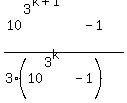
Letting  , we have , we have

Rearrange the terms:

The last term is equivalent to the numerator in the fraction we wish to prove is an integer. Therefore, we can substitute this expression and obtain
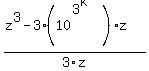 (we are trying to prove this is an integer for all k) (we are trying to prove this is an integer for all k)
Cancel out z from both sides to get
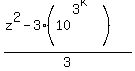
It now suffices to prove that the numerator is divisible by 3, which happens if and only if  is divisible by 3. However, we already know that is divisible by 3. However, we already know that  which is divisible by 3, since all powers of 10 are 1 modulo 3 (therefore subtracting 1 makes it 0 mod 3, i.e. divisible by 3). Hence, the expression is an integer, and we are done. which is divisible by 3, since all powers of 10 are 1 modulo 3 (therefore subtracting 1 makes it 0 mod 3, i.e. divisible by 3). Hence, the expression is an integer, and we are done.
This is a somewhat lengthy proof, but rigorous proofs are sometimes more efficient and strong in terms of explaining their points. You'll definitely see proofs like this in contests like USAMO, IMO, and Putnam.
Answer by robertb(5830)  (Show Source): (Show Source):
| |
|
| |
