Tutors Answer Your Questions about Trigonometry-basics (FREE)
Question 180061: Determine exact values.
Find sin A and cos A if tan A=5/3 and cos A <0.
Answer by ikleyn(53937)   (Show Source): (Show Source):
You can put this solution on YOUR website! .
Trigonometry-basics/180061: Determine exact values.
Find sin(A) and cos(A) if tan(A) = 5/3 and cos(A) < 0.
~~~~~~~~~~~~~~~~~~~~~~~~~~~~~~~~~
Calculations in the post by @HyperBrain are incorrect, producing wrong answer.
For correct solution, see my post below.
Let A be an angle, sin(A) = a/c, cos(A) = b/c, tan(A) = a/b. Where
a=opposite side
b=adjacent side
c=hypotenuse
a, b, and c form a right triangle and therefore must satisfy,

Since tan(A) is positive and cos(A) is negative (given),
we conclude from it that A is in QIII.
Since tan(A) =  , let a = -5, b = -3. , let a = -5, b = -3.
 = =  = 25+9 = 34, = 25+9 = 34,
c = 
sin(A) =  = = 
cos(A) =  = = 
Solved correctly.
Question 180062: Find sin B and cot B if cosB=-1/4 and tan B>0.
Answer by ikleyn(53937) (Show Source):
Question 211804: if a=22, b=14, and c=30, find the area of triangle ABC.
a)33 sq units
b)121.0 sq units
c)130.2 sq units
d)143.8 sq units
Answer by ikleyn(53937) (Show Source):
Question 211794: in triangle ABC, A=47 degrees,b=12,c=8.find a to the nearest tenth
a)6.3
b)8.7
c)8.8
d)18.4
Answer by ikleyn(53937) (Show Source):
You can put this solution on YOUR website! .
in triangle ABC, A=47 degrees, b=12, c=8. find a to the nearest tenth
a)6.3
b)8.7
c)8.8
d)18.4
~~~~~~~~~~~~~~~~~~~~~~
The standard method of solution is to apply the cosine low
a =  = =  = 8.778 square units. = 8.778 square units.
ANSWER. 8.8 square units (rounded as requested).
Question 211809: change 29pi/37 radians to degree measure
a)5220 degrees
b)141.1 degrees
c)167.6 degrees
d)66.6 degrees
Answer by ikleyn(53937) (Show Source):
You can put this solution on YOUR website! .
change 29pi/37 radians to degree measure
a)5220 degrees
b)141.1 degrees
c)167.6 degrees
d)66.6 degrees
~~~~~~~~~~~~~~~~~~~~~~~
Calculations in the post by @HyperBrain are incorrect and lead to absurdist value 745.7.
The correct solution is "angle =  = =  = 141.1 degrees". = 141.1 degrees".
What surprises me most is that a person who calls himself a tutor
received an absurd response and didn't even bat an eye.
Question 207935: Given a point (5,-5) on the terminal side of angle0, find the value of sin.
Answer by ikleyn(53937) (Show Source):
You can put this solution on YOUR website! .
This question is from textbook College Math 1
Given a point (5,-5) on the terminal side of angle0, find the value of sin.
~~~~~~~~~~~~~~~~~~~~~~~~~~
The answer in the post by @HyperBrain " sin(x) = sin(135) = sin(45) =  " is INCORRECT. " is INCORRECT.
The correct answer is " sin(x) = sin(315) =  ". ".
The general error by @hHyperBrain is that he thinks that the angle is in QII, while in reality it is in QVI.
So far, I checked about 30 solutions by @HyperBrain, and found that 7 of them are solved incorrectly.
It is very sad to see so low level tutors at this forum.
In reality, it is not an allowed level for a tutor - it is a level of average student, whose typical score in Math is 3 of 5.
His goal should be to learn for himself - not to deceive other people by presenting himself as a tutor.
Question 212348: Find all angles t such that 3t is coterminal with 180 degrees and t is between 0 degrees and 360 degrees.
Answer by ikleyn(53937) (Show Source):
You can put this solution on YOUR website! .
This question is from textbook Advanced Mathematics
Find all angles t such that 3t is coterminal with 180 degrees and 0 <= t < 360 degrees.
~~~~~~~~~~~~~~~~~~~~~~
The solution in the post by @HyperBrain is wrong from the Math point of view.
It is also wrong from the teaching / pedagogical point of view.
I came to bring a correct solution and to teach you in a right way.
An angle x is coterminal with 180 degrees if and only if when if is divided by 360, the remainder is 180.


So, 3t=180 (mod 360).


It means  3t = 180 + 360*k, k = 0, +/-1, +/-2, . . . (i.e., k is any integer).


In turn, it means that  t = 60 + 120*k.


Thus, t = 60 degrees (k=0),  or  t = 180 degrees (k=1)  or  t = 240 degrees (k=2).


We do not take other values of 'k', since it leads to outside of the given interval for 't'.
Solved correctly and completely and explained in a right way.
Question 212322: Draw the angle in quadrant II whose terminal side is on 1/2x + y = 0.
Answer by ikleyn(53937) (Show Source):
You can put this solution on YOUR website! .
Draw the angle in quadrant II whose terminal side is on 1/2x + y = 0.
~~~~~~~~~~~~~~~~~~~~~~~~
The answer "tan(a) = -2, a = arctan(-2) = 116.565 degrees" in the post by @HyoerBrain is FATALLY wrong.
The correct answer is "tan(a) = -1/2, a = arctan(-1/2) + 180 degrees = -26.57 + 180 degrees = 153.43 degrees".
Question 197454: Solve for x in the equation (1 +sinx/cosx)+(cosx/1+sinx)=4 for 0≤ x ≤ 2π rad.
Answer by ikleyn(53937) (Show Source):
Question 207286: If the latitude of Chicago is about 42 degrees and the radius of the earth is about 4000 miles, how far is Chicago from the equator? ( use pi= 3.1416)
Answer by ikleyn(53937) (Show Source):
You can put this solution on YOUR website! .
If the latitude of Chicago is about 42 degrees and the radius of the earth is about 4000 miles,
how far is Chicago from the equator? ( use pi= 3.1416)
~~~~~~~~~~~~~~~~~~~~~~~~~
The solution and the answer in the post by @HyperBrain are incorrect.
His method is wrong, his formula is irrelevant.
See my correct solution below.
In this problem, the distance from the equator to Chicago is the length of the arc of 42 degrees
on a circle of the radius 4000 miles.
So, apply the standard formula for the arc length via the radius and the central angle
arc length =  = =  = 2932.16 miles.
ANSWER. The distance from Chicago to equator is about 2932 miles. = 2932.16 miles.
ANSWER. The distance from Chicago to equator is about 2932 miles.
Solved correctly.
Question 937255: Solve the following for 0 < x < 2pi
(sin x + cos x)^2 = 1
Answer by ikleyn(53937) (Show Source):
You can put this solution on YOUR website! .
Solve the following for 0 < x < 2pi
(sin x + cos x)^2 = 1
~~~~~~~~~~~~~~~~~~~~~~~~
In his post, @lwsshak3 came to conclusion "no solution: x not in given interval."
This answer is INCORRECT. Given equation has 3 (three) solutions in the given interval.
They are  , ,  and and  . .
The reasoning in the post by @l2sshak3 is conceptually wrong,
it is why he missed 3 solutions.
It is wrong way to teach students, so I came to bring a correct solution.
Your starting equation is
 = 1
Transform it step by step = 1
Transform it step by step
 = 1,
1 + 2*sin(x)*cos(x) = 1,
sin(2x) = 0.
Hence, 2x should be a multiple of .
Since x should be in interval ( = 1,
1 + 2*sin(x)*cos(x) = 1,
sin(2x) = 0.
Hence, 2x should be a multiple of .
Since x should be in interval ( , , ), 2x should be in interval (, ), 2x should be in interval (, )
0 < 2x < .
There are 3 possible values for 2x: , and )
0 < 2x < .
There are 3 possible values for 2x: , and  .
It gives 3 possible values for x: , and .
It is easy to check that all these 3 values satisfy given equation.
ANSWER. Given equation has 3 solutions in the given interval: , and . .
It gives 3 possible values for x: , and .
It is easy to check that all these 3 values satisfy given equation.
ANSWER. Given equation has 3 solutions in the given interval: , and .
Solved correctly to teach you in a right way.
Question 101945: Solve each of the following systems by substitution. I am having major problems with these kind of problems...HELP, ZACK
5x - 2y= -5
1 y - 5x = 3
8x - 4y = 16
y = 2x - 4
This last problem the 4y and the y in the next prblem line up buy it isnt turning out like that before i submit it
Answer by MathTherapy(10858)  (Show Source): (Show Source):
You can put this solution on YOUR website!
Solve each of the following systems by substitution.  I am  having major problems with these kind of problems...HELP,  ZACK

5x - 2y= -5
1 y - 5x = 3

8x - 4y = 16
      y = 2x - 4

I guess , by you saying that ".....This last problem the 4y and the y in the next prblem line up buy it isnt turning out like
that before i submit it
***********************
The following response by the other person, is mere RUBBISH!! It's so senseless that this author thinks that a person who knows nothing
about math, will agree!

"5x - 2y= -5

Divide everything by 2y to get Y by itself.
so 5x divided by -2
y = -5/2x 5/2
the -5 becomes postive because negative 5 divided by negative two is a positive, so positive 5 over 2.
the answer is
y = -5/2x + 5/2

8x - 4y = 16
Divide by -4y on all sides to get y by itself. That is the ultimate goal, y to be by itself.
8 divided by -4 is -2x and 16 divided by -4 is -4.
so y = -2x -4"
==============
For the 1st system, see: Equations/94042 for this author's response.

2nd system:  8x - 4y = 16___2x - y = 4___2x - 4 = y ---- eq (i)
                                 y = 2x - 4 ---- eq (ii)

As seen above, both equations are EXACTLY the SAME, so this constitutes a CONSISTENT/DEPENDENT SYSTEM, with an INFINITE number
of solutions, as both equations represent the same line. This author believes this is why you may've had problems solving it.
Question 940505: Determine the amplitude period and phase shift of y = -2 cos(pi x -3)
Answer by ikleyn(53937) (Show Source):
You can put this solution on YOUR website! .
Determine the amplitude, period and phase shift of y = -2 cos(pi x -3)
~~~~~~~~~~~~~~~~~~~~~~~~~~~~~
In the Internet, where are many similar problems.
But this one is SPECIAL: it is a TRAP, and its solution in the post by @lwsshar3 is incorrect.
Below is my correct solution with complete explanations.
Regarding the amplitude, the question is trivial: I hope, 9 of 10 tutors will answer correctly " amplitude is 2 units ".
With the period, the question is trivial, too: I hope that many tutors will give a correct answer " the period is 2 ".
But regarding the phase shift, 9 of 10 tutors and 99 of 100 students will answer incorrectly,
saying that the phase shift is  .
To answer correctly, we should remember that the parent function to compare with is cos(x), BY DEFAULT.
When we consider y = .
To answer correctly, we should remember that the parent function to compare with is cos(x), BY DEFAULT.
When we consider y =  , we should first write it equivalently with the positive coefficient
before cosine
y = , we should first write it equivalently with the positive coefficient
before cosine
y =  ,
shifting right by half-period . ,
shifting right by half-period .    we can rewrite the function, extracting the shift explicitly
y = we can rewrite the function, extracting the shift explicitly
y = 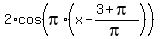 = = 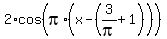 .
Now it becomes obvious that the shift is .
Now it becomes obvious that the shift is  units right, comparing with the parent function cos(x).
ANSWER. The shift is units right. units right, comparing with the parent function cos(x).
ANSWER. The shift is units right.
Solved correctly with complete explanations.
REMEMBER: The sign " - " before the trigonometric functions "sine" and "cosine"
is not a harmless symbol that can be ignored in such analysis.
Actually, this sign means the same and works the same as the half-period shift of the argument.
Therefore, it must be taken into account, and it changes the game completely, turning everything upside down.
//////////// I N T E R E S T I N G ////////////
Driven by my curiosity, I posted this problem today (May 22, 2026, about 12:05 pm) to two Artificial Intelligence
web-sites. One website was Google Overview; the other one was www.math-gpt.org/
Both answered incorrectly, similar to the "solution" by @lwsshar3, giving the shift units right.
Actually, this standard trap is well known to those who learned from good teachers, studied Math following
good educational programs and read relevant popular Math literature.
Question 942251: cos(2θ+20)=sin(3θ−10)
Answer by ikleyn(53937) (Show Source):
You can put this solution on YOUR website! .
cos(2x+20°) = sin(3x−10°). Find x.
~~~~~~~~~~~~~~~~~~~~~~~~~~~~~~~~~~~
The solution in the post by @lwsshar3 is a part of the truth, but not the whole truth.
The solution by @lwsshar3 is correct if and only if both angles, 2x+20° and 3x-10° are in QI.
But if we look for all possible angles x between 0° and 360° (360° is the period for both functions
in the left and the right side of the equation, so it is NATURAL to investigate this interval),
then his solution is INCOMPLETE, because there are 5 (five) different angles 'x' satisfying the given equation
in interval [0°,360°).
And this is the whole truth. See my solution below.
Equation

    cos(2x+20°) = sin(3x−10°)    (1)

implies

    (2x+20°) + (3x-10°) = = 90° + k*360°, k = 0, +/-1, +/-2, . . . (2)


because both functions tan and cot are periodical with period .


So, we can rewrite equation (2) in the form

    5x = 80° + k*360°, k = 0, 1, 2, 3, 4.


We can limit ourselves with 5 values of k, because for other values of 'k', the angles 'x' will be geometrically the same,
but formally will be outside of the interval [0°,360°).


For these 5 values of 'k', we will have 5 different values of x in the interval [0°,360°)

    x = 16°,  16°+72° = 88°,  16°+144° = 160°,  16°+216° = 232°,  16°+288° = 304°.


ANSWER. Taking into account the periodicity of the left side and the right side of the given equation,

it is natural to look for solutions 'x' in the interval [0°,360°).

In this interval, the given equation has 5 (five) different solutions 16°, 88°, 160°, 232° and 302°.
Solved completely.
//////////// I N T E R E S T I N G ////////////
Driven by my curiosity, I posted today (May 21, 2026, about 3:30 PM) this problem to Google Overview Artificial Intelligence
to look how it treats the problem.
It treats it precisely as in the post by @lwsshar3 - so, its analysis is incomplete.
Does it embarrass me? - - - Both "Yes" and "No".
It simply demonstrates the level and the style of work of contemporary AI.
It can not think as a human can (because it is NOT ABLE to think as a human can),
but simply re-writes from the storage of existing solutions, with no thinking.
Question 942249: tan(θ)=cot(4θ+20)
Answer by ikleyn(53937) (Show Source):
You can put this solution on YOUR website! .
tan(x)=cot(4x+20°). Find x.
~~~~~~~~~~~~~~~~~~~~~~~~~~~~~~~~~~~
The solution in the post by @lwsshar3 is a part of the truth, but not the whole truth.
The solution by @lwsshar3 is correct if and only if both angles, x and 4x+20° are in QI.
But if we look for all possible angles x between 0° and 180° (180° is the period for both functions
in the left and the right side of the equation, so it is NATURAL to investigate this interval),
then his solution is INCOMPLETE, because there are 5 (five) different angles 'x' satisfying the given equation
in interval [0°,180°).
And this is the whole truth. See my solution below.
Equation

    tan(x) = cot(4x+20°)    (1)

implies

    x + (4x+20°) = 90° + k*180°, k = 0, +/-1, +/-2, . . . (2)


because both functions tan and cot are periodical with period .


So, we can rewrite equation (2) in the form

    5x = 70° + k*180°, k = 0, 1, 2, 3, 4.


We can limit ourselves with 5 values of k, because for other values of 'k', the angles 'x' will be geometrically the same,
but formally will be outside of the interval [0°,180°).


For these 5 values of 'k', we will have 5 different values of x in the interval [0°,180°)

    x = 14°,  14°+36° = 50°,  14°+72° = 86°,  14°+108° = 122°,  14°+144° = 158°.


ANSWER. Taking into account the periodicity of the left side and the right side of the given equation,

it is natural to look for solutions 'x' in the interval [0°,180°).

In this interval, the given equation has 5 (five) different solutions 14°, 50°, 86°, 122° and 158°.
Solved completely.
//////////// I N T E R E S T I N G ////////////
Driven by my curiosity, I posted today (May 21, 2026, about 2:00 PM) this problem to Google Overview Artificial Intelligence
to look how it treats the problem.
It treats it precisely as in the post by @lwsshar3 - so, its analysis is incomplete.
Does it embarrass me? - - - Both "Yes" and "No".
It simply demonstrates the level and the style of work of contemporary AI.
It can not think as a human can (because it is NOT ABLE to think as a human can),
but simply re-writes from the storage of existing solutions, with no thinking.
Question 944548: Solve the equation 4 times cosine of theta plus 1 = 2 times cosine of theta fortheta greater than or equal to 0 but less than 2 pi..
Answer by ikleyn(53937) (Show Source):
You can put this solution on YOUR website! .
Solve the equation 4 times cosine of theta plus 1 = 2 times cosine of theta
for theta greater than or equal to 0 but less than 2 pi.
~~~~~~~~~~~~~~~~~~~~~~~~~
The solution in the post by @lwsshar3 is incorrect.
I came to bring a correct solution.
4cos(x) + 1 = 2cos(x)
2cos(x) + 1 = 0
cos(x) = -1/2
x = 2π/3, 4π/3 <<<---=== ANSWER
Solved correctly.
Question 944480: Solve for all 0 degrees less than or equal to x less than 360 degrees.
3tan x- sqrt( 3 )=0
2sin x cos x=2sin x
cos^2 x-sin^2 x + 3cos x - 1=0
Answer by ikleyn(53937) (Show Source):
You can put this solution on YOUR website! .
Solve for all 0 degrees less than or equal to x less than 360 degrees.
(a) 3tan x- sqrt( 3 )=0
(b) 2sin x cos x=2sin x
(c) cos^2 x-sin^2 x + 3cos x - 1=0
~~~~~~~~~~~~~~~~~~~~~~
In the post by @lwsshar3, the solution to (a) is incorrect: 150˚ is WRONG answer.
The solution to (b) is incorrect, too: some roots are missed.
I came to bring correct solutions to (a) and (b).
- - - (a) - - -
3tan x- sqrt( 3 )= 0
tanx = √3/3
x = 30˚ or 210˚.
ANSWER to (a). x = 30˚ or 210˚.
- - - (b) - - -
2sin(x)*cos(x) = 2sin(x)
2sin(x)*cos(x) - 2sin(x) = 0
2sin(x)*(cos(x)-1)) = 0
case 1. sin(x) = 0 ---> x = 0˚ or x = 180˚.
case 2. cos(x) = 1 ---> x = 0˚.
ANSWER to (b). x = 0˚ or x = 180˚.
Question 949907: Find all values of t in the interval [0, 2π] satisfying the given equation. (Enter your answers as a comma-separated list.)
(4 cot t)^2 = 48
Answer by ikleyn(53937) (Show Source):
Question 950272: Solve the equation for t on the interval [0,2π) 4 cos t - 4 sin t = 4
Answer by ikleyn(53937) (Show Source):
You can put this solution on YOUR website! .
Solve the equation for t on the interval [0,2π) 4 cos t - 4 sin t = 4
~~~~~~~~~~~~~~~~~~~~~~~~~~~~~~~~~~~~~~
@lwsshar3 in his post gives 3 (three) possible answers t = 0, π/2, and 3π/2, without checking.
This answer is INCORRECT.
Since both sides of the equation were squared on the way, the check is needed to test
if the founded possible solutions really satisfy the original equation.
The test shows that t = π/2 does not satisfy the original equation.
Therefore, the true solutions are t = 0, 3π/2, only. ANSWER
Question 951003: find all solution of the equation, and find the fundamental solutions on the interval
[0, 2pi] tan x= -sqrt3
Answer by ikleyn(53937) (Show Source):
You can put this solution on YOUR website! .
find all solution of the equation, and find the fundamental solutions on the interval
[0, 2pi] tan x= -sqrt3
~~~~~~~~~~~~~~~~~~~~~~~~~~~~~~~~~
The answer in the post by @lwsshar3 is incorrect.
This value of tan is the table value.
The correct answer is x =  , ,  (in quadrants II and IV). (in quadrants II and IV).
////////////////////////////
A note for the math composer and a reader: a normal Math writer will never write [0,2pi] for the interval.
Normal Math writer will write [0,2pi).
Question 1158473: An isosceles trapezoid has a height of 4cm and bases 3cm and 7cm long. How long are its diagonals? Use the law of cosines.
Answer by KMST(5398)  (Show Source): (Show Source):
You can put this solution on YOUR website! In the USA, a trapezoid is a quadrilateral with two parallel sides, and an isosceles trapezoid is one whose other two sides have the same length.
The names of trapezium and trapezoid are not the same in all English-speaking countries.
Here is the American isosceles trapezoid ABCD described in the question, with diagonal AC and BD:
 Diagonal AC is a side in triangles ACD and ACB. Diagonal BD is a side of BDA and BDC. Diagonal AC is a side in triangles ACD and ACB. Diagonal BD is a side of BDA and BDC.
All we know about each of the triangles mentioned above is the length of one side. No angle measures.
The law of cosines allows us to find the length of one side of a triangle when we know the measure of the opposite angle and the length of the other two sides.
Had the lengths of sides AB and CD been given, using the law of cosines would make sense.
Height BP cuts right triangle ABP from the rest of the trapezoid,
and it is easy to figure out that  . .
From that we can easily calculate measure of the angle PAB (angle A, for short).
We can also calculate the length of AB
However, as soon as we figure out that  , we can calculate , we can calculate  , ,
and then it would be easy to calculate  as the hypotenuse of right triangle PBD using the Pythagorean theorem: as the hypotenuse of right triangle PBD using the Pythagorean theorem:
 (rounded) (rounded)
To use the law of cosines on triangle ABD to calculate the length of BD, it appears like I would need the measure of angle A, and the length of AB.
Based on right triangle ABP, 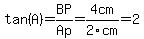 --> --> (rounded) (rounded)
Using the Pythagorean theorem:
 (rounded) (rounded)
The law of cosines for triangle ABD would give us BD from

With the length in cm,
 however however  , so we did not need the measure of angle A, or the length of AB, and , so we did not need the measure of angle A, or the length of AB, and
   (rounded) (rounded)
Question 958122: How many revolution per second will an automobile wheel make at the rate of 63.4km per hour if the diameter is 5.4dm??p
Found 2 solutions by MathTherapy, ikleyn:
Answer by MathTherapy(10858) (Show Source):
Answer by ikleyn(53937) (Show Source):
You can put this solution on YOUR website! .
How many revolutions per second will an automobile wheel make at the rate of 63.4km per hour
if the diameter is 5.4dm ?
~~~~~~~~~~~~~~~~~~~~~~
This is a simple arithmetic problem, but the answer "1957 revolutions per second"
given in the post by @lwsshar3 is absolutely absurdist.
Not only the answer, but his approach in whole and his method are
absolutely inappropriate for the solution and for teaching.
He concentrates on deriving very long formula, which is not needed,
instead of concentrating on the problem's meaning. As a result, he was not able
to solve the problem correctly.
See below my correct solution, as it should be done by a 5-th or 6-th grade student.
The diameter of the wheel is d = 5.4 decimeters, or d = 54 centimeters.
Hence, the circumference of the wheel is  = =  = 169.65 cm.
The car moves forward 63.4 km per hour, or = 169.65 cm.
The car moves forward 63.4 km per hour, or  = 17.61 meters per second, or 1761 centimeters per second.
From it, the number of revolutions per second is the ratio = 17.61 meters per second, or 1761 centimeters per second.
From it, the number of revolutions per second is the ratio  = 10.38, approximately.
ANSWER. The number of revolutions per second is 10.38. = 10.38, approximately.
ANSWER. The number of revolutions per second is 10.38.
Solved correctly.
As I read this post by @lwsshar3, it proves to me once again, for the 1001st time, that this person does not read
what his computer code produces.
Question 958763: how do you find the exact value of the expression
cos(sin^-1 1/3 - tan^-1 1/2)
Answer by ikleyn(53937) (Show Source):
Question 958870: Find all solutions of the following equation: tan (theta/8) +sqrt3 = 0. find the solutions in the interval [0, 2pi]
Answer by ikleyn(53937) (Show Source):
You can put this solution on YOUR website! .
Find all solutions of the following equation: tan (theta/8) +sqrt3 = 0. find the solutions in the interval [0, 2pi)
~~~~~~~~~~~~~~~~~~~~~~~~~~~~~~~~~~
In his post, @lwsshar3 gives the answer x = 16π/3, 40π/3.
This answer is INCORRECT, since both these values are OUT of the interval [0,2pi).
See below my correct solution.
tan(x/8) + √3 = 0, (1)
tan(x/8) = -√3. (2)
We are looking for possible solutions 'x' in interval [,).
So, x/8 should be in interval [0, ), which is the same as interval [0, ), which is the same as interval [0, ).
But in this interval from 0 to , function tan is always non-negative.
Hence, equation (2) with the negative right side HAS NO solutions in this interval.
It implies that the original equation has no solution/solutions in the given interval [0,2pi). ANSWER ).
But in this interval from 0 to , function tan is always non-negative.
Hence, equation (2) with the negative right side HAS NO solutions in this interval.
It implies that the original equation has no solution/solutions in the given interval [0,2pi). ANSWER
Solved correctly.
Ignore the post by @lwsshar3, since it is totally wrong.
Question 959220: Find exact Value of tan Beta/2, Given that tanBeta = square root 5/2 and pi < Beta < 3pi/2
So I think Beta/2 is in quadrant 3 making it positive but I tried square root of 5 as the answer and thats wrong please help!!!!
Found 2 solutions by n2, ikleyn:
Answer by n2(91) (Show Source): (Show Source):
You can put this solution on YOUR website! .
Find exact Value of tan(Beta/2), Given that tan(Beta) = square root 5/2 and pi < Beta < 3pi/2
~~~~~~~~~~~~~~~~~~~~~~~~~~~
use x for Beta
tan(x) = √5/2 (given, so BETA is in QIII)
hypotenuse of reference right triangle in quadrant III = √(√5)^2+2^2)=√(5+4)=3
sin(x) = -√5/3 in QIII (negative)
cos(x) = -2/3 in QIII (negative)
tan(x/2) = sin(x)/(1+cos(x))
tan(x/2) = (-√5/3)/(1-2/3) = (-√5/3)/(1/3) = -√5/1 = -√5.
Check:
tan(x) = √5/2 in QIII
x = 48.19° + 180° = 228.19°
x/2 ≈ 114.095°
tan(x/2) ≈ tan(114.095°) ≈ -2.236
exact value = -√5 ≈ -2.236
Solved correctly.
Answer by ikleyn(53937) (Show Source):
You can put this solution on YOUR website! .
Find exact Value of tan(Beta/2), Given that tan(Beta) = square root 5/2 and pi < Beta < 3pi/2
~~~~~~~~~~~~~~~~~~~~~~~~~~~
Calculations in the post by @lwsshak3 are fatally and totally incorrect.
It is enough to notice that Beta is in QIII (given), hence, Beta/2 is in QII,
so tan(Beta) must be negative, while @lwsshak3 gives a positive number as the answer.
His checking procedure also is wrong.
Below is my correct solution.
use x for Beta
tan(x) = √5/2 (given, so BETA is in QIII)
hypotenuse of reference right triangle in quadrant III = √(√5)^2+2^2)=√(5+4)=3
sin(x) = -√5/3 in QIII (negative)
cos(x) = -2/3 in QIII (negative)
tan(x/2) = sin(x)/(1+cos(x))
tan(x/2) = (-√5/3)/(1-2/3) = (-√5/3)/(1/3) = -√5/1 = -√5.
Check:
tan(x) = √5/2 in QIII
x = 48.19° + 180° = 228.19°
x/2 ≈ 114.095°
tan(x/2) ≈ tan(114.095°) ≈ -2.236
exact value = -√5 ≈ -2.236
Solved correctly and checked in a right way, too.
Question 1158099: Please help me answer this question:
Simplify
sin ( - θ) sin (90θ + θ) - cos (180 θ - θ) cos (270 θ +θ).
Answer by KMST(5398) (Show Source):
You can put this solution on YOUR website! I believe there was a mistake copying the formula in the question.
As written in the question, it says
 , ,
which could be written more simply as 
I do not know of a way to further simplify that, and it does not sound like a typical high school math question.
I suspect that the expression to simplify was meant to be

That could be simplified using the relations know between the trigonometric functions sine and cosine of angles that are reflected or turned by  and and  . .
You could find those relations in any list of "trigonometric identities",
but no need to memorize them, because you can visualize them for any angle in the unit circle.
For example, if we change the sign of the angle , sine changes sign, but cosine stays the same:
 , but , but 
  
Adding to an angle is turning it 1/4 of a circle, and turns sine into cosine and cosine into -sine.
 
So,  and and  . .
Using the two highlighted relations above we can start simplifying:
  } }
Also, adding to an angle (turning it half a circle), causes the sign to change for the sine and cosine functions.
So,
 , but we know that , but we know that  , so , so 
Similarly
 , but we know that ,so , but we know that ,so

Using the highlighted relations above we can continue simplifying:
}


Question 1158051: if sec(t) = -5 and the terminal point of t is in quadrant iii, use the identity sin^2(t/2)=1-cos(t)/2 to find the exact value of (sin(t/2)+cos(t))
Answer by KMST(5398) (Show Source):
You can put this solution on YOUR website! I expect the identity was meant to be  . .
What was written in the question was  , which is not an identity. , which is not an identity.
IMPORTANT NOTE:
On paper, you can draw a long horizontal line under  and write a and write a  under that line. under that line.
That long horizontal line implies invisible brackets wrapping together what is above the line,
and wrapping together what is below. Everyone understands that.
When typing, or entering formulas and numbers into a calculator, those brackets need to be typed in or keyed in.
If you want to calculate  , ,
and key in "101-2/101-1" into a calculators you would most likely get as a result
 , which is not what you would expect. , which is not what you would expect.
I was not expecting anything, you are outsourcing problem solving to a gadget that does not understand what you want, and does just what you asked.
BACK TO THE QUESTION:
Quadrant III means  , so that , so that  . .
That means the terminal side of angle  is in quadrant II, is in quadrant II,
and  . .
 is another trigonometric identity, is another trigonometric identity,
and from  , we know that , we know that  --> --> 
Substituting  for for  in the identity , we get in the identity , we get
  --> -->   --> -->  --> -->  --> -->  --> --> 
Then, 
Question 960664: determine if it is possible for a number t to satisfy the given conditions sint=5/13 and cost=12/13
Answer by ikleyn(53937) (Show Source):
Question 961016: If sin A= -1/squareroot of 5 with A in QII, find sin 2A.
Found 2 solutions by MathTherapy, ikleyn:
Answer by MathTherapy(10858) (Show Source):
You can put this solution on YOUR website!
If sin A= -1/squareroot of 5 with A in QII, find sin 2A.
*******************************************************
This problem gives sin as negative (< 0) in the 2nd quadrant. One of the respondents confirms this, and further
states that cos is positive (> 0) in the 2nd quadrant. When did sin become negative (< 0), and cos, positive (> 0)
 in the 2nd quadrant?
This is so, so RIDICULOUS and obviously WRONG. The opposite holds true, though.
Answer by ikleyn(53937) (Show Source):
You can put this solution on YOUR website! .
If sin A= -1/squareroot of 5 with A in QII, find sin 2A.
~~~~~~~~~~~~~~~~~~~~~~~~~~
As the problem is worded, printed and presented, it is self-contradictory
and describes a situation which never may happen.
In QII, sin is always non-negative, while in the problem it is given as negative value.
So, the problem is either a TRAP or a MISTAKE.
The "solution" by @lwsshak3 is wrong mathematically and dangerous
from the educational point of view, both at the same time.
The computer code which @lwsshak3 regularly uses in his practice,
is not capable to distinct nonsense from sense - it was not trained for it.
When the input is nonsense, this code regularly produces nonsense in response and deceives a reader.
@lwsshak3 does not read the output of his code and does not think on it.
In this sense, he is absolutely irresponsible, exactly as his computer code is.
Therefore, I think that an artificial intelligence will be adequate to his name
only when it will possess major human capabilities, including self-checking and
the sense of responsibility.
////////////////////////////////
Driven by my curiosity, I posted today (5/12/2026, ~ 1:40 am) this "problem"
exactly "as is" to artificial intelligence Google Overview.
It responded with the same FALSE answer and the same DEFECTIVE logic as in the post by @lwsshar3.
See this link
https://www.google.com/search?q=If+sin+A%3D+-1%2Fsquareroot+of+5+with+A+in+QII%2C+find+sin+2A.&rlz=1C1CHBF_enUS1071US1071&oq=If+sin+A%3D+-1%2Fsquareroot+of+5+with+A+in+QII%2C+find+sin+2A.&gs_lcrp=EgZjaHJvbWUyBggAEEUYOTIHCAEQIRiPAjIHCAIQIRiPAtIBCTIwODRqMGoxNagCCLACAfEFy4JCYaOJAy4&sourceid=chrome&ie=UTF-8
Dear Edwin - I hope you will read this.
It is how the contemporary Artificial Intelligence works
in solving trivial/routine school Math problems <<<--->>> it falls in every trap.
This case disproves ALL your arguments in your recent post.
\\\\\\\\\\\\\\\\\\\\\\\\\\\\\\
To be honest, one hour later I posted this problem to another artificial intelligence web-site
math-gpt.org.
This code DID RECOGNIZE the interior error in the problem, so in this aspect
it works better than Google Overview.
I don't know precisely, due to which innovation, why and how math-gpt.org is better than Google Overview.
But I see that Google Overview sometime (or regularly) uses just outdated bases of knowledge,
while more advanced AI use the most updated bases of knowledge, making re-training permanently.
It is very possible that in this case we observe precisely this situation.
In our days, versions of Artificial Intelligence are changing every 3-4 months (if not faster).
One of updates was changing/replacing once-trained AI to permanently re-trained AI to track changes
in the AI's base of knowledge. The developers of AI consider it as an important improvement:
they recognize its great importance in reflecting continuous improvements in solving
Math problems.
I also would like to note that in the area of solution school Math problems, the quality
of the relevant base of knowledge is not as high as it was expected. It happened because historically
this base of knowledge (= the base of solutions) was created by people of different qualifications -
- from reasonably high to inappropriate low. Due to this reason, very often the quality of the base of knowledge
in this area does not correspond to the needs and to expectations. Therefore, cleanup and refinement of this
base remains an important task on the way to high-quality AI in this area.
The fact that the developers switch from once-trained AI to permanently re-trained AI does confirm this need.
There is another aspect of these circumstances.
Years before the era of AI, our solutions here in educational sites, were related to hundreds and thousands visitors.
But now, in the era AI, our posts, solutions and teaching do relate to millions.
Therefore, our posts and solutions (and the whole base of knowledge) should be made ideally
from the Math, logical, educational and pedagogical points of view, as well as from the common sense point of view.
In practice, it means that they should be polished permanently.
The students may not know about our efforts in improving the base of knowledge,
because they do not contact with us immediately - they do contact with AIs now.
But everything what AI knows - it knows from us, the tutors, and thanks to us and our efforts.
Everything I have written in this post is my response to Edwin's call *)
for tutors to stop working on solutions to mathematical problems on this site.
*)
https://www.algebra.com/algebra/homework/word/finance/Money_Word_Problems.faq.question.1161007.html
So, Edwin, I really think that now the objectives and eyepieces
of major AI companies that develop AI for solving school Math problems,
should be focused at this forum www.algebra.com, where I every day fix and repair
wrongly solved problems. They should track my activity every day, if they want
to stay on the top in their competition with other similar companies.
Edwin, we all respect your high qualification and your invaluable contribution to this forum -
I mean "all" including many visitors, tutors and the founder of this forum.
But some tutors may have different vision from yours on what to do next.
In any case, we all love you. Be happy and healthy and live long.
Question 962783: Use trigonometric identities to solve sin(theta)+(sqrt3)sin(theta)=0 exactly for 0 is less than or equal to theta which is less than 2pi;. If there is more than one answer, enter your answers as a comma separated list.
Thank you
Answer by ikleyn(53937) (Show Source):
You can put this solution on YOUR website! .
Use trigonometric identities to solve sin(theta)+(sqrt3)sin(theta)=0 exactly for 0 is less than or equal to theta which is less than 2pi;.
If there is more than one answer, enter your answers as a comma separated list.
~~~~~~~~~~~~~~~~~~~~~~~~~~~~
The solution and the answer in the post by @lwsshak3 both are incorrect.
Find my correct solution below.
sin(x) + √3*sin(x) = 0
sin(x)*(1 + √3) = 0.
It implies
sin(x) = 0,
x = 0 in the given interval.
Question 963379: Find the solutions of the equation that are in the interval [0, 2π). (Enter your answers as a comma-separated list. If there is no solution, enter NO SOLUTION.)
cos 2u − cos u = 0
Answer by ikleyn(53937) (Show Source):
You can put this solution on YOUR website! .
Find the solutions of the equation that are in the interval [0, 2π).
(Enter your answers as a comma-separated list. If there is no solution, enter NO SOLUTION.)
cos 2u − cos u = 0
~~~~~~~~~~~~~~~~~~~~~~~
The solution and the answer in the post by @lwsshak3 both are incorrect.
I came to bring a correct solution.
cos(2u) − cos u = 0
cos^2(u) - sin^2(u) - cosu = 0
cos^2(u) - 1 + cos^2(u) - cosu = 0
2cos^2(u) - cosu - 1 = 0
(2cosu+1)(cosu-1)=0
..
2cos(u)+1 = 0
cos(u) = -1/2
u = 2π/3, 4π/3
or
cos(u) - 1 = 0
cos(u) = 1
u = 0.
Solved correctly.
Question 963649: Please solve this equation exactly.
sin(arccos(3/5) - arctan(5/12)) =
Answer by ikleyn(53937) (Show Source):
Question 968978: if sine theta = -4/7 and is in quadrant 3, then the sum of sine theta + sine (theta-pie)+sine(2pie+theta) is?
Answer by ikleyn(53937) (Show Source):
You can put this solution on YOUR website! .
if sine theta = -4/7 and is in quadrant 3, then the sum of sine theta + sine (theta-pie)+sine(2pie+theta) is?
~~~~~~~~~~~~~~~~~~~~~~~~~~~~~~
This problem allows and assumes much simpler solution comparing with that in the post by @lwsshak3.
Second addend,  , has the opposite value to the first addend, , has the opposite value to the first addend,  .
Therefore , when added, these two addends mutually cancel each other, giving 0 (zero).
Thus the sum of the first two addends vanishes, and the given expression is reduced to the last single term .
Therefore , when added, these two addends mutually cancel each other, giving 0 (zero).
Thus the sum of the first two addends vanishes, and the given expression is reduced to the last single term
 ,
which, due to the periodicity of function sin, is simply sin(theta), which is -4/7 (given in the problem).
So, the ANSWER to the problem's question is -4/7. ,
which, due to the periodicity of function sin, is simply sin(theta), which is -4/7 (given in the problem).
So, the ANSWER to the problem's question is -4/7.
Solved in a simple way, without any calculations, using the basic properties of function sin.
I am 127% sure that this is the desired and the expected method of solution to the given problem.
Question 969216: 
i. find the domain of g in interval form
ii. find the x-intercept(s) of the graph of g
(iii) In what quadrant does the terminal side of an angle of 5 radians lie? justify your answer
(iv) Find all solutions for the equation: 
Thank you
Answer by ikleyn(53937) (Show Source):
Question 1158028: determine the specified trigonometric ratio for each angle with a terminal side that passes through the given point.
1.Sin0; (-8,6)
2.csc0; (2,-1)
3.tan0;(0,1)
4.cos0; (-4,-2)
Answer by KMST(5398) (Show Source):
You can put this solution on YOUR website! The standard position of an angle is vertex at the origin, initial side along the positive x-axis.
We measure angles counterclockwise, and could define an angle measure as negative or greater than 360 degree,
but the trigonometric functions only care about the position of the terminal side.
I will assume  for all angles. for all angles.
Terminal side passing through  : :
 There is a large right triangles with hypotenuse There is a large right triangles with hypotenuse  and a similar triangle whose hypotenuse, and a similar triangle whose hypotenuse,  , is a radius of the unit circle shown in red. , is a radius of the unit circle shown in red.
The large one has legs of length  and and  , and hypotenuse , and hypotenuse 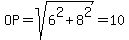 . The length of the small right triangle's hypotenuse, . The length of the small right triangle's hypotenuse,  } ,is 10 times smaller, and so are the legs. } ,is 10 times smaller, and so are the legs.
The function  is defined as the y-coordinate of point A, is defined as the y-coordinate of point A,  , and , and  is defined as the x-coordinate of point A, is defined as the x-coordinate of point A,  . .
We can calculate 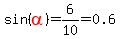 as a trigonometric ratio. and determine that as a trigonometric ratio. and determine that  . .

Trigonometric cosine and sine functions of  , defined as the x-coordinate and the y-coordinate of point A respectively are numerically the same as those for , defined as the x-coordinate and the y-coordinate of point A respectively are numerically the same as those for  , but may be positive or negative depending on the quadrant. , but may be positive or negative depending on the quadrant.
The sign will be the same for coordinates of any point on the terminal side.
Terminal side passing through  : :
is in quadrant IV, with positive x-coordinate, so  . .
The large right triangle, in this case, has leg lengths of 2, and 1, and a hypotenuse length of 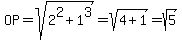 . .
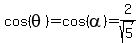 and and 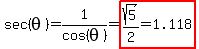 (rounded) (rounded)
The angles involved would be  , , 
Terminal side passing through  : :
P is on the unit circle, so its x-coordinate and y-coordinate are  and respectively. and respectively.
 , ,  and and 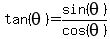 is undefined. is undefined.
Terminal side passing through  : :
Booth coordinates are negative, and so will be sine and cosine.
OP would be the hypotenuse of a right triangle with leg lengths 4, and 2.
The hypotenuse length is 
Question 970477: Evaluate cos[arctan(-5/12)].
Found 2 solutions by n2, ikleyn:
Answer by n2(91) (Show Source):
You can put this solution on YOUR website! .
Evaluate cos[arctan(-5/12)].
~~~~~~~~~~~~~~~~~~~~~~~~~~
Function arctan has values in the interval ( ,). ,).
Therefore, the problem asks to evaluate cos(x), given that 'x' is in the fourth quadrant
and tan(x) = -5/12.
So, let x=angle in QIV whose tan is (-5/12)
tan(x) = (-5/12) (working with a (5-12-13) right triangle in quadrant IV)
cosine is positive in QIV; therefore
cos[arctan(-5/12)] = cos(x) = 12/13.
ANSWER. cos[arctan(-5/12)] = 12/13.
Solved.
Answer by ikleyn(53937) (Show Source):
You can put this solution on YOUR website! .
Evaluate cos[arctan(-5/12)].
~~~~~~~~~~~~~~~~~~~~~~~~~~
In the post by @lwsshak3 the answer is incorrect and reasoning is also incorrect.
See below my correct solution.
Function arctan has values in the interval (,).
Therefore, the problem asks to evaluate cos(x), given that 'x' is in the fourth quadrant
(not in the second quadrant, as @lwsshak3 mistakenly assumes) and tan(x) = -5/12.
So, let x=angle in QIV whose tan is (-5/12)
tan(x) = (-5/12) (working with a (5-12-13) right triangle in quadrant IV)
cosine is positive in QIV; therefore
cos[arctan(-5/12)] = cos(x) = 12/13.
ANSWER. cos[arctan(-5/12)] = 12/13.
Solved correctly.
Question 970567: Find all solutions on the interval (0,2pi)
Sec^2x - 2tanx =0
Answer by ikleyn(53937) (Show Source):
You can put this solution on YOUR website! .
Find all solutions of each equation on the interval (0, 2pi)
Sec^2 x + 2tan x = 0
~~~~~~~~~~~~~~~~~~~~~~~~~~~~~
The solution in the post by @lwsshak3 is incorrect (incomplete).
He provided only one root of the equation in his answer, and gave incorrect value for it.
while the problem has two roots. So, one root was determined incorrectly, while the second root was missed.
I came to bring a correct solution.
sec^2 x + 2tan x = 0
 lcd: cos^2(x)
1 + 2sin(x)*cos(x) = 0
1 + sin(2x) = 0
sin(2x) = -1
2x =
lcd: cos^2(x)
1 + 2sin(x)*cos(x) = 0
1 + sin(2x) = 0
sin(2x) = -1
2x =  , k = 0, +/-1, +/-2, . . .
We take only two values 2x = (k=0) and 2x = , k = 0, +/-1, +/-2, . . .
We take only two values 2x = (k=0) and 2x =  (k=1),
since other values produce values of x out of the given interval.
ANSWER. The given equation has two roots in the interval [,).
They are (k=1),
since other values produce values of x out of the given interval.
ANSWER. The given equation has two roots in the interval [,).
They are  , or 135 degrees, and , or 135 degrees, and  , or 315 degrees. , or 315 degrees.
Solved correctly.
Question 970565: Find all solutions on the interval (0,2pi)
12tan^2(x)=4
Answer by ikleyn(53937) (Show Source):
Question 972189: the point (-3,3) is on the terminal is of an angle theta. find cos theta
Answer by ikleyn(53937) (Show Source):
You can put this solution on YOUR website! .
the point (-3,3) is on the terminal is of an angle theta. find cos(theta)
~~~~~~~~~~~~~~~~~~~~~~~~~~~~~~~~
In the post by @lwsshak3, the answer is  . .
This answer is formally correct, but this is not a simplest form, which is expected.
The simplest form, after reducing fraction, is .
Simply, @lwsshak3 uses a computer code, which does not see further simplifications,
as well as does not have a motivation for seeking such simplifications.
His computer code has no a human feature called "curiosity" - therefore, in particular,
it has limited skills/abilities comparing with a real normal or advanced human.
In general, I think that a computer code can/may become a real secure artificial intelligence,
only if and when it will have many or all human features, including ability to THINK logically,
to look forward and to seek for advances and to have such features as curiosity, human moral and ethical restrictions.
Question 1210628: Please help me to solve this equation. If sin p=3/5 and p is an acute angle, what is the value of tan p ?
Found 2 solutions by Edwin McCravy, ikleyn:
Answer by Edwin McCravy(20086)  (Show Source): (Show Source):
Answer by ikleyn(53937) (Show Source):
|
Older solutions: 1..45, 46..90, 91..135, 136..180, 181..225, 226..270, 271..315, 316..360, 361..405, 406..450, 451..495, 496..540, 541..585, 586..630, 631..675, 676..720, 721..765, 766..810, 811..855, 856..900, 901..945, 946..990, 991..1035, 1036..1080, 1081..1125, 1126..1170, 1171..1215, 1216..1260, 1261..1305, 1306..1350, 1351..1395, 1396..1440, 1441..1485, 1486..1530, 1531..1575, 1576..1620, 1621..1665, 1666..1710, 1711..1755, 1756..1800, 1801..1845, 1846..1890, 1891..1935, 1936..1980, 1981..2025, 2026..2070, 2071..2115, 2116..2160, 2161..2205, 2206..2250, 2251..2295, 2296..2340, 2341..2385, 2386..2430, 2431..2475, 2476..2520, 2521..2565, 2566..2610, 2611..2655, 2656..2700, 2701..2745, 2746..2790, 2791..2835, 2836..2880, 2881..2925, 2926..2970, 2971..3015, 3016..3060, 3061..3105, 3106..3150, 3151..3195, 3196..3240, 3241..3285, 3286..3330, 3331..3375, 3376..3420, 3421..3465, 3466..3510, 3511..3555, 3556..3600, 3601..3645, 3646..3690, 3691..3735, 3736..3780, 3781..3825, 3826..3870, 3871..3915, 3916..3960, 3961..4005, 4006..4050, 4051..4095, 4096..4140, 4141..4185, 4186..4230, 4231..4275, 4276..4320, 4321..4365, 4366..4410, 4411..4455, 4456..4500, 4501..4545, 4546..4590, 4591..4635, 4636..4680, 4681..4725, 4726..4770, 4771..4815, 4816..4860, 4861..4905, 4906..4950, 4951..4995, 4996..5040, 5041..5085, 5086..5130, 5131..5175, 5176..5220, 5221..5265, 5266..5310, 5311..5355, 5356..5400, 5401..5445, 5446..5490, 5491..5535, 5536..5580, 5581..5625, 5626..5670, 5671..5715, 5716..5760, 5761..5805, 5806..5850, 5851..5895, 5896..5940, 5941..5985, 5986..6030, 6031..6075, 6076..6120, 6121..6165, 6166..6210, 6211..6255, 6256..6300, 6301..6345, 6346..6390, 6391..6435, 6436..6480, 6481..6525, 6526..6570, 6571..6615, 6616..6660, 6661..6705, 6706..6750, 6751..6795, 6796..6840, 6841..6885, 6886..6930, 6931..6975, 6976..7020, 7021..7065, 7066..7110, 7111..7155, 7156..7200, 7201..7245, 7246..7290, 7291..7335, 7336..7380, 7381..7425, 7426..7470, 7471..7515, 7516..7560, 7561..7605, 7606..7650, 7651..7695, 7696..7740, 7741..7785, 7786..7830, 7831..7875, 7876..7920, 7921..7965, 7966..8010, 8011..8055, 8056..8100, 8101..8145, 8146..8190, 8191..8235, 8236..8280, 8281..8325, 8326..8370, 8371..8415, 8416..8460, 8461..8505, 8506..8550, 8551..8595, 8596..8640, 8641..8685, 8686..8730, 8731..8775, 8776..8820, 8821..8865, 8866..8910, 8911..8955, 8956..9000, 9001..9045, 9046..9090, 9091..9135, 9136..9180, 9181..9225, 9226..9270, 9271..9315, 9316..9360, 9361..9405, 9406..9450, 9451..9495, 9496..9540, 9541..9585, 9586..9630, 9631..9675, 9676..9720, 9721..9765, 9766..9810, 9811..9855, 9856..9900, 9901..9945, 9946..9990, 9991..10035, 10036..10080, 10081..10125, 10126..10170, 10171..10215, 10216..10260, 10261..10305, 10306..10350, 10351..10395, 10396..10440, 10441..10485, 10486..10530, 10531..10575, 10576..10620, 10621..10665, 10666..10710, 10711..10755, 10756..10800, 10801..10845, 10846..10890, 10891..10935, 10936..10980, 10981..11025, 11026..11070, 11071..11115, 11116..11160, 11161..11205, 11206..11250, 11251..11295, 11296..11340, 11341..11385, 11386..11430, 11431..11475, 11476..11520, 11521..11565, 11566..11610, 11611..11655, 11656..11700, 11701..11745, 11746..11790, 11791..11835, 11836..11880, 11881..11925, 11926..11970, 11971..12015, 12016..12060, 12061..12105, 12106..12150, 12151..12195, 12196..12240, 12241..12285, 12286..12330, 12331..12375, 12376..12420, 12421..12465, 12466..12510, 12511..12555, 12556..12600, 12601..12645, 12646..12690, 12691..12735, 12736..12780, 12781..12825, 12826..12870, 12871..12915, 12916..12960, 12961..13005, 13006..13050, 13051..13095, 13096..13140, 13141..13185, 13186..13230, 13231..13275, 13276..13320, 13321..13365, 13366..13410, 13411..13455, 13456..13500, 13501..13545, 13546..13590, 13591..13635, 13636..13680, 13681..13725, 13726..13770, 13771..13815, 13816..13860, 13861..13905, 13906..13950, 13951..13995, 13996..14040, 14041..14085, 14086..14130, 14131..14175, 14176..14220, 14221..14265, 14266..14310, 14311..14355, 14356..14400, 14401..14445, 14446..14490, 14491..14535, 14536..14580, 14581..14625, 14626..14670, 14671..14715, 14716..14760, 14761..14805, 14806..14850, 14851..14895, 14896..14940, 14941..14985, 14986..15030, 15031..15075, 15076..15120, 15121..15165, 15166..15210, 15211..15255, 15256..15300, 15301..15345, 15346..15390, 15391..15435, 15436..15480, 15481..15525, 15526..15570, 15571..15615, 15616..15660, 15661..15705, 15706..15750, 15751..15795, 15796..15840, 15841..15885, 15886..15930, 15931..15975, 15976..16020, 16021..16065, 16066..16110, 16111..16155, 16156..16200, 16201..16245, 16246..16290, 16291..16335, 16336..16380, 16381..16425, 16426..16470, 16471..16515, 16516..16560, 16561..16605, 16606..16650, 16651..16695, 16696..16740, 16741..16785, 16786..16830, 16831..16875, 16876..16920, 16921..16965, 16966..17010, 17011..17055, 17056..17100, 17101..17145, 17146..17190, 17191..17235, 17236..17280, 17281..17325, 17326..17370, 17371..17415, 17416..17460, 17461..17505, 17506..17550, 17551..17595, 17596..17640, 17641..17685, 17686..17730, 17731..17775, 17776..17820, 17821..17865, 17866..17910, 17911..17955, 17956..18000, 18001..18045, 18046..18090, 18091..18135, 18136..18180, 18181..18225, 18226..18270, 18271..18315, 18316..18360, 18361..18405, 18406..18450, 18451..18495, 18496..18540, 18541..18585, 18586..18630, 18631..18675, 18676..18720, 18721..18765, 18766..18810, 18811..18855, 18856..18900, 18901..18945, 18946..18990, 18991..19035, 19036..19080, 19081..19125, 19126..19170, 19171..19215, 19216..19260, 19261..19305, 19306..19350, 19351..19395, 19396..19440, 19441..19485, 19486..19530, 19531..19575, 19576..19620, 19621..19665, 19666..19710, 19711..19755, 19756..19800, 19801..19845, 19846..19890, 19891..19935, 19936..19980, 19981..20025, 20026..20070, 20071..20115, 20116..20160, 20161..20205, 20206..20250, 20251..20295, 20296..20340, 20341..20385, 20386..20430, 20431..20475, 20476..20520, 20521..20565, 20566..20610, 20611..20655, 20656..20700, 20701..20745, 20746..20790, 20791..20835, 20836..20880, 20881..20925, 20926..20970, 20971..21015, 21016..21060, 21061..21105, 21106..21150, 21151..21195, 21196..21240, 21241..21285, 21286..21330, 21331..21375, 21376..21420, 21421..21465, 21466..21510, 21511..21555, 21556..21600, 21601..21645, 21646..21690, 21691..21735, 21736..21780, 21781..21825, 21826..21870, 21871..21915, 21916..21960, 21961..22005, 22006..22050, 22051..22095, 22096..22140, 22141..22185, 22186..22230, 22231..22275, 22276..22320, 22321..22365, 22366..22410, 22411..22455, 22456..22500, 22501..22545, 22546..22590, 22591..22635, 22636..22680, 22681..22725, 22726..22770, 22771..22815, 22816..22860, 22861..22905, 22906..22950, 22951..22995, 22996..23040, 23041..23085, 23086..23130, 23131..23175, 23176..23220, 23221..23265, 23266..23310, 23311..23355, 23356..23400, 23401..23445, 23446..23490, 23491..23535, 23536..23580, 23581..23625, 23626..23670, 23671..23715, 23716..23760, 23761..23805, 23806..23850, 23851..23895, 23896..23940, 23941..23985, 23986..24030, 24031..24075, 24076..24120, 24121..24165, 24166..24210, 24211..24255, 24256..24300, 24301..24345, 24346..24390, 24391..24435, 24436..24480, 24481..24525, 24526..24570, 24571..24615, 24616..24660, 24661..24705, 24706..24750, 24751..24795, 24796..24840, 24841..24885, 24886..24930, 24931..24975, 24976..25020, 25021..25065, 25066..25110, 25111..25155, 25156..25200, 25201..25245, 25246..25290, 25291..25335, 25336..25380, 25381..25425, 25426..25470
|
